Friday, October 23, 2015

Earn While You Learn

Today it's another advertising card out of the Shaker Heights PCC, this one for CETA.

CETA, which stands for Comprehensive Employment and Training Act, was a federal jobs program for long-term unemployed and low income people; it also provided summer jobs for high school students.  IRM itself was a beneficiary of this program during the 1970s, with "CETA kids" helping out with various duties at the museum.  Some museum members were beneficiaries in a different way; three sisters who worked with CETA all ended up marrying IRM volunteers!

Wednesday, October 21, 2015

All Work Guaranteed

In honor of "Back to the Future Day" it's time for a 1980s edition of our occasional feature highlighting advertising cards.  Here's one, likely from the early 1980s, that can currently be found in Shaker Heights 63.  Other than the fact that this is a Chicago card and not a Cleveland one, the era is about correct for that car's appearance.  I wonder what the $10,000 Curl Contest was?

Monday, October 19, 2015

The Grid That Wasn't

Frank writes...

Sunday I spent a little bit of time reassembling the latest grid box for the 36.  This is an unusual one; of the five grid boxes for each of the cars with GE 66 motors (well, ten for the 309, which has two sets of everything), all of them except for one have three taps so that the circuit can be subdivided within the box.  But one box - this one - just has a tap at each end.  The GE terminology for this box is a 6A18 because it has a total of 18 elements, all of which are #6 size elements.  Or does it?

So here is the box after assembly; in my seldom-humble opinion it compares favorably with its pre-rebuild appearance (see here).  But what's wrong with this picture?  As I was putting elements back into the box and got towards the end, I realized something was wrong.  All of the other boxes have the taps on one side, for the simple reason that they have even numbers of grid elements and the circuit switches from side to side as it proceeds down the box.  So how can a grid box have taps at opposite corners yet have an even number of elements?
The answer, suggested by the "before" photos and confirmed by an exploratory expedition under the 308, is that one of the grid elements actually isn't in the circuit - apparently it's just there for show!  This element is shown above; note that the grid element to the right of the tap doesn't "go" anywhere.  (The white discs are mica insulators.)  Why the railroad did this is beyond me - they could just as easily have used up space in the grid box with some washers - but it appears they were pretty consistent about it.  So this box is actually a 6A17 grid box.  You learn something new every day!
Other highlights around the property included seeing our newest acquisition, Pullman solarium car "Mt Harvard," on the truck trailer near the entrance (see previous post), and the rather unusual view above which was afforded by recent progress on the Electroliner.  Its trucks are going to be sent out for rebuilding and the first step is to separate the train; so far it's been split into two two-car sections.
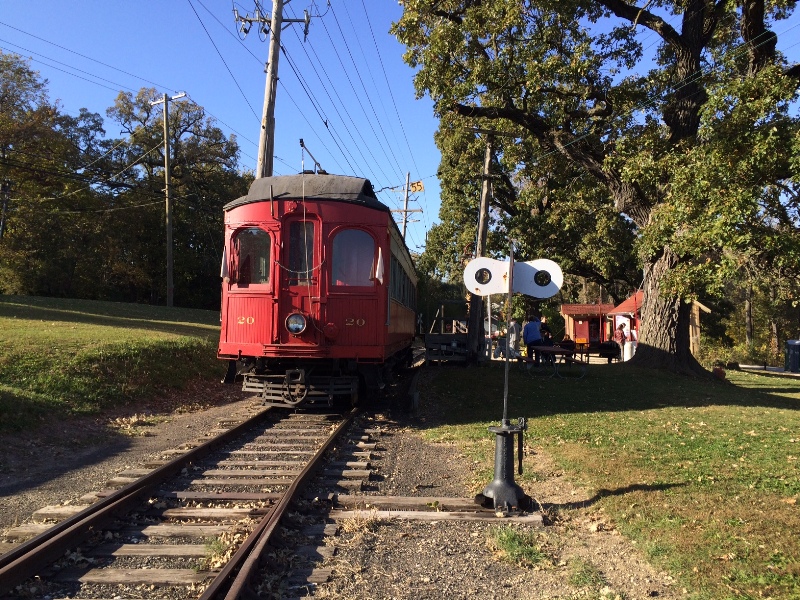
However much of the afternoon was spent on a railfanning trip to the Fox River Trolley Museum in South Elgin, which I hadn't visited in many years despite it being closer to my house than IRM.  I drove down there with Greg, Richard and Joel and we were gratified to see that they were running North Shore 715 and CA&E 20, the latter of which is shown above at the upper boarding platform at Castlemuir.  One interesting thing we were told is that the oak tree at right is thought to be some 300 years old.
And here are Greg, Richard and Joel watching the North Shore car depart from the lower platform.  We went on a trip on each of the two operating cars.
CTA steeplecab L202, which was rebuilt from an ex-Chicago Surface Lines steeplecab, was recently put back into service after some major motor work.
And CA&E St. Louis-built car 458 was recently repainted in its end-of-service livery.
Joe Hazinski and a new volunteer named Mike were kind enough to let us into the barn.  The highlight was seeing ex-Shaker Heights, ex-Fox River Electric car 304, which was acquired by FRTM in 2009 as part of the Trolleyville sale.  It is operational and sees occasional use.
This is how the interior of our car 306 is supposed to look, more or less.  There were some modifications made to these cars when they were sold to Shaker by the Fox River Electric but I'm not familiar with exactly what was done.  Overall, it was great weather to go railfanning and a good time was had by all!

Saturday, October 17, 2015

Moving Mountains


Guess what, today was occupied with more painting on the interior of the 36.  (L) The first section of the ceiling is closer to finish, and so the light bulbs go back in.

And then a second coat of lower paint on the bulkhead, and the middle paint was finished, and so on.


I still haven't figured out how to make this process more interesting.  Any suggestions?


We now have so many operating cars that inspection season has to start in the fall.  Joel never seems to tire of this job, and here he is checking out the 431. 


 And finally, the Pullman sleeper Mt. Harvard has arrived from North Freedom.  It's still sitting on its road dollies, and will be unloaded Monday.  Our buddy Roger was holding an open house, but I'll let you check out the IRM blog for his pictures of the car and the move from Wisconsin, since this is his project.  The actual Mt. Harvard is the third highest peak in the Rockies, so the presence of its namesake here in a county that's flatter than flat is just another one of those weird incongruities that IRM specializes in. 

Wednesday, October 14, 2015

Paint and Varnish

Another two days of painting the interior of the 36.  The one that actually has an interior.


On Tuesday, there was a lot of sanding, and the center ceiling of the first section got white primer. 


And more primer as needed on the bulkhead, and parts of the walls.


 Also the window shade tracks.


On Wednesday, the ceiling and bulkhead were ready for first finish color ("36 Upper").

And the bulkhead and pocket door got a first coat of the lower color, and I started on the middle before running out of time. 


Also, I painted the grid box black as requested.


But that's enough about me.   Let's talk about what else is happening in the Car Dept., although I'm sure I've missed a few projects.


The floor of the 24 is being varnished.


Lorne was welding in pieces for the air ducts in the Cleveland PCC.


Gerry and John H. admire their reflections in the fresh paint on the Lake Shore trailer.

Hardware for the side doors and the ends is now black.


Most of the brake rigging is already in place under the car.  Once the proper trucks are in place, the top rods can be installed, and some adjustments will probably have to be made.  But it's nearly done!


Our old buddy Jack Biesterfeld continues to make progress on the B&M diner.  Right now he's working on one of the vestibules.


 This car has a lot of beautiful varnished woodwork, and it's amazing how much of it survived the degradation of being demoted to work service.


Norm shows off some of the new structural steel on the Michigan car.  He points out that bits and pieces from several other cars in this series were salvaged for use in rebuilding the 28, such as the lower part of the column on the right.  (Having said that, I should have taken some better detail shots.)


And Nick insisted that we should include this never-before-seen anywhere-else-in-the-world combination: the 24 (1024) with its pre-1913 roof hardware next to the Electroliner, built in 1941.

I hope you are impressed.

Tuesday, October 13, 2015

A Sunday in the Country

Frank writes...

Sunday afternoon was a beautiful day, perfect for spending time out at IRM.  My first priority was to work on the latest grid box rebuild for the 36 - for those keeping score, this is the fourth out of five grid boxes under the car.  The first three experienced failures in rapid succession and this one already had some patches in it so it really needed attention.  The plan is to also rebuild the fifth box before it fails and we have to do the job on short notice.

Anyway, I procured a complete new set of #6 grid elements from storage; wire-wheeled the contact surfaces on them; straightened the copper washers salvaged from the box; and sand-blasted and primed the box frame, as seen above.  With help from Richard Schauer I also cleaned up the taps and repaired or replaced the hardware on them.  Next up will be a couple of coats of black paint on the box frame, cutting some new mica tubing to length, and reassembly and reinstallation of the grid box.  We're getting this down to a science!
And speaking of science projects, Richard, Greg and Joel were working on the roof of Shaker Heights 63 to do some trouble-shooting.  They needed to swap out some lugs; above Greg (left) holds the torch while Richard holds the lug up against the cable and feeds solder into it.  The goal, soon achieved, was to permanently disconnect the 600-volt bus sockets which are conveniently (but dangerously) located about 3' above the ground at each end of the car.
And other progress was being made on the property, too.  The Michigan duo of Norm and Jeff were hard at work, as usual, on car 28, test-fitting new steel pieces at the front end of the car.  And above can be seen some recent progress on Lake Shore Electric freight trailer 810.  A week ago the whole car had been touch-sanded; now it bears a shiny coat of Traction Orange and appears just about ready for lettering.  Replacement arch bar trucks for this car have recently seen some repair work and it looks like this restoration project, which has been active for over 15 years, is getting quite close to completion.  Once done, I believe that this will be the only restored interurban freight trailer in the country.

Sunday, October 11, 2015

A Ride on Trolley Car 36

But wait, it's not the car 36 you might think:


 It was a beautiful day for a drive in the country, so my wife and I finally drove out to Rockford to ride Trolley 36, a replica open car operated by the Rockford Park District along the river.

The car is powered by an internal combustion engine, and it was assembled in 1985 or so by some local businesses of various sorts under Park District direction.   The motorman described it as a Rube Goldberg device, but it seems to provide the service it was designed for pretty well.  Top speed is not great, which is just as well as it operates down the middle of the street for part of the trip.  It is the only street running this side of Kenosha I know of.

The operation uses the name "Rockford and Interurban" as seen on the letterboard.  The number 36 was chosen because the original R&I went out of business in 1936.  They say it's based on a 1905 Brill design.


The controls are unfamiliar, to say the least.


The trip starts at this replica station building (L), and nearby is the single track carbarn (R).  The car operates over about two miles of a little-used UP (ex C&NW) freight branch.  They generally run only one train a week on this branch, on Wednesday, so interference is no problem.


Before the trip starts, Motorman Joe gives a safety talk and explains the schedule.


 Rolling out onto the street, as seen from the curb:


 And a view of street running from inside.  Nobody seems to take the car's approach very seriously.  Just like downtown New Orleans....


Farther north, along the river the car lays over by the big Park District greenhouse. 


Most of the line runs through a riverside park, so it's actually rather scenic.

And today they were holding a regatta on the river, so there was a lot of activity, and we saw several racing shells going back and forth.


 And some more views of street running from the car, this time heading south:


This was the last day of operations for this year, so maybe I've played a dirty trick on you.  Sorry.  But there's always next year.