Showing posts with label Lake Shore Electric. Show all posts

Friday, July 28, 2023

Niles's Finest


Niles's Finest: Lake Shore Electric 150
by Art Peterson
All photos are from the Krambles-Peterson Archive and may not be reproduced without permission

Headline image: Cars 150 and 155 sit on the siding at the LSE Cleveland station in this undated view.  Car 150 is signed for Beach Park, about 20 miles west of Cleveland.  This had been a major attraction for LSE riders in pre-auto days.  As a reflection of its importance to the railway, a two-track storage barn, along with a single-track inspection barn was located here.  The car also has its storm windows fitted, as well as a “rear view mirror” visible on the nearest corner post.  The metal fender was a Detroit requirement, dating from the through-operation of these cars to/from the Motor City.

The Lake Shore Electric (LSE) was the creation of Cleveland’s Everett-Moore financial syndicate, a consolidation of four companies dating to August 29, 1901.  LSE served the populous Cleveland-Toledo area of Ohio, with significant access to the Lake Erie beaches and other recreational havens.  The original alignment hugged the lake shore for 45 miles from Cleveland west to Ceylon Junction and then dipped inland to serve Norwalk, Bellevue, Fremont, and Woodville on its way to Toledo.  On July 21,1907, LSE opened the Sandusky-Fremont direct line, which not only increased the miles of line along the lake front, but also shortened the Cleveland-Toledo mileage by about five miles while shaving 30 minutes off the end-to-end running time.

With an expanding traffic base, as well as more miles of line to run, LSE turned to the Niles Car & Manufacturing Company for a batch of 10 straight coaches numbered between 150 and 159.  The order was placed in December 1905 and the first of these cars arrived on the property on May 28, 1906, with all 10 received by mid-June of that year.  These cars had classic wood car architecture, with arched end windows, curved upper sash windows, and a railroad roof.  The cars were also equipped for multiple-unit (MU) operation, which was not the norm for interurbans of the day.  As it happened, LSE was prohibited from running multiple-car trains within the Cleveland and Toledo city limits at the time.

This unidentified LSE Niles coach will have to stand in for the as-built appearance of IRM’s car 150.  In 1910, LSE had grown to 145.5 first track miles, along with 19.4 miles of second track.  A total of 534 employees worked for LSE, with 278 of these engaged in providing transportation.  The Niles cars were equipped with GE Type M MU control and used C36 master controllers.  Four Westinghouse No. 121 motors, each producing 85 HP, were used on the 150-series cars.  LSE would begin MU service with the Niles cars during 1910, outside the limits of Cleveland and Toledo.  This photo shows the original Van Dorn couplers, which were later superseded by heavier-duty MCB couplers.

Niles had a reputation for turning out fine-looking wood cars, including their “Electric Pullmans” for Oregon Electric and the Washington Baltimore & Annapolis (among others), as well as multiple orders for the Chicago Aurora & Elgin.  Like the CA&E, LSE must have liked what Niles produced, for in 1907 they went back for another 15 cars, this time including five combines and 10 coaches.  With the second order on the property, LSE now had 19 straight coaches (car 152 was an early casualty) and the five combines.

From 1912, having resolved their multiple-car train issues with Cleveland and Toledo, LSE and Detroit United (DUR) were now running multiple-car Cleveland-Detroit trains, using cars from both lines in-train.  DUR had also turned to Niles for cars and, in four orders between 1912 and 1915, amassed a fleet of 24 coaches.  By 1915, LSE was carrying 5.2 million passengers annually.  A 1927 survey of the property found that LSE rostered 187 cars, with an average age of 10 years.  LSE had turned to Jewett for its steel-bodied (but still truss-rod-equipped) cars, buying three each in 1915 and 1917, followed by a nine-car order in 1918.  The steel cars took over the premiere runs on the system, though there were still plenty of assignments for the older cars to handle.  This survey was done around the time that Cities Service purchased control of the LSE from the Everett-Moore Syndicate on March 23, 1927.

Coincidentally, 1927 was the first year that the LSE interurban operations posted a deficit.  Sadly, this situation would not change through the end of interurban operations in 1938.  During both 1932 and 1933, LSE’s deficits reached $500,000.  In 1932, LSE defaulted on its interest payments and was forced into bankruptcy.  Frederick Coen, the long-serving Vice President and General Manager of the railway, was appointed as receiver. 

LSE car 150 presented this appearance later in its life.  Most of the older LSE cars maintained a respectable look up to the end of service.  End windows had been squared, the electric markers above the front-end windows had been removed, and Tomlinson MCB knuckle-type couplers were installed on these cars.  The electric coupler was a model DA-82-B for the control circuits and a model DA-35-E for the bus line.  This shot manages to capture the glow of the 23-watt interior lights in the clerestory windows.  We are indebted to the LSE’s “Car Inventory Record” sheets for recording the interior light bulb wattage.

The interior of car 149 from the 1907 order will have to suffice for the appearance of the 150-series of cars.  Coaches from both Niles orders seated 52 and were finished in cherry wood with inlaid white holly borders.  Black leather-covered seats from Hale & Kilburn were provided.  Also evident is the partial Empire ceiling used on the Niles cars, where the carlines are arched, but the alcoves for the clerestory windows are simply squared off.  A car with a full Empire ceiling would have had arched clerestory window alcoves following the curve of those windows.

Car 150 is facing west on State Street near Arch Street in Fremont on August 16, 1936.  Fremont was 84 miles from Cleveland and was west of Sandusky Junction where the original line and the direct line re-joined to run on to Toledo.  Behind the car is the Hotel Fremont.  The earliest parts of this hotel dated to the Croghan House of the 1840s.  Sadly, the Hotel Fremont was destroyed by fire in March 1981.  The town of Fremont dates to the 1849 renaming of Lower Sandusky in honor of the man who secured California for the US. Credit Ralph Perkin for this atmospheric shot.

Throughout the early 30s, as its connecting traction lines succumbed, LSE was steadily declining in terms of both freight and passenger traffic.  As recently as 1929, freight traffic on the LSE had accounted for 48% of the line’s gross revenue.  LSE freight handlers went on strike on May 15, 1937.  Management responded by immediately ending all LSE freight service.  All of LSE’s physical property was sold to Toledo Edison in March of 1938.  The cars were never relettered to reflect the new owner, running with the LSE name on them until the last day on May 15, 1938.

Ralph Perkin also took this shot of one of the 1915 Jewett steel cars working a direct line Express trip connecting with the 150, ready to head to Norwalk on the old line.  This photo was taken on April 17, 1937.  An express could get you to Ceylon Junction in 1 hour, 35 minutes.  LSE’s Limiteds were three minutes faster than the expresses, equating to an average speed of 29.1 mph.  A local on the mainline required 1 hour, 50 minutes for the 45.1-mile trip.  Through trips were still being run on the old line.  From November 15, 1937, service on the original line would be interrupted at Bellevue (west of Norwalk).

After LSE (TE) disposed of the rolling stock during 1938, car 150 became a house in Milan, OH.  It remained there until 1964, when it was moved to Fostoria, OH.  It continued in use as a dwelling until 1977, when it was bought and moved to Station Square in Pittsburgh.  In this guise, it sat on a pair of CTA 4000-series Baldwin trucks acquired from IRM.  At Station Square, LSE 150 was displayed along with an ex-Brooklyn semi-convertible car shell.  For a while, car 150 was used as a flower shop.  In 2000, the former P&LE station was redeveloped, at which time car 150 was sold to the Pennsylvania Trolley Museum.  They resold the body to IRM and ended up trading the 4000-series trucks to a museum near Rochester.  Car 150 has been on display at IRM since its arrival in Union in late 2000 and was repainted in LSE colors during 2005-06.

We'd like to extend our sincere thanks to Art Peterson for writing this article and sourcing these wonderful images of car 150 in service. For more information on car 150, read our 2012 write-up about the car here. Frank Hicks helped with editing for this article.

Monday, June 11, 2018

Work on the workshop

Frank writes...

Sunday was a muggy, drizzly day. That was unfortunate because the steam guys put on quite a show for RPO days; all the way across the property I could hear the 1630 barking as it accelerated across Olson Road to hit the mail crane at speed for demonstration mail catches. What a show, and even more so with the humidity creating clouds of steam. But at least there were a lot of volunteers about!

Rather than ride golf carts back and forth to Barn 13 in the rain to work on the 18, I decided instead to make some progress on our extra-slow-motion project to complete the repainting of our workshop car, Lake Shore Electric 150. The side of the car visible to the public was painted and lettered back in 2005; finishing the other side has been a slightly slower project. But I managed to finish the last of the "tile red" painting that was required. Above, the belt rail before painting...
...and the belt rail after. The entire left side of the car's belt rail was painted thusly. Sorry for the poor photography!
I also did the belt rail across the back end of the car and the two visible end windows, which had been painted with brown primer previously. There are still a few spots that need white primer, then the last of the yellow can be applied. A second coat of orange is also needed on the left side and ends of the car.
But far more exciting things were happening elsewhere. The headline news for the weekend was the return to service of North Shore 160, shown here going through mechanical inspection on the pit. This car was taken out of service three or four years ago when one of its motors suffered a string banding failure (fortunately nothing more serious happened), but it really hasn't been in regular use since the 749's restoration was completed back in 2011. Last weekend the bad motor was swapped out and hooking everything back up was completed Saturday.
By the middle of the afternoon Zach, Good Nick, Thomas, Joel, and Richard had completed inspection work on the 160 and it got moved off the pit. The 68 was switched out of the way and the Electroliner A1 car brought to the pit from the west end of track 41 to have its articulated end jacked up. Between this and the motors in the foreground (the motor closest to the camera is the one removed from the 160; the other three are recently rebuilt) it's really Highwood Shops redux!
Here's what the articulation join on the 'Liner looks like, sorta. The 'L' car shop truck and tow bar are not normally part of the scenery at this point in the train.
The goal of the operation was to remove this brass bowl, which I believe sits in between the bolster "tongues" between the adjoining cars. It's cracked and will need to be repaired or replaced. After that project was done, the 'Liner car was put back in its normal spot and Sand Springs 68 was put over the pit so that Joel could get the door linkage working correctly. The 68 is scheduled to operate on Traction Weekend at the end of the month, since it qualifies for this year's theme of cars 100+ years of age. Unfortunately I didn't get any photos of the car; you'll just have to come out for that event and see it for yourself.
And then, as if the 160 and Electroliner weren't enough North Shore projects for the weekend, Zach, Thomas, and Nick did some more work on fiddling with the balky main journal bearing that's keeping the 251 out of the operating fleet. Here Nick tests out the laser thermometer while Zach puts some dye on the bearing after the most recent round of scraping so that high spots can be identified. Some progress was made but more remains to be done. On the right, Scott is working on rebuilding a Knutsen retriever.
Progress on other projects is being made too. Here the 65 is seen with its roof canvas recently removed. Some spot replacement of wood on the car's roof will be done and then it's time for new canvas and "lobster traps."
And despite his newfound affiliation with the political office, Tim Peters continues to barrel along with the 1754. It acquired an impressive amount of fresh paint over the past week, notably including "tile red" paint on the roof boards. It's really starting to look great! It appears that roof canvas may not be too terribly far in the future. This Chicago Elevated Railways livery that was in use between the early 1920s and late 1930s is really quite attractive.
And finally, many thanks to Dave Diamond and the Buildings & Grounds Department for putting up this memorial plaque in the wood shop to commemorate Bob Bruneau's contributions to the museum. It reprints the memorials that were published in Rail & Wire at the time of Bob's death in 2017. I'm grateful to Dave and his crew for creating this plaque and putting in place. Bob certainly is missed by a lot of us at the museum.

Tuesday, August 15, 2017

A Day at the Lake Shore

Today's projects involved more cosmetic work on the Lake Shore Electric 150.  Frank's paint job still looks great, but there are plenty of opportunities for additions and corrections to the car's structure, what's left of it.  Today I started with a first coat of orange on the car's "letterboard", which never had any letters.  


Say, do you ever have any problems with dust buildup on your window sills?  Whatever you've got, it's probably nothing compared to this.


But of course, after a little brushing, there's a real improvement.


In the Local Nostalgia department, the John McKelvey collection provides this beautiful poster from 1988 of a nearby attraction.  I would have taken the kids there, but it was gone in the blink of an eye.


Next up was making some ersatz tack molding for the 150, so the edge of the roof will look more authentic.  Since it doesn't have to actually hold tacks, I used common pine, which is inexpensive and easy to work because it's so light in weight.  I took a Museum truck over to Woodstock to pick up a couple of 12' long pieces, and then started to mill them in our well-equipped shop.   It was a good day for working inside.


Then they are painted both sides with primer.   Gloss black will be next.


And here we see some visitors from Connecticut getting the VIP treatment from our esteemed Executive Director.  That's Galen Semprebon on the left, and Kelly Buffum riding shotgun.  Galen is the President of the Connecticut Trolley Museum at Warehouse Point, and we're discussing trading parts and so on.  It generally pays to be on good terms with other people in the same line of work.  And nobody is better at this sort of thing than Nick.


Saturday, August 5, 2017

Getting Ready

There was a lot going on today, so I'll try to keep the comments brief.

First, as mentioned last time, I noticed that there are two bolts missing in these brackets for the vestibule floor in the 36.  The back is certainly inaccessible, and I believe the brackets essentially keep the floor held down (as in case of a wreck) rather than hold the vestibule up.  I was unable to find a bolt that would mesh into anything, so we will just ignore this issue.  I am positive the vestibule will not fall off the car.


As Frank mentioned previously, the Steam Dept. guys straightened out our bent coupler drawbar quite nicely.  They have the tools, they have the talent.


 I didn't see Tom around, but decided to show my appreciation by installing it on the 321.  I couldn't find the nuts that hold the piping bracket to the coupler, but other than that, we're ready to couple onto a 100-car freight train and ...  well, maybe one or two.  What would Mr. Van Dorn say?


While over in Barn 11, there was an opportunity to photograph the TM line car D-22.  Frank painted it many years ago, and it looks a lot better than it actually is.


And in our pre-blog days, we specialized in display boards for favored pieces of equipment.


And next in line is North Shore 253, which also looks much better than it actually is.


Meanwhile, everybody's getting ready for the old car extravaganza.  This jewel is the best of the lot, in my biased opinion.  It wound up temporarily next to the Fannette waiting shelter.


And the track guys put an impressive collection of speeders on display in front of Barn 4.


And the B&G guys put signs all over the property for the various makes of vintage cars that will be on display tomorrow.


The 1630 was running, and is always popular with visitors.


 Illinois Terminal business car 233 is not normally open for visitors.  But if you're in the right place at the right time, you can get a guided tour.  Want to come along?  I know you do, so watch this space!

And then I decided to start on some more cosmetic work on the 150.  The front of the car looks particularly wretched.  It's not obvious, but there were screws and nails sticking out of the wood from various attempts to rebuild the car, and it was dangerous to brush against the end.   So let's start removing some of the phony additions.


 After some work, it may not look much better, but at least it's safer.


And I've started cutting out pieces of Masonite to patch over the end of the car.  This particular piece is pre-bent, which is quite convenient.


And I did a little more piping work for the sleet scrapers.


Meanwhile, my buddies in the Track Dept. were carefully putting the pride of the fleet in position in front of Barn 4.


Looking closely, you can even see the tread marks from the special Rail Type tires on the rail.  


By now, I probably don't have to whet your appetite for Vintage Transport.  Just be there!

AND....

My old friend Les Ascher sends us a link to an interesting site: the 1894 diary of a Chicago streetcar conductor.  If we only had an actual time machine....

Tuesday, August 1, 2017

Cosmetic Paint

Randy sez:

Hiya, friends, it's me again!  You know, one of the old guys, the one who's always complaining.  I am not Frank, that narrows it down, nor am I a lawyer.  I don't live in Salt Lake City.  Or Lombard.  I hope that helps, so let's get down to business.

I decided it was a good day for more cosmetic work on the 150.  I don't know how many visitors actually notice the ugly letterboard, but it always bugs me, so I might as well improve it a little.  This is not a thorough restoration like we would do on a car that will ever run in service, but for a display piece it should be sufficient.  I worked my way down the length of the letterboard, filling in gaps and nail holes with putty.


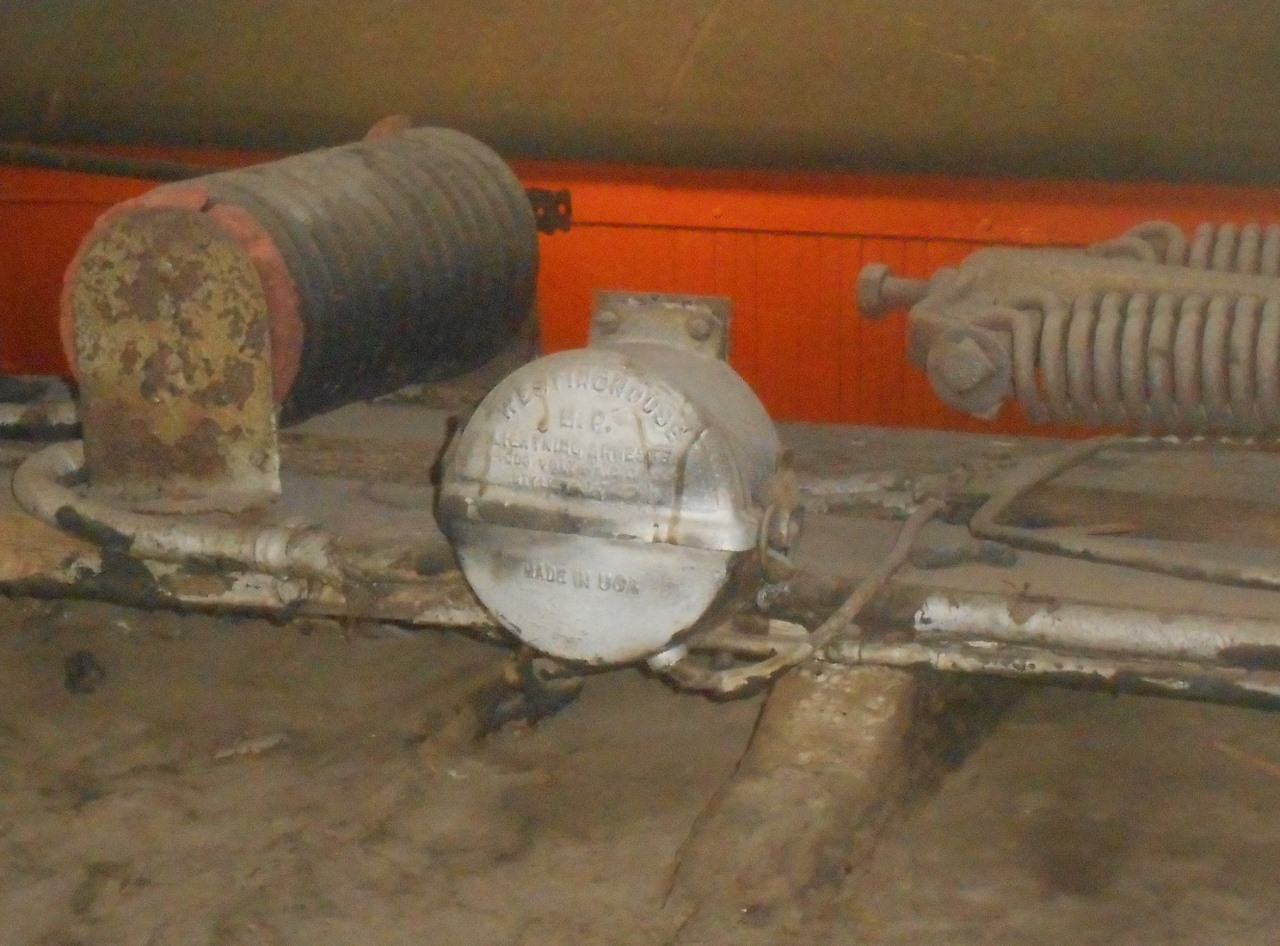
While I was up there, what should I notice but a Westinghouse type MP lightning arrester on top of the M-15.   That looks familiar!   So Bill was right, as always.  I loathe people who are always right.


It's not too clear in this picture, but even from the ground you can see that the house roof sticks out an inch or so from the letterboard, because it was installed over the ugly old wooden gutter that I got rid of last year.  I certainly don't want to do any work on the roof, it's pretty good the way it is.  So what we need, I think, is something that looks like tack molding.  


And here it is as a proof of concept.  A spare piece of  ordinary pine 1x2 has its top edge cut off at a 45 degree angle.  It fits up nicely under the roof overhang.  I will trim the bottom edges to make it look like real tack molding, paint it black, and nail it in place.   And that will complete this side of the car.


By early afternoon the entire letterboard had a new coat of white primer.  Next time it will get a first coat of Traction Orange.


Out by Schroeder's Store, the back porch is getting put together.


And on the west side, this will be the handicap-accessible entrance.


I asked Dave about the plans for the cars currently stored near the depot.  He says the two on the north track will be pulled out once everything is transferred to Schroeder's, and that track can perhaps be used for rotating displays of equipment.  The other two cars may stay there, and be opened for business on special days, such as Thomas.

The other thing was to finish up painting the vestibule floor in the 36.  Getting paint behind all the piping for the brakes and sleet scrapers is a challenge.


And finally, I painted the threshold casting, with its worn lettering "JOHN STEPHENSON COMPANY" still legible after all these years.  Because this part had not yet been painted, I hadn't noticed that we're missing two bolts at this end!   I'll have to look underneath to see if anything can be done about it.


But I'm pretty sure it's been like that for a long time, and is not on the verge of collapse.  None of the other cars have an exposed set of bolted castings like this.

And in conclusion, don't forget to tell your friends and acquaintances about the EXTRAVAGANZA.