Showing posts with label Krambles-Peterson Archive. Show all posts

Friday, October 17, 2025

Hope Springs Eternal

Hope Springs Eternal
by Art Peterson
All Photos Are From the Krambles-Peterson Archive

In previous pieces, we’ve looked at some of the roads that employed 6600V AC power for their traction needs, including the Indianapolis & Cincinnati and the Richmond & Chesapeake Bay. Thanks to the kindness of Bernie Drouillard (and to Gord McOuat and Mike Trosino for establishing that connection) in sharing his roster and other information for the Windsor Essex & Lake Shore (WE&LS) we’re now able to add Canada’s sole 6600V AC line to this coverage.

The January 11, 1908, issue of the Street Railway Journal (SRJ) discussed the new WE&LS line and its plans for the future. The road had built and was operating the first 28 miles between Windsor and Kingsville, ON (location of the road’s powerhouse, as well as a carbarn). A nine-mile extension to Leamington was under construction at the time of this article.

SRJ mentioned the problems the Michigan Central gave the interurban road about crossing its tracks in Essex, ON. Owing to a high water table in the area (which would have ruled out any subway construction) and the urban location (which nixed an elevated crossing), the Canadian Railway Commission permitted the WE&LS to make this crossing at grade. With this concern addressed, WE&LS was able to run its first service on September 26, 1907.

By the time of the SRJ piece, the road was scheduling five round trips per day, with extras being operated to handle additional demand. The fleet comprised five Ottawa Car-built motors, four passenger trailers, and two express trailers. Each of the motor cars was equipped with two WH 132 (160hp) motors and rode on Brill trucks. Four Wason-built (in 1878) ex-New York elevated cars were acquired in 1907 for use as passenger trailers.

The City of Windsor did the WE&LS a huge favor by allowing the road to use the 6600V AC electrification within the city limits. This meant the WE&LS cars didn’t have to be equipped to switch over to 1100V AC, which was the original plan for the in-city electrification.

This postcard view is indicative of the architecture of the original Ottawa-built motors used on the WE&LS. The location is alongside the powerhouse and car barn in Kingsville, ON. Originally named the “King Edward,” this car was first numbered 8 and then renumbered to 308.

In 1913 and 1914 each, WE&LS added two more motor cars to its roster. These were true exotics in the car building world, as all four came from the Ontario-based Tillsonburg Car Co. Tillsonburg delivered just four orders of cars, comprising a total of 18 cars, before exiting the business. Amazingly, a Tillsonburg-built car still exists as one of the dozen single-truck city cars built for St. John, NB, was preserved in 1980 (it had survived as a construction company storage shed for 32 years since the streetcar operation in St. John ended).

Wilbourne Cox photographed one of the 1913-built Tillsonburg cars in Essex, ON, at the corner of Talbot and Cameron Streets. This image was made on July 5, 1926. Following the road’s conversion to DC operation, car 312 was converted to a trailer.

An unknown photographer captured WE&LS 316 from the 1914 Tillsonburg build on Pitt Street in Windsor. This car was among three cars damaged in a 1917 carbarn fire. It was originally planned to have Preston Car rebuild these cars, though it appears this work was not performed.

By 1915, WE&LS found itself in need of additional equipment. Four more ex-New York elevated cars (these were St. Louis Car products) were added. In addition, the road acquired two cars from the Rock Island Southern (RIS). Surviving roster notes are contradictory as to whether these ex-RIS cars were the 201-202 (DC or Eastern Division) built in 1906 by St. Louis Car or a pair of the 300-class 1907 Niles-built cars (ex-Washington Baltimore & Annapolis) from the AC or Northern Division. Either way, the ex-RIS equipment was converted to express car duty on the WE&LS.

As a result of the damage to three cars in the 1917 carbarn fire, in 1920 WE&LS acquired three 1907 St. Louis-built cars from fellow AC road Richmond & Chesapeake Bay (R&CB).

If this shot of R&CB combine 101 on the Richmond approach viaduct looks familiar to you, that’s because it appeared on the Hicks Car Works blog on December 20, 2024.  R&CB’s ac operation lasted just over 10 years – first run October 28, 1907; last run December 20, 1917.  This car became the 320 on the WE&LS roster.

A surviving minutes book for the WE&LS is available online. By July 1927, it was noted that the road was in rough shape, essentially worth more for scrap than anything else. By June 20 of the following year, the on-line communities had agreed to purchase the road and to approach the Ontario Hydro Electric Power (HEP) Commission to discuss rehabbing the road and assuming operating responsibility for the property.

Agreement between the WE&LS Association (of the on-line communities) and the HEP to proceed with this plan was achieved by January 3, 1929. Two weeks later the Association issued $1 million in bonds to fund the required work at 6% interest. No market for the bonds at this rate was found. By April 22, 1929, the Association had sold the bonds to the Canadian Bank of Commerce at 98 cents on the (Canadian) dollar.

The condition of the WE&LS line to the southeast of Windsor is shown in this April 1929 view. WE&LS paralleled the Michigan Central (MC) Canada Division leaving Windsor and the tower to the right of the view is MC’s Tower 4, which was located 5.7 miles from Windsor. The WE&LS Association used $296,000 of the bond proceeds to purchase the railway and the balance ($684,000) was to go to the line’s rehab. Interest was to be used to fund the Association’s costs. 

The communities’ interest in rehabbing the property was twofold – naturally, to keep the service going and in the hope of reducing the operating costs compared to the ac road. Operation of the 600V DC WE&LS began September 8, 1929.

In keeping with the modern look of the 1930 Ottawa-built cars bought for use on the 600V DC WE&LS, they were adorned in blue with yellow trim. In addition, “The Sunshine County Route” slogan appeared on the flanks of the cars. Motor 507 is shown at the Windsor terminal (on Pitt near Oulette) on April 24, 1932. Windsor’s CH Smith department store is to the right of the car. Balancing speed of the motors was 60 mph – each were equipped with four WH548C2 (100hp) field-tapped motors.

Operation of the rehabbed road began just before the Depression but despite its best efforts, the WE&LS lost traffic quickly and substantially. By May 12, 1931, the Association reported the road’s results (for the year ending October 31, 1930) recorded a deficit of $48,135.33. A month later the Association authorized its secretary to reach out to the HEP to discuss whether the road should be disposed of, as well as to address possible discontinuance of interurban services. Outreach to the CN and the CP was made, but there was no interest.

The five-car Ottawa Car order included one trailer – the 502 is shown at the barn in 1931, complete with its observation platform railings (denoting the lounge sections). The other four cars in this order were motors, configured as coaches, and given odd numbers between 501 and 507.

On February 17, 1932, losses for the year ending October 31, 1931, were reported as totaling $38,269.18. In addition, the Association required an additional $70,000 to meet interest payments. Three months later, with continuing losses and the responsibility for covering these losses falling on the owning communities, the Association agreed that railway operations should be discontinued.

By June 23, 1932, it was determined that the last day of operations would be September 15, 1932. On August 8 of that year, the HEP was told to notify all employees regarding that last day of operations.

To meet its freight needs on the rehabbed road, the WE&LS shops built this 45-ton locomotive between April and September 1930. Here, it’s switching cars at the Heinz plant on Erie Street in Leamington on April 23, 1932. The locomotive went in storage with the five 1930 Ottawa-built cars on cessation of operations.

The five passenger cars were sold to the Montreal & Southern Counties in August 1939. After the Montreal line quit operations, three of the Ottawa-built cars would finish out their days on the Niagara St. Catherines & Toronto, which operated until March 28, 1959 (the trailer was used to provide parts for the three motors). The last car, WE&LS 621/M&SC 622, went to the Seashore Trolley Museum, where it remains today. Locomotive 10 finally went to the Cornwall Street Railway in 1943. All other remaining rail rolling stock was scrapped during 1932.

Thursday, July 24, 2025

Carbodies on the Shore

Thanks to Art Peterson for sending along some more unique photos. This time, it's a pair of photos taken in Wildwood, New Jersey, showing cars from the Five Mile Beach Electric after they were retired and repurposed. FMBE was mostly known for its open cars, at least in the later years, and a handful of those were preserved, but its closed cars - including these examples - are more obscure.


FMBE 16 is a great example of a "trolley diner" right down to the message "Eat at Joe's" painted on the end. It was built as a single-car order in 1906 by Jackson & Sharp, order number 2619. Any idea when or where in Wildwood this photo was taken?
UPDATE: Some terrific sleuthing by Zach Ehlers has suggested strongly that this is the corner of Arctic and Garfield (see the "-field" street sign) looking roughly east. There was a gasometer just east-southeast of this intersection that's visible on historic aerial photos. Thanks, Zach!

FMBE 31 is an unusual car. It was built by American Car Company in 1916 on order #1054 and bears some resemblance in styling to a Birney, though it slightly predates that type. It's a straight center-entrance car with no doors at the corners. This car and one other were built for the Benton Harbor & St. Joseph in Michigan, numbers 15 and ??, and sold to FMBE in 1924. Anyone have any idea where in Wildwood this might have been?

Friday, July 11, 2025

CA&E Steel Car Photos from the Krambles-Peterson Archive

To go along with our recent post with CA&E wood car photos sent by Art Peterson, we now have a collection of great steel car photos. Thanks, Art!


Hey, I know that car. This shot of the 409 dates to around 1930 or the early 1930s; the car is in overall red, but it wears the later version with the Sunset Lines herald rather than its as-delivered scheme with no herald and horizontal pinstripes along the side sheets. Behind it is 435, which was built in 1906 (as part of the same order as cars 300-308) as the parlor car Florence, later became parlor-buffet 601, and was rebuilt in 1929 as coach 435.

It's August 29, 1947, and 410 is outside the shop at Wheaton while car 300 is inside. It looks like the 410 has had a rough day - sharp-eyed viewers will notice something pretty important missing.

Around 1928-1929, two cars - 412 and 418 - were painted orange as part of an experiment to paint Aurora cars and Elgin cars different colors. This trial didn't last long. Here, the 412 is westbound at Laramie in 1932 still in orange paint.

By 1934, when this photo was taken at Lockwood Yard by Robert V. Mehlenbeck, the 412 was back in overall red with the Sunset Lines herald. That seems like kind of an unusual destination sign! I don't think the sign curtains included those (or at least not "theatre") in later years.

This picture was taken on October 30, 1937, and shows 412 westbound at Main and 2nd at the St. Charles terminus of the Geneva branch. The next day, the branch was abandoned.

Here's car 416 on March 31, 1957, in a George Krambles photo. I'm not sure of the location - anyone willing to hazard a guess?

This George Krambles photo of the 416 was taken the same day at Clintonville.

The first three 450-series cars arrived at Wheaton on October 3, 1945. Four days later, on the 7th, Tom Desnoyers snapped this photo of car 451 in the shop awaiting its poles and retrievers.

Cars 451 and 453 are pictured near Wayne on December 16, 1945, on a CERA trip. Give us a few years and maybe we can recreate this shot with the same two cars! Photo by Tom Desnoyers.

On June 19, 1957, just a couple of weeks before abandonment, the 451 is on the loop at Des Plaines Avenue with the 434 and another curve-sider ahead of it.

The 460 and Pullman 417 are at Fifth Avenue in Maywood on March 6, 1958, operating as the "Mass Transit Special." This was an effort by supporters of the railroad to raise interest in restarting service, though you can probably guess how well that ended up going.

Tuesday, July 8, 2025

CA&E Wood Car Photos from the Krambles-Peterson Archive

Art Peterson recently sent us a terrific collection of CA&E photos from the Krambles-Peterson Archive. My father added quite a few to our existing CA&E Photo Album page, but here are some extras.


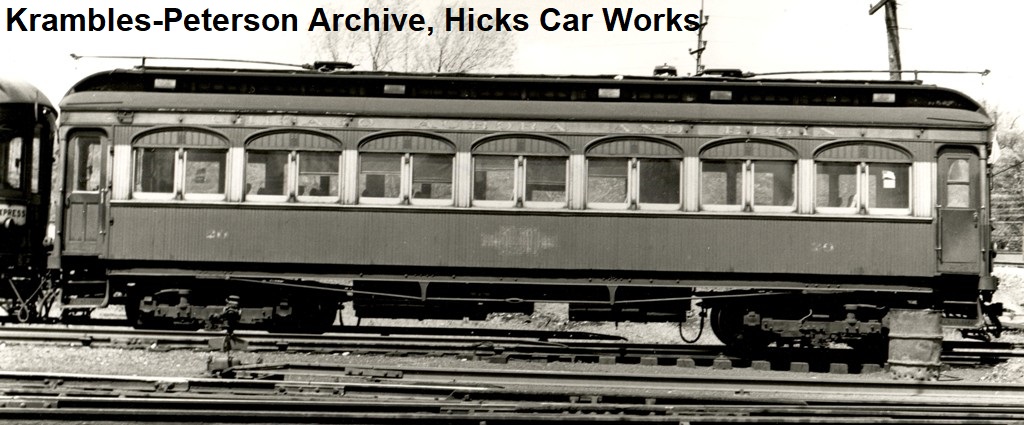
Here's car 20 at Wheaton on May 8, 1945, in a Tom Desnoyers photo. The deferred maintenance of the war years is pretty obvious. It still has its "streamer sash" windows and original doors at the non-cab corners.

Car 300 leads a five-car train west at College Avenue in June 1950 in another Tom Desnoyers photo. 

Here's the 303 westbound at Gunderson on August 17, 1946, in a William C. Janssen photo. You can see that the bottom corners of its pilot haven't been cut back; I believe this is the only car that kept its original pilot profile, and still has it to this day.

George Krambles captured this view of the 320 at Wheaton on June 12, 1937. Like the 321, it wore a folding sign that had been notched out for use on the 311-315 series Kuhlmans. Their MU sockets were originally (albeit briefly) mounted over the anticlimbers. You can also see both headlight plugs on the same side of the train door, but set into the car end rather than into a block as was common in later years.

The red paint on the 320 looks pretty fresh in this August 29, 1950 photo taken by Tom Desnoyers at Racine. The other cars in the train are likely the 105, 321, 205, and 319, which was the so-called "Cannonball consist" often seen together in the later years.

Here's a sorry-looking 321, sporting its own notched-out dash signs, at Desplaines Avenue in an undated photo taken sometime in the late 1940s or early 1950s. The car behind it is a trailer but not a "shorty," so that's probably the 205, part of the aforementioned consist that was often seen together.

Sunday, June 29, 2025

Finding Their Niche

Finding Their Niche
by Art Peterson

All photos are from the Krambles-Peterson Archive

Randy and Frank’s recent commentary on CA&E 451 wearing that Cleveland Southwestern-inspired scheme during its Trolleyville days reminded me that several properties adopted eye-catching schemes/introduced upgraded services in the mid-1920s in an effort to stave off the inevitable. Especially post-World War One, the industry was caught in a cycle where rising costs could not be met by increases in the rate of fare, resulting in abysmal rates of return. In addition, the companies faced stiff challenges from the private automobile and from buses, which seemed far more modern.

Cleveland Southwestern 205 – Cleveland Public Square – ca. 1928

The May 7, 1927 issue of the Electric Railway Journal noted that the management and employees of the Cleveland Southwestern (officially the Cleveland Southwestern Railway & Light Co. since its 1924 reorganization) had designated March 31, 1927, as the property’s “Dress-Up Day.” That was the first day the trainmen wore their new dark gray whipcord uniforms. In addition, the company offered commission incentives to the ticket agents to seek out additional passenger traffic.

Unfortunately, the identities of these employees are lost to history.


Cleveland Southwestern 205 – Cleveland Public Square – Ralph A. Perkin Photo

A spotless 205 along with an unidentified curve-side car pose at Public Square, Cleveland. Note how the film renders the color differences between the heavyweight and the lightweight (see also the shot of the 212, below). Notes from one of Ralph’s shots of a Cleveland Southwestern lightweight indicate these cars were blue, ivory and yellow, while this heavyweight appears to be just blue and yellow.

Despite its best efforts, Cleveland Southwestern would fail again in 1930, and be absorbed by the Columbus, Delaware & Marion the following year. In a deficit situation for the final two years of its existence, Cleveland Southwestern abandoned operations in 1933.


Cleveland Southwestern 201-Class Car

The “Cleveland Chapter of the Cloche Hat Wearer Society” prepares to board one of the 201-series parlor car conversions. With a 1925 inauguration date for the parlor car service using the big Kuhlmans, this service directly overlapped the era of the Cloche Hat as high fashion – 1922 to 1933.

The parlor service proved popular in those early years – Electric Railway Journal reported that the road transported 32,000 parlor car passengers during 1926. Interior views reflect some alternate configurations in the heavyweight parlor cars – some cars had parlor seats on both sides of the aisle, while other interiors reflected just one side being equipped with parlor chairs.


Cleveland Southwestern 212 – Kamm’s Corner – ca. 1928 – Vernon Burke, Jr. Photo

Although the print has some damage to it, this is a great shot of one of the dozen curve-sides Cleveland Southwestern ordered in 1924. These were big cars (as curve-sides go) – 40’-6” long, with eleven side windows. As delivered, they came in dark green with gray roofs and black trim, making the mid-'20s color change quite a transformation. Five of the 12 cars would be sold to the Dayton & Western, running there until 1936.  C&LE would scrap them a few years later.

Kamm’s Corner is on the west side of Cleveland, specifically the intersection of Rocky River Drive and Lorain Avenue, where Kamm’s 1900-vintage general store/post office building still stands. Since 1923, West Park has been part of the City of Cleveland.


Kentucky Traction & Terminal 303-311 – 1928

The details on the back of this print absolutely make me regret that there wasn’t a stable color film sooner! George’s notes on the print indicated that there were three distinct schemes used on the city cars, with a special interurban car livery. A unique scheme was applied to the freight motors, plus there was a separate one for the buses. There’s no record of what scheme the 211 wore, but here are the comparative color details for three of the schemes:

Element

Interurban Car

City Car

Bus

Roof

Atlas Yellow

Pigskin Brown

Straw

Letterboard

Apple Green

Lemon Yellow

Medium Green

Sash Belt

White

White

Pigskin Brown

Wide Stripe

Pigskin Brown

Light Blue

Double Deep Orange

Body

Double Deep Orange

Bright Red

Pigskin Brown

Skirt

Medium Green

Deep Red

Dark Green


As delivered, KT&T’s 300-309 series interurbans (the very first order of curve-side cars, ready for shipment by February 17, 1922) were no slouch in the color context – they came in yellow with black lettering and striping edged in silver. KT&T 211 was one of 27 single-truck curve-sides (with an overall length of just 26’-2”) the property acquired mid-1923. KT&T placed four additional orders for curve-side cars, though two of those (in 1927 and 1929) were for single replacement cars.   

Despite being able to post 35% reductions in track and car maintenance due to using the lightweight cars, the interurban operation in Lexington lasted until only January 12, 1934, while the city car system made it to April 21, 1938. None of the city cars were resold, but five of the interurban cars were sold in 1941 to Shaker Heights, though they were never used in service.


Monongahela West Penn “West Virginia” – ca. 1926

There could be no clearer indication that Monongahela West Penn (the property name used from 1923) was under American Water Works & Electric Systems control than the arrival of two near-clones of the typical West Penn-style interurban from Cincinnati in 1926. MWP 775 and 776 were equipped with air brakes for the MWP application, where the typical West Penn car would have used electromagnetic track brakes. As built, the 775-776 rode on Cincinnati arch-bar trucks, again, quite different from what West Penn would have used.

From September 5, 1926, car 776 was run as the “West Virginia,” wearing this old gold and blue livery to commemorate the colors of West Virginia University. Re-equipped with deep spring leather seats and reflecting “a seat for every passenger” policy, MWP proudly noted it had spent $21,367 to purchase and to upgrade this car. Four daily round-trips were made by the deluxe car on the Clarksburg-Fairmount run, saving 25 minutes compared to existing schedules (only four intermediate stops were made). The service didn’t last long – the car finished out its days as car 776.

Acknowledgements: Richard Wagner’s “Curved-Side Cars” book, along with Hilton & Due “The Electric Interurban Railways in America” and CERA B-110 on “West Penn Traction” were essential to this piece.

Thursday, June 26, 2025

North Shore Album, Part 3 - MD Cars and the 354

Thanks again to Art Peterson for more pictures of IRM cars in service, from the Krambles-Peterson Collection.

North Shore 213 is the only one of the original order of MD cars that was preserved.  

Here it is at Wilson c. 1925 in a portrait by A.F. Scholz.

213 at 5th and Clybourn, Oct. 1934.   Photo by Glenn Niceley.

The MD cars were also used for clearing snow from the streets of Milwaukee.  We have several good views of this process:

The 213 spotted at Highwood with its scraper attached,  Apr. 8, 1939.

Photo by Bill Jansen of the 213 on 5th Street, Feb. 1947.

Another photo at the same time by George Krambles.


Then, the 229 spotted at Highwood on Feb. 11, 1950.  For many years this was the Highwood shop switcher.


And then, the only preserved North Shore streetcar:


First, a classic view of the 354 meeting a southbound interurban train at Genesee St.
Undated photo by JLD.


The 351 and 354 at Harrison, south end of the line for streetcars.  Photo by George Krambles.


And finally, this intriguing view at Chicago Hardware Foundry!  I wish I knew when and by whom this picture was taken.  The car has gotten a partial or temporary roof job and has been repainted, so this is probably later in its time at North Chicago.  Behind it is the 966 or 972, and I can't decide what might be to the left.

Wednesday, June 25, 2025

North Shore Album, Part 2

Thanks to Art Peterson for sending us more pictures of IRM cars on their original lines from the Krambles-Peterson archives.  We continue with North Shore Line cars 714, 749, and 757.


This is the 714, which I believe is in traction orange, dating it to the late 1920s to late 1930s.


The 714 at Highwood on Jan. 1st, 1946.  Photo by Tom Desnoyers.


Leading a southbound train at Belmont on the outer track, Nov. 4, 1958 by Roy Benedict.


The 749 newly delivered from Pullman in 1928.


Northbound at Dempster,  July 4th, 1944, by George Krambles.


Interior of the 749, undated but possibly in the 1940s when it was modernized prior to the advent of the "Silverliner" program.


Ready to start loading at the Milwaukee terminal, Sept. 9, 1950.  Photo by Tom Desnoyers.


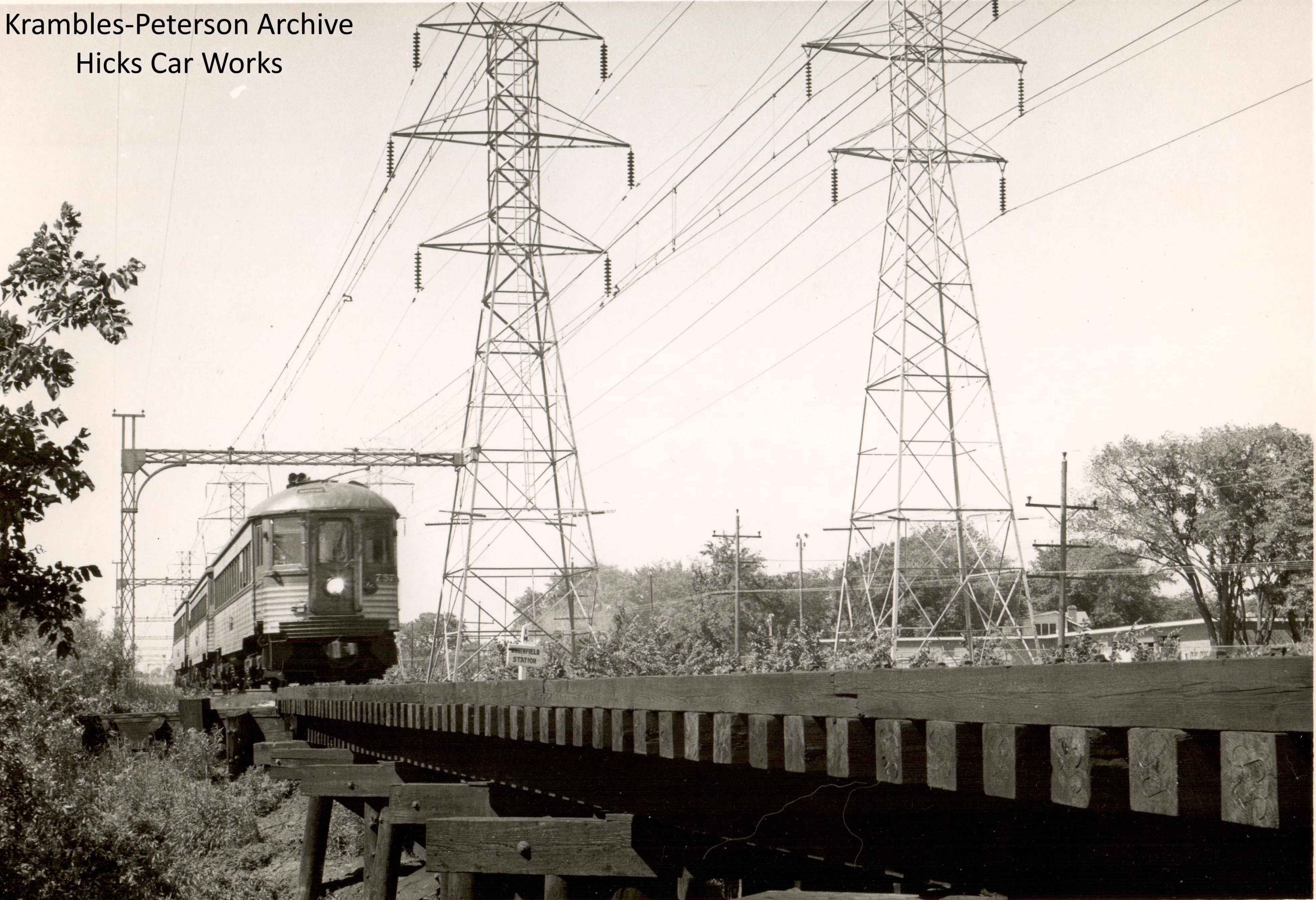
757 crossing the Skokie River trestle, June 12, 1962 by Roy Benedict.


Southbound at Dempster, March 7, 1937.  Photo by George Krambles.