Updated with pictures from the Krambles-Peterson Archive.
Usual warnings against reproduction apply.
Illinois had a large number of small interurban lines scattered throughout the state, all of which went out of business at an early date and have been largely forgotten. The late Stephen Scalzo put a great deal of effort into collecting information on many of these lines, and we're planning to use this information as the basis for histories of some of them. We start with the Central Illinois Traction company, a ten-mile line between Mattoon and Charleston in Coles County.
HISTORY OF
CENTRAL ILLINOIS TRACTION
BY RANDALL HICKS

CONSTRUCTION
In 1901, Mr. E. A. Potter, representing a group of Chicago financiers and promoters, arrived in Mattoon. The Potter syndicate soon purchased the local utility company and renamed it the Mattoon Heat, Light, and Power Company (MHLP). In 1902, during the height of the first interurban building boom, Potter proposed to his backers the construction of a street railway in Mattoon and an interurban line to Charleston, ten miles away. At the time, Mattoon was an expanding industrial center, located on the main line of the Illinois Central, and Charleston was the county seat and site of the recently built Eastern Illinois State Normal School, now Eastern Illinois University. Two new companies, the Mattoon City Railway (MCR) and the Central Illinois Traction (CIT) were formed, although they remained under the same financial control, as was common at that time.
During 1903, franchises were obtained and property bought, and construction began. The first city cars ran on June 4, 1904, and the first interurban train to Charleston on June 5. The carbarn for both the MCR and the CIT was located alongside the utility company's power plant in Mattoon. The interurban line largely paralleled the Big Four (NYC) line between Mattoon and Charleston.
As was common during the building boom, the interurban promoters immediately proposed a huge expansion of the system. The line would be extended about thirty miles east of Charleston to Paris, Ill. and a connection with the THI&E. To the west, the line would be extended about seventy miles through Shelbyville and Pana to a connection with the Illinois Traction system at Hillsboro. Thus the Central Illinois Traction would have been part of a direct electric route from Indianapolis to St. Louis, which never happened, of course. As a preparatory move, the MCR bought up the street railway in Paris, but nothing more came of these grandiose schemes.
EQUIPMENT
Unfortunately, complete roster information seems to be unobtainable. The Mattoon city line operated throughout its history with single-truck cars, both open and closed in the early days. The interurban line started operation with two combines, at least one Robertson-style passenger car, basically a suburban type, and a box motor, known as the "express car". No reports ever refer to a number for the express car.
There are occasional references to freight service, but this must have been limited to local express packages and so on. Since there appears to have been no track connection with other railroads once construction was complete, there could have been no carload or LCL freight at any time.
There are occasional references to freight service, but this must have been limited to local express packages and so on. Since there appears to have been no track connection with other railroads once construction was complete, there could have been no carload or LCL freight at any time.
OPERATIONS AND SAFETY
The interurban line had a dreadful safety history in its early years. The most common type of accident on early interurbans was a head-on collision caused by faulty dispatching or failure to follow orders, and the Central Illinois Traction was one of the worst offenders, in spite of its small size. There were major wrecks in 1905 and 1906, involving the same equipment and nearly the same situation. The 1906 wreck killed two people and injured many more, and the dispatcher then committed suicide. Car #11, which was badly damaged, was renumbered 14 after rebuilding in the hope that people would not recognize it as the same car. And there seem to have been many minor accidents and near-misses.
The worst wreck occurred on Friday, August 30, 1907. The county fair at Charleston was in progress, and many people rode the interurban from Mattoon to attend. A two-car passenger train eastbound from Mattoon was approaching Charleston, and at the bottom of a grade with a long curve, it collided with the westbound express car. The express car telescoped the leading combine, #14; 18 people were killed and 50 injured. Both motormen were able to jump to safety and survived the collision. This was the worst interurban wreck up to that time, and made the line infamous throughout the country.
This tragedy naturally caused an uproar in the area, and the case went to trial. The superintendent of operations, who was also the circuit clerk of Coles County, had been on the job only a short time. The newspaper reports: "For some reason he was regarded as an experienced railroad man, although it was said that any experience which he had must have been gained in a short time as a brakeman on the Clover Leaf many years ago." On that Friday, due to the heavy traffic to the county fair, the usual hourly schedule had been changed to a half-hour schedule, but testimony differed as to whether the express car motorman had been informed. The superintendent testified under oath that he had told the motorman of the change in schedule, while the motorman and his assistant testified under oath that they were told "the trains would run the same as yesterday." So the express car departed westbound at its usual time, with fatal results.
Railroads played a large part in the life of a small town at that time, and most people would be familiar with the basic principles of dispatching, which aren't hard to understand. A newspaper article immediately after the wreck makes the point that the electric line's operations were criminally negligent:
What Would Happen?
What would transpire on a steam road if a dispatcher told a conductor and engineer that trains "would run the same as yesterday." The conductor and engineer would refuse to leave the terminal and they would be upheld in this course. Railroad men look with disgust upon the verbal order system, which President Potter stated upon the stand, is in effect on all interurban lines.
The newspaper also reports that nearly the same thing happened a few months later, at the same location, but somehow the motormen were able to bring the cars to a stop "within a foot of each other." However, the problem was eventually solved and the later history of the interurban operation was much more satisfactory.
In the court case, CIT officials were indicted by the grand jury on 52 counts but later acquitted. Damage claims put the company into bankruptcy and a receiver was appointed on Sept. 5, 1907.
During 1909, the receivership was lifted and much of the stock was acquired by the United Light and Railway Company, a large holding company located in Chicago and Grand Rapids. In 1911-1912, new financial interests combined to form the Central Illinois Public Service Company (CIPSCO), which passed into the control of Middle West Utilities, part of the Insull empire.
CIPSCO built a local streetcar line in Charleston in 1912, with 1.75 miles of track and two cars operating out of a barn at 6th and Jackson. This provided service between the State Normal school, downtown Charleston, and the railroad stations. Service on the city lines and the interurban continued largely unchanged until the end of WWI.
After the war, in an effort to cut costs, the company purchased five new single-truck one-man Birneys, assigning three to Mattoon and two to Charleston to replace the older equipment. During the coal miners' strike in the fall of 1919, there were power shortages and the company was forced to reduce the number of trains, but this was later changed back to the old schedule, twelve trains a day.
Postwar inflation caused serious problems for both steam and electric lines, and after the war ended the various CIPSCO lines all started to lose money. In 1920, the paved highway to Paris was completed and the company started running buses from Charleston,, along the route originally planned as an electric railway. In 1924, the older interurban cars were replaced by two new St. Louis lightweights (see below). But these did little to maintain ridership, which plummeted as automobile ownership increased throughout the region.
The company started applying to local authorities to replace the electric cars with buses. CIT was granted permission to replace the interurban line on December 8, 1926, but for various reasons actual conversion was delayed more than a year. In January, 1927, the City of Mattoon allowed the company to substitute buses on the city lines, and the last streetcar operated on March 16, 1927. The last interurban train ran on May 8, 1928. The Charleston city service lasted until September 18, 1929.
1. Cincinnati Combines
Two heavy wooden interurban combines, built by Cincinnati, 1904. Numbered 11 and 12.


4. McGuire-Cummins Combines
Two heavy wooden interurban combines, built by McGuire-Cummins, date not known. Probably later than 1907 wreck. Numbered 205 and 207.


These were in service until 1924, when they were replaced by 230 and 231. They were then sent to St. Louis Car Company for rebuilding and modified for 1200V, then sent to the Southern Illinois Railway and Power line at Harrisburg, which was also a Central Illinois Power property. Here they were numbered 55 and 56.

5. St. Louis Lightweights
Two lightweight interurban cars of typical St. Louis design, similar to IT 415. SLCC order #1300, 1/16/1923. Put into service 1924.


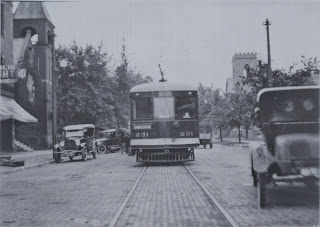

Other cars were then retired. In service until abandonment in 1928. Sold 1928 to Chicago and Joliet Electric, where they were renumbered 250 and 251.
When the C&JE was abandoned in 1934, these two cars were sold to the Jamestown (NY) Street Railway, renumbered 87 and 88.


Out of service 1938, sold for sheds in 1941.
1. St. Louis Closed Cars
Built 1904. Two cars, one of which was #16. SLCC order #481A. 21' body, 32' overall. 2 GE 800 motors. Assigned to Mattoon.
2. Brill Closed Cars
At least three cars, 31' 6" overall. 2 GE 800 motors, K-10 controllers. Two assigned to Charleston in 1912, one or more to Mattoon.
3. Brill Open Cars
Two cars, 26' body. 2 GE 800 motors. Assigned to Mattoon.

4. Birney Safety Cars
Built 1919 by Cincinnati to replace all older cars. Order #2395, dated 7/8/1919. Overall length 27'10", Cincinnati 139 trucks. Five cars, three assigned to Mattoon, two to Charleston. (Order included identical cars for other CIPSCO lines, such as Anna, Taylorville, and Paris.)

In the court case, CIT officials were indicted by the grand jury on 52 counts but later acquitted. Damage claims put the company into bankruptcy and a receiver was appointed on Sept. 5, 1907.
REORGANIZATION
During 1909, the receivership was lifted and much of the stock was acquired by the United Light and Railway Company, a large holding company located in Chicago and Grand Rapids. In 1911-1912, new financial interests combined to form the Central Illinois Public Service Company (CIPSCO), which passed into the control of Middle West Utilities, part of the Insull empire.
CIPSCO built a local streetcar line in Charleston in 1912, with 1.75 miles of track and two cars operating out of a barn at 6th and Jackson. This provided service between the State Normal school, downtown Charleston, and the railroad stations. Service on the city lines and the interurban continued largely unchanged until the end of WWI.
RETRENCHMENT AND ABANDONMENT
After the war, in an effort to cut costs, the company purchased five new single-truck one-man Birneys, assigning three to Mattoon and two to Charleston to replace the older equipment. During the coal miners' strike in the fall of 1919, there were power shortages and the company was forced to reduce the number of trains, but this was later changed back to the old schedule, twelve trains a day.
Postwar inflation caused serious problems for both steam and electric lines, and after the war ended the various CIPSCO lines all started to lose money. In 1920, the paved highway to Paris was completed and the company started running buses from Charleston,, along the route originally planned as an electric railway. In 1924, the older interurban cars were replaced by two new St. Louis lightweights (see below). But these did little to maintain ridership, which plummeted as automobile ownership increased throughout the region.
The company started applying to local authorities to replace the electric cars with buses. CIT was granted permission to replace the interurban line on December 8, 1926, but for various reasons actual conversion was delayed more than a year. In January, 1927, the City of Mattoon allowed the company to substitute buses on the city lines, and the last streetcar operated on March 16, 1927. The last interurban train ran on May 8, 1928. The Charleston city service lasted until September 18, 1929.
INTERURBAN ROSTER
1. Cincinnati Combines
Two heavy wooden interurban combines, built by Cincinnati, 1904. Numbered 11 and 12.

Builder's view of #12 on shop trucks - Dave'sRailPix.
Car 11 was damaged in the 1906 wreck and renumbered 14 after rebuilding. Both cars were damaged in the 1907 wreck. Probably renumbered into the 200 series (perhaps 201 and 203?) Out of service by 1924.

Cincinnati combine at the Clover Leaf bridge, looking west. Appears to be #203.
Scalzo collection
2. Express Car
Unknown builder, probably 1904. Unknown number, if any. Evidently destroyed in 1907 wreck.

Wreck of 8/30/07, looking east. Car 14 (ex 11) in the center, telescoped by the express car. At left is probably 12. Scalzo collection
3. Robertson Car
Number 18. Probably built by St. Louis, unknown date. Probably destroyed in 1906 wreck.

Dave'sRailPix
4. McGuire-Cummins Combines
Two heavy wooden interurban combines, built by McGuire-Cummins, date not known. Probably later than 1907 wreck. Numbered 205 and 207.

Builder's photo of 205
Krambes-Peterson Archive

Car 205 at 16th and Broadway in Mattoon
Krambles-Peterson Archive

Car 207 at the carbarn in Mattoon
Krambles-Peterson Archive
These were in service until 1924, when they were replaced by 230 and 231. They were then sent to St. Louis Car Company for rebuilding and modified for 1200V, then sent to the Southern Illinois Railway and Power line at Harrisburg, which was also a Central Illinois Power property. Here they were numbered 55 and 56.

Dave'sRailPix
5. St. Louis Lightweights
Two lightweight interurban cars of typical St. Louis design, similar to IT 415. SLCC order #1300, 1/16/1923. Put into service 1924.


Builder's photos - Scalzo collection
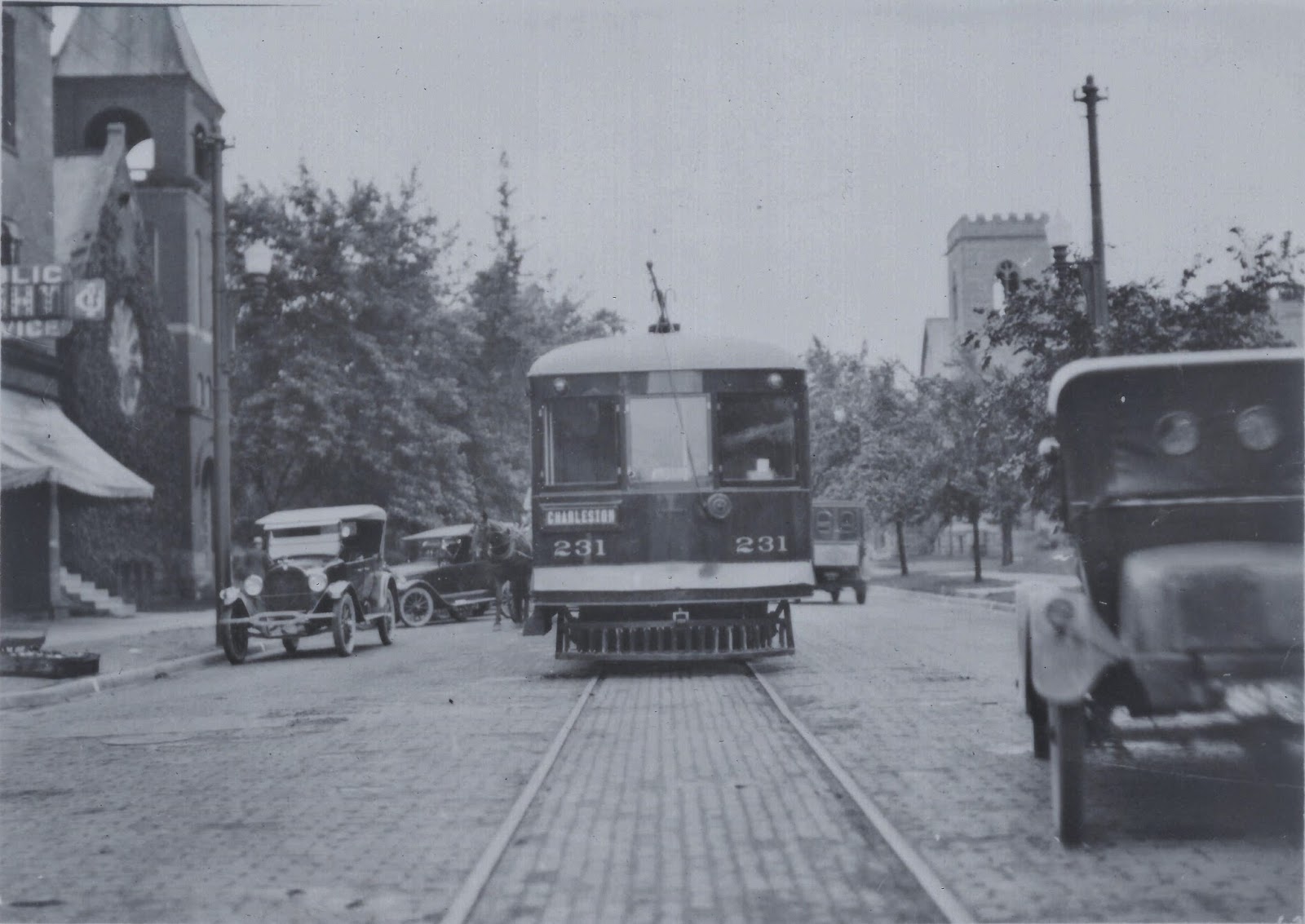
Looking south on 16th in Mattoon

Another view, from nearly the same location. Looking SW.
Krambles-Peterson Archive
Other cars were then retired. In service until abandonment in 1928. Sold 1928 to Chicago and Joliet Electric, where they were renumbered 250 and 251.
When the C&JE was abandoned in 1934, these two cars were sold to the Jamestown (NY) Street Railway, renumbered 87 and 88.


Dave'sRailPix
Out of service 1938, sold for sheds in 1941.
CITY ROSTER
All city cars were double-end, single truck.
Information on the city equipment is even sketchier than for the interurbans, unfortunately. For most of them we don't even have numbers.
1. St. Louis Closed Cars
Built 1904. Two cars, one of which was #16. SLCC order #481A. 21' body, 32' overall. 2 GE 800 motors. Assigned to Mattoon.
2. Brill Closed Cars
At least three cars, 31' 6" overall. 2 GE 800 motors, K-10 controllers. Two assigned to Charleston in 1912, one or more to Mattoon.
3. Brill Open Cars
Two cars, 26' body. 2 GE 800 motors. Assigned to Mattoon.

Open car on Broadway, downtown Mattoon. In the foreground is the cut for the IC main line, which is below grade at this point. Scalzo collection.
4. Birney Safety Cars
Built 1919 by Cincinnati to replace all older cars. Order #2395, dated 7/8/1919. Overall length 27'10", Cincinnati 139 trucks. Five cars, three assigned to Mattoon, two to Charleston. (Order included identical cars for other CIPSCO lines, such as Anna, Taylorville, and Paris.)

#131 on the 6th St. line in Charleston. Signed for "State Normal", i.e. Eastern Illinois U.
Scalzo collection
MAPS
Mattoon


This is a map of the Mattoon city system, with red lines hand-drawn by Stephen Scalzo. I have corrected two details on the scan: The line on 16th street went a block farther south to Wabash, and the interurban line left Broadway at about Division and curved north to the railroad. This part of the alignment has now been obliterated by a shopping mall, but it shows up clearly on the 1938 aerial photograph (circled in red):

Charleston

This is a similar map of Charleston. I have added the line to the east of the Big Four station, on the south side of the tracks.
From Mattoon to Charleston the interurban line paralleled the Big Four until a point about three miles west of Charleston, now in the middle of a golf course. The right-of-way shows up clearly on the 1938 aerial photo, to which I have added some red arrows to point it out:

PRESENT-DAY VIEWS
There are very few surviving traces of the Central Illinois Traction operations. No equipment was preserved, and the city trackage has disappeared without a trace. In some sections grading for the interurban line is still apparent, although it's much easier to see in person than in a photograph.
In Mattoon there are essentially no traces left. This picture was taken looking south on 16th, at the same location as one of the pictures of car 231 above. The tower of the Methodist Church is one remaining landmark. The Public Service building and the carbarn are now parking lots.

You have to imagine the interurban track running parallel to the pole line at this point:

The Clover Leaf bridge is still in existence. This picture was taken at about the same location as the picture at the top of this post, showing a Cincinnati combine.

The point in Charleston where the interurban line left the street and headed down the hill.

Finally, 6th Street in Charleston, looking towards Old Main and the end of the car line, which would have been in the middle of the street, of course.


