The Alton Jacksonville & Peoria Railway
by Stephen M. Scalzo
Headline image: AJ&P 53, one of the 1912 McGuire-Cummings cars, is shown at the Jerseyville station at the north end of the line. All photos are from the Stephen Scalzo Collection of the Illinois Railway Museum.
The interurban line between Alton and Jerseyville, Illinois, was one of the least-known and shortest-lived, if not one of the most ill-fated, interurbans in the state of Illinois. The developer had ambitious plans for an initial 64-mile line from Alton to Jacksonville (and later on to Peoria), with a branch from Jerseyville to Hardin. Most of Jersey, Calhoun, and Greene Counties wallowed in mud and slush in winter and spring, and choked with dust in summer and autumn, because Illinois at that time had no paved highways. The two steam railroads in the area, the Chicago & Alton Railroad and the Chicago Peoria & St. Louis Railroad, only offered limited public transportation. Thus, the interurban seemed to be the most logical way to end isolation for the balance of the three counties.
The Central Traction Company was the first company to develop plans for the interurban line. In February 1904, the company's president was in Jerseyville to secure signatures from property holders to petition the town council to allow the company to build a line through the town streets. In June, the company contracted the Cincinnati Engineering and Investment Company to investigate the feasibility of also building a line from Jerseyville to Hardin. By October, a detailed survey had been completed for that route, with a $500,000 estimate to build the line.
On November 19, 1904, the Alton Jacksonville & Peoria Railway was incorporated by the same organizers of the Central Traction Company, and a Cincinnati engineer was contracted to obtain the right-of-way through the cities involved. Following the organizational meeting in December in Jerseyville, the engineer met with officials in White Hall and Kane, and in Roodhouse in January 1905. On January 26, the Jerseyville city council passed an ordinance granting a franchise to the company to build their line on State Street. The company procured all the necessary franchises for a term of 50 years in all of the cities and towns between Alton and Jacksonville, and made terminal arrangements with the local city streetcar systems in
Alton and
Jacksonville.
Surveying the new line began during the summer of 1905, and by August 15, it was announced that the exact distance from the beginning of the line at the foot of Piasa Street in Alton to the National Bank corner in Jerseyville was 19.1 miles. The survey continued on through State Street in Jerseyville northward, reaching Carrollton through Kane about September 1, and on to Jacksonville by winter. It was initially estimated that the cost to build and equip the line would be $3,000,000. Though the survey and right-of-way acquisitions went smoothly, the actual construction work did not.
AJ&P 1 was one of the secondhand city cars purchased in 1907. It is shown on Belle Street in downtown Alton, near 3rd Street.
The Fisher Construction Company of Joliet was contracted to build the line. Construction within the City of Alton, scheduled to begin on October 28, 1905, was halted by an injunction, and it was not until mid-December that work began. On August 20, 1907, 5.9 miles of track from downtown Alton to the suburb of Godfrey was placed into service using a small city car for hourly service. The company had expected to use each section's earnings to pay for the construction of the next part. The company's treasurer died on February 1, 1909, and financial troubles began. By 1909, the short stub had carried 300,000 passengers with four small city streetcars. The line was barely able to produce bare break-even returns, with a net profit of $189 in 1908 and a loss of $486 in 1910. The average fare was five cents per passenger.
In 1911, construction began northward from Godfrey through 10 miles of hilly and thinly populated country. By July 1911, tracklaying was just south of McClusky. However, after having spent about $600,000 on constructing the line towards Jerseyville, construction was halted because the company had become badly entangled legally and was bogged down with unpaid debt. The right-of-way, particularly that portion which passed through the Piasa Creek Valley (located halfway between Godfrey and Jerseyville), was laid in topographically rough country, and later maintenance of the track was difficult. Much rock was encountered in the grading operation and many water courses had to be controlled and bridged, with 55 curves and 15 bridges (not including culverts). The high construction costs and the difficulty of maintaining that section were factors in the company's later demise. The company's president then dropped out of sight along with the company's books; he was located in Los Angeles in October and later convicted of embezzlement. On September 11, 1911, the company was placed into receivership, and it was determined that the property was worth only $111,000 while $712,000 had been spent.

This handsome 1912 American Car Company interurban and its four sisters never made it from the builder in St. Louis to the AJ&P in Alton - the railroad's financial woes meant it couldn't pay for the cars and led to their resale to different interurban lines.
Another year passed before the last four miles of track were built to the south side of Jerseyville. On July 9, 1912, the receiver was authorized to sell $90,000 in certificates to raise the money to complete the line to Jerseyville. The city of Jerseyville had given the company a franchise to run the line on State Street from the south to north city limits. Several blocks on South State Street had previously been torn up to lay about 1,800 feet of ties and rail, and were left unfinished. The franchise in Jerseyville expired and the city council refused to renew it unless the trackage was completed to the north city limits; additionally, paving the street along the trackage became the company's responsibility. When tracklaying reached the south edge of Jerseyville in October 1912, the company was denied entry onto the State Street trackage. Reluctantly, a station was built at the Jersey Landing Road at the south city limits, a half-mile from the business district, which discouraged the citizens of Jerseyville from using the system. That proved to be another cause of the later failure of the company. The additional 16.19 miles was placed into service in December 1912, offering hourly service between Alton and Jerseyville.

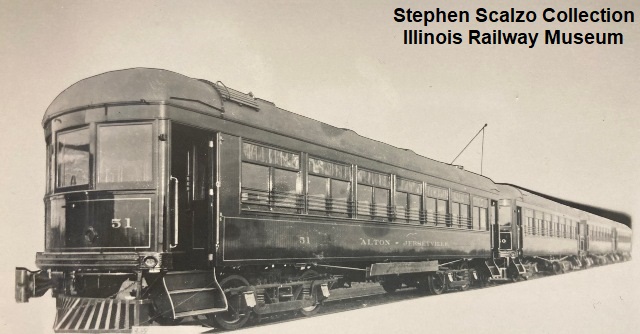
Later in 1912, the McGuire-Cummings company of Paris - which provided equipment for many smaller and less financially stable lines - built these four handsome interurban cars for the AJ&P. The board mounted to the truss rod has the builder's name painted on it.
The 22-mile line had cost about $500,000 to build, using six passenger cars. The company also offered freight service. The system was operated at 500 volts DC. Power was purchased from the Alton Gas and Electric Company in Alton through the local streetcar company for the southern portion, and for the northern portion power was transmitted from the Alton power station over high tension lines to a substation located 6.1 miles south of Jerseyville. The pole lines and overhead from Alton to Jerseyville were of standard bracket construction on tangents, and cross suspension on curves. The entire line was equipped with a private telephone system and with a special electric train order signal system. Trackage consisted of 80- and 60-pound rail in the streets in Alton, 85-pound rail thereon to Godfrey laid on stone ballast, and 70-pound rail thereon to Jerseyville on earth ballast. A frame carbarn with pits and complete repair shop equipped with all necessary machinery, appliances, and repair parts was located just south of Godfrey.

This builder's photo of AJ&P 53 was presumably taken at the McGuire-Cummings plant in Paris, Illinois.
The company undertook the construction of a large, modern power station on the line near the Big Piasa River. Plans and specifications were prepared for the building and equipment, and the equipment was purchased and delivered on the ground where the construction of the power station building proper was begun. After excavation had been completed and a portion of the concrete footings laid, it was decided to purchase power instead of generating it. The entire work was abandoned and the equipment sold at a loss. A considerable sum was also spent on a study for the proposed extension from Jerseyville west to Hardin on the Illinois River, and from Jerseyville north to Jacksonville; complete surveys and profiles were prepared and other auxiliary expenditures were incurred. In addition to construction between Alton and Jerseyville, the company under its franchise in Carrollton, which was located about 15 miles north of Jerseyville, had constructed about 500 feet of track and paid for a proportion of the street paving.
The best year was 1914, when the line earned about $47,000 and had about 365,000 riders. On May 25, 1914, the receiver sold the property for $500,000 to the Alton Title Guaranty Trust Company, and on June 11, 1914, the company was reorganized as the Alton & Jacksonville Railway Company. Between 1913 and 1916, the company had a small operating profit, averaging about $4,000 per year, but in 1917 it became unprofitable. Even though the company operated freight service, the total volume only brought in about 8% of its revenue.
Car 53 is pictured at Jerseyville in the mid-1910s. Note that these cars were built with poling pockets at the corners, a sure sign - in addition to their MCB couplers - that they were intended to be capable of hauling freight cars when necessary.
During the spring of 1917, the entire trackage was re-ballasted with cinders by a 30-man gang. On July 22, 1917, passenger service was discontinued between Godfrey and Jerseyville. That did not affect service on the Alton to Godfrey section. The company's president said the action was necessary because of the weakened condition of some of the bridges on the line. Plans were made to exchange some of the heavier interurban cars for lighter cars. Both Alton and Jerseyville appealed to the Illinois Public Utilities Commission, and after examination of the 25 bridges involved, it was determined that they were safe for two to three more years. Service was ordered resumed on August 8, 1917, but never did because three of the interurban cars had been sold and shipped to Fort Riley, Kansas, and no replacements were obtained. There followed many irregularities, accusations, petitions, and suits for foreclosure.
During the period of 1916-1917, the company had about a $7,000 operating deficit, and about $90,000 was needed for repairs. In the fall of 1917, the company applied for abandonment, citing its losses and the deteriorating condition of its physical property. Permission was granted in January 1918 to permanently abandon the system, when the Commission agreed, noting the parallel steam railway service and the limited potential growth of the area. The Commission remarked in its January 1918 authority to permanently abandon that the railroad should probably never have been built. The last interurban car was sold and shipped to Kansas early in January.
A small city streetcar continued to operate on the Alton to Godfrey section for the few remaining passengers. Service was finally suspended on February 1, 1918. The line was sold shortly thereafter under foreclosure and dismantled; the rail was shipped to the army in France. Thus died the Alton Jacksonville & Peoria Railway.
This article was edited and laid out by Frank Hicks. Thanks to Ray and Julie Piesciuk and to Richard Schauer for making available the materials from the Stephen Scalzo Collection that were used to publish this history.
Roster of Equipment
Cars 1-3 - DT city cars, purchased 1907 from United Railroads of St. Louis - car 3 rebuilt in St. Louis with a baggage compartment, rebuilt in 1912 as an express car and used for LCL shipments
Car 42 - ST city car, purchased from Baltimore, rebuilt into a line car
Cars 100-104 - DT RR DE interurban combines, built 1912 by American Car Co (ord#892), never delivered - 100-101 resold to Kankakee & Urbana Traction, 102-104 resold to East St. Louis Columbia & Waterloo as their 20-22, resold in 1917 to Nipissing Central as their 22, 24, and 26.
Cars 50-53 - DT AR DE interurban combines, built 1912 by McGuire-Cummings - sold 1917 to Manhattan City & Interurban Railway as their 903-906, two possibly resold in 1921 to the Evansville & Ohio Valley as their 120-121
Locomotive 805 - steam locomotive, purchased used in 1907 for use during construction
Two boxcars and 11 flatcars, all secondhand, were also owned
This photo appears to have been taken at the same time as the photo of car 51 earlier in this article, but this time an unidentified gentleman in a bowler is sitting on the steps.
Route Map
There is remarkably little of the AJ&P left today. The line ran north from downtown Alton on Belle Street to North Alton, on private right-of-way from there to McClusky (except for a stretch of street running through Godfrey), and thence alongside State Route 109 to Jerseyville. Little of the private ROW is evident today, but period maps and aerial photos dating to the late1930s - when the AJ&P had already been gone for two decades - make the route of the line evident. The precise location of the carbarn, though, is unknown. No buildings or pieces of rolling stock are thought to survive.


 As for the family, we took a look at the nice new gallery space, then swung through Barn 7 to take a look at my current project.
 Then it was on to Depot Street for a ride on the "Matchbox" (thanks to Zach, who was working as conductor, for the above photo) and of course some time on the playground. On our way out of town, we stopped by the bus barn (keep an eye out for yet another Scalzo history article later this week) where Richard and Jerry, helped by Good Nick and Greg, were working on moving a few of the non-operable buses to a nice new indoor storage location.
 Perhaps Richard can chime in with some details on what's going on with CTA 9799. All I can tell you is that some of our buses are truly forked.