News and views of progress at the Illinois Railway Museum
Friday, May 10, 2024
Seat Project Update
Posted by
Frank Hicks
at
7:00 AM
0
comments
Labels: 460 Progress
Monday, May 6, 2024
Sunday Report
Frank writes...
Thanks to Bill Wulfert for sending the above photo, which was taken at the end of the day on Saturday. About quarter after 5:00, a major squall line passed through, knocking down some tree branches and cutting the ComEd AC electrical feed to the campus. Unfortunately, the service train - CA&E 460 and 431 - was down at Kishwaukee Grove when the power went out, so Joel had to go out on the 44-tonner to rescue the cars.Speaking of Joel, he sent along this photo from the ITS meet on the 27th showing him running the 277. Neat!
Posted by
Frank Hicks
at
8:39 PM
1 comments
Friday, May 3, 2024
The Illinois Valley Lightweights
Posted by
Frank Hicks
at
8:00 AM
4
comments
Labels: Illinois Terminal
Wednesday, May 1, 2024
IT 1702 Operational Restoration Photo Album
Frank writes...
Above, it's January 21st and work has started on disassembling the smallest of the three contactor boxes. Nick E is painting Glyptal insulating paint onto disassembled arc chute pieces while Zach cleans dirt off the next batch. When work started, it wasn't even clear what type of contactors the car had. We soon determined that it has DB-41 contactors, which are a very early type - possibly even the next common type to be developed after the DB-15, which was the very first production model of contactor GE produced. These are pretty similar to the DB-131 contactors under the 308 and 409, but they're wider and beefier, presumably because they were designed for four motors rather than two. They were also designed for use without a line switch, similar to the DB-15.
A lot of people pitched in on this project, including Bob O, shown above taking a break from track work to paint more arc chute parts with Glyptal on January 21st. I know that Greg K, Norm K, Brian L, Zach E, Mikey M, and Bob S were all heavily involved in the project, and many others - some pictured in this post, some not - also contributed time as needed. It was truly a team effort.
Above, it's now February 11th and Greg K is under the car (right) working to disconnect the second contactor box. The third box, with three contactors, was formerly right over where his head is, but that had already been removed and was on the bench in the shop. Work hadn't really started yet on the two five-contactor boxes, though. You may see some legs to the left in the gauge - that's Zach E, who was working on cleaning up the valves for the 1702's air compressor. The compressor meggered okay, but the valves were stuck and the thing needed a good cleaning. Other brake work that was needed included rebuilding some slack adjusters.
Also on February 11th, here are the electromagnetic lifting coils for the first three contactors to be rebuilt. From memory, these three were all in good shape and didn't need any significant work besides a fresh coat of Glyptal. We would not be so lucky with all of them.
Above, it's February 18th and more DB-41 arc chutes are on the bench in a state of disassembly as the team gets started on rebuilding the second of the three contactor boxes. More importantly, though I didn't get a photo of it, February 17th was the first day the 1702's air compressor ran. There were some leaks in the system, but nothing that wasn't fixable, and the car was successfully pumped up and the brakes tested.
On February 25th, I snapped this photo of Zach E cleaning up more arc chute parts. A completed arc chute is in the foreground. It's hard to see, but on the bench right behind where he's working is a little plastic "shoebox" atop an orange box. That's a tumbler, of sorts, where arc chute hardware (especially 14-24 brass machine screws, which GE really liked to use but are almost impossible to find nowadays) was put into a vibrating "bath" of coarse abrasive grit for a day or two to clean it of paint and dirt.
Here's one of the rebuilt arc chutes. Compare this with the first photo in this post! You can also compare it with the photo of the DB-131 contactors underneath the 308 here.
Above, it's February 25th and the first of the three contactor boxes is going back together. The coils have been re-mounted along with the armature and rocker arm assemblies. There's an awful lot yet to do, though, and this is just the first - and smallest - of the contactor boxes. Brian L and Mikey M worked extensively on the reassembly of these boxes, including cleaning up and repairing (or replacing from a very limited supply of spares) any rocker arm and interlock parts that needed it.
On March 3rd, you can see more work on reassembling contactors. Toward the upper right is an armature and rocker arm, while at lower center is a replacement shunt. Some of the 1702's contactors had broken shunts, meaning the motor current was going through the rocker arm pins - yikes! Greg K flattened copper pipe over the ends of braided cable to create replacement shunts.
The arc chute assembly line is still hard at work - seven are completed as of March 3rd.
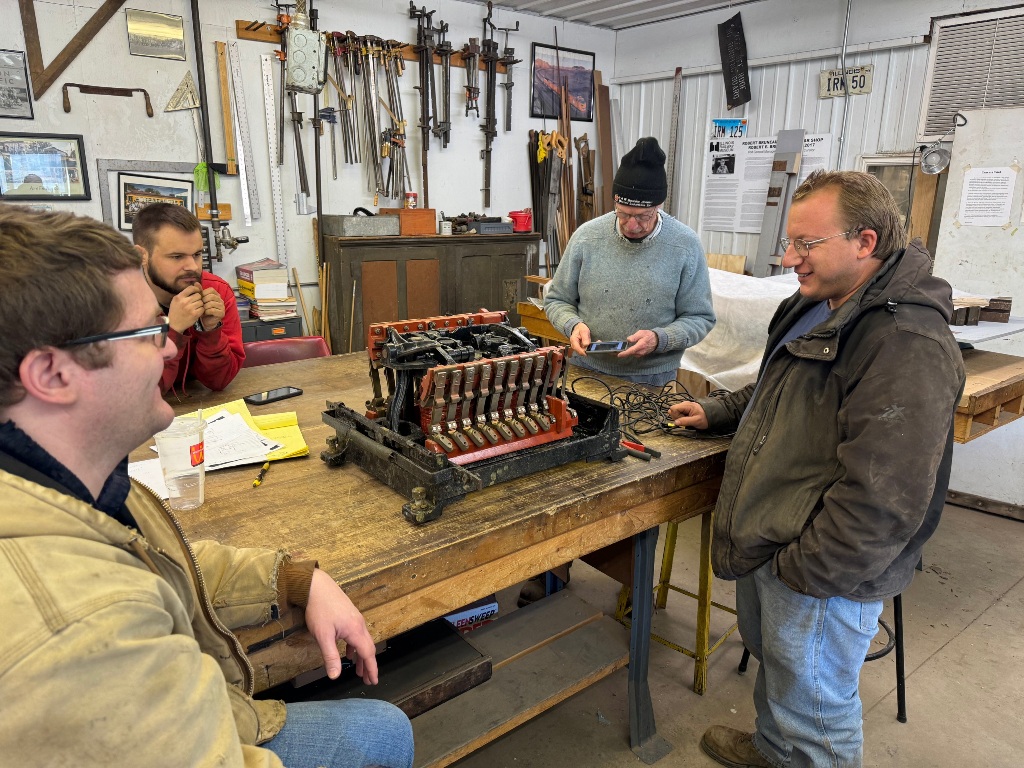
On the same day, Zach E and electronics wiz Bob S are using Bob's vintage turbo encabulator (with optional pentametric fan) to test electromagnetic coils for the contactors. I believe only one or two were bad, needing replacement from stock, but a number of them had bad string banding, which is obvious from a glance in the left foreground.
It's March 10th, and Nick E, Matt K, Norm K, and Greg K are working to decipher the DB-22 reverser, which has been removed from the car and set on the bench. Norm's extensive experience with various types of MU systems, combined with information gleaned from the DB-22 reverser under IT 233, enabled him and Greg to wire this thing up, installing as much wiring as possible on the bench and then the remainder under the car.
Also on March 10th, we get a demonstration of how to replace string banding on contactor coils. The coil is mounted on a lathe; Nick E (right foreground) turns the coil slowly by quickly cycling the lathe on/off; Zach (center) feeds string onto the coil as it turns; and Greg (right background) unwinds the spool of string. This is the kind of thing you get really good at just as the project gets completed.
It's St. Patrick's Day, and Norm and Greg are finishing up the wiring to the reverser. Here, Greg is under the car while Norm is outside.
And now they've switched places. Being able to work over the new concrete floor is great, but this isn't exactly comfortable.
Also on the 24th, the second contactor box has been reassembled, as shown, and the first three-contactor box has been hung under the car. The third box, though, is still in pieces, and it's just five weeks until the ITS meet - and only three weeks until the team's self-imposed deadline of April 14th to get the 1702 at least minimally operational.
I wasn't out over Easter weekend, but the above photo was taken on April 7th, by which time the third contactor box had been reassembled and all three boxes were hung on the car. Later on the 7th, 600-volt power was put to the rebuilt control system and the car was successfully sequenced. With the entire control system now operational and the motors meggered, it remained only to hook the two together. During the week of the 7th, Greg K, Norm K, and others worked to do this, and power was applied to the first two motors on the evening of April 10th. They both turned in the same direction, moving the 1702 under its own power - if only tentatively - for the first time since 1958.
Okay, this isn't really related to the operational restoration, but it's mildly interesting. The platform on the 1702 is raised and lowered using this chain hoist. The nicely varnished posts to its left and right hold up the platform on this side of the car, and the chain hoist acts to lift that steel bar joining the bottoms of the two posts. Cables connect to lift a similar steel bar on the other side of the car, too.
This isn't a photo of everyone who worked on the 1702's operational restoration, by any means, it's just a photo of the people who were along for the inaugural trips - though I think just about everyone here did contribute at one point or another. L-R: Nick K (in the golf cart - okay, he didn't contribute to the effort!); Richard S; Will K; me; Nick E; Zach E; Norm K; Jimmy L; Greg K; Brian L; and Matt K. Photo by Jim W.
Posted by
Frank Hicks
at
4:56 PM
2
comments
Labels: Illinois Terminal
Tuesday, April 30, 2024
Name That Face
Posted by
Frank Hicks
at
5:00 PM
15
comments
Monday, April 29, 2024
More from the ITS Meet
Frank writes...
The two cars were put on the west track because they're a bit wider than Chicago 'L' standard, so wouldn't clear the east track. That said, they're also not as wide as standard railroad equipment (or South Shore/Illinois Central cars, which is what the west track was laid out for), plus their traps can only be lowered with the doors closed. So, Joel made up nice "gangplanks" to access both cars across the gap. Here you can see the 233; structurally it's quite solid, though it could use work on a few corner posts and a few spots in the belt rail, as well as the roof.
Backing up to the main compartment, on the other side of the wall Aaron is sitting against in that earlier photo, is the stove and prep table shown here in the compact kitchen. The stove is gas-powered, as is the water heater - that vertical can-looking thing in front of the window contains a coiled tube connected to the overhead hot water tank, and there's a gas burner at the bottom of the can to heat the water in the tube. The heated water then ascends to the tank, replaced by cooler water. At the left edge of that prep table is a pass-through window for passing food out of the kitchen to the steward to be served in the main compartment. The back wall of the kitchen, out of view to the right, holds a sink (with both hot and cold taps) and an icebox. I didn't take photos of them, but behind the kitchen just forward of the rear platform are the lavatory on the right side of the car and the Peter Smith water heater compartment on the left side.
The car was designed with ten sections, generally similar to Pullman sections in concept but with some important differences. Roughly half the car was more-or-less gutted when it was converted to work car service, but one end of the car with six sections was left largely original. Above, this section is set up in "bunk" configuration. I think the upper bunks folded down from the wall similar to in a Pullman car, but of course one innovation on the IT was the use of small windows for upper-bunk passengers. The lower bunk was created by pulling out the seats, but in this particular section, the seats were removed when the car was put into MOW service.
Fortunately, on the other side of the aisle, we have a section that retains its original seats and shows what the daytime configuration of these cars looked like. There are a lot of neat little touches that are difficult to make out here, including tiny reading lights that fold out from the wall, tiny wall safes for locking up valuables (though nothing much larger than a wallet and watch would fit), and of course porter call buttons. There are also slots under the main windows for removable tables, so you can play cards or do paperwork at your seat.
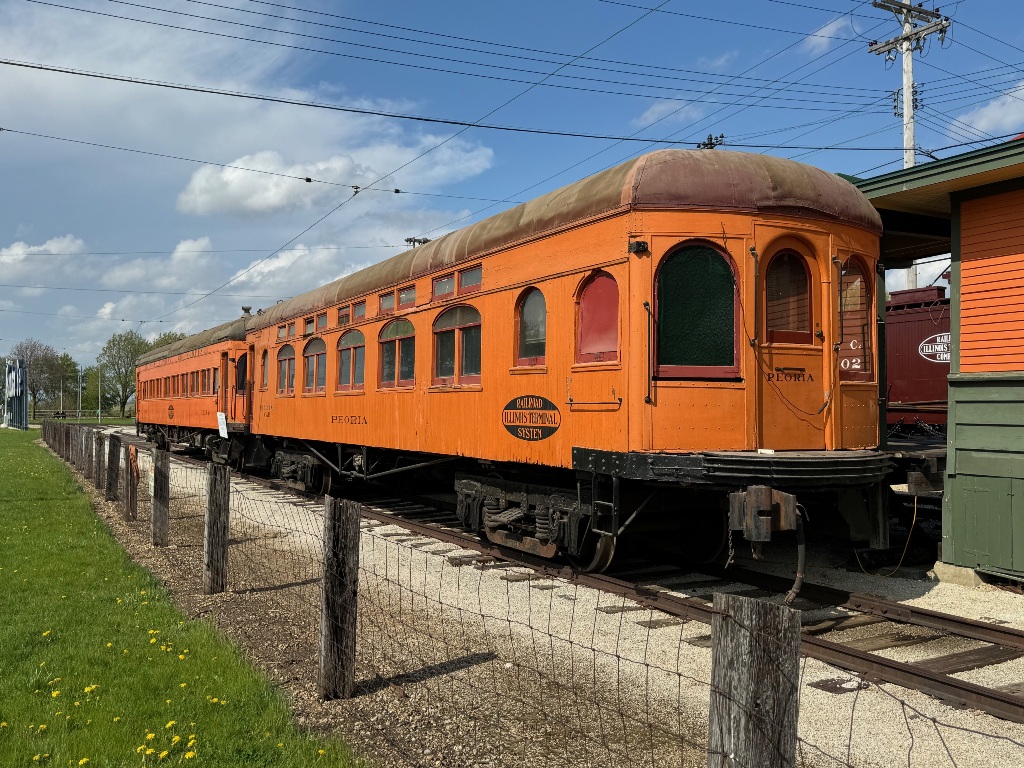
Here we are looking down the aisle of the car at the two sections already shown. Visible straight ahead, where we blocked off access to the gutted MOW section of the car, is a rare backlit sign for The Owl, the famous IT overnight train between St. Louis and Peoria. The "Peoria" would need an immense amount of work - the woodwork requirements are probably on the order of what was done on the "Talisman" - but someday, with enough money, this car will hopefully ride the rails again.
Now, let's turn our attention to operations. Of course, one highlight was the first-ever public operation of the 1702, shown here passing the south wye switch. The operational restoration of this car was kept close to the vest by the museum, partly because we wanted to make it a surprise for the convention attendees but also because we weren't sure we'd get it running in time! Watch this blog for a retrospective look at all the work that went into getting the 1702 running for the first time since 1958.
Also in apple green was center-entrance car 101, shown here just after dinner on Station Track 2. During the dinner break, the 233 and "Peoria" were switched back into the barn because they don't have interior lights and we were worried about incoming rain. My assignment after dinner was conductor of the 101, which is always a great gig.
Another debut was IT "Class B" 1565, which has been out of service for several years (anyone recall how many?) with contactor problems. Following a remarkably involved two-year project to analyze, diagnose, and rebuild the locomotive's entire complement of contactors, this was the 1565's first day back in public service. It saw a couple of teething troubles, including a balky feed valve and a bolt in one contactor that vibrated loose, but those were quickly fixed and it served through the day and into the evening in freight and Take-the-Throttle service.
This photo, taken about 7pm, shows the 101 on Station 1 with the "Tangerine Flyer" on Station 2.
As the last bits of sunlight faded, the 1702 was posed in front of Barn 4 with lighting set up by Dave Zeman. Here, Zach is up on the roof inspecting the wire ("say, this wire is no good"), Gregg is in the motorman's cab, and Billy Halstead is on the deck. All three have close connections with this car: Zach was instrumental in the project to make it operational; Gregg spent several years rebuilding the entire car, without which nobody would have even considered trying to make it run; and Billy's father worked for the IT as a lineman on one of the railroad's line cars, possibly on the 1702 itself.
At the end of the evening, the "Tangerine Flyer" made a final round trip. The thought occurred to me that, considering all the IT equipment we had in operation, Bob Bruneau would have been loathe to let half of the stuff out of the barn in the first place... but if he'd been here to see all this, I have no doubt he would have loved it.
Posted by
Frank Hicks
at
8:00 AM
7
comments
Labels: Illinois Terminal
Sunday, April 28, 2024
Just Can't Get Enough of IT
On Saturday, the Illinois Terminal Historical Society held its annual convention at IRM, and a good time was had by all. And perhaps the most exciting news:
- 277, 518, and 234 (IT standard heavy interurban cars)
- 101 (center-entrance car)
- 1565 (Class B locomotive)
- 415 (suburban car, the flagship of IRM)
- 1702 (line car)
- 1605 and 988 (Diesel era locomotive and caboose) plus freight cars
![]() |
| Photo by Matt Gustafson |
Posted by
Randall Hicks
at
8:31 AM
4
comments
Labels: Illinois Terminal