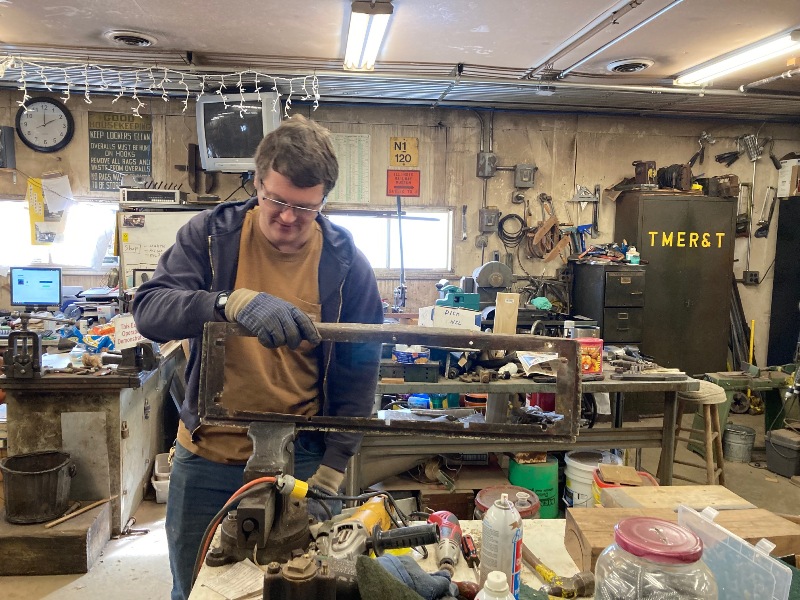
Monday, February 15, 2021

It's still really cold

Frank writes...

Our cold snap continues and I believe the high this weekend was around six degrees again. But fortunately the work needing to be done on the 18 is work that can be done inside the shop. Even more fortunately, several people have pitched in to help make this progress possible.

During the week Joel picked up some sheet metal for the "tin can" tail light housings and cut it to the size needed for the housing sides. Richard and I went out into the barn and used the rolling machine, shown here, to make the straight pieces of metal into curly pieces of metal. This is a very simple but fairly useful gizmo that I'd never used before. About 10 minutes out in the freezing barn was enough, but we got two pieces of metal rolled, enough for both tail end light housings.
After that Richard spent a while with a vice and some locking pliers to put a jog in one end of the metal side so that it will overlap. And by the time he was done with that, Greg showed up from an errand he had run to Harbor Freight. He purchased something for the department we hadn't had: a spot welder. This little machine is perfect for welding together pieces of sheet metal. Greg had to put a 240v plug on the thing but then he got it set up and tested, as shown here.
Greg and Richard got our curly piece of metal welded into a circle and then showed me how the thing worked. Then it was off to the races, welding the base of the can we made last week to the side. Thanks to Richard for snapping this photo, and the one at the top, of me working on this. It's tough to see but that flyer clipped to the white board right behind my head is a fundraising flyer from back around 2004 proclaiming "You can run this train!" and advertising Take the Throttle trips on the 308-309. At the time this was one of the things we were doing to help pay off the motor rebuilding costs for the 309. Plus ça change, plus c'est la même chose.
We made a lot of progress and the first tail light housing is almost ready for primer and paint. As is usually the case, we'll be experts at this right about the time we finish and move on to some other part of the 18. Above, clockwise from top left we have the can of Bankers Grey, the new housing, a transfer punch set, the old housing, and the inner casting that holds the red glass.
That cast ring shown in the previous photo is attached by two machine screws that thread into the outer casting, but one of the threaded holes broke off at some point in the distant past. So Richard is shown working on a replacement piece of steel that will be bolted on to that casting to allow us to bolt everything together properly. And hey, when we're done with this, it will be time to do the second one!

I can't thank Richard and Greg enough for all of their work on this project. Joel's help was also invaluable in sourcing and cutting the steel we needed. While all of this was going on, Good Nick was hard at work cleaning up metal flashing for the 415 and Joel spent most of the afternoon fighting with the department pickup truck to recharge its battery, inflate its tires, and dig it out of the snow so that it can be used if and when we need it.

Doodlebug Progress

In spite of the bitter cold, work continues at IRM on several fronts.  Gregg Wolfersheim sends us the latest update of his work on the UP doodlebug over in Barn 2:

On January24th, the last ceiling panel in the smoker was installed. It was a nearly two hour ordeal, as it didn't want to go in, even with Blake, Logan, and Andrew all helping.  Thanks to these steam department volunteers!


In spite of the cold weather outside, in the Diesel shop the heat was sufficient to get a first coat of ivory on the ceiling panel today.


Also, three ceiling vents have been stripped and primed. Soon they will be installed in the smoker section.


Three overhead lights have been brought out of storage. Hopefully they can be restored and installed. The half circle pieces go between the ceiling and roof boards. The fixtures are held up by them. We are missing several globes, also.


The front seat on the left side of the smoker was removed. Soon this side of the car will get the treatment that was done the past few years on the right side of the car.


This must indeed be the smoker -- notice the match striker on the window post at left.  Thanks again to Gregg for keeping us informed!

Saturday, February 13, 2021

More Van Dorn couplers

Bill Wulfert has sent in more photos and information about additional Van Dorn couplers at the museum. This time he was taking photos underneath recently-restored Northwestern Elevated car 1754 as well as more photos underneath our Metropolitan-West Side cars. He writes:


 'L' car 1754 has Van Dorn #4A couplers.  The one on the west end has not yet been painted.

Next is the drawbar mounting on the (west) motor end. It is quite compact. The coupler on the (east) end is the same. The cables for the Heat & Light" jumper and MU control are shown.

I also looked at the couplers on the 1797 and 1808, and they too are #4A's.  Of course the North Side 'L' lines used Stearns & Ward couplers on their cars. The CTA swapped out the Stearns & Ward couplers, supposedly for use on the Plushie 'L' cars 4251-4455 that had Van Dorn couplers. Remember that the Lake St. and Metropolitan Plushies used Van Dorns. When looking at our Plushie cars, it does not seem possible to swap out the drawbars. Perhaps the 4A came off of other wooden cars that were being scrapped. I have not found any documentation on the swap to the 4000s   However, we know that 1797 was at Wilson Ave. shop on September 20, 1954 for a coupler change out.  A group of wooden cars had the change out between July and September of 1954. Most were in and out in one day, but 1796 was at Wilson for five days. Probably it was delayed by more pressing projects.

We've know about the coupler change outs on the wooden cars, but have determined that the Plushie & Baldies Stearns & Ward couplers are mounted totally different than what is on the North Side wooden cars.  Glenn Andersen mentioned that the Lake St. and Met Plushies had Van Dorn couplers, and that made it difficult to make up trains when all of the 4000s were sent over for North-South service via the new subway. All of the Baldies, including those on the Met had Stearns & Ward couplers, and it appears that most of the Baldies were assigned to Ravenswood - Englewood service prior to the subway.  In order to spread the 66 Baldy trailers out among the Ravenswood - Englewood & Howard - Jackson Park trains, they had to have Plushies with Stearns & Ward couplers. They supposedly did NOT operate revenue trains with adapter couplers. So the solution was to change out the couplers on the wooden cars, in order place the S&W couplers on Plushies.

As I mentioned earlier, I have not seen any work orders or bulletins about putting the S&W couplers on the Plushies, but we have a shop list that shows some of the wooden cars getting Van Dorns.

I also went back to the Met cars to look at how they are attached to the car body. With my trusting quartz light, I was able to get some good pictures.
The first one is the rear of the drawbar, which goes through a car body frame member. It has a short spring. 
The next one is on the other side of the frame member, and again it has a small spring. I was not able to see any mill marks on the rail, such as weight or date of rolling. I did not venture down to the other drawbars to look at them.

Friday, February 12, 2021

Report from Florida

Having just gotten back from a couple of weeks in Florida, I can report that it's warmer, sunnier, and drier than Illinois, and we had a great time.  Not much in the way of railroad preservation to present, however.  In fact, about all I ran into was this short train of out-of-service equipment on a disconnected siding in the town of Lake Wales, presumably the relics of a former tourist operation.

First, we have this unusual Whitcomb switcher, built for the Army in 1944:


The builder's plate tells you everything you need to know:


Then there was a wretched old heavyweight, which appears to have a collapsing roof and plenty of other problems.  There was no apparent way to identify it.


Finally, a wooden caboose which has been nicely restored and is in much better condition:


And the station building has been preserved, used as a community center.


But there's no place like home, and now I'm ready to get back to work!

Thursday, February 11, 2021

Wednesday update

Many thanks to Jon Fenlaciki and Bill Wulfert for sending along some photos they took in the car shop on Wednesday. First off, some photos from Jon:

Here's Pete Galayda, with Henry Vincent in the background, working on doors for North Shore 160. It was pointed out last weekend by Zach that a North Shore coach has no fewer than 13 doors and may have as many as 15. (That's quite a difference from the grand total of three doors on Shaker Heights 18!) QUIZ TIME: Can you figure out where all of them are?

The doctor is IN!

And here are some update photos sent by Bill:

Bill: "Frank Kehoe was busy needle chipping the Baldwin motor truck that will be used under CRT 1754. It is getting a complete overhaul."

Bill: "Henry Vincent just finished stripping the bottom paint off of 160s cab makeup door. The top half will just require a good sanding before painting."

Bill: "Jon Fenlaciki is buffing some aluminum brackets that were recently cast for the rear windows of Indiana Railroad 65.  They need to be drilled out, and aluminum rods will be attached."


Bill took a walk over to the 50th Avenue station and snapped a few photos of the ticket booth in the station. This plywood booth, likely installed by the CTA, will soon be replaced by the older-style booth Tim has built. It's obviously newer and of less refined construction compared with the original parts of the station. Wags at IRM have called me newer and less refined than the original, too, but I digress...


Bill: "The exit door was removed from 50th Avenue on February 3rd.  Those were replacement doors built many years ago, but there were some cracks and water damage in places. The doors get a lot of Sun since they have a Southern exposure. The door has been repaired and has received some wooden slats that protect the glass, which show up in station door pictures. The entrance door will be done next."

And here's some exciting progress on the 18:

Bill: "The small metal tabs were attached to the end of Shaker 18s front sign by me. The sign roll is ready for installation, once the inside of the sign box is painted, weather permitting."

Monday, February 8, 2021

It's really cold

Frank writes...


I was out at IRM on Sunday but pretty much confined myself to the heated car shop, as did most of the other volunteers for most of the time. The high for the day was around seven degrees (for our many European readers, that's about -14 C) so working out in the barns was, er, unpleasant.
My first task was to retrieve the Shaker 18 window my father rebuilt last month from the 453, bring it into the shop, and put a coat of hardware store "almond" paint on it. Once we get a gallon of the correct color mixed, it will get a second coat of the correct color, but this works well to make the window presentable so that it can be installed in the car. Why are we waiting to get the correct color of cream mixed? Money! A gallon of paint costs about $50 and we don't have that much in Shaker 18's fund. Please help! No donation is too small to make a difference.
Richard Schauer arrived and proceeded to help in constructing a couple of "tin cans" that will make up the housings for the 18's rear end market lights (to refresh your memory, the housings that need replacing are pictured here). Joel had sourced some 18-gauge sheet metal for this project and with Richard's help we marked out the two circles that will make up the bases of the "cans" and cut them out on the band saw. They were notched around the edges and bent up to form a flange, as shown. We will need some additional steel to make the sides of the "cans" but that won't take long to procure.
And Richard also helped out with reassembling the castings that make up the outside of the first marker light. The two parts of the casting, which nest together, were painted last week and this week we procured some hardware to affix the red glass circle (not a lens, just flat glass) into the inner ring. The outer casting has a break, not visible from the outside, that prevents one of the screws through the inner ring from threading in. So Richard made up a small insert that will make it possible to hold the inner cast ring in place as designed.
As usual, there were other people out and hard at work. Tim was working on more doors for 50th Avenue. Joel was working on various projects, mostly relating to tidying up the shop and putting spare parts into storage (see below). Greg and Nick were largely working on the 415, which - if everything goes to plan - will be repainted this year. Above, Nick is shown straightening out the flashing for one of the car's roll sign boxes. On Saturday evening, Nick, Greg, and Zach spent quite a while photographing roll signs from the 415, our North Shore cars, and Shaker 18 with the goal of getting replica signs made.
Greg also spent some time measuring up the replacement air tank for CA&E 451 that we are going to order. Zach was mostly working on side doors for the 757. At least one of the car's side doors is deteriorated enough that it will need a new one made. The door shown above, though, will not need to be replaced but only needs a bit of repair. It's not an original door, it's a replacement made during the car's time in East Troy, but it's perfectly serviceable.
Nick isn't usually one to toot his own horn, but when the horn is this shiny, well... Here he helps Joel in moving some recently-acquired items into storage. The horns mounted to this board came with a note that they were used on a 1961 fan trip with our own CNS&M 229 and at one point were owned by IRM founder Howard Odinius. So that's interesting.

Saturday, February 6, 2021

Electroliner progress

Many thanks to our intrepid freelance photographer Nick Espevik for sending along some update photos from the Electroliner. The news from the "mechanical crew" (not to be confused with the "interior crew" that is hard at work on reassembling the A car interior and reupholstering the seats in the cafe car) is that the electrical connections throughout the train have now been restored. Among other things this means that the lights work again. The weather this weekend is forecast to be frigid, so that may delay slightly the continuing mechanical and electrical work on the train, but the "second shift" regulars are working hard towards the goal of getting the train running again.


So here you can see the lights lit as well as the reupholstered bench seats for the cafe car, currently stowed in the A1 car (or the A car, I don't know which is which!) for safekeeping.

Friday, February 5, 2021

Van Dorn automatic coupler equipment

Bill Wulfert reminded me that he had sent me photos a couple of months ago taken in the cab of our Broad Street subway car, the 55, showing the car's automatic coupler cutout switch. On the Broad Street cars, which used Van Dorn #2350 tight-lock couplers (more here), the air and electric connections were made automatically when the couplers locked but the motorman had to manually cut in the connections from the cab. Bill explains:

There is a cutting valve in each cab, and a "key" is inserted (it looks like a piece of steel with a notch in it) to uncouple cars. I'll have to look for that.  But it also talks about closing the Westinghouse valve (which is just a standard WABCO brass angle cock under the coupler). That part never made sense to me, as either the couplers are automatic or they are not!

There is an air operated drum switch behind the coupler, and when you put the "cutting key" in the slot, and move the handle part way, you can hear the drum throw, which I'm sure is disconnecting the coupler buttons electrically. Then you can move the key a bit more, and turn the handle in the cab a bit more, and I believe those air buttons on the sides of the electrical contacts activate the pneumatic uncoupling mechanism.

I did try the cutting valve when we still had the 126. It did not have power, but I used the key in the 55, and it worked. The cars uncoupled, and there was no big rush of air, so the automatic equipment worked. Hopefully I can find those instructions for you.

You can also move the lever on the top of the coupler in order to manually uncouple cars, such as cars in the yard. I'm not sure if you have to throw anything else, as when the car is pumped up the air connections may not be closed.

Bill sent these photos of the cut valve or switch in the cab of the 55. The first two photos show the switch; then there are two photos of the switch with the handle inserted, in two different positions; and finally a photo of the handle.


Van Dorn made a variety of switches, contacts, junction boxes, valves, and other appurtenances that were related in some way to the operation of its automatic couplers. Very few examples of any of it are thought to still survive.

Wednesday, February 3, 2021

More Van Dorn couplers at IRM

Many thanks to Bill Wulfert, who has been looking into Van Dorn couplers that are in the museum's collection. Our CA&E wood cars use Van Dorn #16 couplers, which were designed around 1900 for use on the Manhattan Elevated electrification project (which makes sense since the GE 66 motors and DB-15 contactors used on the earliest CA&E wood cars were also designed with the Manhattan Elevated electrification in mind). But Bill has discovered that our Metropolitan-West Side Elevated cars, 2872 and 2888, use a different style of Van Dorn. All photos by Bill Wulfert.

This photo is of the trailer end of the 2888, with some additional lighting Bill brought along, and shows the car's coupler which is a Van Dorn #18. This was one of the types that the company made to be fitted to lengths of rail that would serve as the drawbar. In this case, it seems that the Met used 80# rail.

Here you go - a Van Dorn #18.
It's tough to tell what kind of anchor casting we're looking at here. Even among the Van Dorn illustrations it seems there's some inconsistency in terminology. There are couplers with rail drawbars that are described as "rail draft gear" but in other cases couplers with rail drawbars have a Van Dorn part number listed for their draft gear.


The #18 couplers on the Met cars are very similar to the #16 couplers on the CA&E - given how closely they're numbered, it's possible that the only different is whether they're designed for rail drawbars, though that's pure speculation on my part. But they have no problem coupling to each other, and an illustration of a #18 coupler that was included in the Van Dorn collection donated last year by Larry Larson mentions that it's fitted with a #16 pin and #16 link.

Many thanks to Bill for looking into this further! You can read more about Van Dorn link-and-pin couplers here. So far IRM is known to have CA&E cars with #16 couplers, Met cars with #18 couplers, the Broad Street car with #2350 tight-locks, and CSL 9020 with what I believe is a #1450 tight-lock. EDIT: Joel Ahrendt confirms that our TMER&L interurban cars also have Van Dorn MCB couplers, so at some point I'll see if I can grab some photos thereof and see if they have part numbers cast into them to ID them exactly. Olin Anderson has also suggested that our Chicago Tunnel Company equipment may be fitted with the half-size MCB couplers mentioned here.