Jeff Trimble, a traction fan from California, recently visited the museum and took a tour of the 205. It wasn't the first time he'd seen the car, though - he helped move it back in 1989! At the time it was one of three cars owned by Bob Hively (the other two were Brill Master Units from Yakima, WA) and stored in Snoqualmie, Washington at the Northwest Railway Museum. NRM needed more space and asked that the cars be removed, so Hively had them transported down to Yakima to the trolley operation there, which at the time was using a Portuguese streetcar and a couple of non-revenue pieces original to the operation. The Master Units were moved on Army trucks while the 205 was transported on a truck belonging to Paul Class. Only a couple of years later Bob Hively passed away. After his death all three cars were acquired by the group in Yakima, with the 205 quickly being put up for sale. The rest, as they say, is history.
Jeff was kind enough to send us some photos of the move. Thanks!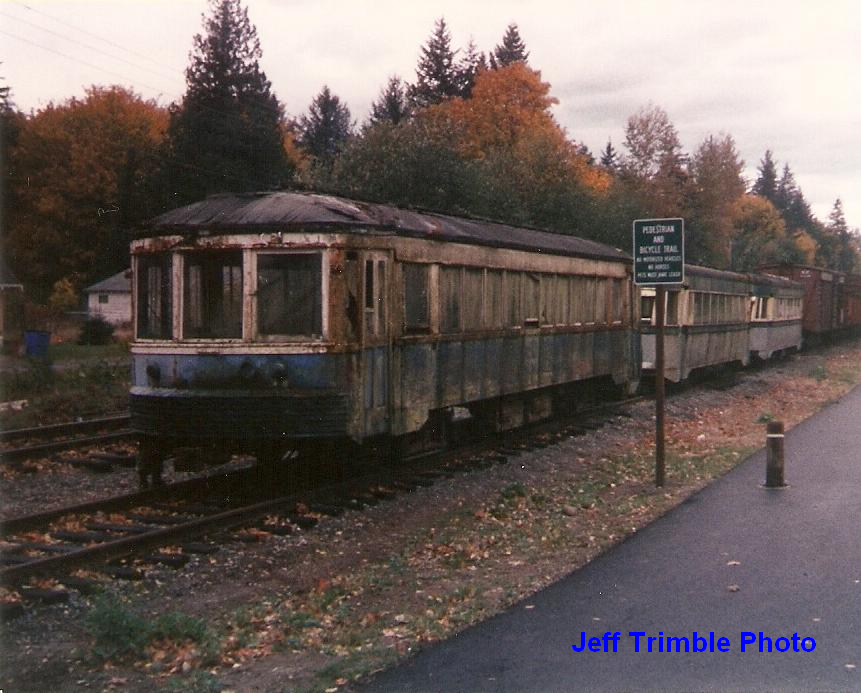
The 205 - at the time painted in an approximation of the livery it wore on Portland Traction, where it was numbered 4003 - sits in Snoqualmie with the two Yakima Master Units behind it. The car was in rough shape at the time, having spent three decades sitting unprotected in a rain forest area.
The car is eased onto a ramp for loading onto a truck. This part of the car is currently the southwest corner and has been cosmetically restored.
Some of the people involved in moving the cars, with the 205 in the background loaded atop a Gales Creek Enterprises (Paul Class) truck with the Master Units beyond.
Showing posts with label 205 History. Show all posts
Showing posts with label 205 History. Show all posts
Thursday, July 14, 2011
The 205 Moves to Yakima

Wednesday, March 11, 2009
Moving the 205
The service history of car 205 has been covered here. After it was removed from service in Portland, it was acquired by a private owner and stored for many years. In 1993, it was purchased by IRM and moved to Union that December. Three members traveled to Yakima to move the car: George Clark, Dave Diamond, and the late Don Liberko. This is a sampling of photos of the move, by all three of them (credits are thus GC, DD, and DL) in the Dave Diamond collection.
Note: All these photographs are copyrighted and may not be reproduced without permission.
 Here the 205 is being moved on street trackage in Yakima, being pulled by a steeple cab. (DL)
 George checks out the car prior to having it loaded onto a trailer for shipment to Union. (DD)
 Another view in the yard at Yakima, with Dave Diamond. (GC)
The car was then winched onto a trailer still on its trucks, and left Yakima.
 Traveling down a long steep grade towards the Columbia River. (DD)
 At a rest stop somewhere in Washington state. (DD)
 However, the weight of the car with its trucks and motors was too much on the rear of the trailer, and rear tires blew out a couple of times. Here they have stopped after the first blowout; the trailer has been jacked up to take the weight off the rear axles so the tire can be replaced. A young Dave Diamond stands next to it. (DL)
 At the weigh station between Montana and North Dakota. (DD)
 Finally, the trailer was deposited at Electric Park. Note the truck on the neck in front of it. (GC)
Fifteen years later, the car is nearing completion of a cosmetic restoration, as documented in regular posts on this blog.
Thursday, October 23, 2008
History of Indiana Railroad #205
History of:
Interstate Public Service #266
Indiana Railroad #205
Portland Traction #4003
Indiana Railroad #205
Portland Traction #4003
 Indiana Railroad 205 on Wabash Avenue in Terre Haute, Indiana in April 1939. George Krambles Archives.
Note: These photographs are copyrighted and may not be reproduced without permission.
When the Indiana Railroad (IR) was formed in 1931 through the combination of several large interurban systems, its roster was a motley assortment of interurbans, streetcars, freight and work motors spanning several decades. The three-decade old wooden interurban combines of the Terre Haute Indianapolis & Eastern stood in stark contrast to the modern steel coaches, parlor cars and sleepers that Interstate Public Service (IPS) had purchased only a few years before.
IPS owned perhaps the most modern fleet of the IR predecessor companies, and while it was best known for the heavyweight interurbans built for Indianapolis to Louisville service, its newest equipment was a small group of modern lightweight suburban cars. These cars, numbered 261-266, had been constructed in 1927 by a Brill subsidiary, the G.C. Kuhlman Car Company of Cleveland. The 261 series was purchased to modernize service on the standard gauge suburban lines that IPS operated north out of Louisville to the cities of Jeffersonville and New Albany across the river in Indiana.

Car 261 is shown in this builder's photo. Body color was a light, sand-like orange with tile red roof and doors and black lettering, striping and details. Kuhlman Photo from the Krambles-Peterson Archive.

The six cars of Kuhlman order #924 were classic examples of contemporary lightweight car design. They were 45'6" long, fitted with Tomlinson couplers and Westinghouse HL control for multiple-unit operation, and were designed for either one-man or two-man operation. They were safety cars, fitted with M28D brake stands and "dead-man" controller handles, and - befitting their role as suburban cars - were fitted with unusual double-height anti-climbers to prevent telescoping in an accident with either a low-floor city car or a high-floor interurban car. The cars had modern Brill 177E1X trucks, GE 247 motors and were fitted with leatherette walkover seats for fast, smooth and comfortable operation at speed.
 Car 266 at Scottsburg Shops on September 10, 1934; note original air whistle and steps at all corners, plus Public Service Company of Indiana lettering. George Krambles Archives.
The 261 series didn't see service out of Louisville for very long, though. On July 2, 1930, IPS operations were officially incorporated into the Indiana Railroad system, though IPS continued to exist as a distinct corporation. The following year, in 1931, IPS changed its name to Public Service Company of Indiana, and some of its cars - including car 266 - were relettered for PSC. Time was running out for the local service out of Louisville, though, and in 1934 all routes over the Big Four and K&I Bridges into Indiana were sold to local operators Home Transit and New Albany & Louisville. The six cars of the 261-266 series, only seven years old, were run to PSC's Scottsburg Shops and put into storage.
 Car 266 is pictured in March or April 1936 during testing in Terre Haute. Note that the PSCI name has been painted out on the letterboard; also note the electric marker lights installed over the end windows. These were soon relocated to the dash. George Krambles Photo, Scott Greig Collection.
After two years, the Indiana Railroad came up with a plan to put the six modern suburban cars it had inherited from IPS to use: it would adapt them for use as streetcars for service in Terre Haute. Car 266 became the prototype. In mid March the car was transferred to Terre Haute and tested in service; the test was deemed successful and all six of the 261-series cars were sent to Anderson Shops for rebuilding. Modifications for use as one-man city cars included closing off the lefthand doors at each end and installation of electric marker lights. The other members of the series received modifications similar to 266's, and all cars were repainted and lettered for Indiana Railroad. They also received new numbers in the 200 series, PSC 266 becoming IR 205.
 Car 204, seen in front of the Wabash Barn in Terre Haute on April 3, 1939, shows what this series looked like during its Terre Haute days. George Krambles Archives.
 Map of city car lines in Terre Haute, Indiana during the 1930's. Map drawn by Frank Hicks.
 Car 205 is shown at Anderson Shops on January 28, 1937, probably sent there for maintenance or repair work. Note the front pole tied back, which seems to have been done to these cars for all intercity moves. George Krambles Archives.
Following rebuilding, cars 200-205 were operated from Anderson to Terre Haute in two trains of three cars each, entering service in early July 1936. Their assignment to Terre Haute would prove to be even shorter than their days running out of Louisville; in December 1938 an agreement was signed to transfer all Terre Haute city operations to National City Lines. June 3, 1939 was the last day of streetcar operation in Terre Haute, after which the six 200-series cars were operated to Scottsburg and put back into storage. Indiana Railroad was imploding; with the failure of the Insull utilities empire that had fostered its creation, and with the advent of the Great Depression and the expansion of automobile use, the last great system of the Indiana-Ohio interurban network was in its death throes. In January 1940 the interurban line to Terre Haute was abandoned and by February 1941 the only surviving remnant of the Indiana Railroad system was a short segment of former IPS track between Indianapolis and Seymour, Indiana, operated under the name not of IR but of PSC. In September 1941 that service came to an end due to a fatal head-on collision, finishing off the last of the Indiana Railroad system.
 Car 205 and its sisters are in storage at Scottsburg Shops on September 3, 1939, three months to the day after their last run in Terre Haute. Note that it is MU'ed to the car in front of it. Malcolm McCarter Collection.
By that time, car 205 and its sisters were far away. In 1940 the 200-series cars were sold to the Portland Electric Power Company (later Portland Traction) in Oregon, where they were put into suburban service. Car 205 was renumbered PEPCO 4003 and received minor modifications, most notably air horns and a new blue-and-white paint scheme. PEPCO 4000-4005 joined other second- and third-hand suburban cars, including Cincinnati curve-sides, Brill Master Units and "Hollywood" center-entrance cars, operating between Portland and Oregon City into the late 1950's.
 PEPCO 4003 (ex-IR 205) at an unknown location in Oregon in 1943. The only real modifications have been removal of the permanent headlight and addition of air horns. Leonard Foitl photo, Brinckmann Collection.
PEPCO 4003 is turning onto 1st Street in downtown Portland on September 16, 1949. Krambles-Peterson Archive.

PEPCO 4003 passes steeplecab 1410 and a track crew in service in Portland on September 16, 1949. Krambles-Peterson Archive.

Portland Traction
4003 (ex-IR 205) and another ex-Indiana car at 1st & Washington in downtown Portland during the 1950s. By this time the dash at this end of the car had been replaced, likely due to accident damage, and the car's livery has changed from blue to red. Al Reinschmidt Collection.
In 1958, Portland Traction abruptly abandoned service, and within a short time its entire fleet had been sold or scrapped. A railfan from Washington state named Robert Hively purchased car 4003 and moved it to some private property in Snoqualmie, Washington, near what is now the Northwest Railway Museum. It was stored there with other assorted equipment including another ex-Interstate Public Service car, the heavyweight interurban sleeping car "Scottsburg." The cars were stored outdoors in what was essentially a rain forest area; car 4003 in particular suffered extensively from water damage and neglect. Its original roof largely rotted away and was replaced with plywood; its interior headlining and wall panels were badly damaged and removed; and the steel sides of the car were steadily eaten away by rust. For three and a half decades the car sat, exposed to the elements and occasionally the victim of vandals, in Snoqualmie.
In November 1989 car 4003 was moved to Yakima, Washington (photos here) and following Hively's death it was made available for sale in 1993. One other car from this series, Portland Traction 4001 (ex-IR 202 - PHOTO), had been preserved in good condition by the Western Railway Museum, and that organization expressed an interest in purchasing 4003 to scrap it for spare parts. Several members of the Illinois Railway Museum, though, spearheaded by J. Johnson, expressed an interest in saving car 4003 for preservation, and in the end they were successful in purchasing the car. A crew of volunteers led by Dave Diamond drove to Oregon in December 1993, loaded car 4003 onto a trailer and trucked it over the mountains to Illinois. (For more on this move, click here.) The car arrived at IRM on December 13, 1993.
 IR 205 in 2004 before the commencement of restoration work. The blue-and-white color scheme the car wears was applied by Robert Hively to approximate the PEPCO livery the car wore during the 1940's. Photo by Frank Hicks.
 Within a year, with the construction of Barns 6 and 8, car 4003 had been moved into indoor storage, which it has enjoyed ever since. IRM volunteers led by Bob Bruneau performed minor repair work to the car, replacing broken windows and securing the doors, but otherwise it remained an unrestored display. In 2004 work began on a cosmetic restoration of the car. Due to the extensive modifications made by Anderson Shops in 1936 it was judged impractical to backdate the car to its Interstate Public Service days, so the decision was made to backdate the car to its days as a Terre Haute city car - and to return it to its Indiana Railroad number, 205. The extensive body deterioration also made it impractical to restore the car to operation without a frame-up rebuild costing somewhere around half a million dollars. Between 2004 and 2018, work slowly but steadily progressed to restore the exterior appearance of the car. The end result was be an attractive display piece representative of streetcar operation in the smaller cities of the Midwest.

List of Known Modifications During the Car's Service Life
- Electrical cabinet to motorman's left replaced with window (pre-1934)
- Installation of electric markers on the end letterboard (March 1936)
- Installation of mirrors on right side corner posts (March 1936)
- Removal of left-side steps and closing off of left doors (May/June 1936)
- Removal of letterboard markers and installation of dash markers (May/June 1936)
- Removal of air whistles (May/June 1936)
- Replacement of trolley retriever with trolley catcher (1936)
- Removal of permanent dash-mounted headlight (1940)
- Replacement of trolley catcher with trolley retriever (1940)
- Removal of lower marker brackets (1940)- Removal of mirrors (1940)
- Installation of air horns (1940)
- Replacement of lifeguard baskets with truck-mounted pilots (1940?)
- Interior painted brown (post-1940?)
- Replacement of steel fold-out steps with wooden ones (post-1940?)
- Removal of MU sockets (post-1940)
- Window shades removed (post-1940)
- Replacement of dash at one end of car following an accident (post-1940)
- Replacement of three brass end window sash with wooden sash (post-1940)
- Installation of drop sash in left-side doors (post-1940)
- Removal of window guards (late-1940s)
Thanks to David Wilkins, Randy Hicks, Charlie Myers and Jeff Trimble for their help with researching this account. Thanks also to Robert Bruneau, John T. Csolka, Art Peterson, Al Reinschmidt and David Sadowski for providing photographs.
Subscribe to:
Posts (Atom)


