Showing posts with label 205 Progress. Show all posts

Monday, September 10, 2018

Light the lights

Frank writes...

Sunday was a gorgeous day; the hot, humid weather that seems to have hung over Chicago for months finally broke and the day was practically cloudless with a high right around 70. The steam engine was running, there were Army soldiers on-site to work with our Track Department, and all the water from last weekend had disappeared with no obvious damage. What's not to like?

When I first arrived, I turned my attention to Indiana Railroad 205, which - for a project that's done - never quite seems to be done. Earlier in the summer we discovered an Ohio Brass trolley catcher of the type that's correct for this car, so Richard cleaned it up and painted it orange. It just took me forever to get around to putting it on the car. Above is what the car's been wearing; OB retrievers, which are significantly larger than what it actually had on IR (though close to what it had both earlier, on Interstate, and later, in Portland).
And here it is with the correct OB catcher installed. This is the west end of the car; the east end of the car still has the incorrect OB retriever, but if we can get our hands on the correct-type catcher at some point then that will be put on the car. Fingers crossed.
After that I happened upon Good Nick, who was over at 50th Avenue working on getting the platform lights working. This is a long-running project; the station platform was completely rebuilt maybe ten years ago, but before that we believe that wiring issues meant the platform lights hadn't been used for a while. It's possible that it's been as long as 20 years since the platform lights were lit. But earlier this year a plan was finally approved for rewiring them to run off of the 600 volt DC line, as they would have originally, and over the summer the car shop guys have been steadily fixing up the components needed. Nick started working on the project and before long a whole group of us had joined in. Here, Nick is on the left and Greg on the right, securing some of the last "crooks" into place.
Once a few final brackets were installed to hold the crooks in place, we needed to run a few ground wires through them using a fish tape; all of the other wiring had already been run. This took longer than expected but once it was done we were ready to start installing the shades and fixtures, which go inside the shades. Above, Jeron (left) and Rich are shown along with a shade that has had the fixture installed. Each fixture has two light sockets which are on different circuits. These use street railway bulbs, since they run on 600 volts. Not shown is Bob Sundelin, who also helped on the project, and Max, who stopped by briefly to make sure we could correctly answer the question "how long is a piece of wire?"
Almost all of the crooks face away from the station house, but the four closest to the station alternate. Richard explained to me why that is: there are supposed to be wind breaks, basically just wooden slat walls, in between two of these pairs of posts, and the crooks face away from the wind breaks. I suppose those wind breaks will be the next thing to be installed on the platform once the lights are done.
Here's one of the lights, complete with its shade and fixture, wired in, and with light bulbs installed.
By the time everyone finished, around 7pm, it was starting to get dark but all of the lights had been wired in - including not only the platform lights but also some lights inside the station house and one fixture over the entry steps. The only things left to do are to connect some ground wires underneath the platform and then wire in the switch board, where the 600 volt feed will come in and where the big light switches will be located. The hope is that the lights may be working on Saturday for Member's Day, when we typically have night operations for museum members. If so it should be a pretty impressive display.

PUBLIC SERVICE ANNOUNCEMENT: Right now the 36 and 309 are scheduled to operate on Saturday, but this may not happen! Why not, you ask? Because we don't have a conductor! Please contact Jim West to sign up if you are free on Saturday and would be interested in helping out.

Monday, May 21, 2018

Rainy Sunday

Frank writes...

Sunday was the first public day of steam operation at IRM, and I didn't even get any photos! But there are some nice photos on the Steam Team's Facebook page here, and you don't even need to register to see them. It was very rainy in the morning so the crowds were small, unfortunately. The 1630 was in service all day regardless, with a very nice-looking train consisting of the Santa Fe combine and a Rock car (no "water bottle") that looked like it could have jumped off of a Frisco branch line in the 1930s, while the 749 running solo held down electric service on the main line and the 3142 went in circles.

When I arrived in the early afternoon the rain had stopped and a Car Department switch crew was down in Yard 13 at work. Above, they've just pulled the Detroit Peter Witt out of track 134 for the purpose of retrieving cabooses stranded behind it. The cabooses will be needed next weekend for the caboose train, of course. The Witt is waiting for its slot on track 131, which will be opened up when the crane is repaired and Shaker Heights 18 can be moved to Barn 7, but in the meantime it's in the way. The Witt has narrow wheels and is prone to derailing so a bunch of people were watching the wheels at frogs and switch points.
I decided I wasn't helping much in switching cabooses so I went back to the car shop to get some tools. While I was there, I saw this Ohio Brass trolley catcher disassembled on the bench. Last weekend this was discovered while we were going through spare parts. It's exactly what the 205 needs (though of course the 205 needs two so we're still short one); what it has now are OB retrievers which are much bigger. Over the previous week Richard and the other guys had disassembled this catcher, cleaned it up, and primed it.
After that I spent a while sanding down the belt rail of the 18. I managed to do the entire right side of the car. I'm a bit conflicted on whether to strip or just sand the window posts but I'm leaning towards stripping them, which will mean breaking out the heat gun. After that's all done it will be ready for some primer along the windows. While I was working on this Greg was stripping duct tape residue off of the car's windows and posts. Of course in my usual negligence I failed to get any photos of this work, but I did snap a photo of Joel happening by with a makeshift "bumping post." This was modeled after the one we use to keep the CA&E cars from running into the 150 on track 84. With the Peter Witt now buried behind a string of cabooses on track 134, Joel decided that we might not want anyone trying to couple a caboose to it through its headlight. So this will help keep the cabooses in their place until the Witt can be moved to its permanent home on track 131. We'll have to add "track bumper" to the Van Dorn uncoupling devices and CA&E trap lifters already on the list of patent-pending Hicks Co inventions.
Anyway, I headed back over to Barn 4, and what did I find there but a bunch of crooks! Well these crooks are actually light poles for 50th Avenue 'L' station, which Greg was working on priming. They get bolted to the wooden poles spaced out along the length of the platform and have pie-pan lights attached to them to light the platform.
Joel said he had something to show me in one of the storage cars, so I went along and got to see this interesting bit of history. It's a panel off of a Kansas City Public Service streetcar (or bus, or something) and has the intricate KCPS "The Scout" logo on it. You never know what you'll happen up on at IRM. And that takes us to the infamous material yard.
"Where unrecorded names and navies rust, and untold hopes and anchors rot..." Richard does his best Captain Ahab from atop a set of stairs in the material yard, pointing out among the piles of iron. The Track Department, among others, has initiated a major cleanup of the material yard. Typically "cleanup" plus "piles of rusty iron" equals "scrapping" so Joel sent Richard and me out to start marking with spray paint anything the Car Department wants to ensure doesn't get cut up. There's a lot of interesting (anyone looking for a pair of Brill 27A1 trucks?) and/or useful (spare GE 73 motors for the 604) stuff out there so it was a pretty fascinating expedition. I think these stairs may have been used so that visitors could get into the cab of L&A 99 when it was on display just east of the depot on the now-gone pocket track.
While I'd been sanding on the 18, Richard reassembled the OB trolley catcher and got it working. So that's one thing on the 205 that will be fully serviceable! I put a first coat of Indiana Railroad orange on it; once it's all painted up I'll install it on the car. Bob Bruneau would be happy: it always bothered him that we didn't have the correct OB catchers for the 205.
Besides the cabooses being switched around in Barn 13 there were other things going on. Notably, Nick and Thomas took the 251 for a couple of trips around the car line to further test out the new main journal bearing, which had been scraped by Zach following earlier unsuccessful tests. Unfortunately it will still need more work but progress is being made. Doodlebug Bob was also doing some machining work and John, back from Florida, was doing upholstery work in the wood shop. Tim wasn't out but he's continuing to make progress on the 1754; above is a shot of it in the evening, by which time the sun had come out.

Monday, March 5, 2018

Best laid plans

Frank writes...

Today was spent working on Shaker Heights 18, both directly and indirectly. When I arrived, I went over to Barn 13 and measured the ceiling panel that was removed from the car last week. It turned out to be 63-1/2" x 113-3/8", or a bit over 5' wide and a bit over 9' long. So that will be fun to source a replacement for. I also swept up the rear half of the car with the results shown below.

You'll note that the second-to-last seat on the blind side (on the right side of the photo) is missing the wooden handle over the seat back; I replaced it with one from a spare seat back at the end of the day. The white trip pieces atop the seats are lap strips which cover the edges of the ceiling panels and hold the panels in place; these ones are from the panel which was removed by Trolleyville.

Then came the interesting part: working on the 18 indirectly through the device of a multi-part switch move. The goal was to swap the 18 with Detroit Street Railway 3865, which has been in Barn 7 since it came to IRM back in 1998. A bit of history of car 3865 can be found here; suffice to say that while it makes a very nice display piece, it is nowhere close to operating due to an advanced state of disassembly of both interior and electrical components. As such, it was a good candidate to go into storage in Barn 13 so that car 18 can go into Barn 7 were it is under wire. The first part of the switch move was to extract the 3865, located fifth from the door on track 73. First out were two cars that moved under their own power, CTA 4391 and CSL 1374.
Behind those came Shaker Heights 63, which was originally built for the Twin Cities and is currently down with a blown MG set. At this point the Army 45-tonner entered the picture to move the dead cars.
And then came an exciting moment for me, at least: the final car blocking in the 3865 was Indiana Railroad 205, which hadn't seen the sun since the completion of its paint job about two years ago. With the 45-tonner out of sight, she could almost be pulling into Barn 7 under her own power here.
Not bad for a 50-foot piece of iron oxide with a face only a mother could love.
After that came the 3865. This move was made gingerly because the Detroit car has streetcar wheels with narrow treads, so it's liable to derail on switches or in spots with slightly wide gauge. The decision was made to move it down to Barn 13 but it soon became clear that the brakes were binding up on curves. The culprits were the slack adjusters on that truck; pins had to be removed to free those up and that took some time. But eventually the car was back on the move. Here it is saying farewell to Yard 7.
It was pushed down the connector and onto the Yard 15 lead. It's distinctly possible that this is the furthest the car has rolled at one time since it left service with Detroit Street Railway! It has never traveled far at IRM; as far as we know it was unloaded in 1998 at the throat to Yard 7 and immediately went into the barn. Before we got it, it went straight from DSR to the Henry Ford Museum, which doesn't have any traction operation so it presumably didn't really go anywhere at all while there. Who knows? Anyway, it was posed "with the pole up" on the lead to Yard 15 which someday will be part of the extended streetcar line.
And now we get to that "best laid plans" part. We intended to switch the 18 out and put the 3865 into Barn 13 in its place, but someone had put a padlock on the switch to the track we wanted. This is unusual to see at IRM but certainly communicates that the track is a no-go. So the 3865 was temporarily placed in Barn 13 on another track and the 18 was left where it sits until its track is accessible. Stay tuned for the exciting conclusion!

Many thanks to all of the Car Department people who worked on this switch move: Joel A, Nick E, Jeron G, Greg K, Richard S, and Thomas S helped running the engine, as ground men, and in working to free up the 3865's brakes. The switch move finished with putting the 205 back into Barn 7 (it is now one spot further west, where it will stay for the foreseeable future) followed by the 63, the 1374, and the 4391. At some point the 18 will be placed between the 63 and the Matchbox.

There were other exciting things happening as well. Thomas was working on the interior of the 4410, whose ceiling now has a coat of primer, and later he ran the 1797 over to the pit and returned it to Barn 6 towing trailer 1268. The 1268 still has one cab out of service pending reinstallation of the control wiring conduit, but the pit will be needed this week for annual inspection of the 3142. Meanwhile Nick was working on adjusting the J-governor for the 4410 as shown below.
Other projects were seeing progress too. Doodlebug Bob was working on machining parts for something (I'm not certain what); Norm and Jeff were working on installing steel framing on the front end of the Michigan car; Joel was working on more shop cleanup and sorting; and Shelby was working on sorting and cataloging the Car Department's collection of technical drawings and documents. Joel also showed me the below map, drawn in 1975, which arrived this week:
The O'Hare line is shown extending only to Jefferson Park while I-355 doesn't exist, only an exit off of I-290 ending at Lake Street. There are also references to both CR and PC trackage heading east out of Chicago. And then there's the below poster, which was rescued from car 18 and may find its way onto a wall somewhere at IRM.
It's easy to forget but Trolleyville USA ceased to exist, for all intents and purposes, in 2006 when the cars were moved from North Olmsted and the track and wire removed. From then until the collection was liquidated in late 2009 it was called the Lake Shore Electric Railway, the founding of which this poster commemorates, and that organization's goal was the creation of a publicly-funded traction museum on the Cleveland lakefront. In 2006 that seemed attainable; three years later, with the economy much worse, it didn't and the collection was sold off. The best laid plans, indeed.

Monday, September 26, 2016

Finishing up

Frank writes...

Sunday afternoon I was able to continue with some of the final touches on the 205 as well as keep going with my current secondary project, completing the repainting of the left side of the 150. First off, I was able to reattach one of the 205's "nickel seat" backs that had come loose from the wall. Then Dan Fenlaciki helped me by tightening the tension on one of the car's trolley bases a little bit. It could still use some more attention but this will help. To make a long story short, back around 2008 or so we got some rusty trolley bases from storage and backed off the tension as much as possible, so as not to put too much pressure on the trolley hooks, but we backed one off a bit too much and it won't hold the pole tight up against the trolley hook. There are worse problems to have but it's a good thing to address.

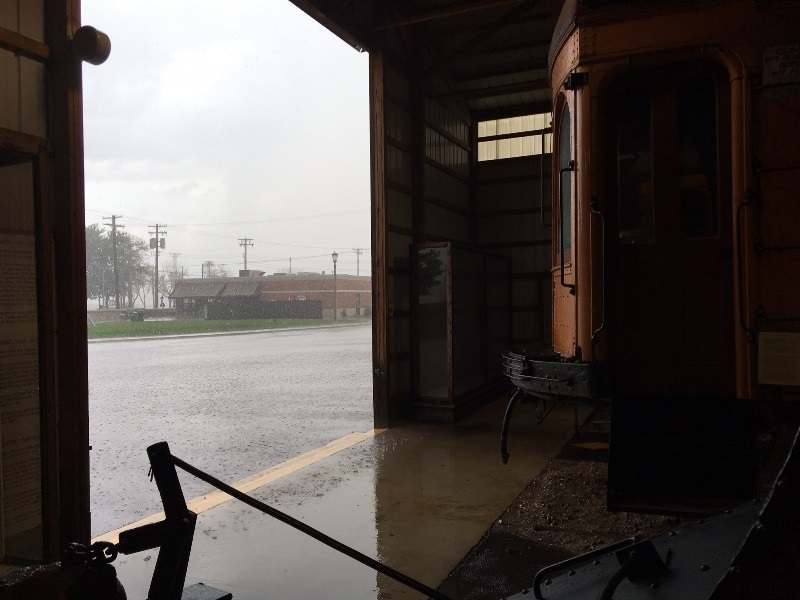
After this work I decided to head over to the 150 and start painting. Just after I got over to Barn 8 the skies opened up, as seen above. It was quite the deluge, and anyone who has spent time at IRM during rainstorms knows that the rain hammering on the barn roofs makes a tremendous din. I was glad that my original plan for the day, to pull the 319 over to the pit lead for needle chipping work, hadn't ended up happening!
And here's the result of a couple of hours' work on putting Tile Red paint on the 150's windows. All of the car's windows now have finish paint, though I'll still need the Tile Red paint for the belt rail stripe on this side of the car. Next will be some more primer, then the belt rail stripe and the cream color around the windows, then a final coat of orange and the car's left side will be ready for lettering.
And here's the reason the 319 didn't make it over to the pit: spam cans! A crew of volunteers including Joel Ahrendt, Nick Espevik, Greg Kepka, and Richard Schauer were working on hooking up newly-installed traction motors on 6656 all day; the 6600s are near the camera and the single cars, there as locomotives, are further away.
Here's Nick (under the truck) and Richard working on the installation. By the end of the day the motors were hooked up and the car ran for the first time in some three years. After inspection work is done this will give us another pair of operating "L" cars. More spam for everyone!

In other news, Jeff Brady was working on the Michigan car while John was over in the Electroliner end car continuing with interior work. The woodworking club is coming to visit in the next couple of weeks so if anyone reading this has anything they've left in the wood shop or "lean-three" then make sure you retrieve it in the immediate future before it gets thrown out or otherwise relocated!

Sunday, September 11, 2016

Two out of four ain't bad

Frank writes...

I was able to make it out to IRM for a few hours Sunday and managed to check off two out of the remaining four items on the 205 "to-do" list. Not bad for an afternoon's work! The first thing was to get some black paint on the step well at the east end of the car. This had been partially primed, which unfortunately made it stand out like a sore thumb. Some black spray paint took care of it. Before and after:


And then there was washing down the seats. This took a couple of hours but it needed doing; the seats in the car were horrendously dirty. I figure they probably haven't actually been clean, per se, since soon after the car was taken out of service in 1958 and the last time they saw water it was coming from the sky and being filtered through what was left of the car's roof. Some of the seats are really trash but most are okay, if not pristine. Another before and after of one of the nickel seats:

It's not a huge difference but it helps. Here's the interior of the car at the completion of the cosmetic restoration. Not a lot was done to the interior other than straightening and general cleaning.
The two remaining tasks on the car are, first, to reattach one of the nickel seats to the wall (the screws have pulled out of the seat back but can be reattached); and second, to install door edge rubber on the new door leaves. This is the process of being sourced and ordered.
My other good deed for the day was to gather up the four serviceable CA&E marker lanterns, test them, and put them into secure storage where we can get at them next Saturday. The plan is to run the wood cars after dark as part of Members Day and having four markers means we don't have to carry them through the train every time we change ends, we can just switch lenses.

BREAKING NEWS - MET CAR BEING WORKED ON

You read it here first - there's a Met car being worked on over on the pit lead!
...well, okay, it's not a real Met car. But it does say Met on the side.

Monday, August 15, 2016

Thomas Sunday

Frank writes...

I didn't make it out to IRM until Sunday afternoon, but the Thomas event was in full swing and it seemed like we had a good crowd. The weather was spectacular, with a nice breeze, picturesque clouds, and not too hot.

I spent my time on some miscellaneous projects around the car shop. When I arrived, Richard, Joel and Greg were working on the annual inspection for the 714. I helped a little bit with diagnosing a problem with one of the lighting circuits. It was traced to some aged insulation but that was easily fixed. Then I headed over to the 205 to finish up one of the few remaining items on the to-do list.
Unfortunately I didn't take a "before" photo, but when I started this window was mostly painted white. Trust me. This was the one end window we weren't able to remove, due to some obstinate piping inside the car that was getting in the way, so it had never gotten the Portland paint stripped off. I didn't do a perfect job but I was pleased with the results overall.
And then when I got back to the shop the 714 was off the pit and the 972 was on! The aforementioned crew plus Doodlebug Dan was able to install all of the rebuilt slack adjusters on the car. There are a few things remaining to be done, including installing the rollers on the brake rods and tightening some bolts, but the car is very close to being ready for operational testing. This car hasn't run in some 15 years and hasn't seen revenue service in probably close to 40 years so we're hopeful that it will be out on the road and carrying passengers in the not-too-distant future.
And our favorite E.D. was out and about in his Model T roadster. Hey buddy, get a horse!


Randy adds:  He already tried that.

Monday, June 27, 2016

Progress aplenty

Frank writes...

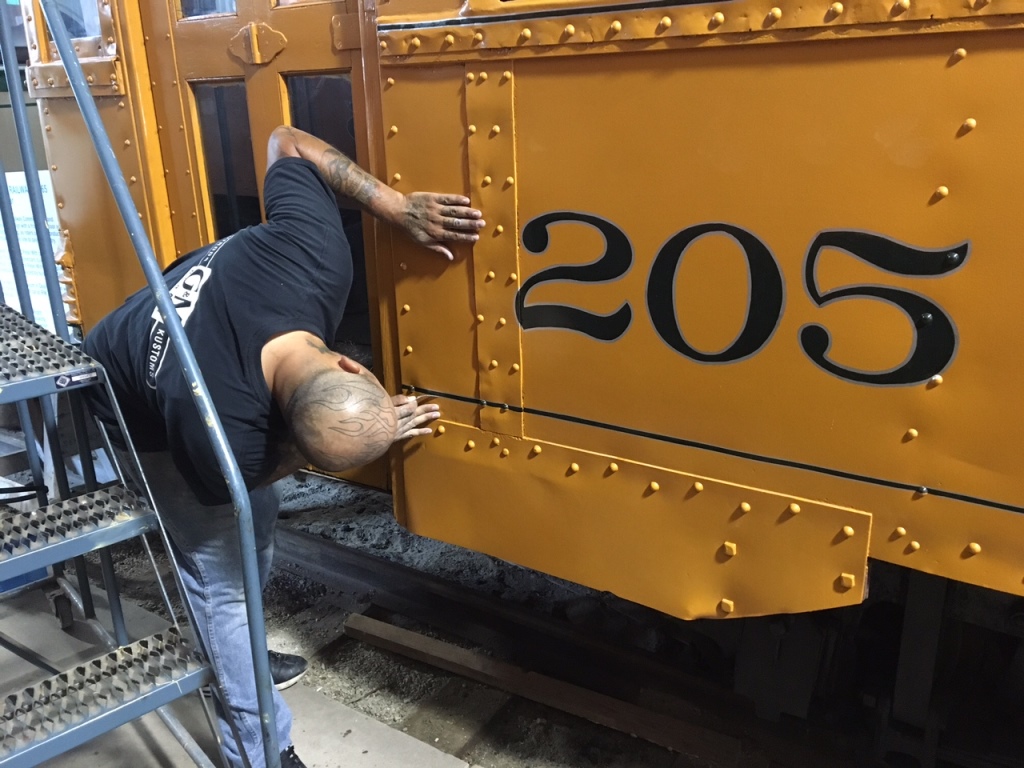
Sunday was one of those days when a lot got done, and on a number of different fronts too. The big news involved the 205. Professional sign painter Ron Coy (the same guy who painted the lettering on the Trolleyville CA&E cars back in 2010), came out along with his understudy Jerry and completed all of the silver outlining and striping on the car.  Painting on the 205 is now done!
Ron gets started on one of the numbers...
...while Jerry works on the pin-striping.
The silver outlines really make the lettering pop, especially when you add a little daylight. As with the 65, the 205 has dark (very dark) green lettering with silver outlines.
And here's Ron and Jerry after completing the car. They did a beautiful job!
But while painting might be done I should mention the project isn't completely done. The silver outlines were the largest and most obvious part of the job not previously finished but I still need to strip a little Portland paint off one of the car's window frames, add canvas-backed rubber to the folding door edges, and wash down the seats. But that's about it!
And the rest of the day was devoted to the CA&E cars. First, Phil (pictured above) and another guy from the Steam Shop whose name I neglected to get brought over the new tank for the 36 after it successfully passed its hammer and hydro tests. Thanks to the Steam Team for working on these tanks and getting them approved for service!
And while Ron and Jerry were at work, I switched the order of the cars. We started with (from the door) 309, 308-319, 36 on track 84. Since we want the 36 in the middle of the 308 and 309, a few switch moves resulted in the order being changed to 309-36-308-319 with the 309 still at the door and the 319 now fourth in. And more importantly, in the afternoon I brought the 36 and 309 over to the pit to finish up inspection work. They're shown above on the tail track.
Earlier in the day, Richard, Greg, Joel, Dan and Nick (not that Nick!) finished annual inspection work on the 2000s, so after that the pit was clear for the 36. My father had already finished most of the inspection work on both the 36 and 309 but we needed to do pit work (motor and truck inspection, mainly) on the 36 and roof inspection on both cars. Above is the view of Barn 4 from the roof of the 36. On the far track (43), L-R is the 306, 810, 4223, 300 and 19; on the center track are the Toledo steeplecab, 4146, 28, and 24/1024. Next to us on the pit track are a couple of Electroliner sections.
I had quite a bit of help on this inspection work. Joel completed the roof inspection on the 309 and also did the armature bearing and axle cap lubrication on the 36. Doodlebug Dan helped with brake adjustment and also helped retrieve our newly-tested air tank from the steam shop. Greg helped me fetch the other air tank from Barn 8 for priming and, speaking of that, Richard primed both of our air tanks (shown above) and offered to paint them black tomorrow - thank you! Nick Espevik also helped with switch moves to get the cars put back in the barn in the right order. It's truly a team effort. By the end of the day all of the cars had been inspected and all were back in Barn 8, in the correct order, and all trained together. While the Trolley Pageant may have been officially canceled for next weekend, we will be reenacting the abandonment of the CA&E on Sunday the 3rd in impressive fashion with all (or nearly all, depending on crew availability) of the museum's operating CA&E cars out on the railroad. There will also be a lot of other interesting electric cars running over the weekend plus the 1630, which if rumors are to be believed will be pulling some rather interesting consists.
Mark next weekend on your calendar - official shop mouser Mr. Socks says you'll regret it if you miss it!