Showing posts with label 319 Progress. Show all posts

Monday, April 20, 2026

Annual Meeting Weekend

Frank writes...


This past weekend featured a day full of activities on Saturday, with the safety meeting and rules test in the afternoon followed by the annual membership meeting in the evening. Unfortunately I missed the afternoon's festivities, but I did make it to the membership meeting.
One interesting part of the meeting, which took place while the tellers were counting ballots during the board of directors election, was a presentation on the planned Visitor Center and on the capital campaign that is getting underway. Our Event Manager, Tricia (above), one of the leaders of the capital campaign, Mark (below), and Executive Director Marcus Ruef all gave excellent presentations and took questions.
Everyone was cheered by the fact that only one ballot was necessary to elect three board members. The usual congratulations and condolences go out to Marcus Ruef, who was reelected, and to new board members Scott Nauer and Andrew Ossler. Outgoing president Nick Espevik, who went off the board due to term limits, was succeeded by fellow Electric Car Department volunteer Zach Ehlers, who is now the museum's president. Congratulations, Zach!

Glutton for punishment that I am, I was back out at the museum on Sunday. What was it Bob Bruneau used to say concerning the subject of how much time he spent at IRM? "When you're dumb, you suffer!"
I spent much of the afternoon looking through the contactor box under the 319. The goal was to figure out why the car doesn't sequence in parallel. While this isn't necessary for operation, we'd still like to determine what's going wrong.

For future reference, the sequence chart here (the first one, not the "correct" second one) is still what we're seeing. Numbers 1, 3, 4, 5, and 6 aren't picking up at all, and 9 isn't picking up until the 10th point. The interlocks all appeared to make, and some (though not all) were tested for continuity. We also tested the connection from the cabinet to #2 interlock, and that wasn't a problem. The next guess is that the lifting coil on 1, 3, or 6 may be bad. I was able to test the coil on contactor 3, and it read okay, but wasn't able to get to the other two. The coils on these DB-260s are hard to access; you need to detach the board on the back of the contactor that holds the interlocks or control resistors, depending on the contactor. Anyway, the next step is probably to test the coils on contactors 1 and 6 at some point. In the meantime, the 319 has been cleared for service (except for lubrication, which needs to be done outside at some point in the next few weeks) and can be moved back home to Barn 8. Many thanks to Brian, Jimmy, and Richard, who helped with this project, and to Nathan, who finished up a lot of the tough inspection work (like motor and roof inspection) on Friday.
You unlock this door with the key of imagination. Beyond it is another dimension - a dimension of sound, a dimension of sight, a dimension of mind. Or maybe it's just Yard 6. Good Nick hauled this 460 door, which he painted last weekend, over to Yard 6 to compare to the actual car in the sunlight. Unfortunately, for the second time, the color match was noticeably off. We will need to have the paint company come out and color-match the car.
However, we need the 460 in service, so we agreed that the short-term solution is to patch the paint on the doors with "slightly off" red and put them back on the car. Here are the doors ready to be touched up; I sanded and primed the Bondo patch my father had applied to the side door, on the right, to fill a rust hole in the steel sheet.
More exciting things were happening elsewhere. On Saturday, we were notified that the occupancy permit for the new South Storage Building - aka the Bob Bourne Transit Building - had been granted. Richard moved the first bus into the building Saturday after the annual meeting. On Sunday, it was time for everyone's favorite air compressor wagon, AX545, to finally exit the "lean-three" shop. Above, Brian and Richard hook it up to our new-to-us airport tug.
And away they go! This is Richard and Steven on the tug, with Brian following. It was at just this point I got the call to come check paint matches on the 460 door, so I didn't follow AX545 all the way to the new barn.
Fortunately, Brian sent photos of AX545 in its new temporary home. It is not remaining in this barn long-term, but to send its wheels out to get badly needed replacement tires, we need to leave the wagon on blocks for a while. Once the wheels come back repaired, the wagon will leave the Bourne Building.
As you can see, AX545 was the second thing in the new barn after the newer of the two Janesville buses. (Well, I suppose the airport tug was the second thing.) Speaking of new tires, we still need to raise money to get the wheels for AX545 shipped out and re-tired! You can help - click here and donate to the Electric Car Department/Equipment Restoration fund. And don't forget to email us and let us know your donation is to go to AX545!
I spent a few minutes talking with Steve, who was grinding away rusted steel on the Kansas City PCC. I need to trace the front and back outline of the "spitball" along with the car number, since the plan is to strip the paint off the car and repaint it using good-quality paint. Steve revealed that careful examination of a portion of the car that hadn't seen sunlight revealed that the color I painted the 755 back in 2001 was pretty spot-on accurate, so that was nice to hear. We had matched the color to an original sample that, as it turns out, Steve himself had procured from a junkyard somewhere out in Kansas.
Of course, Brian and Will were working on air brake things as usual. While we were looking around for DB-260 stuff, we happened upon some boxes of governor parts, which were forwarded to Brian. Included in the miscellany was this bag of gaskets marked for "700 loco." That would be for 700-series South Shore locomotives, the big ex-New York Central freight locomotives that were cut up in the 1970s. I'm sure this bag made its way to IRM from Michigan City at some point thereafter.

Monday, May 19, 2025

One for Four, Two and a Half of Four

Frank writes...


Some days you get the bearing, and some days the bearing gets you. First, a big THANK YOU goes out to the crew that worked on the 309 axle cap bearings on Saturday. This involved taking the car out for a test trip, during which the #1L bearing ran hot; bringing the car back; doing a bit of reprofiling of the spots on the bearing where there was evident wear; blueing the bearing surface; and taking the car out for another test trip, during which the axle ran hot again. It seems that although the bearing has been machined true, the axle itself has high spots, leading to point loading and spots where the clearance is too tight.
The axle cap above shows some of the uneven wear, though also keep in mind that the entire surface of the bearing was not blued, only the middle parts. Anyway, this will require more trial and error in terms of getting the bearing surface to match with the axle, but more cars need to use the inspection pit, so that work needs to be put off. I worked with Will and Ted to remove the axle cap, pull out the new bearings shown above, and put in the old bearings.
After service ended, Joel had the 309 hauled out to live overhead and we took it down the main line at low speed to test out the last of the three new bearings. Unfortunately, this one started running warm, too, though not as hot as the other bearings. Rats. We brought the car back to the inspection pit and, later in the afternoon, Will and Ted removed that axle cap as well, as shown above. We then put the old bearing back in this axle cap, too. So, for the moment, we are one-for-four on the new axle cap bearings -  the one we installed last year is still working just fine but these latest three will need some sort of additional work to be serviceable. This is a project we plan to work on over the course of this summer.
In other news, in between all the 309 activity, I also made good progress on the 319's grid box. Joel ordered new mica tubes during the week, and Ted helped me assemble the grid box on the bench and get it all bolted together. We then took it over to Barn 8, removed the grid box with the failed element, and installed the rebuilt grid box, as shown above. After dinner, Greg, Good Nick, and I successfully tested the car with the new grid box and then coupled it up to the 308, completing this grid box rebuild project. The CA&E wood cars are on the operating schedule for this Sunday, so our current plan is to run the 319 towing the 308 as a control trailer. The 309 should be ready for service - we haven't tested it since reinstalling the old bearing in that last axle cap, but we don't anticipate any issues - so we're back to having "two and a half out of four" cars available for service. The 36 still needs leaf springs replaced and the 308, of course, is in service but is sans motors.

I didn't have too much time to take photos, but let's see what else is happening on this fine Sunday!
The indefatigable B&G Department will have someone pouring concrete inside the west end of Barn 6 during the week, so track 61 had to get pulled. When I arrived, the IC MU cars were spotted in Yard 5, as shown. Jimmy has been working on fixing some minor issues with these cars, so later in the afternoon, they were towed over to the main line across from the depot and operated back and forth to test them out. As I understand it, no problems were found, which bodes well for these cars making more appearances in service.
And the South Storage Building continues to make rapid progress. Other than doors, the exterior looks to be just about complete.

This coming weekend is Memorial Day, so there will be some unusual equipment out. The 24 is scheduled to run Saturday, CA&E wood and steel trains on Sunday, and the IT "orange cars" on Monday. Tell your friends!

Monday, April 14, 2025

I Feel Like I've Been Here Before

Frank writes...


Thanks to the shop guys, who did a terrific job of conducting all the annual inspection work on the 319, I knew before I even arrived Sunday what I'd be working on. Joel even sent me a photo.
Sure enough, one of the elements in grid box #1 under the 319 was almost completely burned through. It's also burned into the adjacent grid element. There's still contact, so the car can move itself around, but clearly we need to fix this before it goes into service. And unlike failures at the "bottoms" of the grid elements, which can be patched quite handily with small nut/bolt/washer sets, this particular failure point requires replacing the grid element.

This all seems a bit familiar, of course... I've rebuilt a number of these grid boxes on our CA&E cars. It's a weak point in the system, I suppose, though these castings also weren't intended for 100 years of service and we probably accelerate more slowly than they did on the CA&E, putting additional strain on the grids. (Though trust me, I'm quite happy putting more strain on the grids and less on the motors!!)
With the 319, my hope was that we could pull grid box #1 off the 321 and swap the two boxes. But it turns out, we already did that! Back in 2013 (12 years ago to the day), my father and a brand-new volunteer named Brian Patterson had swapped these two grid boxes. When Will and I went over to Barn 11 to the 321, we found the grid box originally off the 319 there, complete with the spike still stuck into it. So, we removed it and brought it back to the car shop.
The box is shown above, after the pulled the spike out but before we took the box apart. This box is really odd: the five elements at the left end are completely out of the circuit. They're basically just there for show. Is it possible that the shop would move taps around to adjust the rate at which the car accelerated on certain points? That seems strange, but it's the best guess I can come up with. Anyway, I spent the rest of the day disassembling the box and starting to clean up the box frame. I'll need one replacement tap, one replacement grid element, a bunch of copper washers, and new mica tubes and washers, but it should be a straightforward rebuild.
Again, a huge THANK YOU to everyone who worked on the 319 inspection! Among other things, Joel swapped out an intransigent trolley shoe insert while the guys also replaced a balky governor. At the end of the day, the shop crew switched the 319 back over to Barn 8 and brought the 309 over to Barn 4, as seen here. Will even got a bit of an early start on 309 inspection items.

So, what else was happening? I swung by the south end, where the Southwest Storage building, the "U-store-it" style building, looks to be nearly complete.
And the posts are in along the north wall of the next building to the east, the South Storage Building. I think our B&G Department's motto is "go big or go home!"
Sunday was the second of three days of Bunny Trolley Hop, and it seemed quite well attended. Matt Kalnins sent along the following three photos of streetcars at Depot Street, starting with the 4391.
This car and the 3142 received nice magnetic Bunny Trolley Hop panels on their flanks
The third car in service, the 144, has wooden sides so didn't get the additions. Here, motorman Paul Cronin and conductor Zach Ehlers demonstrate proper CSL attire.
Elsewhere, the indefatigable DC Line crew were out working on various repairs while Joel was doing more transferring and rearranging of parts and tools as part of the shop expansion project.

Saturday, February 17, 2024

Saturday Report

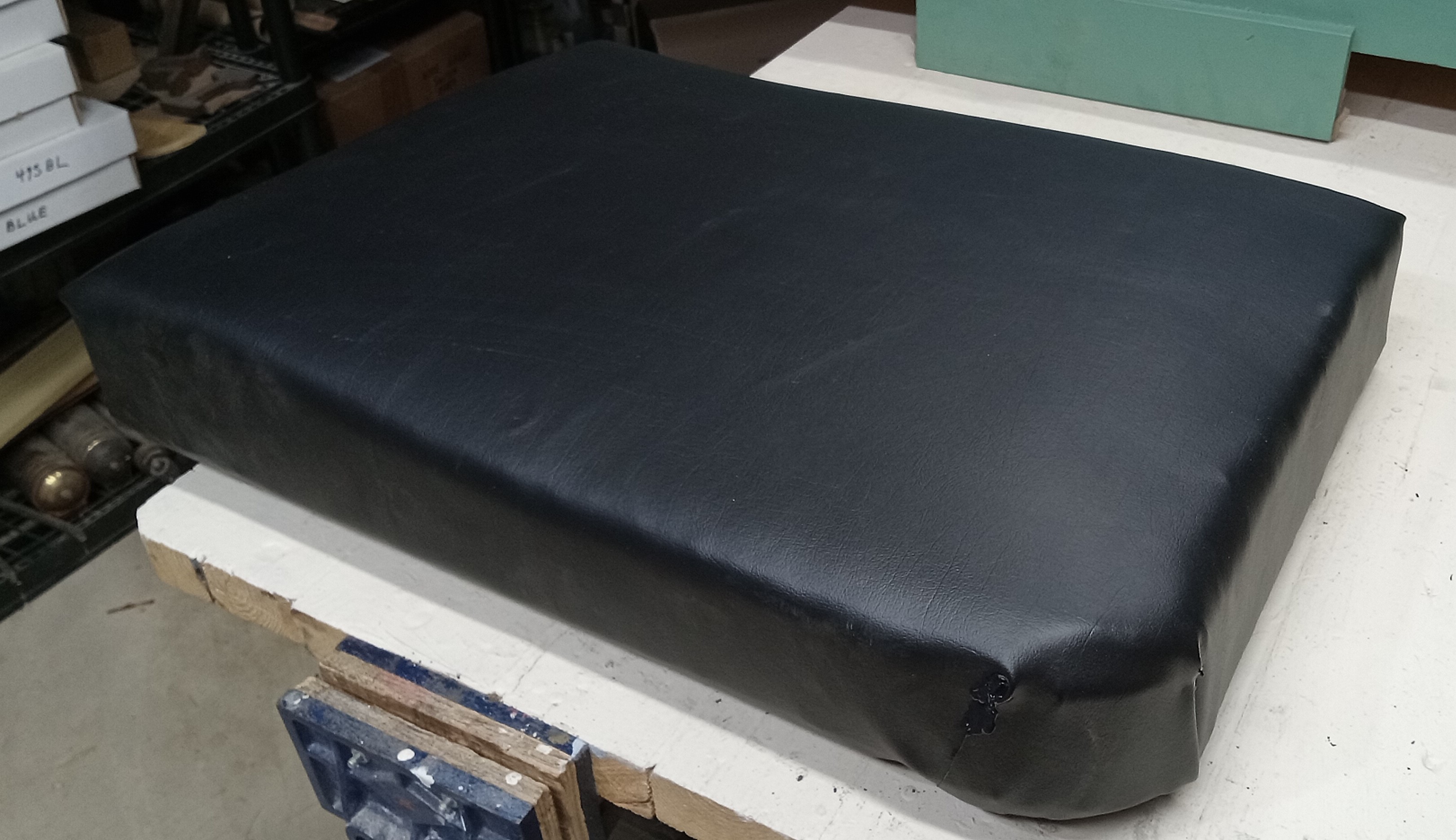
Today I did most of the remaining work on installing the reupholstered seats in the 319.  I replaced the material on the nickel-seat cushion at home and brought it out.  


Before:


After:


Another seat back was replaced, and the seating in the smoker is now complete. and up to CA&E standards.


Then I started installing new seat backs in the main compartment.  One interesting improvement is as follows.  At the location shown below, opposite the toilet compartment, this car originally had a stationary bench against the wall, as the 308 and 309 still do.  But at some point this was replaced by a walkover seat.  However, because of the wall construction, this seat frame is different from the rest of those in the 319, and seems to be the same as those in the earlier 300's.


But the seat back (as received) was not the correct width, and as a result the brackets didn't fit properly, so the seat was always coming out of the track, and among other things some of the wood on the arm rest got chewed up.  This has been a constant headache since we got the car.  I blame Cleveland, but I really don't know for sure.


In any case, I realized that I could replace the seat back with one from the 300 that we got from MCRM, and that ought to fit.  Here it is after I repainted it at home, and installed it today.  It seems to work perfectly, so that's one problem solved.  The arm rest needs to be replaced at some point.


Anyway, all of the new seat backs have been put in place.  Getting all the screws tightened up is very time-consuming due the tight clearances, so that's not finished yet.  Wait till next time.

Of course, several other things were going on.  Here's just a small sample from the car shop.  Tim continues working on the 1808, and here he shows off all the clerestory windows recently repainted by Fred Zimmerman.


And Bill was working on windows from one or two of the 4000's.  These cars have always put in a lot of mileage since arriving at IRM, and constant maintenance is necessary.


Thursday, February 15, 2024

Better Living Through Upholstery

This morning six reupholstered seat backs arrived from Wisconsin, and they look excellent.  My thanks to John Sheldon for arranging this and providing the transportation.


In particular, the straps over the seams are very well done.


I needed to attach the brass handles, though, and that took some time.  Some of the original brass screws that hold these in place had broken, so that had to be fixed.   Tim helped by supplying me with replacement screws from the Sirinek Collection.


Meanwhile, John and Gerry were painting more 306 parts.


Steve and Pax were working on polishing up Liner parts, but somehow my picture of them got lost.   Sorry!

Something looks different when you wander into the old ("Lean One") shop.  The sliding door in the east wall is open...


And inside, contractors are finishing up work on the Lean-Zero.  Notice how the light fixtures are hanging from the ceiling.


Finally, I managed to get a handle on all six backs.  And then they were taken over to the 319.


While we're in Barn 8, here's some progress that Richard has made on his display of historic rails.


This is actually more interesting than you might expect.  The explanatory labels are nicely done.

I loaded the new seat backs into the car, and installed one.  That took a while, mostly because there's very little clearance between the inner bracket and the wall.  I hope to find a better offset screwdriver to make this process easier.


But the seat certainly looks nice.  Next stop, Jewell Road!


Finally, this nickel-seat cushion was taken home for recovering.  That's an easy job.


Friday, February 9, 2024

They've Got Our Backs

 The big news for Thursday, from my perspective, was getting the 319 seat project into real motion.  John Sheldon has been instrumental in making this possible.  The seat backs will be recovered by the same upholsterer who did all of the seats for the 306.  They're located in Walworth, Wisc. which is right on the way home for John.  I cut out ten yards of the material we acquired a few years ago with the expert aid of Dick Lukin, and gave it to John.  I then removed five more seat backs -- it takes a while -- and helped load them into his truck.  When all six are done, they'll be put back in place.  Most of the rest of the seats in the 319 are in pretty good shape, and they will be painted as necessary.  So that's pretty exciting.


Here John is polishing up some more 306 hardware.


And he also spent much of the day painting the new walls in Barn 4, along with Tim.


Two photos by Bob Olson


Gerry worked on cleaning up one of the door motors for the 306.  He pointed out that we have two, and that's all we will need for the original configuration.  There were double doors on the left side of each platform, controlled by these door motors, and a single door on the other side, which was manual. 


And speaking of exciting, today as I walked by Steve, who was painting again, Pax suddenly started barking fiercely at me for some reason.


But he was soon brought under control.   Cave Pacem!