Sunday, September 14, 2014

Mysteries Solved

Frank writes...

My trip out to IRM today was all about solving mysteries.  The first mystery: what is what disc of metal cast into each of the axles on the 972 trucks?

Answer: it's part of how the motor is kept from moving laterally on the axle and provides a shoulder for the "thrust collar" to jack against.  As shown above, this thrust collar (obviously installed since yesterday) serves as an adjustable spacer between the nearest axle cap bearing and the cast disc.  If the motor were larger, the thrust collar could just line up to the back of the wheel itself.  On large interurban motors, like those on the 309, the motor is wide enough that the axle cap bearing is up against the wheel on the non-gear side and no thrust collar is needed.
This was pointed out to me while I was helping Rod and Greg to install the second motor in the 972's truck.  As shown above, the truck now has both motors fitted.  There are still some final pieces of the puzzle to fit together, but without too much more work this truck will be ready to put under the car.  The other truck is currently disassembled in the "lean-three" but I believe the plan is to reassemble it this winter.

The second mystery: what's the identity of that shiny orange streetcar in Barn 7?
Answer: as visitors will now be able to see, it's the 205!  When I first arrived at the museum I cut out the stencils for the numbers over the end windows of the 205 and then traced all four of the numbers (two on the car sides and two over the end windows) onto the car in pencil.  After helping out with the 972 motor I got to work with a paintbrush.
So the car is now identified as IR 205.  I still need to paint the striping onto the car - it gets a stripe the length of the body at the floor line and one at the belt rail - but other than that, which should be pretty straightforward, the lettering is ready for outlining.  I am hoping to hire a sign painter to do the 1/8" thick silver pinstriping that outlines all of the car's lettering.

And a final mystery: what's going on in that little building west of Barn 9?

Answer: as was shown during an early-evening "railfanning" trip over to the Steam Shop, a lot!  The 1630 was sitting just outside the shop, ready for service next weekend during Museum Showcase Weekend.  Inside, the first engine in evidence was Rock Island 938, which is in the shop for cosmetic repair work.
This is the museum's only Pacific and was once a very attractive passenger engine.  Time has not been kind to the 938 but the Steam Team is hard at work reversing the effects of weather.  And beyond the 938 was J. Neils 5, the museum's Shay, which is undergoing restoration to operating condition.
Though it looks like it's being launched, the Shay is just jacked up to permit removal of the front truck, which has been rebuilt.  UP 428 is also in the shop undergoing work on the axle boxes and a small crew was working on repairs to a large lathe.  All in all, an interesting trip to another of the museum's numerous shops.

Saturday, September 13, 2014

Anticipation

 
Today was mostly spent tacking down nearly all of the center canvas on the 319's roof, as seen here.  It seems to be going well.  The ends will require extra care due to the compound curves, but canvas paint should not be far away!  I was told many years ago that the canvas should be tight enough so that on the lower deck, at least, you can easily see the outlines of the individual boards.  Looks good to me!


While we're up here, you can get a good view of the 309's clerestory.  The window hardware is still in place for opening the window, as you should be able to see.  These windows were fastened shut sometime in the 1920's, and haven't been opened in about 90 years, but the parts were left in place.  I'm sure the 319 had something similar.

Speaking of the 309, I took the opportunity to turn the 308 and 309 around and make up the train with the 36, in preparation for next Saturday.  Paul Cronin helped as switchman.  We'll be running the three-car blue train in revenue service again, so don't miss it!


Here are some closeups of the 972 truck.  The wheel hubs and axles have not been changed, but new tires were pressed onto the hubs, and you can see how the new tires have a smaller back-to-back than the original tires, because we now have standard profile wheels.

Bill Wulfert and I discussed the part on the left shown by the yellow arrow -- we're not sure what it was for.  Bill though it might be part of an earlier dirt guard system.  I thought perhaps it was for an axle brush, but we just don't know.


Meanwhile, Max has made good progress on the new trolley bus loop.  The car line crossing is complete (L) and the frogs are in place farther east on Central (R) and you can see the insulators needed for the reverse loop -- just like toy trains!


Some more work needs to be done on the curve from Central onto Railroad Ave., but the guys were running a bus to test it out.   The track guys were busy loading ballast and running it out to the Deep South, and of course many other projects were being worked on.  We had a good crowd of visitors.


Did we mention that next weekend is our Museum Showcase, otherwise known as Member's Day???  Operations will (weather permitting) include the CA&E wood cars, CRT wood cars, the Decapod, the Zephyr, the bilevels, and who knows what else.  We'll have food, fellowship, nighttime operations, what more could you want?   I can't wait!


Thursday, September 11, 2014

It's a Stretch

When installing a canvas roof, you always want to make sure it's stretched as much as humanly possible before nailing it down.  Otherwise, you get wrinkles and lumps which not only look stupid, but are more likely to cause real problems like cracks and rips.  


For the canvas over the center of the 319, we already had it pretty well stretched lengthwise.  In the morning, I was able to take out a little slack, but not much.  So we can start tacking it down.   If there's only one man doing the work, you start by tacking it on one side for a short distance, then go to the other side and stretch the canvas crosswise before tacking.  As long as you have two scaffolds to work from, it goes pretty quickly.  


In the first picture, you see one of the special canvas clamps we use for this process. In the second, it should be noticeable how the wrinkles have been smoothed out by stretching the section nearer the camera, where the canvas has been tacked.  Pretty smooth, eh?


But wrinkled canvas isn't the only thing that annoys me.  The older I get, the more annoyable I seem to be....

It's not spray-painted graffiti, to be sure, but all these markings on the windows just make the barn look more like an abandoned junkyard.  So I equipped myself with a combination mop and squeegee on a long pole, so I could wash all these windows just by walking down the aisle.   This is the 233 -- it doesn't deserve this sort of degradation.

Ah, much better.  Of course, the cars that never move, such as the 233, 150, and so on are much worse than the regular service cars.  But if I do two or three each week and then keep cycling around the barn, at least during the summer, it should look much better.  Then maybe I can find volunteers for 6 and 7.


Speaking of the 233, its front buffer is just the right size, and shape, and location for painting the last two curved tack molding pieces.


Of course, lots of other things are going on at the same time, even on a Thursday.  Here  Bob Olson is loading ballast into one of our hoppers on the new cutoff track.  This material will be dumped in yards 13 and 14.


And here's what a streetcar traction motor looks like when installed in the 972 truck.  Man, is it tiny!  Slightly bigger than a compressor motor, if you're accustomed to dealing with older and much bigger interurban motors like the GE 66.


And by the end of the day, I had finished about a third of the roof on both sides, as seen here.  I ran out of energy and tacks at about the same time, which is fine.  On Saturday I should have more of both.

Wednesday, September 10, 2014

Preserved Electric Cars website updated

Frank writes...

As some of you know, a side project of mine is maintaining a list of all historic North American electric railway equipment in existence.  The website, known as PNAERC for Preserved North American Electric Railway Cars, has just been updated by our intrepid webmaster Jeff Hakner of the Branford Electric Railway Association.  Check it out at the link below and let me know of any issues, errors or omissions that you notice.  Thanks!

www.bera.org/pnaerc.html

Monday, September 8, 2014

Back to the 205

Frank writes...


I spent a while Sunday working more on lettering for the 205; this time it was time to create number stencils for the sides of the car.  Previous sanding on the car itself had revealed only fragments of the car's Indiana Railroad number.  There was ample evidence of the original Interstate "266" numbers as well as the later Portland "4003" numbers but it's possible Portland sanded through some of the IRR paint in 1940 because traces of the "205" numbers were very difficult to find.
So after combining the fragments of lettering traced off the 205 with photographic evidence I came up with what you see above.  Jeff Brady, who was in the shop working on straightening metal bars for the side doors on the 28, helped out with the "eyeball test" to make sure the numbers looked right.
I very briefly helped a crew that was working all afternoon on putting the first of four rebuilt motors into the trucks for Milwaukee 972.  This car has been an on-and-off project for many years and a lot of work has been done on it.  Rod, Joel and Greg (the latter two seen above) got the first GE 265 motor put back into the first truck, a major step forward for this car.
And Nick was around, as usual.  He gave me the above poster which he found in the attic of one of our buildings.  You never know what you'll find lying around at IRM!
It was a beautiful day, so I figured I'd grab a shot of a makeshift Milwaukee Electric interurban freight train spotted behind Barn 7.  The locomotive is the L3, the eldest of four "TM" steeplecabs owned by the museum and the only one of the quartet with GE Type M control.  Behind it is container car M37, a quite historic car from the very earliest days of intermodal shipping and the only surviving example of its type.

I also tightened down the straps on the 319's new roof canvas and spent a few minutes chatting with Mark Wolodarsky, an IRM member from New York City who was visiting.  And I took some measurements needed for making up the final stencil for the 205, the numbers over the end windows.  Other than that the only lettering left to do are the stripes along the belt rail and floor line.

Sunday, September 7, 2014

Dave's Depots -- Al's Annex or Was This the MILW in Wisconsin (almost)?


Al writes....

After another visit by Murphy to the house addition project (brand new Bosh dishwasher quit working) on the Tuesday before Labor Day the wife and I just needed to get away for a bit. We had a graduation/going away party to attend in a small town in Wisconsin on Sat. so we decided to just head north and wander for a couple of days.  Although this was not a station hunting trip, it presented the opportunity to spot a few depots.

We left late in the afternoon so our first stop was in New Glarus. The depot here was on MILW branch from Broadhead. It now serves as the head house for the Sugar River bike trail on that ROW and as the New Glarus Chamber of Commerce office. It was built in 1887 and its wood construction presents a typical station profile,


The station's interior has been nicely restored and the station is on the national register of historic places.


The Swiss references in the interior relates to New Glarus' reputation as Little Switzerland.


Nearby is Mineral Point, said to be the birthplace of Wisconsin as the first Governor was sworn in here. This place has had a bit of fascination to me as in the 50's Model Railroader ran a series on building a model railroad theamed around the turn of the last century. The name of the Railroad was the Mineral Point & Northern.  Once again the town was on the end of a Milwaukee Road branch line.  However the station is very different from New Glarus.It was built in 1856 by the Mineral Point railroad.  Being built before the use of train orders for train control it does not have the usual station outline with a bay window for the operator. Pre Civil War depots are somewhat rare in the Midwest.


 The interior has been refurbished and is home to the Mineral Point Railway Historical Society ($5 admission, no cameras allowed). Unfortunately it was closed on Wednesday.


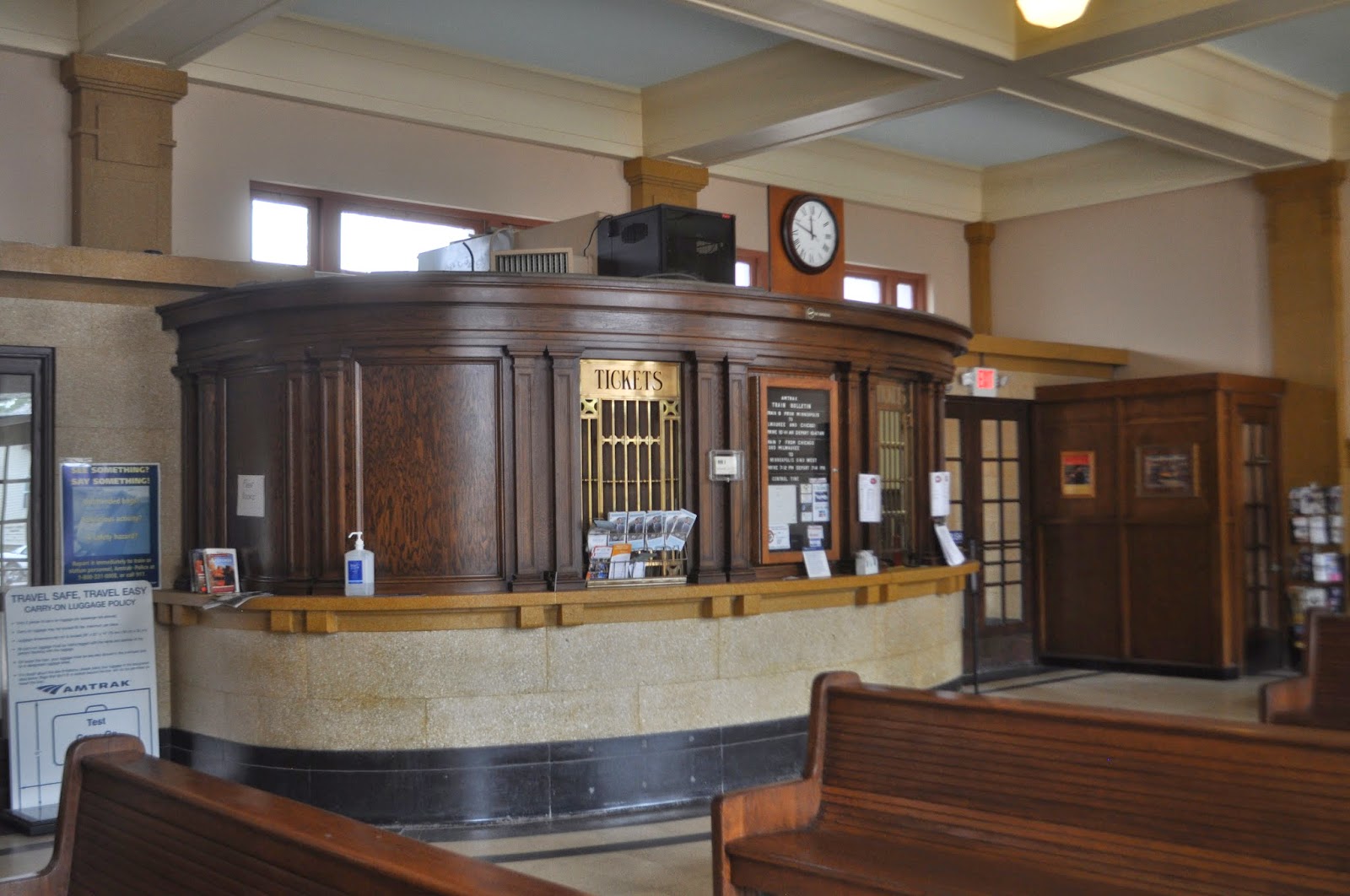
Next we encounter the La Crosse.The depot was built in 1927 by the Milwaukee. Due to mergers and acquisitions it passed to the Soo and then the CP. The depot is active for Amtrak as well as the local crew transport service. The Empire Builder stops here twice daily.


The interior was renovated in 1997 and is very attractive.


 Also of interest in La Crosse is Copeland Park.


Several artifacts are stuffed and mounted here.  Largest is Big Alice or CB&Q 4000.  As I recall this is the only Q Hudson that was built by the Q in West Burlington.  


In spite of the missing headlight and Mars light and the primer on the cab she appears to be in fairly good shape.

Also in the park are this caboose of unknown (to me at least) heritage and the Grand Crossing tower that once protected the CB&Q/MILW crossing.


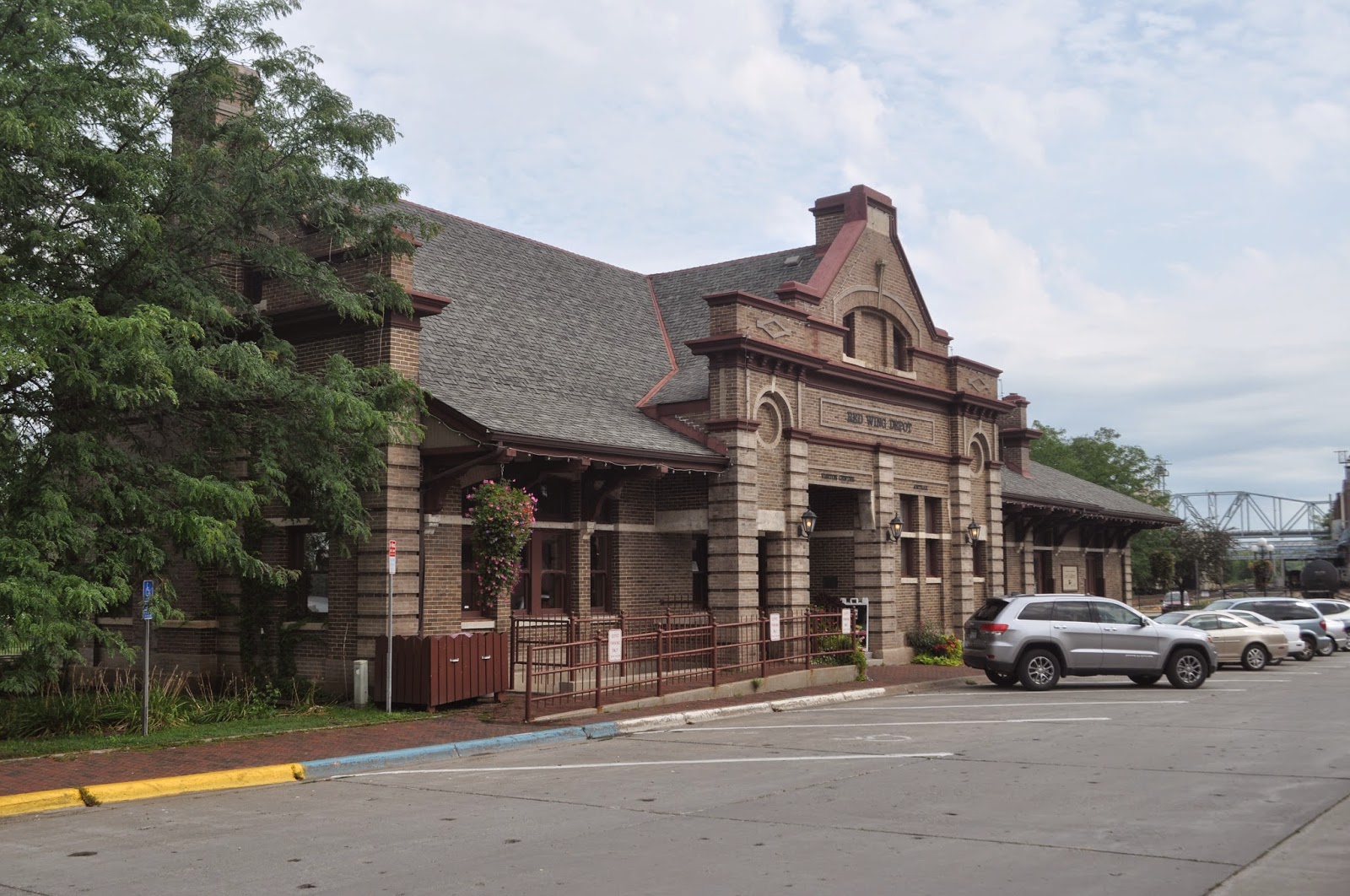
Our next stop was Red Wing, Minnesota not Wisconsin. We were treated two stations here.  The first like La Crosse was a former Milw/Soo now CP Amtrak stop.


The station, built in 1905 also serves as a visitor center for the City of Red Wing and is in very good shape.

The second station in town is a former CGW building serving the abandoned branch that ended here in Red Wing. Built in 1906, the building now serves as a Caribou Coffee restaurant. The operator's bay window now serves as the drive through window.


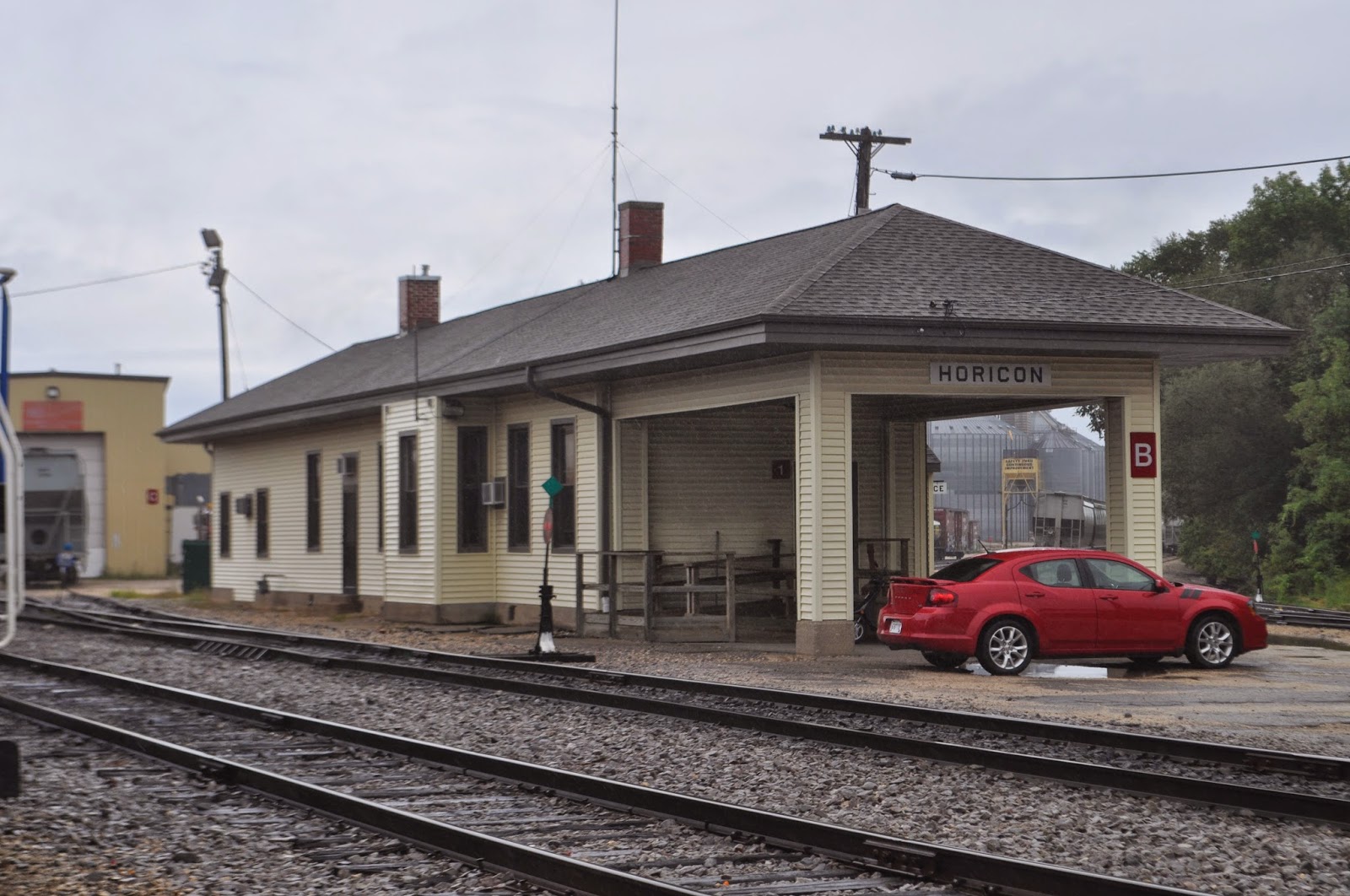
Our final entry is the Former Milwaukee Road depot in Horicon Wi. It currently serves the Wisconsin and Southern.  It was raining cats and dogs when I was here so there is only this single photo.


But the surprise here was this string of sad looking former C&NW gallery cars.