Thursday, March 19, 2020

UP M35 update

Here's the latest from Gregg Wolfersheim and the M35 project:

Work continues on the "self propelled" interurban, M35. Windows # 25 and 26 are back in place.

Below both windows, foam board insulation was applied, and now is covered with a plywood panel. Here we see it in primer with the quarter round that holds it in place.

The brown color that is on the bottom half of the walls has been applied. Several more lower wall areas are now being prepared for restoration.

Monday, March 16, 2020

Pole up!

Frank writes...

I was out at the museum Sunday afternoon, working in the car shop more-or-less normally despite the recent cancellations and other changes. Yes, IRM is closed until May, but the restoration shops are still open. When I arrived, the Matchbox was being moved off of the pit following inspection work while VC 19, shown below, was being moved onto the pit.

For much of the day Joel, Jack, and new volunteer Jesus were working on inspection on the 19. After the 1374 was put in Barn 7, Richard also removed the east end brake valve for some work to repair a small air leak.
Other shop news includes a first coat of Indiana Railroad green on the roof of the 65. This project is coming along very nicely!
While the others were working on inspections, Greg, Nick E, and I grabbed the block-and-tackle and headed over to Barn 7. The goal was to continue the reassembly of Shaker Heights 18 by lifting the trolley base back onto the roof. This entailed hooking the block-and-tackle to the barn rafter and winching the base, which is extremely heavy, up from the ground. I worked on the roof and Greg raised the base while Nick was in charge of making sure we didn't lose any windows. As shown above, it worked like a charm! Nick is shown atop a ladder checking on progress. I then fetched some hardware and bolted the base down. The main trolley lead from the base to the fuse box (shown above between the base and Nick) wasn't attached yet but that will be quick to do later.
The trolley base's "resting" position is normally sticking almost straight up. Some bases can be latched down but this one couldn't, and the trolley poles are long enough that the car needs to be outside to give you enough space to insert the pole and then lower it down to a horizontal position. It was at this point that Nick and Greg pointed out that it probably wouldn't be too big of a problem to pull the 18 outside and get this job finished, so we trooped back over to the shop. Richard was just finishing up on the 1374's brake valve, so with that installed, the Matchbox and 4391 were moved out of the way and Shaker 63 and the 18 were towed outside. Many thanks to the entire crew for their help with this! Joel came over and was instrumental in getting the pole installed; above he's shown lowering it so that we can hook it down. He asked me whether I had done this before, and amazingly the answer was yes! In fact I even have proof.
So here it is: the 18 is a trolley car again for the first time since 2010.
This is just a gratuitous photo of the Matchbox I took while switching everything back into the barn. How can you not like a CSL streetcar in late-afternoon light?
After this the new Toronto CLRV was again fired up, with more success than last week, and was operated a couple of times back and forth for maybe 40'-50' in each direction. It's the least interesting, and yet - given the proximity to the end of track - also the least forgiving ride at Union. But it's also a rare chance to ride a piece of equipment at IRM running on track that isn't standard gauge.
The last project of the day was that Richard and Greg wanted to check on some air system repairs that they'd made to a San Francisco Fageol-Twin Coach trolley bus we got a few years back from Orange Empire. The air system repairs seemed to be substantially successful, though fixing one leak revealed another smaller one, but progress is being made. They also identified an issue with the MG set on the bus that should be fixable. Above is an interior photo; this thing is in rather good shape though years in the Perris, California heat led to most or all of the seats being damaged.

Tuesday, March 10, 2020

Sunday report

Frank writes...

The weather on Sunday was unusually balmy, with a high of 60 degrees, so it was an ideal day to head out to IRM. When I arrived most of the car shop crew - including Joel, Greg, Good Nick, and Thomas, along with Wes from the diesel shop - were out on the line car inspecting the overhead and making repairs and adjustments where needed. I've been promised some photos documenting this.

Zach and Brian were working on the 757 out in the barn, though. After a sojourn accompanying them to hunt for spare parts, I decided to do a little bit more cleanup on Shaker Heights 18. In this case, "cleanup" isn't so much washing the thing off as simply getting it put back together. The first job was to reattached a length of drip rail on the left side of the car that was hanging loose, as shown above.
After some drilling, dowls, and screws, the section of drip rail was reattached. We will likely want to replace much of this drip rail, as there are some short sections missing and it seems like running off some longer sections would be better than piecing in short lengths, but that's for later. This view is looking west/northwest along track 73; west of the 18 are the 972 and 205.
The car's trolley base was too heavy to hoist up to the roof myself, but the trolley hook wasn't. So after locating appropriate hardware I bolted it to the car's roof boards. This is looking east; next to the 18 on track 73 is our other Shaker Heights car, PCC 63, which is currently out of commission with MG problems, and beyond it the Matchbox. Over on 72 is a rake of 4000s while on track 74 you can see the 144 with the open car and 3142 beyond it.
Stepping back a couple of feet, you can see a couple of interesting items on the roof of the 18. It's obvious where the trolley base will go, and off to the right is the fuse box. That loop on the left would have held a spare trolley pole, which is something I tend to associate more with interurbans than with suburban lines. At the far end of the trolley boards is a hook - barely visible as a shadow in the preceding photo - which I assume is where you'd hang the harp of your spare pole. Another intriguing detail is that the roof canvas of this car is divided into three strips, a strip down each side of the roof and a strip down the middle that's just wider than the trolley boards. Car 18 had a row of Scullin ventilators down its entire roof until it was rebuilt around WWII. I wonder whether the roof canvas may have been patched in when those ventilators were removed, which would make this canvas at least 85-90 years old. It's pure speculation though.
I spent a few minutes hauling some excess wire pieces around in the golf car for the line car crew when they returned to the property, but that was about it for my useful contributions. I did have time (of course) to wander around aimlessly taking photos. Above we see a rebuilt motor for the L4, recently back from the motor shop.
There isn't a lot of progress being made currently on the S105 but I snapped a photo anyway since it's one of the most recent arrivals in Barn 4.
The recent progress on reassembly of the rear end of of Michigan Electric 28 is impressive. Virtually the entire wooden floor is installed, as are the baggage door thresholds.
As I mentioned earlier, Zach and Brian were working on the 757, addressing the few electrical gremlins with the car. Here Zach shows off a rebuilt board that has something to do with the battery-powered emergency lighting circuit (thanks for the correction Zach!); nearly out of sight underneath the car is Brian, getting ready to install the board. They were also working on the 757's smoker door and on fitting the new end windows for the car.
At the end of the day, it was suggested that the Toronto CLRV should be powered up to avoid any unnecessary sit-itis. Above can be seen the interesting setup for this. The usual trolley bus stinger, with forked hooks at the end for the positive and negative wires on the trolley bus line, can be seen hung on the wires to the left of the railroad crossing sign. The negative wire is clamped to the rail on the wide-gauge panel track while the positive is hooked to the car's trolley pole. And voila! Unfortunately, there was no voila this time, as the car's batteries had drained down and it didn't want to start up until they were recharged. But I was told that when the crew returned to the museum after dinner, and after some time on a battery charger, the car was powered up without any trouble.

Sunday, March 8, 2020

Doodlebug Update

Gregg Wolfersheim sends us another update on the UP M-35 doodlebug.


A couple of windows are being painted in preparation for installing them.


Here are three panels recently cleaned up and getting primed.  
They will go above the windows to hold the insulation.


A little while later they got painted.


Some of the fabricated wood trim pieces all primed.


The lower wall area all painted.


The insulation panel in place. Also, the board at the bottom that covers the void between the wall and heater pipes. Some rock wool type of insulation was put in below. Next will come the plywood panel which faces the interior.

Friday, March 6, 2020

Sleet Scrapers In Action!


This was posted a while back to Facebook, and it's by far the best picture I've ever seen of the CA&E's air-powered sleet scrapers in action.  The train is approaching us; the motorman had control over the scrapers only on the car he was operating.  The scrapers are connected to the third rail shoes with shunts, so they act as current collectors when in contact with the rail.  And this provided a dramatic light show when the train was moving.

This picture shows the very last passenger train to operate on the CA&E: a fan trip on December 7, 1958.  The location is just east of the 5th Avenue station in Maywood and this is probably at the end of the trip, which began and finished there.  (In the morning there was no snow on the ground.)  Evidently the train continued somewhat east of the station, just because they could, and then returned, running wrong main.  Today the 319 is preserved at IRM, of course, and the second car was the 320, now at Mt. Pleasant.  Those were the days....

Wednesday, March 4, 2020

Midweek News

Another busy Wednesday has come and gone, and we have the pictures to prove it.

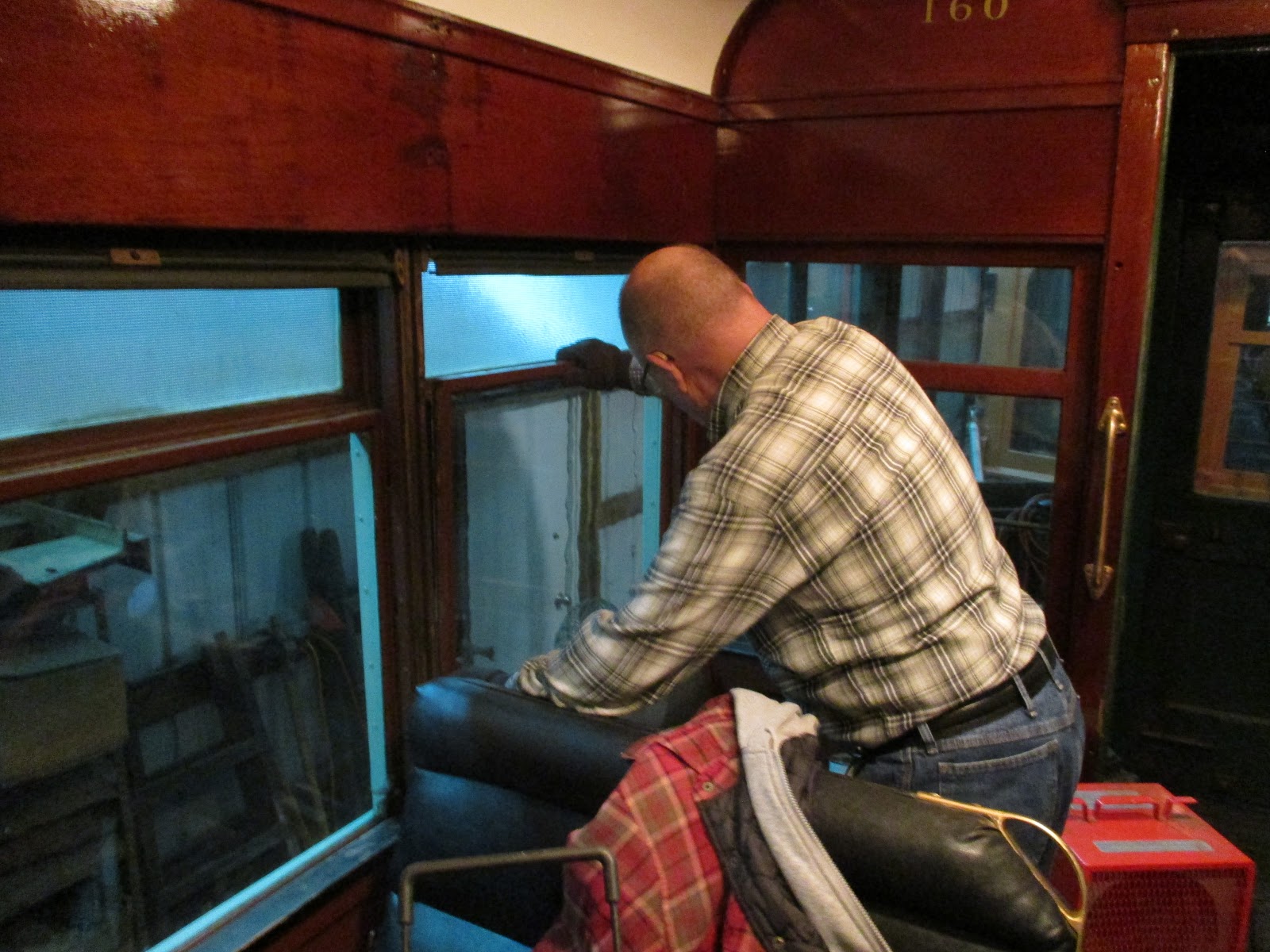
Pete Galayda continues to restore the interior of the 160.  Here he's installing a repainted window.


Here's a part of the floor that has recently been repainted.


The smoker door is next on the list for refinishing.


While this refurbished door to the platform will be installed soon.


And there are lots of miscellaneous activities going on:


Henry is cleaning up another seat frame for the 306.

Photo by John Sheldon


John S. and Reggie work on a new door frame for the 213.


Chuck continues to wire-wheel the PCC truck frame.


John Arroyo is working on the Electroliner over in Barn 7, and pays a visit to the car shop.


 Then we have more work on the Michigan Electric 28.  New member Jesus Mendoza is seen helping Norm grind down a metal bar.  Because the car was used for transporting heavy package shipments, the floor had about 16 metal bars attached to the wood floor to enable crates to be slid easily across the floor without damaging it.


Here Jesus is helping Rich with installing a new wall panel.


Jon was ironing out the wrinkles in the new canvas on the 65.


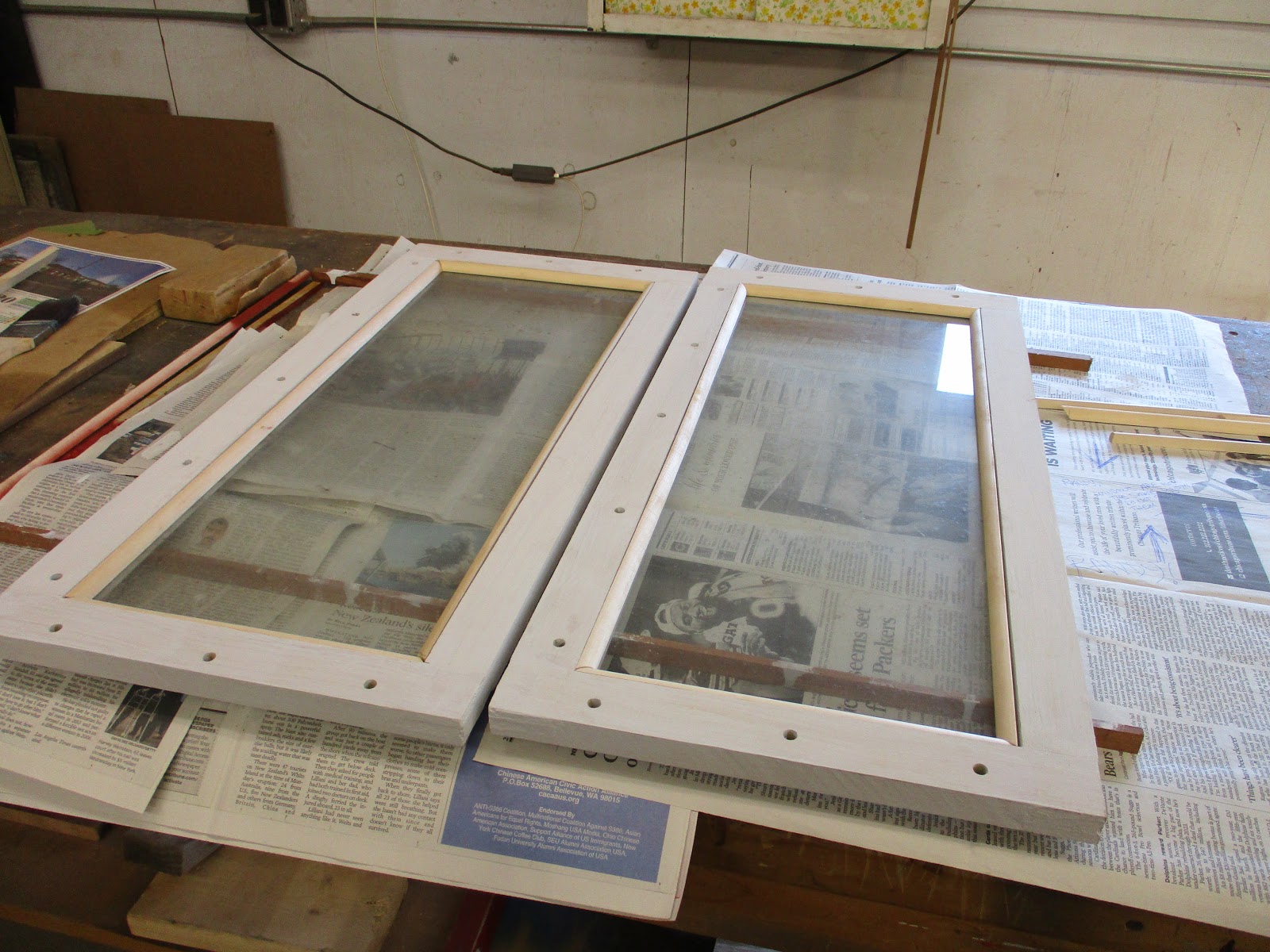
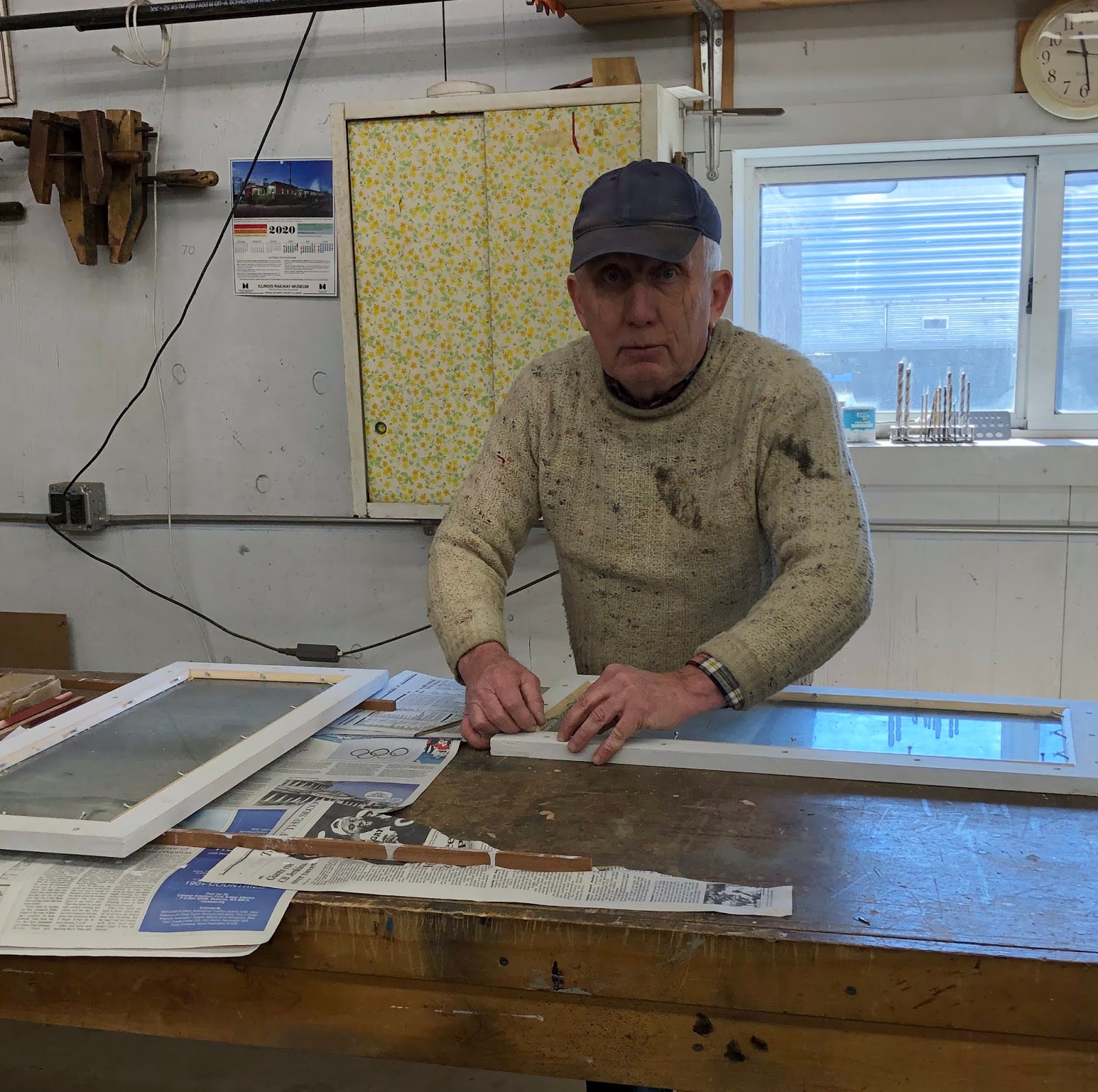
I installed the glass in the two new frames I made for the roll sign boxes on the 451, with new quarter-round moldings.


Photo by Jon Fenlaciki


Photo by John Sheldon

Later, the front side got another coat of primer.  And then, I had time to install all four new lift tabs on the drop sash in the 451.


Finally, progress continues on the interior of the MPB.


And as usual, a good time was had by all!

Sunday, March 1, 2020

Don't Say You're Soirée

Our friend Jeron sends us a couple of pictures from the annual Soirée: