Wednesday, July 25, 2018

Today's Quiz

The last quiz we posted was probably a little too easy -- I'm getting out of practice.  So today's subject is Father-Son Teams.  Give the first names for each of the following father-son teams that have worked at IRM over the years.  In some cases there are multiple answers.  And there are probably some I haven't thought of, so send in any additions.  (Frank and I are disqualified.)  Please don't answer via the comments, but use the contact form if you have them all -- and win a prize!

  • Anderson
  • Choutka
  • Evans
  • Fenlaciki
  • Habermaas
  • Jirsa
  • Kramer
  • Lloyd
  • McKay
  • Naglich
  • Opolony
  • Schneble
  • Weege

Monday, July 23, 2018

Busy Monday

We usually don't have anything to report on Monday, but today was different.  As promised, we had a large group (more than 200) Lionel enthusiasts visiting.  They all got to ride the Zephyr and the CA&E train, which stopped at Seeman to let them off so they could take pictures of the Zephyr passing through.  This process was then repeated with everybody changing trains in between.  I was too busy to get pictures of either the 308-319 or the Zephyr myself, but you've seen them before many times.  At least we have a crew portrait.


Conductor Henry Vincent, myself, and trainman Thomas Slater.  Thanks for the help!


Everything seemed to go well, and evidently the charter group was very satisfied.


Then I pulled the 36 out, ran it over to 84, and put the three-car train back together.  Here it is posed on some rare trackage.

Several other things were going on today.  Among others, the Electroliner crew were making up for lost time.   Here John Arroyo is working on the window openings...


While Ed Oslowski cleans up the frames.


I want to repaint the roof of the 309, and got some expert advice from Tim.  First, I dug out a can of Pewter Gray, which we used for painting the clerestory woodwork thirty or forty years ago.  Amazingly enough, it was still liquid.  Here's a paint sample card drying in the shop.  


Tim also found a gallon can of the grey paint most recently used on 4000's.  It looks pretty close to what we used on the 309, and we might be able to avoid having to rematch the color.   You can see the patch of wet paint in the middle here; I'll wait until it's dry to decide.  This roof has not been repainted since about 1995.  It's still in excellent condition but dirty and stained from years of use.


Did we ever mention that IRM is an educational organization?  It's true!  Long time friends Bill Fronczek and Walt Stafa were visiting from Ohio, and Bill wanted some education on exactly how a C6 controller is mounted.  He's planning to install controls and motors in the parlor car Toledo now at Arden, and here he is taking some pictures for reference.  Getting that car to run under its own power would be a great achievement for the guys at Arden, and we're glad to help where possible.


Another one in the bag

Frank writes...

Sunday was the last day of the 2018 Thomas event. I didn't arrive at IRM until about 3pm, too late to be of much help, but there were still people coming in the gate.

Richard, Greg, and of course Johnnie and his crew of ticket sellers had the entrance well in hand as usual. The weather reports had been dire, as they had been for all four days of this year's event, but it never did anything more than spit a little in Union - the predicted showers never really materialized. The crowd seemed pretty good despite the poor weather reports.
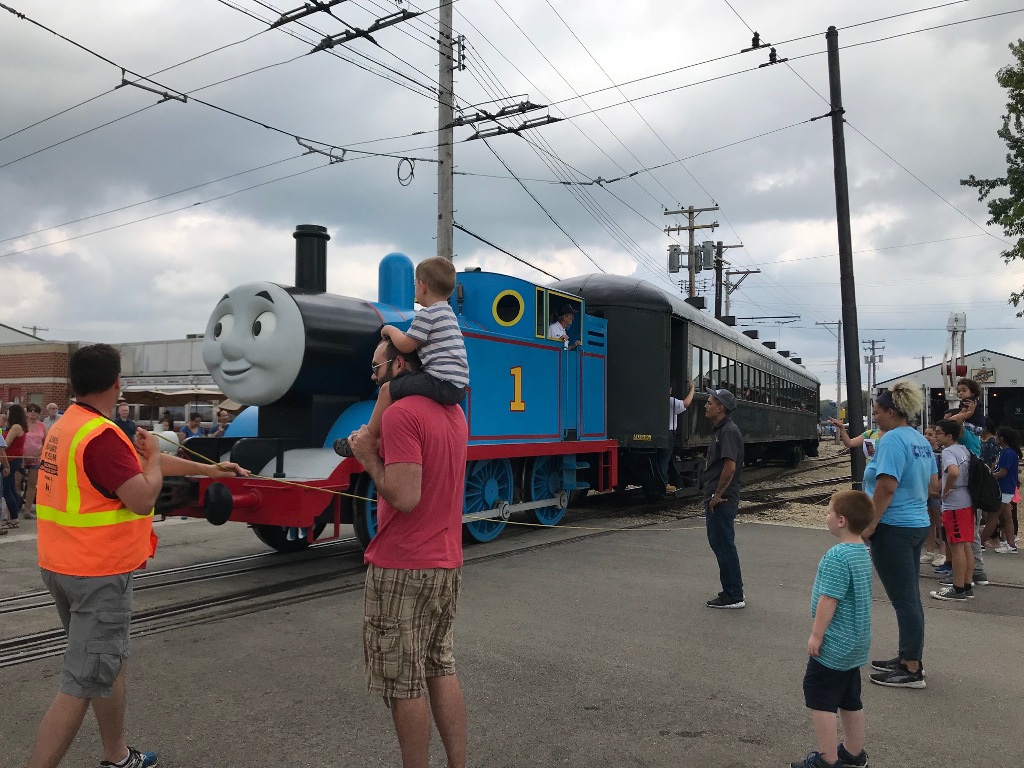
You're probably getting tired of seeing photos of the Thomas train, but too bad.
The streetcars in service were the usual: the 415, 3142, 144, and 4391. The Thomas train had the 7700, one Lack coach, and five Rock Island coaches, while the mainline Percy train was a rather attractive all-railroad-roof consist with the B&LE and Santa Fe combines bracketing two Lack cars and the DM&IR day coach.
I spent a little while working on cleaning old caulk and paint out of the end window frame on Shaker 18; a new piece of glass has been procured and I hope to install it soon, which will be a big improvement. The end windows on that car are big, about 34" square! Then, as operations were winding down, I moved the 36 over to Barn 7 just to get it out of the way for Monday. The 308 and 319 are supposed to be in the station around 9am so I figured I'd save my father a bit of switching. Barn 7 was home to the 309 and 321 for six or seven years, from the early 1990s until 2000, but I'm not sure the 36 has ever been in Barn 7 at all. I'm also not sure whether any of the wood cars has been on track 71, which for many years was home to the Electroliner. So here you go. Exciting, isn't it?
As I was closing the doors on 71, Bob Opal was bringing the 415 into the yard to officially close out operations on the Thomas event for this year.
And we are all set for the 308-319 to run tomorrow. Note to self, we still need to reinstall an "off 1" sign, marking where to shut off for the breaker, to replace the one that fell down. In other news, Jeff was working on more wooden platform bracing for the Michigan car while Thomas was "on call" in case of streetcars problems (there weren't any) and was working on catcher repairs on the 4410.

Saturday, July 21, 2018

Thomas Thomas Thomas

Say what you will about him, he's a very useful engine.  I spent most of the day handing out maps and schedules to incoming visitors, and answering questions.  We all need to make ourselves useful in some way or other, and this was it.  And it was quite enjoyable, I must say, compared to checking compressor oil.  The weather was excellent, and as usual everybody seemed to be having a great time.  Off-topic rant: these stupid weather reports on the TV nowadays are killing us.  They always want you to think the world is coming to an end, unprecedented disasters are around the corner, you'd better stay inside and watch TV instead of getting outside and doing something active, and as a result I think attendance suffers.  So there.  End of rant.

For us old-timers, Day Out With Thomas can perhaps seem a little monotonous, but for all the new visitors, it's very exciting.  One thing I don't remember seeing before is this inflatable Thomas blocking Central Ave.


And here we have the star of the show, along with two Chicago streetcars, only at IRM.


And I certainly don't want to ignore Percy.  


Once Percy has gone by, the train looks entirely normal.


And here is the Percy train in the station, with the Thomas train passing in the distance.


Dept. of Civic Improvement:


There are lots of things to do with small children.   Get in line to have your picture taken:


Ride a small engine around a circle of track:


Bounce down a slope:


Play in a sand pile:  


Watch a magic show:  


And get your picture taken, again and again:


Later in the day, Nick informed me that we have a fairly large crowd of something over 200 visitors coming Monday.  It's a club of Lionel collectors, and he wanted to operate the Zephyr and a two-car wood train in the morning for them.  I naturally agreed, and so I took off from handing out maps to checking compressor oil, main journals, and disconnecting the 36 from the 308 and 319 so we'll be ready to go Monday morning.  Henry Vincent will be the conductor.  And if YOU happen to belong to a group of any sort that want to have a good time, you can always charter a trip at IRM!

Thursday, July 19, 2018

The Great British Railfanning Trip: The Bluebell, Part II

This post follows Part I of our trip to the Bluebell Railway in England back on 23rd June, as the British would say. So we left off at Horsted Keynes, where we toured the carriage shop, looked over the wares of the Model Railway Weekend vendors, and followed Zach's suggestion and left some money with the nice folks at the Bluebell. We also had a quick lunch of sausage rolls and beer. What could be better?

While we're in Horsted Keynes, one of the southbound trains was the third train of the day, which I'll call the "older" train (as opposed to the "old" BR-era train and the "oldest" pre-grouping train, both shown in Part I). This was a train of four Southern Railway-era carriages pulled by South Eastern & Chatham 65, a gleaming O1-class 0-6-0 built at Ashford in 1896. As built it had a domeless boiler but it was rebuilt in 1908 and ended up running in service until 1961. It's been immaculately restored, as have the cars in the train: 6686, a 1935 Maunsell corridor brake composite; 1336, a Maunsell 1933 "droplight" ("drop sash" in American) open third that was built as a dining seating car; 1309, a Maunsell 1935 open third; and 1098, a rather older pre-grouping "hundred-seater" ten-compartment third built for the SE&CR in 1922 for use on London commuter runs. All cars are restored to matching SR green. The signal box in the background is original to the site and hasn't been moved since it was built here in 1882 by the London Brighton & South Coast.
The next southbound train was SR 847 pulling the BR-era consist that we rode on our first trip, so we hopped aboard and proceeded to the south end of the line: Sheffield Park. If Horsted Keynes was busy, Sheffield Park was even more so, with a large carriage shed, the locomotive workshop, a restaurant, and a very nice museum all clustered here at the railway's terminus. Here we see the levers at Sheffield Park Signal Box, which is located right on the platform. It was quite an array and was keeping the volunteer working it quite busy, but he was happy to answer a few of our questions when he had a moment to catch a breath.
I got the above video of 847 running around the train at Sheffield Park. It has just uncoupled from the train (visible on the right side of the frame) and is now returning on the passing loop. To the left is the locomotive shed with the coaling stage in the center background. The grey building in the right background is not, I believe, part of the Bluebell's property.
There was a lot to see at Sheffield Park. The engine shed, shown here, had been emptied out for Model Railway Weekend. The large modular layout in the foreground was a live-steam G gauge layout on which they were running, among other things, double-headed live-steam GWR Castles on an express. Pretty neat stuff! And that overhead crane isn't bad either.
Out in back of the engine shed there were some interesting items. I believe that the locomotive in the back is British Railways 4MT (MT = Mixed Traffic) 2-6-4T 80151, built in 1956, but the Bluebell has three of these weighty tank engines so I'm not sure. I'm also not sure to which locomotive that upended boiler belongs.
It might belong to BR 34059, a Bulleid "Battle of Britain" class 4-6-2 built in 1947 and currently undergoing overhaul. This locomotive had a full Bulleid casing when built, similar to the "West Country" class locomotive pictured in Part I, but the casing was later removed during a rebuilding and the locomotive was given more typical boiler jacketing.
Off to the side of the engine shed yard was one of the things we were really looking forward to seeing: the Atlantic House. Here the Bluebell is hosting a project to construct a replica of a London Brighton & South Coast 4-4-2 Atlantic. The replica, to be named "Beachy Head" as was one of the original Brighton Atlantics, is getting excitingly close to completion; the race is on between this engine and GWR 2999 "Lady of Legend" at Didcot for the honor of being the next new-build express passenger locomotive to run. Above, the rolling chassis was complete and on display with driver patterns hung on the wall.
And alongside the chassis was the boiler, which has been steamed and now needs to have such minor details as the smokebox fitted. The Atlantic project does have a ways to go but they've made a tremendous amount of progress and when done it will be the only standard-gauge Atlantic running in Britain.
At the southeast corner of the engine house yard, past Atlantic House, were a couple of tracks which I believe are used for running inspections and light maintenance. Two of the Bluebell's three signature P-class 0-6-0T shunters were spotted here. Above is 178, built in 1910 for the SE&CR and sold by BR to a paper mill in 1958. It was acquired by the Bluebell in 1969 but wasn't restored to operation until 2010. These P-class engines weren't terribly successful, as they were too light for many duties, but the eight built stuck around fairly late.
One of the P-class locomotives, 323 shown here, is the traditional flagship of the Bluebell fleet and indeed has been christened "Bluebell" (it's the engine pictured at the top of Part I). This engine was built in 1910 and acquired from BR by the Bluebell in 1960; it was one of two steam engines in use when the heritage railway opened that year. In honor of Model Railway Weekend, they were letting visitors walk into the pit underneath "Bluebell" and inspect the engine from underneath. It was pretty interesting!
Parked behind "Bluebell" on the same track, and also available for inspection from underneath, was BR 30541, an ex-Southern Maunsell Q-class 0-6-0 built in 1939 and the only survivor of its type.
After emerging from underneath the two engines (note the hardhat) we were able to inspect the cab of "Bluebell." Here Zach and Greg take a look. You'll note a couple of unusual things: first, the cab walls are grained, which the SE&CR apparently did to its engines. Second, it's right-hand drive. The SE&CR was one of a handful of British railways that had the driver on the right, American-style.
Around the time we made our way from the engine shed apron back up to Sheffield Park station, SE&CR 65 and the "older" Maunsell-era train came into the station while 263 and its "oldest" train of teak cars sat in the passing loop waiting to depart. What an operation!
The Bluebell is known for its small Southern 0-6-0T locomotives. The predecessor to the P-class was the A1-class, better known as "Terriers." One of two on the Bluebell is this one, number 672 "Fenchurch," was built in 1872 and was the first of the type to go into service. It remained in service for an incredible 92 years until it came to the Bluebell in 1964, by which time it was the oldest steam engine in service on BR. It's out of ticket currently but was on display at Sheffield Park.
Here's the teak train at Sheffield Park waiting to depart. Note the pedestrian walkway over the tracks; Sheffield Park is the only station on the Bluebell to have this feature, as East Grinstead only has a single platform and the other two stations have pedestrian underpasses.
Here's the 1905 H-class 0-4-4T departing Sheffield Park with its train. The ambiance here, as elsewhere on the Bluebell, is terrific, with original buildings and restored signage. The station houses a very nice restaurant (though we'd already eaten in the small cafe at Horsted Keynes). There's also a sign on the platform noting that the Prime Meridian goes right through the platform location, which is kind of fun.
On the west side of the Sheffield Park platform, across from the original station, is a small but very nicely-appointed museum. Out by the museum entrance were a couple of advertising posters which caught my eye.
I just thought these were pretty droll.
The museum is arranged more-or-less chronologically by era, noting the rise of the railways, the glory days, and the decline of rail travel. There are a lot of uniforms, signs, models, and miscellaneous artifacts on display including some ship models.
At the north end of the museum, visitors can walk outside and inspect Withyham Gate Box, beautifully restored as an LB&SC signal box.
Adjacent to the museum, and sharing its back wall, is the relatively new Sheffield Park carriage shed. It was mostly empty, as many of the line's carriages were in use during our visit! But there was a neat bay window where you could look into the carriage shed. Britain's heritage railways have been slower than their American counterparts to adopt a policy of putting as much equipment under cover as possible, as quickly as possible, but in recent years several of the big lines have focused on constructing expansive carriage storage buildings. This three-road building is about 400' long.
The SE&CR O1-class 0-6-0 was watered at Sheffield Park while we saw the museum and toured the model railway displays.
The second-to-last northbound train of the day was the 0-6-0 with its train of Maunsell carriages, so we took these back north to Horsted Keynes. On our way into the station we passed another large carriage shed, part of the Bluebell's "Operation Undercover" project, which will get quite a few more carriages under roof and out of the weather. Some of the tracks are already full of carriages, including the Bluebell's train of Pullman cars visible on the left side of the building. The water tower at this location is also evident on the left side of the photo.
We disembarked at Horsted Keynes for the purpose of hitting a few of the model railway vendors that were there. Here, the driver waits for the "right away" from the guard. Note that he's on the right side of the cab per SE&CR practice.
I picked up a couple of books on trams from the used bookstore at Horsted Keynes, but while we waited for our northbound I enjoyed a beer and watched the southbound arrive. And who knew palm trees grew in England? Here's the H-class with its teak train.
Regrettably we didn't get a chance to ride the four-wheelers that were part of the teak train, but they were a beautiful sight to behold. This carriage, London Chatham & Dover 114, is a brake third built in 1889 and restored by the Bluebell from a body.
But our time was almost up; the last northbound train on the Bluebell was the BR-era train behind SR 847, the same train that had opened our day, and we needed to catch it if we wanted to get back to London. Here's the train coming into the Horsted Keynes platform from Sheffield Park.
I'm more of a GWR fan myself but there's no two way about it, 847 sounded great going up the grade towards Kingscote. Most of the trains earlier in the day had been packed with people but this one was mostly empty. The Bluebell has seen a significant spike in attendance since they extended to East Grinstead and made their connection with the national rail network, but most of their visitors still come by car.
We passed the O1, on its last return trip southbound to Horsted Keynes, at Kingscote. This was actually the first time all day that we had stayed on any of the Bluebell's trains when it stopped at a station! From here we went up to East Grinstead, stopped at the grocery store next to the station for a quick snack, and took the train back to London. What a fantastic day!
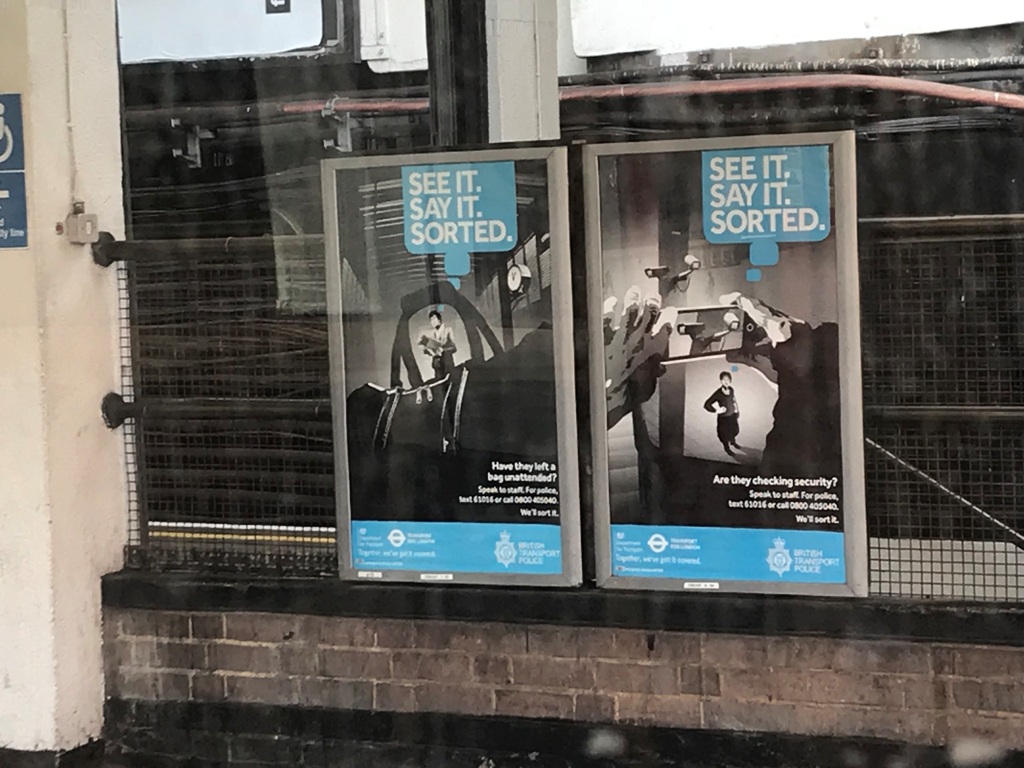
"See it, say it, sorted." This phrase was just as omnipresent on our public transit journeys as "If you see something, say something" is in the US but, of course, commendably more British.

Click here for Part VII of our trip.