Thursday, January 20, 2022

Doodlebug Update

Gregg Wolfersheim once again provides us with detailed pictures of his restoration of our classic UP doodlebug.  Enjoy!


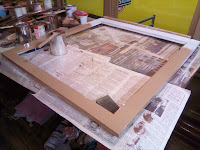
Slowly making progress on the doodlebug with one of the windows getting painted on the interior side. Some gluing and filler were necessary before getting to this stage.


Under windows 13 and 14 the insulation was applied last week.


Today the wall panel and bottom were applied.


The upright trim was also installed.

Wednesday, January 19, 2022

Tuesday Report

 Time for another progress report from Barn 4.  

Good progress was made on the lobster traps.  I removed a few more slats from the forms in the shop and took them out to the #1 end to start installation.  Then all of the other forms were put back in the shop, and all remaining slats that had been soaking were bent to shape and clamped.  In the picture below, two of them have extra bending so they will fit the bottom part of the assembly.


It was warm enough for primer, so I started on the #2 end as seen here.  The bottom surfaces can be painted with a small trim roller; that seems to work well.  I decided I didn't want to go up on top of the car to paint the other half today.


When it gets a little warmer, I'll need to apply some caulk in various places, and then it will be time for black paint.  


Nick came along and suggested a better shot of the two North Shore cars alongside each other.


I did some more trimming and painting on the saddles at the #1 end, and then started attaching a few slats.  They will then need to be removed, redrilled, countersunk, trimmed, and so on.  But by now I almost know what I'm doing...  I think.


The other regulars certainly seem to know what they're doing.  This is the west end of the 1808, with parts of the structure badly rusted out.


Gerry is working hard on grinding and welding to fix it.  Behind him you can see the new steel that will be welded in place.


And here he's grinding down the new pieces.


Tim continues working on doors and windows for the car.


John spent all day sanding down and finishing window moldings for the 306.


And I was very happy to see the progress that's being made on the compressor for the 36.  Here we see the pistons and rods.


And looking inside the cylinders, with the crankshaft visible at rear.  


Finally, since I'm done with soaking wood for now, I started siphoning the water out of the cylinder so it can be moved, emptied, and cleaned up.  I ran out of time so that will get finished next time.

So today was a day for us to do what we have been doing, and what we did got done.   What more could anyone want?

Tuesday, January 18, 2022

In Memoriam - Charlie King


We're sad to say that IRM's longest-serving member, Charlie King, died last week at the age of 84. We will all miss him; he always had great stories about his days at the CTA and was always an outgoing and friendly presence whenever he was on the property. He had done just about everything you could do at the CTA, I think - at one time or another he drove trolley buses and (I think?) motor buses, ran 'L' trains, served as a tower operator, and I think he worked at Skokie Shop for a time as well.

He was also an early member of IRM - the photo at top shows him on the right, with a couple of others, working on track at North Chicago around 1960 give or take - having joined in March 1956. I recall him saying that he had joined at the end of March 1956, just a few weeks after Bob Bruneau. He was also a volunteer (though not a full voting member) of the Electric Railway Historical Society in Downers Grove, and helped that organization acquire its collection of streetcars and build its barn. When Charlie had the opportunity to purchase CSL 84 in 1960 before it was scrapped, he bought it and it went to Downers Grove to become part of the ERHS collection. It was conveyed, along with the other equipment, to IRM in 1973.

Charlie's health had been declining for a while but he was able to come out and visit on Members Day this past year. Richard brought out CSL 84, the trolley bus that Charlie was personally responsible for saving and today one of the jewels of the trolley bus collection, and took Charlie for a last ride or two.

Obituary information can be found here. Visitation will be on Saturday at Tezak Funeral Home in Joliet.

Top photo: Ed Mizerocki. Bottom photo: Richard Schauer, 2008

Monday, January 17, 2022

Sunday update

Frank writes...


Sunday saw some more incremental progress on the 18. One thing I wanted to check on was the fit of the new longitudinal seat frame. Success! Many thanks to my father for building this.
I was able to find a spare piece of sheet metal of the right thickness that will form the seating surface for this, and atop that will go a layer of felt (or something) and then the rattan. Eventually. I ran out of time before I could cut it to size and drill holes for the nails, but hopefully that will be relatively straightforward.
The next order of business was to sand down the windows I painted last week for a second coat, and also to paint the two additional windows on hand. All of this seemed to go just fine, with the result that we now have four windows that should - depending on how they look when dry - be ready to go back into the car, nice and freshly repainted. I also removed two more windows from the car that will be next in line for stripping and repainting.
And I trooped over to Barn 7 to gawk at the interior of the F305 again with Joel. This is the view from the center door toward the east end of the car. The large black block on the left is the bumper block that hangs under the frame at the east end of the car. It was built some years back, it just never got installed.
Back in the car shop, there's some exciting news on the D3-EG air compressor for the 36. Our air compressor guru, Dan, was obviously back at work on this and he has the motor portion all reassembled. Next up is working on the air pump portion, so as you can see, the pistons have been removed for inspection and any necessary work. One thing he told me that was a requirement of his was that once the pump is rebuilt, it needs a fresh coat of paint before it goes back on the car - we want it to look as good as it runs.
As for other activity, Thomas was working on rebuilding a retainer valve for the Pennsylvania Railroad bobber caboose; Greg and Bob were out on the railroad finishing up the project to restore power to the railroad following a downed tree last month; Tim was working on doors and window sash for the 1808; and Nathan and Mike were working with Joel on various projects. 
I also made a quick trip over to the Hoffman garage to pick up another information file from the Scalzo Collection, so keep your eyes out for another article. Richard was putting another coat of silver on the left side of the Connecticut Company bus, as shown here. He's also been stripping paint off of the bottom half of the bus preparatory to repainting that portion blue. By the way, we're interested in feedback on the steady diet of "smaller electric lines of Illinois" historical articles we've been publishing on the blog. Let us know what you think of these, good, bad, or indifferent.

Thursday, January 13, 2022

Steps to Success

It's time for another progress report, as promised.  I started by making several adjustments to the saddles so the bottom two slats could be more securely fastened, and then installed two of the nifty new brackets that Zach made for this purpose.  I noticed, by the way, that the 160 has three of these at one end and one at the other, which makes no sense, but I'm told there should be two at each end, on the left side since that's the side that has the steps on the door frame.  When finished, it looks like this.


There were also several screws that needed to be removed so the holes could be redrilled.  Not much to see there.


And everything seemed to be nice and tight, so the real test is to actually climb onto the car using the grab irons and lobster trap.  Here I'm putting all my weight (no jokes, please!) on the second slat, the one with the brackets.  It's nice and solid.  Success!


Too bad it was too cold to start painting.  I did, however, change the bends in the drip rail slightly (with Tim's help) so it will fit this car properly.


And I removed some of the slats that were still in the bending frames to check their fit to the #1 end.  It should be fine.


The drip rail was wire-wheeled, but most of the paint stayed in place...


so I just put primer over it.


And started bending more slats for the #1 end.


Meanwhile, the Track Dept. guys spent much of the day unloading a new shipment of rails and hardware.  This will be used to replace about a mile of mainline with much better rails, and the old ones will then be used for Yards 12, 16, and elsewhere.


And back in the car shop, the other guys were at work.   Tim, of course, continues to refinish doors and windows.  But don't even think of touching them!


And John spent all day working on windows for the 306.  As he says, it's a job that sometimes never seems to end.  But he's making good progress.


That's it for today, but stay tuned for news of our latest acquisition, most recently reported to be at Dolton.

Wednesday, January 12, 2022

News from Home

 Even when travel is difficult, there are usually things we can do at home on Museum projects.  Here's the new seat frame for the Shaker Heights 18, next to the seat we were using as a pattern.  Frank pointed out that this seat will go in the spot where the car stove used to be, before the 18 was converted to electric heat.


And before we put it all away, here's this year's Christmas layout, with American Flyer wide gauge trains.


But in another day or two, we should have some news from the Museum itself.  Stay tuned!

Tuesday, January 11, 2022

City Railway Company of Mt. Vernon


City Railway Company of Mt. Vernon
by Stephen M. Scalzo

Headline image: Car 20 is seen with a load of passengers in August 1914. The motorman is Louie Cameron, the conductor at rear is John Fuqua, the boy on the step is O. Ragan, and the girl with the bow leaning out the window is Merle Shoop. Frank E. Butts photo.

Ed. note: Mt. Vernon is a city in southern Illinois, east-southeast of St. Louis. In 1910, its population was roughly 8,000 people.

Local planners talked about building some sort of public transit in Mt. Vernon, IL, as far back as 1889, but nothing serious was done until the Mt. Vernon Traction Company was formed on July 5, 1912, and a franchise obtained for two routes. On October 14, 1913, the company became the Mt. Vernon Traction & Power Company, and it received a new franchise. That company became the Mt. Vernon Traction & Car Company, which planned to construct a 2.5-mile streetcar system.

On January 7, 1914, construction started when a steam tractor engine started plowing a trench on Broadway just south of the Southern Railway tracks. Bad weather slowed the work, but by February 4th, the construction grading crew was working on the south side of the downtown square. By the middle of February, bad weather stopped construction, and it was the middle of March before it resumed.

Car 22 is shown in service in 1914. Frank E. Butts photo.

Due to legal technicalities, the company was reorganized as the City Railway Company of Mt. Vernon on April 1, 1914, with $40,000 of capital. A new franchise was granted shortly thereafter, and construction resumed. By April 15th, most of the rail on the Broadway line had been installed, and by the end of the month, all work around the downtown square was completed. In July, construction started on the car barn on 9th Street near Taylor Avenue, and the Public Utilities Commission granted the company permission to install a crossing with the Southern Railway on Broadway Street. On July 21, 1914, streetcar service began from the Chicago & Eastern Illinois Railroad depot out on the Broadway line, followed a few days later by service on the Oakland line. The company had 3.5 miles of trackage consisting of 55- and 60-pound secondhand rail over which three streetcars operated. The fare was five cents per trip.

Motorman Louie Cameron (left) and conductor Louis Pavey stand in front of car 20.

During 1915, earnings were only $3,231 with 64,616 passengers carried. Patronage never did come up to expectations, and on February 16, 1916, service was discontinued due to a lack of funds. In September, a receiver was appointed for the company, but operations were never resumed. In 1917, the property was sold by the receiver to Hyman-Michaels Company of Chicago, which dismantled the system.

The following was written about the Mt. Vernon system by James Buckley:

There isn't any doubt whatsoever that the entire project was part of a real estate speculation, the Columbia Heights subdivision especially. ...The Mt. Vernon Car Company and the other industries were located in the southeast section of the city and most of these workers lived on the east side, not in the north and west sections of the city. Yet there were not any plans to extend the car line to the east side (of course they would have to cross the C&EI tracks someplace). The north and west sides consisted of mostly single-family homes; many of these people were well-to-do and had automobiles. In fact the city was repaving and improving streets all over town at the very time the car line was under construction. The business just wasn't there.

Either car 20 or car 22 is shown at 9th and Harrison in 1914. The distinctive five-window end and roof-mounted headlight were hallmarks of Chicago Union Traction cars.

This article was edited and laid out by Frank Hicks. Thanks to Ray and Julie Piesciuk and to Richard Schauer for making available the materials needed to publish this history. For the record, the Mt. Vernon streetcar line operated for just under 19 months, surely a strong contender for shortest-lived electric railway in Illinois.

Roster of Equipment

Cars #20 & 22 - single-truck closed cars - built by American, 1892 - 31'2" long, 7'6" wide, 10'1" high, 17500 lbs - 28 seats - Brill 21E truck, 2 x GE 800 motors, K-10 control - Note 1

Car #? - single-truck 10-bench open car - built by Pullman, 1895 - 29'6" long, 7'6" wide, 11' high, 17000 lbs - ? seats - Brill 21E truck, 2 x GE 800 motors, K-2 control - Note 2

Note 1: Two cars purchased March 27, 1914, from broker Lloyd J. Smith; built for the West Chicago Street Railroad as their numbers 875 and 805, first used as cable trailers, to Chicago Union Traction in 1899, motorized in 1907 and renumbered CUT 4423 and 4434, to Chicago Railways in 1908.

Note 2: Open car purchased March 27, 1914, from broker Lloyd J. Smith; original owner uncertain, then Chicago Consolidated Traction 181; converted to utility service in Mt. Vernon.

Track Map
Monday, January 10, 2022

Sunday update

Frank writes...


It was very cold on Sunday and there was a lot of ice on the sidewalks (fortunately the roads were clear - the salt trucks had been out working overtime) but it was nice and warm in the car shop, so I spent most of my time at IRM there.
Since my father's been working on a seat for the 18, I figured I'd help a bit on the 714. Zach bent up some hat-section braces that will help reinforce the second slat from the bottom of each "lobster trap" because that's the slat that you're most likely to grab, or use as a step, when climbing up the end of the car. I found some screws of the right size and drilled the necessary holes; Zach later primed these and then in the evening I gave them a quick coat of black paint. In the meantime, Zach also bent up some bar-stock guards that go over the ventilator at the end of the car so that the pole doesn't strike it. By the end of the night those were primed and painted black as well.
I also spent a while working on windows for the 18. I didn't pull any more out of the car, but the two that received Epoxy last weekend got a coat of primer.
And then the windows that had primer on them got a first coat of finish cream. In the meantime, I also spent a few minutes helping Zach run some wood through the jointer and planer that will go towards new side doors for the 757. He split his day between the 714 and 757. Nick and Greg were out on the railroad repairing some storm damage to our overhead on the main line, and Joel was rearranging things in one of our document storage areas to make room for some new acquisitions.
The new acquisitions are several boxes of North Shore Line drawings and records, and there's a lot of very useful stuff here, including a wide variety of blueprints and drawings. In addition, there are records from the Research Department - including some pretty neat stuff that was proposed but never built - and some artwork for paint scheme proposals. Here's the really cool one: a battery locomotive done up in Electroliner green and salmon, complete with "The Road of Electroliners" on the hood.
And here's a drawing for a simplified Electroliner paint scheme. It's a bit reminiscent of something you'd see on an ACF MotoRailer, and I'd guess it would have looked pretty decent in real life, but I think keeping the original striped color scheme was the right move. Keep in mind, these aren't railfan drawings, these were done at Highwood, probably in the 1950s!

And a couple more proposed steeplecab paint schemes. The upper one is pretty horrible, with a coat-hanger kind of outline, but the lower one looks like it probably would have been pretty sharp. It's also reminiscent of the livery used by the CA&E on its steeplecabs in later years, though, so maybe I'm biased.