THE INTERSTATE
CSL 2846 and the Streetcar Service to Indiana
By Frank Hicks
Car 2846 stands at the wye at Forsythe & Exchange in East Chicago on May 18, 1923. It wears the early version of CSL red with the cream letterboard. CSL photo, Krambles-Peterson Archive.
CONTENTS
Foreword
Acknowledgments
Northwest Indiana
The Hammond Whiting & East Chicago
Streetcar Service Across the State Line
The Interstates
Changes in Ownership
Work Service and Retirement
Appendix A: Original Specifications
Appendix B: In-Service Modifications
Appendix C: HW&EC Roster
Bibliography
The Chicago Surface Lines was the largest streetcar system
in the United States. The CSL operated over 1,000 miles of track
and over 3,000 streetcars from its formation in 1914 until absorption into the
Chicago Transit Authority in 1947. Among
that massive roster, among the hundreds of Old Pullmans and New Pullmans, Big
Brills and Little Brills, Turtlebacks, Sedans and Muzzleloaders, was a small
but very unique group of 11 cars known colloquially as Interstates. They were the only CSL streetcars with
railroad roofs; the only ones built with Minneapolis-style platforms; the only
ones designed specifically for operation over the state line into Indiana. They were the closest things to interurban
cars that the Surface Lines ever ran.
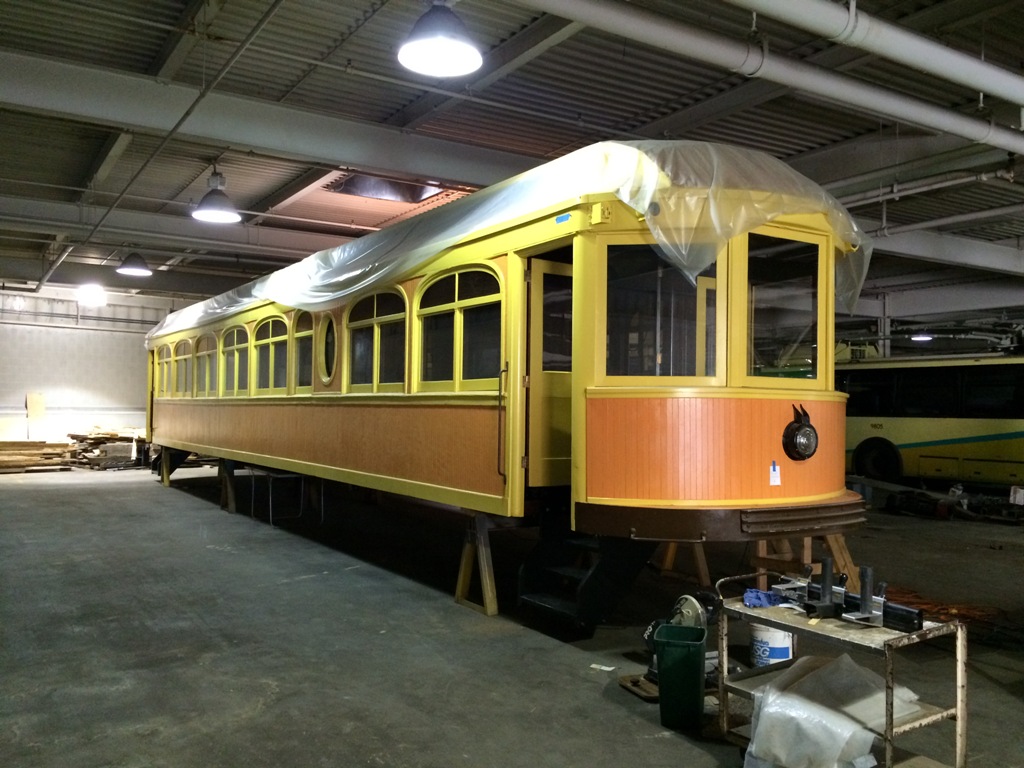
Remarkably, one member of this series, CSL 2846, survives to this day at
the Illinois Railway Museum. More than a century old, it remains largely
intact and unchanged since it was removed from passenger service 85 years
ago. The story of car 2846 is
intertwined with the other ten CSL Interstates, the South Chicago City Railway
that built them, the Hammond Whiting & East Chicago over which they
operated, and the cities of far northwest Indiana to which these cars ran for
their entire revenue service lives. This article will attempt to tell that story.
Thanks go to Joe Stupar, Art Peterson, Don Ross, David Sadowski, and Bill Wulfert for
providing the photographs used in this article.
Randy Hicks helped with correcting and proofreading the final draft.
At the time of the Civil War, when Chicago
was already a booming frontier city that had hosted the Republican presidential
nominating convention and was the foremost gateway to the west, northwest Indiana was largely
empty. Chicago
itself was a fraction of its size today and just over the state line Lake County
in northwest Indiana
was mostly swamps, prairie and farmland.
It wasn’t until 1868 that the first real development came to northwest Indiana, when Marcus Towle built a meat packing plant
along the tracks of the Michigan Central Railroad just over the state line from
Illinois. The plant was soon taken over and expanded by
George Hammond, whose Hammond Packing Company was based in Detroit.
Hammond
was a pioneer in the use of refrigerated railroad cars and his business
prospered for thirty years. In November
1883 the town of Hammond
was incorporated, though a de facto town site had existed for some eight years. Downtown was at Hohman Avenue, which ran past the Hammond
Packing Company site, at the Michigan Central Railroad. As the city developed, other industries moved
in to take advantage of the burgeoning number of railroads in the area and the
availability of water transportation via the Grand Calumet
River.
More towns weren’t long in coming to the area. Some four miles northeast of Hammond,
near Lake Michigan along the Lake Shore &
Michigan Southern Railroad, the Standard Oil Company came looking for a
refinery site in the late 1880s. It
purchased a large plot of land in a location known as Whiting, named after an
LS&MS man who had lost his life on the railroad, and constructed the
largest oil refinery in the state of Indiana
there in 1890. It wasn’t until 1895 that
Whiting was incorporated as a town, then as a city in 1903. As time passed additional oil facilities were
built in the area by Sinclair and Cities Service.
Around the time Whiting was sprouting up out of the ground,
the third city in this story was created, again by the arrival of heavy
industry. In 1887 the town of East
Chicago, Indiana was platted about 2.5 miles northeast of Hammond and the
following year the construction of the Chicago & Calumet Terminal Railroad
(later Baltimore & Ohio Chicago Terminal) connected the new town to the
Chicago railroad network. Industries
such as Grasselli Chemical followed but the city’s development didn’t really
take off until 1901, when Inland Steel built a giant steel mill on the east
side of East Chicago at Indiana Harbor. Within the following decade a planned
community had been built at Indiana Harbor and the Indiana Harbor
Ship Canal had been
dredged, allowing for the rapid development of heavy industry in the area.
In the late 19th century, the cities of northwest
Indiana were
developing at a rapid pace. But while
they were situated largely because of easy access to transportation, the
abundance of railroads and waterways in the area was also a problem. In downtown Hammond,
for instance, the main roads of State and Hohman were crossed by the Michigan
Central, Nickel Plate, Erie,
Chespeake & Ohio, Monon, and Indiana Harbor Belt Railroads – all within the
space of just a mile or two. Generally
poor roads typical of the time combined with heavy railroad traffic to make
transportation in and around these cities a serious issue and an impediment to
growth.
THE HAMMOND
WHITING & EAST CHICAGO
The solution to the transportation problem, as it was in so
many cities across the country in the late 1800s, was the street railway. The first franchise for a local street
railway had been granted in Hammond
way back in 1866 but it had gone nowhere.
However on April 18, 1892 a franchise was granted to the Hammond
Electric Railway Company. At the time
the only public transportation in town was an omnibus line to the Pennsylvania
Railroad depot. The streetcar line,
which was required to be powered by electricity, was to be built along two
miles of Hohman Avenue
starting at the cemetery south of town. The route proceeded north to Gostlin (145th)
Street, where it would turn off to go to the Pennsylvania depot. The line was put into service in September
1892, by which time the franchise had been acquired by the Whiting Hammond
& East Chicago Railway.
The line was an abject failure. The modest population of Hammond (about 7,000) coupled with the short
distance of the line drove the company into bankruptcy within months. It was purchased in early 1893 for $25,000 by
a trio of local investors who renamed it the Hammond Whiting & East
Chicago. Though they had gotten the line
for a fraction of what it had cost to build, it soon became clear that it was
not a money maker. One described it as
“a road which started nowhere, ended nowhere, and did everything but haul
passengers.” The hapless line was making
$15 a day, half of its operating expenses.
One motorman would simply leave his streetcar in front of his house at
night when his shift ended. The track
quality was so poor that it further depressed ridership.
The new owners of the HW&EC decided that the line had
potential; what it needed was somewhere to go.
The answer was right there in the company name. On May 15, 1893 a new branch was completed
east from Hammond
along Gostlin, Columbia Street
and Chicago Avenue
as far as Forsythe (today known as Indianapolis
Boulevard).
Later in the year a line up Forsythe to Whiting was built. Then on March 12, 1894 a line from downtown
Whiting along Indianapolis Avenue
was built all the way to the state line at Roby. Here the line connected with the South
Chicago City Railway, which could take passengers all the way to the South Side
Rapid Transit terminus at 63rd
Street.
Finally the Hammond
streetcar line had somewhere to go.
A map showing the extent of the joint streetcar operation across the state line. Roy G. Benedict map courtesy First & Fastest/Shore Line Interurban Historical Society.
STREETCAR SERVICE ACROSS THE STATE LINE
The South Chicago City Railway, or SCCR, had its origins in
a horsecar line inaugurated in 1885 in the town of
South
Chicago (annexed into
Chicago
in 1889). In March 1893, shortly
after electric streetcar service had begun in
Hammond, the SCCR had switched over from
horse power to electric power. Within
months the line had built an extension to the north, from downtown
South Chicago at
93rd Street to a connection
with the new South Side elevated line at
63rd Street. The SCCR also built in the opposite
direction, to the southeast, into the
East Side
neighborhood and towards the state line on
Indianapolis Avenue. (
More on the history of the SCCR can be found here.)
With the arrival at Roby (at Indianapolis Avenue and the state line)
of streetcar lines from both the east and west, it became obvious that
connecting service between Chicago and the Indiana cities would be
mutually beneficial for both the HW&EC and SCCR. The Indiana
system was quickly improving its physical plant: the capacity of the East Chicago powerhouse
was doubled in 1895. On June 18th
of that year a line straight north from Hammond
along Sheffield Avenue
to Indianapolis was put into service, providing
a direct route from Hammond
to the SCCR connection. That year the Indiana line carried
half a million passengers.
In 1896 the owners of the SCCR purchased a controlling
interest in the HW&EC, putting both companies under common ownership. (The SCCR acquired full ownership of the
Indiana company in 1900.) The line
between 63rd & Stoney
Island Avenue in Chicago and Hammond was
double-tracked and through service was inaugurated on May 15, 1896. There were two through routes from Chicago, a 14-mile line to Hammond
via Sheffield Avenue
and an 11-mile line to Whiting and East Chicago
following Indianapolis
and Forsythe Avenues. The cars ran over
the SCCR via 106th, Ewing, 92nd, Commercial, Baker,
Exchange, 79th and Stony
Island as far as 63rd Street.
Through service was immediately popular. Each company provided half of the equipment
required. All cars had two separate fare
registers, one for the Illinois side and one
for the Indiana
side. Cars were operated by SCCR crews
in Illinois and by HW&EC crews in Indiana. The Indiana
system never had a large roster, but with the close corporate ties to the SCCR
it commonly leased equipment from the larger Chicago system.
A track map of the HW&EC, in this case dating to the 1930s.
Then on October 23, 1901 the Hammond Packing Company plant
in Hammond
burned to the ground. About 2,000
workers were thrown out of work; over the coming months a total of 4,000
people, roughly half the population of the town, left. Hammond
was left half deserted. Although the
HW&EC’s line to East Chicago was largely
unaffected, the bulk of its business was on the Hammond line and the company suffered
financially. It sold off part of its
fleet, dispensing with all but 12 of its motor cars. Recovery would be slow but the streetcars
kept running.
At this time both lines were operating entirely with
single-truck cars, a mixture of closed and open cars, motors and trailers. In the 1890s, street railways were only
starting to appreciate the advancements in rolling stock design that
electrification made possible. Most streetcars
were still small, four-wheel cars not much bigger than a horsecar. But bigger streetcar lines had been ordering
larger, double-truck streetcars since the late 1890s and the lengthy through
routes from Chicago to Hammond
and East Chicago
were natural candidates. Double-truck
cars could not only carry heavier loads but they were much more comfortable and
could, hopefully, thus attract more business.
In 1902 SCCR built five big double-truck cars in its shops and the
following year ordered another five from Jewett. These ten cars were mostly assigned to the
interstate routes to Indiana. But more modern cars were needed.

SCCR Interstate 337 stands at the 63rd Street terminal soon after construction in this period postcard view.
THE INTERSTATES
In 1907 the fleets of the SCCR and HW&EC were fairly
unified as the companies continued to modernize. Older single-truckers on both lines were
numbered fairly randomly between 1 and 99; newer SCCR single-truckers were in
the 100-series; SCCR open cars were in the 200-series and 400-series; and
double-truckers of both companies were in the 300-series (later HW&EC
double-truck cars were renumbered into the 500-series). Both systems operated under the moniker “Red
Lines” and painted their cars red with cream along the windows. The SCCR, with more money and resources, had
built double-truck cars 301-305 in its shops and had bought 321-325 from
Jewett. Around this time the HW&EC
purchased four big double-truck cars numbered 326-329; their exact origins are
unknown but they were likely built at the SCCR shops on Ewing Avenue in South
Chicago. What is known is
that SCCR built for itself, in 1907 at its Ewing
shops, a group of 11 cars designed – as the four HW&EC cars were –
specifically for service on the through routes across the state line. They became known, fittingly, as the
Interstates.
SCCR cars 332-342 were as close to interurban cars as
anything operated in daily service by the Chicago
streetcar lines. They were big cars,
31’3” over the body posts and 43’ long over the bumpers with a height of 12’1”. They had several features unique among Chicago streetcars. Most noticeably, they had Minneapolis-style
rear platforms (as built, the Interstates were single-ended although they had
controls at both ends). This design,
which was almost universal in the Twin
Cities but rare
elsewhere, featured a large and entirely open rear platform with full-height
folding gates across the steps. The
conductor could open and close the gates as one would folding doors in an
enclosed car.
Car 342 sits in front of the Ewing Avenue barn in this image from a 1908 valuation report. The gates on the open rear platform can be clearly seen.
Another unusual feature of the cars was their partially
convertible design. Each car had a
smoking compartment at the front, itself unusual for a streetcar (though common
on interurbans). But while the main
seating compartment featured normal lifting window sash, the smoker had a lower
belt rail and removable window panels that converted the entire front of the
car into an open-air compartment with low sides. The seats in the smoker were
schoolhouse-style wooden seats with flip-up seat bottoms, presumably because
the seats would suffer less from exposure to the elements than would typical
rattan seats.
In this c1908 postcard view of car 341 at the 63rd Street terminal, the convertible panels at the front of the car have been removed and what appear to be wire mesh panels have been substituted in.
And a final distinguishing feature was the railroad roof that the series sported, rather than the deck roofs common among street railway equipment. These are thought to have been the only streetcars to run in revenue passenger service on the Chicago city system with railroad roofs.

Floor plan of the "Interstates" in their original configuration from a 1908 valuation report.
The motorman was ensconced in an enclosed cab at the front
of the car with an exit door to his right and a Peter Smith coal-fired water
heater to his left. The cars were built
with Taylor
trucks, like the 1903 Jewetts, and included such interurban-like features as
hang-on headlights and air whistles.
Cars 332-342 were certainly designed with the interstate routes in mind
and, if they weren’t unusually modern, they were still products that the SCCR
shops could be very proud of.
This is the right, or door, side of car 340 (later 2854) in its original configuration. The convertible section at the front has been opened up, with screens replacing the side panels. The front door, set well in from the side of the car, is visible as is the Minneapolis-style rear platform with partially wrap-around steps and wire gates instead of outside doors. A hang-on headlight can also be seen on the front of the car. Photo from the Illinois Railway Museum Scalzo Collection.
The blind side of car 338 (later 2852) is shown in South Chicago when brand new. Note drop rear - but not front - platform, solid window frames in the convertible section, and water heater on front platform. The emblem resembles a flower with "Red Lines" in the center. Joe Diaz photo.
At about the same time the HW&EC acquired four cars of
very similar design, though differing in some aspects (for instance, they
lacked the convertible smoker and railroad roof of the SCCR cars). It is thought that these were also built at Ewing but there is no evidence to prove this; only their
marked similarity to SCCR 332-342 lends credence to this theory.
CHANGES IN OWNERSHIP
The Interstates did not last long in their original
condition and within
a couple of years the entire 11-car fleet had seen
their smokers enclosed. Even their
“Red Lines” livery of red and cream was kept for only for a short time.
Car 2853 shows how the Interstates appeared in 1915, following their 1910 rebuilding and just after absorption into the new Chicago Surface Lines (note the "patch job" numbers and herald). CSL Photo, Illinois Railway Museum collection.
In 1908 the SCCR merged with the Calumet Electric to form
the Calumet & South Chicago (C&SC).
The new C&SC management also assumed ownership of the HW&EC,
though as before it remained a distinct operation. The “Red Lines” name was dropped and the
Interstates, along with the rest of the fleet, were repainted in Pullman green. They also got new numbers; cars 332-342 were
renumbered C&SC 831-841. It’s likely
that at this time the HW&EC too repainted its fleet in Pullman green. To replace its lost nickname it started going
by the name “Green Lines,” a name which stuck for decades and by which the
Indiana line would be remembered even after it was gone.
End view of car 2853 in 1915. Note the hang-on headlight. CSL Photo, Illinois Railway Museum collection.
Before long the Interstate fleet underwent a dramatic
transformation. As the various Chicago streetcar operators consolidated, there was a
movement towards standardization – and oddballs like the Interstates, with
their Minneapolis
platforms and schoolhouse seats, were as nonstandard as it got. All eleven cars were rebuilt around 1910 at
Burnside, the main C&SC shop. They
did keep their railroad roofs (all except car 835, which had been hit by a
Pennsylvania Railroad train near 94th & Cottage Grove in 1909 and had been rebuilt
with a deck roof). But there were plenty
of other changes. The cars were
converted to full double-end cars; lost their Minneapolis gates at the rear and
motorman’s cab at the front; were given large drop platforms at each end with
manually-operated folding doors; had their smoker bulkheads removed; and had
their seating replaced with normal Hale & Kilburn rattan walkover
seats. They also lost their Peter Smith
heaters and were converted to electric heat.
A schematic of the Interstate fleet at the time of absorption into Chicago Surface Lines in 1914. Illinois Railway Museum Collection.
The oddball of the Interstate fleet was car 2850, rebuilt with a deck roof following an accident. It is pictured on May 18, 1923 at the East Chicago wye on Forsythe. It still has its original compressor, likely either a D1-EG or D2-EG. CSL photo, author's collection.
They emerged as handsome cars, still as imposing as ever
with their big windows and railroad roofs.
And they were still assigned exclusively to the interstate lines to Indiana. Within just a few years, C&SC’s fleet had
been absorbed into the new Chicago Surface Lines (CSL) operating company to
form the largest street railway system in the country. With the CSL came more changes, though minor
ones this time; the Interstates were converted to Pay-As-You-Enter (PAYE) fare
control, with passengers entering at the rear platform and exiting at the front
rather than paying a roving conductor.
This necessitated installing crank-operated doors at the front and
mounting the doors to the platform corner posts rather than the body corner
posts.
Car 2854 is at Buffalo & 92nd in July 1929, just before the stock market crash. William Janssen photo, Krambles-Peterson Archive.
Through all of these changes, the eleven cars remained
assigned almost exclusively to the Interstate routes to Indiana.
Into the early 1920s they shared these routes (Hammond
became Through Route 11 while East Chicago
became Through Route 12) with the same ex-SCCR cars that had operated there for
years, plus some 2800-series ex-Chicago
City Railway cars. The routing did change somewhat; after 1914
the through service’s northern terminus moved a mile and a half west of Stony
Island Avenue and the cars ran over the CSL via Ewing, 92nd,
Commercial, 91st, South Chicago and South Park to a terminal at 63rd
& Vernon on the South Side “L”. Some
runs from Whiting also terminated in South Chicago
at 93rd & Commercial.
The car number isn't legible, but this photo shows an Interstate crossing the Illinois Central on April 23, 1930, possibly on 92nd.
Car 2851 is at Cottage Grove car house, probably during the 1930s and possibly around the time these cars were removed from passenger service. Don Ross Collection.
WORK SERVICE AND RETIREMENT
The Interstates became so closely associated with the routes
to Indiana because they were never assigned to
any other route – a rarity in a system as large and diverse as Chicago’s.
The Interstates soldiered on in their service to Indiana right up until the Depression even
while other ex-SCCR cars like the Jewetts, which suffered from small platforms
and were correspondingly slow-loading, were retired. Although they saw some modifications (like
Utility ventilators) that were standard features on the CSL, they retained the
air whistles and dual fare registers that were hallmarks of the interstate lines. In about 1932, with ridership (and car
requirements) down and costs up, the CSL pulled the old two-man Interstates
from service. All of the old wooden
cars, in fact, were taken off of the Indiana
lines and replaced with 1920s vintage steel cars 6199-6220. These were part of a series of cars built as
multiple-unit (MU) cars, but by 1932 they had been stripped of their couplers
and converted to one-man operation. Some
“Muzzleloaders” (Nearsides) saw service on the lines to Indiana as well but the 6199-series MU cars
were the ones that held down most service there during the depression.
CSL 5708 was one of the "Muzzleloaders" that briefly saw use on the lines to Indiana. David Sadowski Collection.
The HW&EC, by this time, was a financial wreck. The 1910s had been a time of expansion as
industry exploded in northwest Indiana,
particularly in the Indiana Harbor area to the east of downtown East Chicago.
In 1914 a 3-mile long extension to Guthrie & Michigan in Indiana Harbor had been built and between 1916
and 1919 a total of 16 new all-steel cars were purchased by the HW&EC. But in the mid-1920s motor bus competition began
to decimate the Indiana
line’s profits on its local lines; in 1929 the company went into receivership
and was sold to Calumet Railways.
Grandiose plans to expand and modernize the Indiana system were made but, with the
Depression taking hold, all collapsed. In
1931 Chicago & Calumet District Transit (C&CD) acquired the line,
abandoned some local lines, cut back on track maintenance (to the obvious
detriment of passenger comfort), and converted its newer cars to one-man
operation. But ridership continued to
plummet, propelled by the nauseating ride over the increasingly deteriorated
C&CD track. On June 9, 1940 the last
car pulled into the barn at Hammond
and the C&CD was abandoned.

Car 2846 is shown in one of the CSL's car barns; the year and location is unknown but this is most likely during the 1930s. Author's collection.
This rare interior view of car 2854 was taken on April 23, 1936 by Ed Frank Jr. The car looks to be in very good condition but is almost certainly out of service, given that there aren't light bulbs in any of the sockets. Scalzo Photo Collection, Illinois Railway Musem.
Since 1932 the ten remaining Interstates (unlucky car 2850,
the same one that had been wrecked in 1909, was destroyed in a fire in 1924)
had meantime been in dead storage, likely at South Shops. During the Depression the CSL had a large
number of cars in storage, awaiting a possible upturn in traffic. (The CSL always seemed to have a lot of old
cars it kept around – as late as 1930 it still had an entire carbarn full of
ancient single-truckers in dead storage.)
It was fortunate that this was the case when World War II began; with
ridership hitting new highs, the CSL went looking through its own retired fleet
for spare equipment to fix up and put to use.
The dark green paint job means car 2846 is now officially in work service in this 1943 photo. It still wears its window guards on the outside and hasn't yet received a CTA AA-series number. Robert Gibson photo from the Don Ross Collection.
In the early 1930s the CSL had started using salt to melt
snow along the tracks. For this it
tended to employ retired streetcars, suitably modified, and around 1943 it
converted all ten of the stored Interstates to salt cars. The cars had their seats removed; bins for
salt bags were installed inside the cars and holes were cut in the floors for
spreading salt; the windows guards were moved from the outside to the inside of
the cars; and somber dark green replaced the red and cream passenger
livery. In this guise they continued to
operate into the early 1950s, acquiring AA-series work car numbers in 1948 from
the Chicago Transit Authority. But the
fleet steadily shrank. Car 2847 was
scrapped in 1948 (before being renumbered into the AA-series); three more were
scrapped in 1951, one in 1952, two in 1954 and two in 1956.
Only one car was left.
Car AA-98, the first of the series, built as SCCR 332, then C&SC 831
and latterly CSL 2846, survived on a storage track at South Shops along with a
motley assortment of other old-timers including an ex-SCCR Jewett, a “Matchbox”
and an 1899-vintage “Bowling Alley” – all likewise converted to salt car
service in their later years. There the car sat in 1958 when members of the
Electric Railway Historical Society, a group of streetcar fans that had broken
off of the Illinois Electric Railway Museum in North Chicago, came looking for
Chicago streetcars to save.
Salt car AA-98, ex-2846, is pictured outside of South Shops on May 25, 1958, possibly one of the last times it operated under power. While the car was renumbered by the CTA, it still retains its CSL herald some ten years after the advent of the CTA. Photo by Bob Selle, David Sadowski Collection.
They were in luck.
All four of the old wood cars on that storage track at South Shops were
preserved. Car AA-98 (2846) was the
third car to be removed from CTA property and was trucked to the ERHS site in
suburban Downers Grove in December 1958. But alone among the cars ERHS bought from the
CTA, the 2846 was not acquire complete.
Bill McGregor, one of the ERHS members, advocated acquiring a different
set of trucks because the Taylor
trucks underneath the car could not, in his opinion, be easily converted to
full-width wheel treads for operation on open track (all CSL cars ran in
service with narrow-tread wheels, of course).
So instead the car was acquired with a set of McGuire MCB trucks that
would eventually be used under Chicago & West Towns 141.
Car 2846 is in its new home in Downers Grove in this 1959 photo. Behind it is "Matchbox" 1374. The ERHS barn is starting to go up around the small collection. Glenn Anderson photo from the Krambles-Peterson Archive.
McGregor’s plan was to backdate the 2846 to original
condition, with Minneapolis
gates and convertible smoker, and to that end the ERHS also acquired a pair of
truly ancient Gilbert MCB trucks from the Intramural Railway at the 1893
Columbian Exposition. The idea was to
build a replica SCCR open car trailer using these trucks and pull it with the
backdated 2846.
But none of it happened.
What did happen was that ERHS built a sturdy barn and put all of its
ex-Chicago streetcars inside, protecting them from the elements. There the 2846 sat for 15 years until the
ERHS was dissolved in 1973 and its collection was donated to IRM. The Interstate was trucked out to Union, much
further from its birthplace than it had ever been before, and was again put
into indoor storage – first in Barn 3 and then, from the 1980s until May 2016,
in Barn 7.
Indoors it has remained ever since 1960 or so when the ERHS
barn was completed. Although missing
trucks, motors and some underbody equipment, the body of car 2846 is
essentially unchanged from its salt car days of the 1940s. It has suffered relatively little from the
weather, though its underbody may have deteriorated from its years as a salt
car – a comprehensive survey of the car’s condition has never been done. But car 2846, the last Interstate, remains
intact and available should the interest ever arise in restoring it.
May 2016 saw car 2846 outside of Barn 7 for the first time in some 15 years. It was relocated to Barn 13 at the south end of the property. Photo by the author.
APPENDIX A: ORIGINAL SPECIFICATIONS
Cost new: $3,152 (less trucks and motors)
Double-truck, 4’9” wheel base, 33” wheels
Length overall 43’
Length over body 31’3”
Width 8’3-1/2”
Height floor to ceiling 8’
Height rail to trolley board 12’1”
Truck centers 19’6”
Seating capacity 43
Main compartment, 10 reversible Hale & Kilburn, 2
longitudinal, rattan covered
Smoking
compartment, 8 wooden folding A.H. Andrews & Co. cross seats, school
pattern, seven two-passenger seats and one single-passenger
Side sills, 5”x6” yellow pine reinforced with 3/8”x18” steel
plate
End sills, 4-1/2”x10” oak
Corner posts, 3”x4-1/4” ash
Center posts in main compartment, 1-1/2”x4-1/4” ash
Center posts in smoking compartment, 3”x5” ash
Sheathing, 3/8”x14” poplar above 3/8”x18” steel plate
Car lines, ash
Roofing, canvas
Ceiling, quartered oak veneer
Floor, yellow pine with ash strips
Main compartment interior woodwork, cherry
Smoking compartment interior woodwork, oak with exposed
posts
Main
compartment side windows (14), double, drop sash – lower sash 29-1/2”x27”,
upper 29-1/2”x16-1/2”
Smoking compartment side windows (8), removable –
5’1-1/2”x28-1/2”
Front body end door, single sliding, 26-1/2” opening
Rear body end door, double sliding, 37” opening
Partition door, single sliding, 26” opening
Front vestibule side door, single swing, 31” opening
Fare register, Sterling-Meaker #5, operated by rod
Track scrapers, one pair Van Dorn & Dutton
Fender, one Berg
Front steps, double Stanwood
Rear steps, single Stanwood built to suit two 35” platform
openings
Main compartment interior finish, one coat shellac, two
coats varnish
Smoking compartment interior finish, finished weathered oak
Exterior finish, vermilion below the belt, chrome yellow
orange above
This 2015 photo shows the interior of car 2846 as it exists now. Hardware, including clerestory window cranks and light fixtures, is generally intact and the interior wood is in good condition though the finish has deteriorated. Photo by the author.
APPENDIX B: IN-SERVICE MODIFICATIONS
1910 CCRy rebuilding:
-rebuilding
of rear platform into fully-enclosed platform
-smoking
compartment changed from semi-convertible to enclosed
-left side
doors added at both ends
-removal of
couplers
-heating
system changed from hot water to electric
-smoker
partition removed
-school-style
seats in smoker changed to standard walkovers
-seating
arrangement changed
-truck
fenders (guards) added
-original
step wells (“Stanwood” type) replaced with folding steps
-sign boxes
installed in center window at both ends
-upper sash
sign boxes added at middle of car
-addition
of angled dasher panels
-wire mesh
window guards replaced with eight-bar guards
1914 PAYE rebuilding:
-doors
changed to hinge from end post rather than body post
-hand crank
added for opening right doors at each end
-conductor’s
stool and foot pedal for fare register added to platforms
c1915-1920: addition of Utility style ventilators in roof
c1915-1920: removal of air whistles
c1915-1920: removable arc headlight replaced with permanent
dash headlight
c1920s: window guards shortened from eight to six bars
c1920s?: air compressor changed to National A4
1943 salt car rebuilding:
-all seats
removed
-bins for
salt installed
-chutes and
holes in floor added
post-1943: window guards relocated to inside of windows
This blueprint from 1915 shows modifications made to the Interstates to convert them to Pay-As-You-Enter. Illinois Railway Museum Collection.
The interior of car 2846 is largely as it was when it left passenger service in 1932. Note the dual fare register mounts, one for each side of the state line. In-service lettering is also visible. Photo by the author.
Liveries:
c1907-1908 – SCCR 332 – vermilion body with chrome yellow
along windows, varnished windows and doors, “Red Lines” emblem centered on lower
side panels, side numbers on lower panels over trucks, end and side numbers in
script, striping
1908-1914 – C&SC 831 – Pullman green body, varnished or
brown windows and doors, gold C&SC emblem centered on upper side panels, side
numbers on upper panels over trucks, gold numbers in Roman, gold striping
1914-1923 – CSL 2846 – Pullman green body, brown windows and
doors, gold CSL emblem centered on upper side panels, side numbers on upper
panels over trucks, gold numbers in Roman, gold striping
1923-1943 – CSL 2846 – carmine red body with cream along
windows, brown windows and doors, silver CSL emblem centered on upper side
panels, side number centered on lower side panels, silver numbers in Roman, silver
striping
1943-1947 – CSL 2846 [salt car] – dark green body, brown
windows and doors, silver CSL emblem centered on upper side panels, side number
centered on lower side panels, silver numbers in Roman
1947-1958 – CTA AA98 [salt car] – dark green body, brown
windows and doors, silver CSL (not CTA) emblem centered on upper side panels,
side number centered on lower side panels, silver numbers in Roman
APPENDIX C: HAMMOND
WHITING & EAST CHICAGO ROSTER
Roster Information from James J. Buckley
Up until 1896 revenue cars were numbered in the single-digits; after that passenger cars were numbered into the 300-series (possibly cars used on interstate lines, as cars in this series were numbered around some cars on the SCCR), 400-series (city cars - motor), and 500-series (trailers). In 1909 all double-truck cars were renumbered into the 500 series (the trailers had all been scrapped). Then in 1916 remaining revenue cars in service were renumbered with two-digit numbers starting at 51 and, eventually, ending at 80. Service cars during this period were numbered 1-10. After 1932 only cars 70-80 were used in revenue service, with only rare exceptions.
One of the steel HW&EC Brills, shown at the East Chicago wye in service in May 1923. First & Fastest/Shore Line Interurban Historical Society.
Revenue Equipment
1 – Pullman, 1889 – single-truck closed motor – purchased 1892, had previously been a double-deck demonstrator – out of service 1893
46-47 – Jewett, 1896 – length
30’ – weight 18000# - 32 seats – 2 x WH 12A motors, McGuire truck, K-control – identical to SCCR 38-44, ex-HW&EC 416-417 – retired 1916-1917
51-55 – Laclede?; year unknown – length, weight, seats unknown – 4 x GE 80 motors, Taylor
trucks, K6 control – scrapped by 1925 – see note A
56-57 – St Louis, 1901 – length
46’8” – weight 52800# - 44 seats – 4 x GE 67 motors, McGuire 10A trucks, K6
control – purchased 1912 and 1909 resp. from Chicago City Railway, ex-CCR 2561 and 2545 resp.,
ex-HW&EC 506-II and 507 – scrapped c1930s
58-61 – Jackson
& Sharp, 1902 – length 44’3” – weight 53000# - 47 seats – 4 x GE 80 motors,
Peckham 26 trucks, K28 control – purchased c1907 from Indianapolis Shelbyville
& Southeastern, ex-HW&EC 326-329, ex-HW&EC 508-511 – scrapped 1938
62-64 – St Louis,
1901 – length 46’8” – weight 52800# - 44 seats – 4 x GE 67 motors, McGuire 10A
trucks, K6 control – purchased c1910 from Chicago City Railway, ex-CCR 2543,
2548, 2547, ex-HW&EC 512-514 – scrapped 1934-1940
65-68 – American,
1916 – length 48’ – weight 56400# - 54 seats – 4 x GE 80 motors, Brill 77E
trucks, K28 control – scrapped mid-1930s
69-70 – American,
1917 – length 48’ – weight 56400# - 54 seats – 4 x GE 80 motors, Brill 77E
trucks, K35 control – 69 scrapped mid-1930s, 70 converted to one-man 1932
71-80 – American,
1919 – length 48’ – weight 56850# - 54 seats – 4 x GE 203L motors, Brill 77E1
trucks, K35 control – converted to one-man 1932
301-304 – Pullman, 1896 – single-truck open motor – scrapped 1900
401-404 – Pullman, 1892 – single-truck closed motor – built for CNS St Rwy, ex-HW&EC 1-4 – out of service by 1907
405-406 – Laclede, 1893 – single-truck closed motor – ex-HW&EC 5-6 – out of service by 1907
407-408 – Pullman, 1890 – single-truck open motor – built as Pullman demonstrators 300-301, ex-HW&EC 7-8 – scrapped 1900
409 – Pullman, 1895 – single-truck open motor – ex-HW&EC 9 – scrapped 1900
410-415 – Pullman, 1896 – single-truck closed motor – identical to SCCR 32-37 – out of service by 1907
418 – Jewett, 1896 – length 30' – weight 18000# – 32 seats – 2 x WH 12A motors, McGuire truck, K-control – identical to SCCR 38-44 – transferred 1916 to SCCR, later C&SC wrecker 57, later CSL P301
501-507? – builder unknown, acquired 1894 – single truck open trailer – scrapped 1900
506-I – St Louis, 1901 – length 46'8" – weight 52800# – 44 seats – 4 x GE 67 motors, McGuire 10A trucks, K6 control – purchased 1909 from Chicago City Railway, ex-CCR 2544, returned to CCR in 1912
508-511 – Pullman, 1896 – single-truck open trailer – scrapped 1900
Non-revenue
equipment
? - snow sweepers (2) - McGuire, 186 – scrapped 1900
1-3 - snow
sweepers – McGuire, 1900, 1909, 1913 – length 28’4” – 2 x GE 67 motors, McGuire
truck, K35 control
4 – 5000 gal
sprinkler – McGuire, 1913 – length 34’ – 4 x GE 80 motors, McGuire MCB trucks,
K35 control – rebuilt as plow 1919
5 – line car –
homebuilt, 1910 – length 35’6” – 4 x GE 80 motors, Peckham 29 trucks, K12
control
6-I – line car - homebuilt, 1907 – scrapped c1916
6-II – line truck – Garland, 1916
7-8 – work cars –
homebuilt, 1910 – length 36’ – 4 x GE 80 motors, Peckham 29 trucks, K28 control
9 – wrecker –
homebuilt by CE Co, 1907 – length 30’ – 2 x WH 12A motors, McGuire Columbian
truck, K-control – rebuilt from express car 1912
10 – 2500 gal
sprinkler – McGuire, 1902 – length 25’6” – 2 x WH 12A motors, McGuire truck,
K12 control – scrapped c1930s
All equipment scrapped 1940 except where noted.
Photo of HW&EC car 505 in service. The car retains its open rear platform but has been given Peckham instead of Taylor trucks. James Buckley photo.
Note A: The most
interesting cars on the HW&EC roster for students of the SCCR Interstates
were cars 51-55. They had formerly been
numbered 316-320 and then, from 1909 to 1916, 501-505. Records about them are scarce. James Buckley concluded that they were built by Laclede and acquired in 1903. Two in-service photos show that
they were extremely similar to the SCCR Interstates as built including window
design and arrangement (including smoking compartment at the front), the
unusual Minneapolis rear end, deck roof, truss
rods, and Taylor
trucks. The biggest difference is that
they apparently lacked the partial convertible design of the SCCR cars. Early in life they wore red and cream, as did
the cars of the SCCR, and at least some featured a “Red Lines” roundel on the
car side. It's possible that these cars were rebuilt by Ewing Shops around the same time as the Interstates or that they simply influenced heavily the SCCR cars.
BIBLIOGRAPHY:
Andreas, A.T. History of Cook County, Illinois.
Chicago, IL:
Andreas Publishing, 1884.
Arnold, Bion J.
and George Weston. Detailed Exhibits of
the Physical Property and Intangible Values of the South Chicago
City Railway. Chicago, IL:
Traction Valuation Commission, 1908.
Benedict, Roy G. The Streetcar System of Hammond, Indiana. Hoosier Traction Meet, 1997.
Buckley, James
J. Bulletin Number 8: The Hammond Whiting and East
Chicago Railway. Chicago, IL:
Electric Railway Historical Society, 1953.
Calumet & South Chicago Railway. “D.T. Pasenger Cars Series #831-834
and 836-841.” Blueprint, 1914.
Chicago Surface Lines.
“Proposed P.A.Y.E. Floor Plan, Car Series #2846-2856 (Old #831-841).”
Blueprint, c1914.
“East Chicago, IN,”
Encyclopedia of Chicago, accessed
March 4, 2016, http://www.encyclopedia.chicagohistory.org/pages/402.html
"Hammond, Whiting &
East Chicago Railway," Electric
Traction, September 1912: 896-898.
Lind, Alan R. Chicago Surface Lines: An Illustrated
History, Third Edition. Park
Forest, IL: Transport
History Press, 1986.
“Whiting: A City Rich in History,” Whiting, Indiana City Website, accessed
March 4, 2016. http://www.whitingindiana.com/about-the-city/history/
“Whiting, IN,” Encyclopedia of Chicago, accessed March
4, 2016, http://www.encyclopedia.chicagohistory.org/pages/1353.html