Sunday, June 19, 2016

Deaccession List -- Wulfert Photos

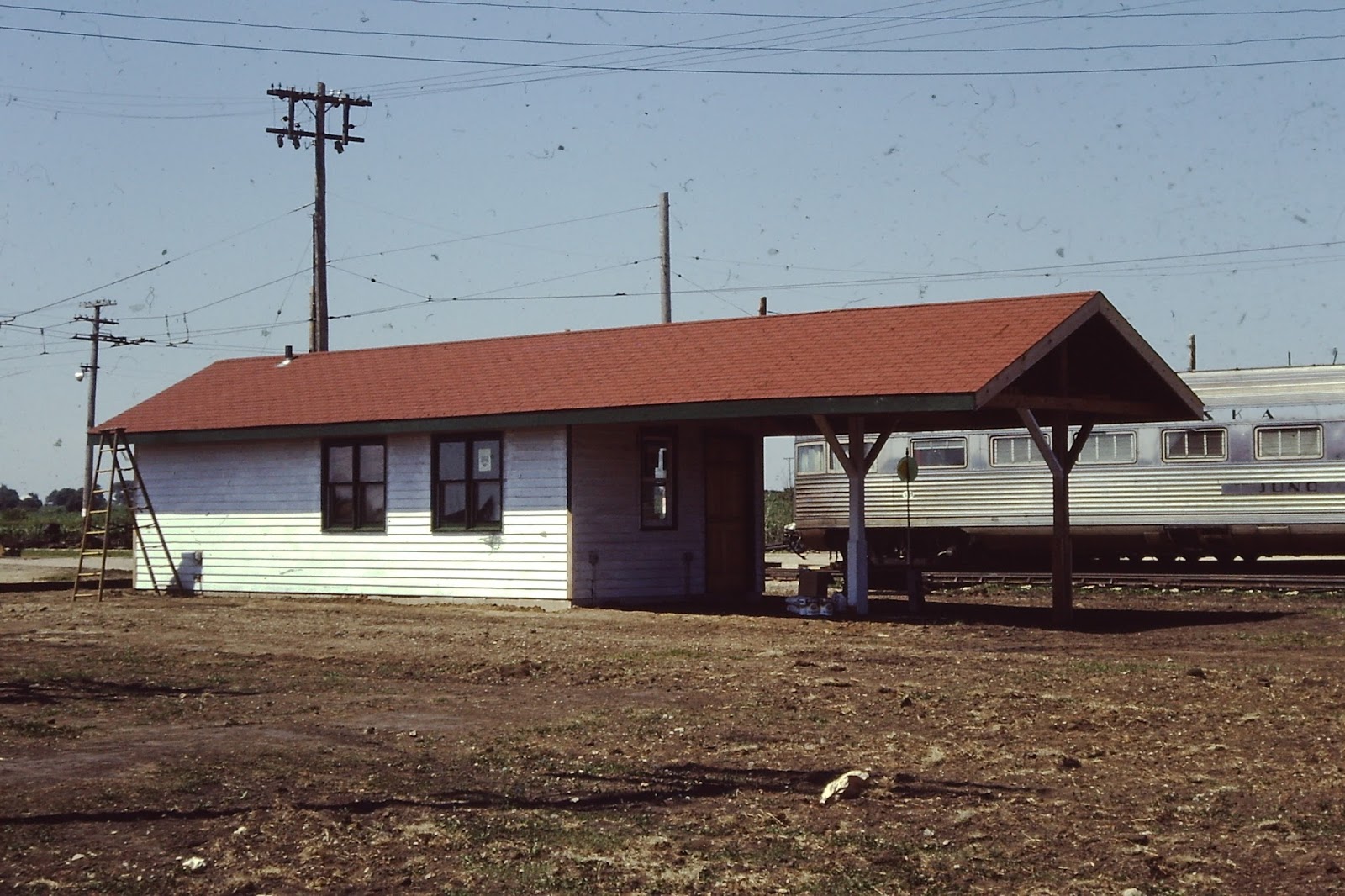
A collection of slides from Bill Wulfert of equipment on the deaccession list, and also some buildings and other features of the landscape that are no longer there.  This is a work in progress, and we will be adding and rearranging.

All images copyright by Bill Wulfert.   Do Not Use or Reproduce Without Permission.


CTA Line Truck 604
Oct 1978


NSL 202
Mar 1974


PRR 4668

Jul 1978

Nov 1978

Dec 1978


PST 68

Aug 1976

Aug 1976

Oct 1976

Jul 1980

Mar 1983

Mar 1983

Mar 1983

Mar 1983


First Hot Dog Stand
Jul 1977


Mobile Classrooms


Jan 1980

Jan 1980

Jan 1980

Jan 1980

Jan 1980

Mar 1980


VO 667

PRR Diner

C&WT 140
Sep 1988


IRM Tank Cars
Jan 1980


 SF 2302

Oct 1974


Boston PCC


2002

IRM Removing CA&E Track in Aurora
Dec 3, 1994


Kettle Moraine 2

Jan 1980


IC 3719 (I think)


Jan 1987


IRM Narrow Gauge


Nov 1983

Friday, June 17, 2016

Visit to Pennsylvania Trolley Museum

On the way to Boston, my wife and I had a chance to stop at the Pennsylvania Trolley Museum to meet with Bruce Wells.   Frank and I had been there a couple of months ago, so there won't be a lot of pictures.   But great progress has been made on their Cincinnati curved-side car, West Penn #832, which Bruce was naturally proud to show us.  I've been impressed with the quality of the restoration work done here ever since I first visited the Arden Trolley Museum back in the seventies.

 The exterior paint job looks great.


Wiring in the control compartments at each end is nearly complete. 

The most noticeable thing is that the ceiling is also nearing completion. 


Then it was time for a relaxing ride on an open car.  This is a car from Rio, so it's not on Frank's list.  The controls are still labeled in Portuguese, but it's not that hard to figure out.


Time for a speed run!


Gregg W. comments:  I've noticed that every time we see pictures of the PTRM shop, it's so clean and organized.  Not like some other places I've been to.  I wonder what's their secret?
I've wondered the same thing, Gregg.  And I myself am certainly no great example of cleanliness and organization.  Maybe Bruce should give us a seminar at the next ATRRM conference.

Doodlebug Report

Gregg Wolfersheim has been helping us out as needed with inspections and mechanical work, but also finds time to keep the pot boiling on the M-35 doodlebug.   He reports:

A few more items from the M-35 project. This is the front window near the air compressor. We have been trying to locate the frames, and remember how they were applied. After 38 years, the memories are a little fuzzy. I then found a frame which I thought went to the trainline door. It was in primer, but as you can see, it fits the lower opening. The upper is still missing. It slides up and down.


Some more roof progress on UP doodlebug M-35. Here we see the very front carline on the right side that has been reworked. Also the strip at the right of the picture was created, since the original was gone. It simply holds the roof boards and ends the carlines. Notice the radiators are next to it.


Here is the left side carline. Some epoxy was used to fill in where some wood was missing. Also, the end piece had to be created as the original was gone. That is the white piece in primer. It overlaps the curved part.


The whole assembly has been installed on the left side of the car. Next will be making the full length carlines, and putting them on the car. That should be a lengthy process!


Thursday, June 16, 2016

309 Report


Today I was able to run the 309 over to the pit for inspection.  It's been known for a long time that the motor bearings on the #1 truck were loose, and there was much more vertical play than is desirable.  So I started by removing one of the axle caps, with the essential help of Gregg Wolfersheim.  Unfortunately, the situation is pretty grim.


Not only are the bearings loose on the axle, the holes in the outer half are badly worn in all directions.  I suppose the good news is that we're managing to keep oil over the bearing surfaces, or the bearings would have worn through long ago, but there's way too much motion taking place between the frame plus axle caps and the bearings themselves.

This next picture is fuzzy, due to the bad lighting, but the pins on the axle cap seem to be wearing out too.

As best we can determine, the bearing surfaces on the axles of this truck were turned down somewhat at Wheaton.  The CA&E then should have used thicker bearings with a smaller inner diameter, but didn't, because money was tight and the railroad was heading for abandonment.  The bearings have been loose ever since.  I have no reason to expect the other bearings on this truck to be any different.


We also showed the situation to Paul Cronin and Tim Peters, who happened to be around.   Both Gregg and Paul have professional experience with Diesel locomotive traction motors.  Everybody agreed that this was well beyond usual tolerances.  Our friend Jeff Hakner is an expert and gave a seminar on this very subject last year at the ATRRM convention, and I'm sure he'd have a heart attack if he saw what we were running.  So I decided to put the bearings back together and run the car back to the barn.  

The 309 is probably out of service for at least the rest of this year.  The 308 and 319 will be ready for service this weekend, and once the air tanks have been hydroed and reinstalled, the 36 should be able to substitute for the 308.  Switching moves for the 309 should not be a problem, but I do not want to risk any sort of malfunction during sustained running.  The Car Dept. experts will have to determine what happens next.  The simplest and best solution would probably be to have new bearings cast, but how much that would cost I have no idea.  Stay tuned.  I should point out that the other cars do not appear to have this problem.

Well, that was rather depressing, but if I were easily discouraged I would have quit this hobby long ago.  So let's change the subject.

Buzz, buzz....  Maybe you haven't heard, but all of the CA&E cars, both wood and steel, have electric buzzers for communication, instead of gongs like on streetcars or the North Shore cars.  The rope down the middle is attached to a switch, and you do NOT get a louder sound by yanking harder on the rope.  Last week the rope was pulled out of the hook on the 319, which really shouldn't happen.  It's not a big deal to fix.  We all just need to contain our inner rage.


It was also reported that the buzzer at the #1 end wasn't working.  I found that it was actually buzzing very softly, which isn't useful when the train is running.  There's always lots of background noise.  This buzzer is in a rather inaccessible location, so rather than replace it, I tried loosening up the flapper with a nail.  It now works much better, although some may think it should still be louder.  But this is not the end being used by the motorman at this point, so it will have to do.

The 308 and 319 should be running both days this weekend, so come on out and see us!

Our Latest Acquisition

The Museum has taken delivery on a wooden reefer, as seen here.  Frank's detective work suggests that this is FGEX (Fruit Grower's Express) #55407, renumbered from (perhaps) 356932, built in 1924.  Here is a link to pictures of an identical car which has been beautifully restored and put on display at the California State Railroad Museum.  As you will note, our car badly needs paint, but it appears to be in fairly good condition for a wooden car of this vintage.


The "Silver Dome" adds a nice touch, you must admit, something the CSRM car is missing.


Remember, you read it here first!

Tuesday, June 14, 2016

Allegheny Portage Railroad

For the past two weeks we were on vacation in the East, visiting my daughter in Boston, which is why I haven't posted anything recently.  But now it's time for more trip reports.  We'll start with something unique.


In  the early 1800's, when railroads were first developed, most engineers expected that wherever it was available, water transport would always be cheaper and more useful than rail, and most early railroads were designed as feeders to the local seaport or riverside.  Whereas the state of New York could be crossed with a nearly water-level route canal, Pennsylvania's mountain ranges posed huge challenges to the desire to compete for trade between the Atlantic and the Midwest.  The state's original solution to this problem was a series of canals connected by inclined ramps and short sections of railroad on which canal boats would be transported.  This did not work very well and was soon replaced by what became the Pennsylvania Railroad, but the remnants of this portage system are quite interesting.

The Allegheny Portage Railroad Museum, an NPS property located near Horseshoe Curve, as it happens, has a large collection of artifacts, models, and replicas to demonstrate how the portage system worked.  This is a replica of one of the locomotives used to haul trains on the more level sections of the route; on the inclined planes, ropes were used in cable-car fashion.


Special canal boats were developed with hinged sections, so that a boat could be loaded and unloaded at the transfer points between water and rail with relative ease. 


Many parts of the right-of-way are still in evidence.


Down the hill from the museum are the remains of one of the power houses.  This modern building is slightly larger than the original, so that it covers what's left of the old foundation.  Inside is a full-size replica of the winding machinery and the tracks.   The tracks run right through the power house, which is located at the top of the incline on both sides.  There are examples of both strap rail and later iron rail supported by chairs set on stone blocks.


The boilers were located inside this brick structure. 


By modern standards, of course, travel was agonizingly slow.  Let's stop at this hotel next to the power house, which is still standing and has been nicely restored.

I'll take a pint of porter and a leg of mutton.  I sure hope they have wi-fi in the rooms.