Monday, July 18, 2016

Fan Appreciation Day

 The Arizona State Railway Museum in Chandler (a suburb of Phoenix) shuts down for the summer, from sometime in May to the middle of September.  I can see why.

We're not in Arizona, but with high temperature and humidity, it was another good day not to do anything strenuous.   First, I worked on the 460 some more, but up on the platform near the roof of the building, it's worse, even with a fan.  But I now have the parts I'll need for the next step.

And then it was time to reletter the 308.  Here, at least, it's easier to have a fan providing some air movement.  Much appreciated.
If you're not in on the secret, I think it would be hard to detect that this ever said anything else.  I did both ends of the south side of the car, and the north side will be next.  Then I can start on the 36, unless Frank takes away my lettering brushes and insists on doing it himself.

Then there was a problem with the controller at the #2 end of the 319 that I wanted to work on.  The following picture is blurry, which makes it harder to explain, but what can happen is that a brass casting in the controller gets worn away, so that the throttle doesn't close all the way on the first point as it should; generally it will close all the way on the second point.  


The worn-out part is shown by the red arrow.  This could perhaps be brazed up, but that's way beyond my abilities, so for the immediate future I'd like to replace it.  I went out to the 321 to remove the shaft assembly from the controller at the #1 end, which has never been used.


While we're here at Barn 11, notice the nice new paving alongside the barns.  A lot of landscaping work has been done in the area of the new barns, including along the route of the streetcar loop.  I'll have to get some pictures of it sometime soon.


Here's the 321's controller after partial disassembly.  The handle shaft has already been removed.


The 319's controller after removing the top casting.  The handle shaft is still in place.


It turned out, however, that the two parts are somewhat different and could not be interchanged.  But we have several more C6 controllers in stock, and now that I know what to look for, it should be possible to find a good replacement.  So the controller was reassembled and tested, and it works as well as it ever did.  Good enough for the rest of this year, at least.

And then there was more cleaning and straightening.  I also took several pictures of the 24's motor truck; this will make a nice photo essay on how a motor truck works.   Watch this space!

Let's see what other guys are doing.  


Max is installing a replacement pole near the diner.  At lunch he was telling me about installing new ground rods, and the results of his experiments with different ways of avoiding excessive corrosion.  The ground rods consist of four 8' rods that go 32' into the ground, well below the top of the water table.  It's right near the edge of the water table that most of the corrosion occurs.  I could go into greater detail on the principles of electrolysis and its effects, but you can look them up for yourself. 


Bob Olson spent the day moving bundles of new ties.  They were piled near the steam shop, where we will want to have parking for Thomas, so moving them over near Barn 8 is a big help.

John Arroyo continues to work on the interior of the Electroliner nearly every day.  Surface prep is extremely time-consuming, but at least they have a portable air conditioner to make things bearable.  Much better than relying on just a fan.


The inside of the motorman's door is really down to bare metal.


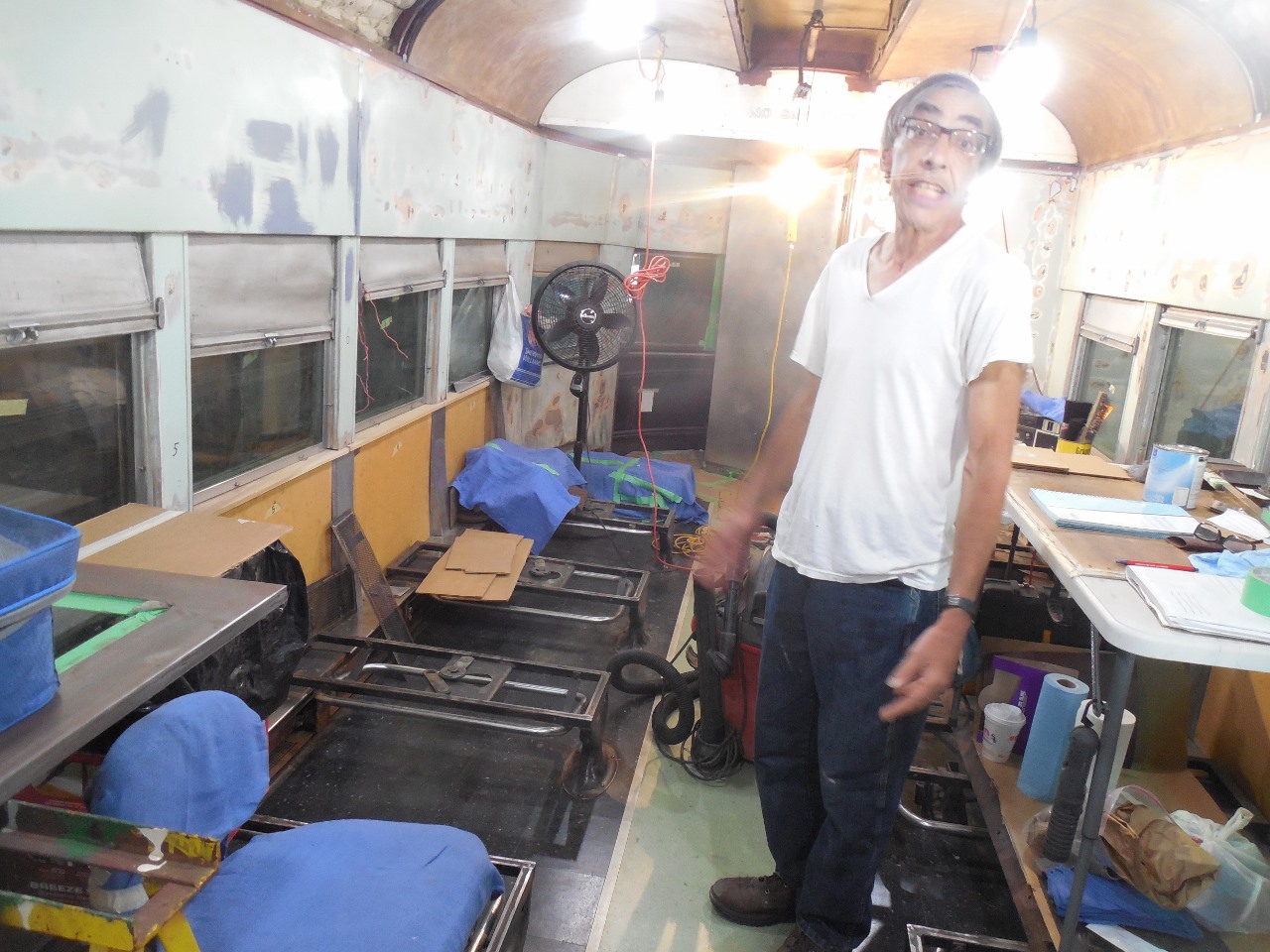

Things are progressing well, and John and Ed can be very proud of their work.


The flip side

Frank writes...

So for a while now I've been meaning to paint the other side of the car orange. It's true that "one-sided cars" are a longtime IRM specialty and that most people probably haven't even noticed that only one side of the car has been cosmetically restored, but the other side of the car really isn't in bad shape and there's no particular reason not to get it painted and looking nice. Even if it's years or even decades before any visitor sees it, it's something that will be good to get done. So when I was out at IRM on Sunday I decided to get started on this.

Here's part of the "other" side of the car before I began.  By the way, did I mention that I was talking about Lake Shore Electric 150? One side of this car got nicely painted back about ten years ago but the "flip side" is still partly in the same paint it wore when it was a flower shop at Station Square in Pittsburgh in the 1990s. While the color scheme is generally similar to LSE colors, the photos here (flower shop colors) and here (post-repainting) show that there are some marked differences. So the first job was to put a coat of white primer over the orange window piers so that the finish cream color will cover better.
There, that's better! Then I started in with brown primer on the window frames, which will get painted tile red. I was using a 1-1/2" brush so the edging wasn't all perfect, but I'l be able to clean that up a bit when I put on the finish paint.
Now it's starting to look more like a proper Lake Shore Electric car. As mentioned before, it's unlikely any visitor will see this work anytime in the foreseeable future but it's still good to get it done. Dan Mulvihill helped out some with this painting work and within a couple of hours it was all ready. Next I'll need to clean up the belt rail a bit and prime the bare spots there before starting in with finish paint.
There was plenty happening out at the museum on Sunday. The big draw was that it was the 50th anniversary, to the day, of the first "real" train operation at IRM! Our first-ever trip with a piece of revenue equipment was July 17, 1966 at exactly 11:27am and the car to make that trip was the old reliable IT 415. There were three motormen on that first trip in 1966: Roger Smessaert, Bob Kutella and the late Dave Shore. Bob has been in poor health recently but Roger was at IRM and ran the 415 on a commemoration trip that left the depot at the same time as the original trip. Unfortunately I didn't arrive until a couple of hours later but they did have the 415 out all day in honor of the occasion.
And there was plenty happening in the electric car shop. Norm and Jeff were hard at work on cutting and drilling new pieces of structural steel for Michigan Electric 28. Across the aisle from them, I noticed that John Faulhaber has been painting the trucks on Lake Shore Electric 810 green, as shown above. This freight trailer is getting very close to completion.
And here's Tim Peters, wasting away in the car shop. He's actually working in winding and tying new bundles of waste for the axle cap bearings on the truck for the 24; it's a laborious job but somebody's got to do it. Below, one of the new waste bundles goes into the axle cap to test the fit. These need to be packed tightly into the axle cap housing so that constant and relatively even contact is made with the axle surface to keep it oiled.

And then a small crew headed by Richard Schauer and Greg Kepka were working on the Metra (ex-Illinois Central) "Highliner" MU cars, which had been brought over to the pit lead. We acquired four of these cars with the idea of keeping two and scrapping the other two for parts, but the decision of which to keep and which to scrap won't be made until we have a better idea of the condition of each car. To do that, we need to get them up and going, and Saturday and Sunday were spent doing just that. This weekend focused on the westernmost car, 1534, and after quite a bit of fiddling and some fighting with the motor-alternator set, they eventually got the car to run. Behold: the first "Highliner" to run in a museum!
That maniacal laughter is courtesy of Diesel Department volunteer Jeron, who took a break from preparing for "Diesel Days" next weekend to come over and check out the MU cars. The 1534 isn't quite ready for prime time, as it needs a little bit of work with finicky air valves and the MA set, but given that virtually no changes were made to adapt it to 600-volts, it seems to be doing admirably so far. Work will continue on inspecting and testing these cars to make sure that the museum ends up with the pair in the best shape.

Sunday, July 17, 2016

Motors for the 24

Tim Peters sent me another update of important progress on #24, our 1898 Chicago gate car:

I worked with Rod and Richard on Thursday to install the motors in 24's truck.  Some axle cap work still needs to be done on one motor, and new spacers will be needed to go with the modified motor nose mounts. Otherwise installation is nearly complete.


Visit to St. Louis

View of St. Louis
(oil on canvas, Joe Jones, c. 1932)

Over the weekend we were visiting friends in St. Louis.  Not much time for railfanning, but the St. Louis Art Museum is great.  It suddenly struck me that the WPA painting above might depict the entrance to the Illinois Terminal subway under construction.  If you've got a better idea, you too can be an art critic.

Nearby, there's no doubt that this new light rail streetcar line is under construction.  One end terminates near the history museum (barely visible at right) and most of its length runs west on Delmar Avenue to Washington U.  There is no evidence of a connection to the current Metro system, or anything else for that matter.


I'd say that somewhat more than half of the track construction is complete, with the rest in progress.
If and when this system is put into operation, we'll try to report on it.

Wednesday, July 13, 2016

It's Too Darn Hot

It was hot and humid today, being the middle of summer, so not a lot of heavy lifting got done.  Anyway, I started by working on the hole in the roof of the 460.  I had hopefully tried steaming some pieces of wood and home and bending them into shape, as seen here in my workroom.  But they didn't stay bent enough, and the first one snapped while I was installing it.  

So I now have a different plan for filling the gap, but I'm not going to tell you what it is until it actually works.

I cleaned up all the tools and parts I had used for installing the air tanks under the 36.  After that was done, here's a more rewarding task.  From pictures, it appears that all of the folding signs on the wood cars originally had a latch that looked like this:


But this is the only one we've got.  The one at the other end of the 309 disappeared, as did both of the latches on the 308.  Here's one I made from hardware store parts several years ago.  It's OK, but not great.

But while looking through the 321 a few weeks ago, I happened to kick a loose part on the floor.   It was a brass casting we had made as a test several years ago.  Unfortunately, the surface was very rough and it was set aside as unusable.  But I took it home, filed it down somewhat, and then applied Bondo over the surface, and sanded that down.  Much better.  And today I installed it.  It will need at least another coat of blue, but it should look much like the original.


And while I had the blue paint out, it's time to fix the lettering on the 308.  Somehow, we had thought that this message read "Do Not Board a Moving Car" but it is certain that the last word is "Train".  I determined that this can be easily fixed.  "CAR" is reduced to "AI" as seen here, and will then be expanded to "TRAIN".  The 36 should probably also have this message by the side doors, and it would be good to have them both correct.  And I touched up some of the recent lettering in the 36.

The 309 had been having problems with the controller at the #1 end; it was arcing excessively on the fifth point (full series).  There is no real way to adjust the tension on the controller fingers, so I tried swapping the finger with one that is used only in parallel, which we don't need.  The problem seems to have gone away.  And then there was some more sorting of parts and cleaning.

Tim showed off the hardware for the gates on the 24, all parts of which are now in position at both ends.  You can see the castings recently installed with shiny screws that stop the gate from swinging too far.  He also worked some more on the window shades and other parts.  It's getting closer to completion!


Pete Galayda and John Faulhaber worked on sequencing the control system for the Charles City engine; it's mostly functional, but there are some contactors that aren't coming up in parallel when they're supposed to.  Some adjustments to the reverser also need to be made, but it's getting close to operation.

John Arroyo and Ed Oslowski continue to fix up the Electroliner, inch by inch.  It's nice in here, due to the portable air conditioner.  


Ed explained how he had to reset the tiles on the floor in this corner, due to water damage.

Brake shoes made a handy set of weights for gluing the tiles.


Patching up the ceiling.  They were trying to determine exactly what material this is.


The motorman's cab will be next.  It sure is a strange shape; you can't see it from this, or almost any picture, but there is a triangle extending out to the left that is inaccessible to man.  The carefully stenciled warning "Do Not Spit In Cab" is also striking.  What was it with the North Shore?   Out in the western suburbs I would think that people, or at least motormen, were more civilized, since this message wasn't needed.  But I could be wrong.  

Tuesday, July 12, 2016

Honest Nick's L Car City

 When the CTA 4000's were taken out of service in the middle/late 70's, they were put up for sale at bargain prices.   Several trolley museums across the country bought them.  IRM acquired several for preservation, of course, and many more to be scrapped for parts or for possible resale.  Nick's unique flair for salesmanship led to the creation of a used L car lot.  You had to be there.  If you weren't, you can still watch this video of Honest Nick in action.

And as you'll see, for a while, we also had the world's only 4000 gate car.  This is just a sampling of Bill Wulfert's slides of 4000's at IRM -- enjoy!

S-350 (4318) + 4279  at Honest Nick's L Car City:  (Apr 79)


4290, 4253 (Jul 79)


S-313 Wheel Car   (Dec 81)


4253 with gate, at IRM (Jul 84)


S-368 (4386) and 4253 (Jun 85)


4253 (Jun 85)


4253 just after last trip: (Jun 85)


4253 on carline: (Jun 85)


4253 scrapping  (Aug 13, 88)


4253 end falling off:


4146 with new end:   (Jun 89)

Window Shades for the 24

Tim Peters sends us a report:

Bill Wulfert and I worked on shades yesterday, installing salvaged hardware on the otherwise finished shades. Note that Ray Neuhaus acquired them in 1971.  They've been waiting to be installed for 45 years.  Talk about advance planning!