Sunday, January 1, 2017

Rock Island Southern - Northern Division Roster

NORTHERN DIVISION ELECTRIC EQUIPMENT


No.
Built
In svc
OOS
Type
Builder
Notes
PASSENGER EQUIPMENT
300
1907
1910
1920
Wood Coach 62'
AC motors


Niles

ex-WB&A

301
1920
Burned in Monmouth fire c. 1931
302
1919
Burned in Monmouth fire c. 1931
303
1920

304
1920

305
1920
Rebuilt as combine
425
1910
1918
Wood Coach 62'
Trailers
Burned in Cameron fire 8/6/18
426
Burned in Cameron fire 8/6/18
FREIGHT EQUIPMENT
101
1910?

?
AC Box motor
?
Renumbered 201?
102?

?
AC Box motor
Renumbered 202?


THE NILES CARS

Certainly the most interesting cars to operate on the line were the Niles passenger cars built for the Washington Baltimore and Annapolis.  The WB&A was designed as a high-speed direct route between Washington and Baltimore, and its original equipment consisted of an order of 19 large, heavy interurban cars built by Niles.   They were 62'3" long, weighed about 120,000 lbs, and seated 66.  The builder was very proud of these cars and advertised them as the "Electric Pullmans".

The original electrical equipment was very complex.  The main line of the WB&A was wired for 6600V AC, but the cars had to operate over low-voltage DC streetcar tracks in both Washington and Baltimore.  The line in Washington used a dual overhead.  The cars had two poles at each end, one 12' and one 15' long.  The longer pole was used on the AC main line, and the shorter pole was used in Baltimore for the 600V line. Both poles were used in Washington, with the longer switched to negative.  The cars were used for only about two years, and were then withdrawn from service for various reasons and returned to the builder.

When the Rock Island Southern was looking for passenger equipment in 1910, these seemed to be just about right.  Some modifications were made.  The originally double-end cars were converted to single end, and the trolley poles were replaced with pantographs.  The dual-voltage equipment was replaced, since only 11,000V AC was used.  Six cars were purchased in 1910 and sent to Westinghouse for the changes to the electrical system.  Two more cars were purchased, but delivered as unpowered trailers.  The trailers were withdrawn from service by WWI and stored in the Cameron carbarn, where they burned in 1918.   The six motor cars continued in service on the Northern Division until the end of electric operation early in 1920.  It appears that all of these cars were retained for many years, and saw occasional use on steam-powered trains.


One of the Niles cars on the WB&A in its original configuration.


Car 300, newly rebuilt, apparently missing its motors (Stephen Scalzo Collection, Illinois Railway Museum)


A two-car train pulling into the Matherville station.


A two-car train at Rock Island.


One of the cars at Aledo.


Car 302 at Monmouth.


Car 305 on one of the spindly trestles.


Car 305 at Alexis around 1913. "The wind-damaged building served as the ticket office. The line was built as the Rock Island & Alexis Railway by the RIS and operated from 1910 to 1921 when the line was pulled up." The building is still standing on the northwest corner of Main and Broadway in Alexis. Bill Graham photo from the Scalzo Collection.


One of the motor cars retained for use as a trailer on steam trains, seen at the 20th St. station in 1924.


Little information on the two box motors is available.  They had offset doors at the end of the car for loading lumber.


The two freight motors on the trestle over the Edwards River, with the power house in the background.


The Northern Division also owned several steam locomotives, cabooses, and freight cars of various types over the years, but very little information is available.  For the locomotives, in most cases all we have are the road numbers, and in some cases, not even that.  Most engines seem to have been smaller, obsolete types; 4-4-0's and 2-6-0's, mostly purchased or leased from the CRI&P.

Information from photo: "RIS 4-4-0 #100 heads north across Cedar Creek north of Monmouth, Ill in the late summer of 1910 with a borrowed CB&Q coach to officially open the railroad. The 100 was owned by the American Construction Company and started life on the Michigan Central. Off the roster by 1916. Collection of B. Graham." Stephen Scalzo Photo Collection, Illinois Railway Museum

All of the below pictures are from the Don Ross collection except where noted.

All of the Rock Island Southern's locomotives wound up in the scrap line at Silvis.

Caption information: "RIS 220, Silvis, Ill 3/7/1940 - The Rock Island shops at Silvis, Illinois performed any repairs needed on the RIS engines. The 220 came to the RIS in 1912 [this may not be correct -ed.] and lasted until the road folded in 1952. The 220 was scrapped in Peoria, Ill the same year." Stephen Scalzo Collection, Illinois Railway Museum


The last locomotive to operate was Wisconsin & Michigan 527, acquired in 1938.


Rock Island Southern - Northern Division

HISTORY OF THE NORTHERN DIVISION

CONSTRUCTION 

The Davenport, Rock Island and Southern Ry. Co. was organized by the Walsh Brothers interests on January 7, 1905.  Nothing was done toward construction until Sept. 5, 1908 when the name was changed to Rock Island Southern Railway.   On that date, a 25 year lease was signed with the CRI&P permitting the RIS to electrify the line from Rock Island through Milan to Preemption.  The RIS would have exclusive rights to the passenger service, but the CRI&P would still use the line, which extended to Sherrard and Cable, for freight service (using steam locomotives, of course.)

The P. T. Walsh Construction Co. was awarded the contract for construction of the new line, starting at a junction with the leased portion of the Rock Island about a mile and a half west of Preemption.  This point was labeled Monmouth Junction, also known as Southern Junction.  By Sept. 10 surveyors had laid out the line south to the Edwards River crossing.  On the 15th, a crew was put to work installing switching tracks at the junction to handle the work trains.  Another crew of 25 men were fencing the right of way, and several men with teams and scrapers were put to work on the grade.  A map issued at that time indicates that the plan was to eventually build straight north from Monmouth Junction to Milan for a more direct entry into Rock Island, but no work was ever started.  Similarly, the Walshes claimed to be interested in extensions to Burlington or Macomb, but nothing came of them. 

The Rock Island Southern decided to electrify the northern line with 11,000 volt single-phase AC, the last major interurban to select AC.  One of the attractions of AC was that there was no need of substations; the entire line was powered directly from the power house, located about in the middle of the route at the Edwards River.  Six motor cars and two trailers were purchased from Niles and rewired by Westinghouse.  The original intention had been to run trains down the street in Rock Island to the center of the city, but the cars were too long and heavy for this use, and were always confined to the CRI&P tracks.  A makeshift station was constructed at Fifth St. for use as the terminal.

On Oct. 21 five cars of steel were received.  By this time graders were a little over a mile south of the junction and a temporary track was started so the big steam shovel could be moved to where it was needed.  On the 27th a trainload of equipment arrived for the Walsh Construction Co., consisting of three construction locomotives, a steam pump, another steam shovel, dump cars, a kitchen car, a diner, sleepers, an office car, and a private car for the officials.  50 more men and 50 more teams were put to work at this time.  By Nov. 5, three miles of temporary track had been laid and the two steam shovels were moving huge quantities of dirt.  By Dec. 15 the grade was almost to the Edwards River and surveyors were working south from Gilchrist.  Severe weather closed the work a short time later and little was done until spring.

About the middle of March, 1909 crews started work on the grade south of the Edwards River. In June contracts were let for building the Edwards River bridge, the bridge over Cedar Creek, the Pope Creek trestle, and so on.  Grading and tracklaying continued through the summer, and in October the branch to Aledo was surveyed.  By late October a crew of 38 men were working along the CRI&P line, north of Reynolds, bonding rails and setting poles for the electrification.  By this time, the construction of the power plant at the Edwards River was underway.  There was a detailed article about construction of the powerhouse in Electric Traction Weekly at this link.

In November two steam locomotives were purchased, both 4-4-0 types, for use on either freight or passenger trains.  By December 1 the poles were set from Milan to Pope Creek, and the crew were working south toward Monmouth.  The track was withing 12 miles of Monmouth, and four more miles of grade were ready for the ties and rails.

  Pope Creek

About March 1, 1910 work again resumed; by the 25th two camps were located on the uncompleted portion, one at Cedar Creek and the other at the county line.  Gravel ballast was being placed on the completed portion of track from Southern Junction to south of Gilchrist.  By the middle of May the track was nearly completed and it was announced that train would be run with steam power until the overhead work was completed.

On Monday, May 30, 1910 Rock Island Southern locomotive #100, pulling a borrowed Burlington coach, #6123, filled with nearly a hundred prominent men of the region left Monmouth at 10 AM, stopping at the power house camp for lunch, and arriving at Rock Island about 2 PM.  On June 22, an excursion was run from Rock Island into the center of Monmouth; Rock Island #526 pulled three Rock Island coaches with about 200 passengers.  Regular passenger service started on Sunday, June 26, with two trains daily between Rock Island and Monmouth and two between Rock Island and Sherrard.  Steam power was used, as the electrical system was still uncompleted and the electric cars had not been delivered.

Cedar Creek

At Monmouth, the old CB&Q depot was rebuilt for RIS use, and the tracks were completed for connection with the line to Galesburg.  

In Sept. 1910, the Aledo branch was completed.  On Sept. 30, the first electric car was shipped from the Westinghouse works at Pittsburg.  However, delays in construction of the overhead set back tests of electric operation until late November.  Finally, electric operation between Rock Island and Monmouth started on Dec. 12, 1910 with one round trip daily, quickly increased to four round trips.

The depot at Matherville. Retro Quad Cities photo


DETERIORATION, USRA CONTROL, AND RECEIVERSHIP

The RIS was heavily impacted by conditions arising from WWI and the resulting inflation.  It appears that maintenance nearly ceased and service suffered badly.

In August 1919, an engineer with the Illinois Public Utilities Commission made an inspection of the line, and issued an extremely critical six-page report, summarized here.  Hearings were held and as a result, in November the Commission ordered the line to repair all dangerous bridges, secure sufficient power to operate the cars on schedule, resurface tracks on the branches, repair and maintain the passenger cars in safe and sanitary condition, repair all pole lines and to maintain suitable terminal facilities at Rock Island.  

Essentially none of these things were done, and on Jan. 11, 1920, the power house was shut down for major repairs and all train service was stopped without warning.  The company also stopped supplying electric power to the surrounding communities, and it appears the power house never restarted.  A report issued at that time is summarized here.  On Jan. 17 the Public Utilities Commission ordered the line to resume service at once, but nothing happened.  On Jan 26, the USRA assumed control of the railway, and resumed steam-powered service from Rock Island to Aledo.   On Feb. 9 service was resumed to Monmouth.  USRA control only lasted a little over a month, until Feb. 29, 1920.

The company was put into receivership at the petition of the minority bondholders, and operated by the receiver from March 19, 1920 to December 24, 1921.  The Walsh brothers then resumed control.  We will not attempt to explain the confusing details of the corporate history.  Sorry.

In 1920 the Westinghouse Company repossessed the electrical equipment at the power house, which had never been paid for, thus ending any chance for resumption of electrical operation on the Northern Division.

It appears that the USRA never took control of the Eastern Division, which at that time was known as the Galesburg and Western.  The law establishing the USRA had exempted interurban lines from government control.


DECLINE AND PARTIAL ABANDONMENTS

On Sept. 28, 1920, the RIS was authorized to abandon the Alexis branch, and to dismantle poles, wires, powerhouse and other equipment pertaining to electric operation.  This work began soon thereafter.

On Jan. 28, 1925, the RIS was authorized to abandon service on the 5 miles between Preemption and Cable, and at the same time authority was granted to the CRI&P to dismantle the line, of which it was the owner.  Other minor branches and mine spurs were abandoned over the years.

In May 1929 the trestle south of Gilchrist near Burgess burned and was not replaced.  As a result, service on the Northern Division was cut back to operations between Rock Island and Aledo, and the southern half of the main line was not used again, although the rails remained in place for many years.

The passenger equipment seems to have been preserved long after it had been removed from service, and several cars were stored in the carbarn at Monmouth.  The carbarn burned down about 1931 or so, but we have been unable to determine the date.  The cars stored there were destroyed, but it's thought that a few cars that had been stored at Rock Island when the main line was cut were still there a few years more.

Freight service on the remaining portion of the line from Rock Island to Aledo continued for many years.  There was enough business in moving agricultural supplies and fuel to keep the line barely alive.  The last run was in Feb. 1952.

Report of 1920

In November 1919, the Illinois Public Utilities Commission ordered the Rock Island Southern to make several immediate improvements to the railroad.  On February 1, 1920, O. N. Posegate, an engineer working for the Commission, made an inspection to see what, if anything, had been done:


In compliance with your verbal instructions of recent date, I made a careful examination of all of the bridges, tracks, pole line, cars, etc. of the Rock Island Southern Railway Company with a view of determining what action, if any, had been taken by this Company toward complying with the provisions of the order of the Commission dated November 17, 1919.

This inspection was made Sunday, February 1, in company with the Walsh brothers, Superintendent Quackenbush, Track Supervisor Gannon and other officials, the trip over the road being made in a Chicago, Rock Island and Pacific coach attached to a Rock Island Southern engine.

I found that the only showing made was repairs to Bridge No. 13, which have been made in a satisfactory manner.

While the ground is frozen, there, of course, is much less danger either to bridges or track, but as soon as the alternate thawing and freezing comes in the Spring neither the bridges or the track will hold up properly.

On January 11, the Rock Island Southern Railway Company ceased operation entirely and did not resume traffic until January 26, at which time the company commenced operating a steam train between Rock Island and Aledo through some kind of a working arrangement with the Chicago, Rock Island and Pacific Railway Company.

I understand that the C.R.I.&P. Ry. Company were induced to allow their engine to operate over this line principally as an accommodation to themselves in order to get coal for their own road from the mines on the RIS, the latter company receiving no compensation whatever for the use of their right-of-way or rails, and any revenues accruing must go to the cost of operation.

The RIS Railway Company were preparing to go before the Federal Court on Monday, February 9, at Peoria, and ask for a receiver favorable to themselves, but I believe that it was Mr. Culver's intention to file a cross petition for receivership and request the court to name a receiver who would be favorable to the minority and to the public rather than to the Walsh brothers, so that the public might at least have a chance of getting some kind of satisfactory service.  Assistant Engineer Wood was there at the time and advised Mr. Culver relative to the Edwards River Power Company plant at Matherville, service there having been discontinued for some days back, and the plant being in a very dilapidated condition.

It appears that the Walsh Brothers want to discontinue the operation of electric cars on their line and also the furnishing of power to various industries on their line in the villages.

It appears also that they want now to operate nothing but steam cars over the line and possibly abandon the Alexis branch entirely.

Under the working arrangement with the CRI&P, the train, which has been put on between Rock Island and Aledo, runs into the 20th Street Station, Rock Island, thus abandoning the old 5th Street Station, temporarily at least.

Rock Island Southern - Maps

We have several types of maps of the Rock Island Southern system.  The best starting place is an interactive Google maps overlay developed by Frank, covering the entire system, embedded below or at this link.

We also have a selection of the historic USGS topographic maps of the area which clearly show the extent of the system during the twenties, plus some hand-drawn maps by Mr. Scalzo.


MONMOUTH

Monmouth was the center of the RIS system.  As mentioned, the two divisions met at the depot in downtown Monmouth.  Here passengers could change trains, and freight cars were transferred.  The small city system was operated as part of the Eastern Division.

First, we have a map of the entire city, with hand-drawn lines presumably by Mr. Scalzo.


The Northern Division enters at the top of the page, and proceeds south to downtown, where it curves east to the RIS depot, located on the west side of Main, south of Fourth Ave.   The Eastern Division main line continues east and then curves to parallel the CB&Q tracks all the way to Galesburg.  The city line heads north from the depot, curves around the Public Square, and then heads east on Broadway to Eleventh St. (just off this map to the right).  There it turned south and connected to the main line.

Two partial copies of early valuation maps give greater detail on the trackage downtown.


NORTHERN DIVISION

We start with the 1912 Milan quadrangle map.  The Rock Island Southern used CRI&P tracks south from downtown Rock Island, at the top of the map, to the junction at Milan.  The Sherrard line then heads west from Milan, and curves south through Taylor Ridge and Reynolds.  It then turns east towards Preemption.  A mile and a half west of Preemption is Monmouth Junction (aka Southern Junction) where the Rock Island Southern main line started.  It heads south in a fairly straight line to the bottom of the map, through Matherville.  The powerhouse for the electrification was located just south of Matherville, near the Edwards River.


On the 1923 Alexis map, the RIS line heads straight south down the middle of the map, through Gilchrist, Burgess, Alexis Junction, and Woodvale.   At Gilchrist the Aledo branch headed straight west to Aledo.  The Alexis branch went straight east from Alexis Junction to Alexis, but doesn't appear on the map because it had already been abandoned and removed in 1920.


And finally, on the 1923 Monmouth map the line heads south through the middle of the map to Monmouth.  You can actually make out the Monmouth carbarn, located on the west side of the main just north of the city.


ALEDO

There were major branches to Aledo and Alexis.  The line to Aledo was the last part of the system to survive.  In both of these towns, not only is the RIS long gone, but so are the steam roads.


ALEXIS

The line to Alexis was the first part of the system to be abandoned.


EASTERN DIVISION

Referring to the Monmouth map above, the Eastern Division starts in downtown Monmouth and parallels the CB&Q mainline east towards Cameron.  The line is labeled Galesburg and Western.

Below is the 1927 Galesburg map.  The Galesburg and Western enters the map from the west and follows the CB&Q, bending to the north, until it meets the PT line to Abingdon along route 41.

Operations in Galesburg have already been covered in a previous post about Galesburg streetcars.


Rock Island Southern - Eastern Division

HISTORY OF THE EASTERN DIVISION

The initial segment of the Rock Island Southern was incorporated as the Western Illinois Traction Company in 1902, intending to build a 16-mile interurban line between Monmouth and Galesburg parallel to the CB&Q.  This company laid two miles of track in Monmouth and then failed.  It was reorganized by the Walsh Brothers as the Rock Island Southern Railroad in 1905 and resumed construction of the interurban line to Galesburg.  The powerhouse and carbarn were located at Cameron, about halfway between the terminal cities.  In Galesburg, the final 2½ miles of the route used tracks of the People's Traction Company (PT).  Service between Monmouth and Galesburg started on May 30, 1906.   Power was the usual 600V DC with simple suspended trolley wire.


Initial rolling stock consisted of three interurban combines of standard design, plus one box motor. Two ex-New York Elevated cars were added in 1908, although little information and no pictures of them are available.

 With this limited roster, regular service at first consisted of 19 round trips daily on hourly headway.
In the early years, cars coming into Monmouth from Galesburg paralleled the CB&Q to Eleventh St. and then turned north on Eleventh to Broadway, where the line turned west to Public Square.  The cars looped around one corner and then headed south to the ex-CB&Q depot, where they terminated on the north side of the building, while Northern Division cars terminated on the south side.

  The Cameron carbarn burned down on Aug. 6, 1918, reducing the roster to two cars and destroying the substation.  The company went into receivership on July 7, 1918, and was then reorganized as the Galesburg and Western Railroad on Nov. 26.  The name was changed to avoid confusion between the Rock Island Southern Railroad (the Eastern Division) and the Rock Island Southern Railway (the Northern Division.)  On Dec. 1st, 1918, the G&W was leased to the Rock Island Southern Railway.

By 1921 only 8 trains a day were operated, barely more than the 6 trains operated by the CB&Q on the same route.  About this time, the city tracks in Monmouth were abandoned, and the track was rerouted at Eleventh St. so the cars ran along the CB&Q all the way to the depot, and terminated on the south side of the depot.  By now the AC electrification of the Northern Division had been removed, so there was no conflict.  The local highway was paved in 1924 and the G&W ended passenger service soon thereafter.   

By 1925 only two daily freight runs remained and by 1931 this was reduced to one.  A succession of second-hand freight motors were used as motive power, and gradual deterioration of the tracks and bridges reduced service to one through train a week by 1949, plus local switching at the terminal cities.  By 1951 the only operational motive power was a Differential dump car from Kansas City, and service finally ended on March 29.


EASTERN DIVISION ROSTER


No.
Built
In svc
OOS
Type
Builder
Notes
PASSENGER EQUIPMENT
201
1906
1906
1918
Wood Combines
52'

St. Louis
Burned in Cameron fire 8/6/18
202
1934
Rebuilt to locomotive c. 1920;
not scrapped until 1951
203

Burned in Monmouth fire c. 1931
240
1904
?
?
City car – Monmouth?
St. Louis
Ex-Tri Cities #240, renumbered #2 (?)
130
1878
1908
?
Ex-New York Elevated cars
Wason

193
1878
?
Gilbert

FREIGHT EQUIPMENT
301
1907
1907

Box motor
St. Louis
Burned in Monmouth fire
800

1940
c. 1947
Locomotive

Acq. from Moline, rebuilt streetcar
2012
1920
1934
1940
Box motor
Kuhlman
Acq. from Eastern Michigan Rwy.;
not scrapped until 1951
0035

1947
1951
Dump car
Differential
Acq. from Kansas City


THE ST. LOUIS COMBINES


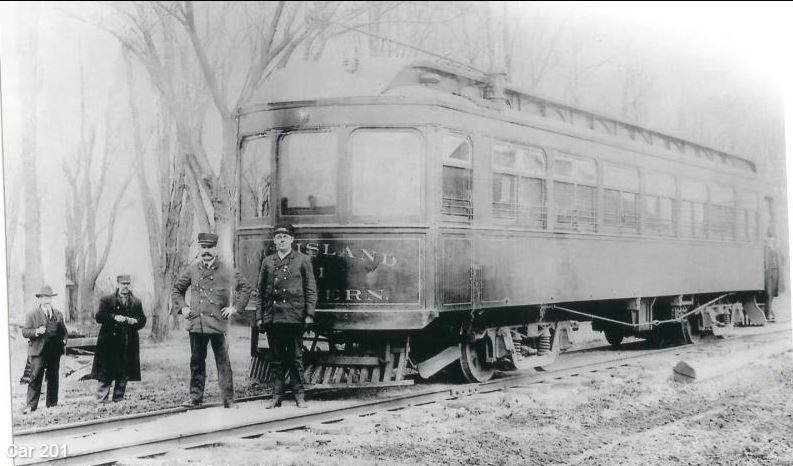
Car 201 in Monmouth

Car 201

Car 202 at Monmouth

Car 202 at Monmouth in 1906


Two-car train at Cameron


Car 203 at Monmouth, 1915


FREIGHT EQUIPMENT


Car 202 after rebuilding as a locomotive, March 23, 1933


Car 202


202 (SDM)


Locomotive 800 (not 202) at Monmouth in 1948 (Don Ross)


Locomotive 800 at Monmouth in 1949


Car 2012, August 27, 1942


Car 2012 in Monmouth in the late 30's (Dave Mewhinney)


At Monmouth, probably late 40's  (Don Ross)


Dump Motor 0035 in 1948

Dump Motor 0035 in 1948 (Don Ross)