Frank writes... Monday morning we left Hammersmith and headed to Waterloo Station, which is the busiest railway terminal in London. Our destination was the Isle of Wight, where on the "Island Line" they are still running electric cars built in 1938 for the London Underground. The reason is that when this line was electrified in 1967 (trains were steam-hauled before that year) they had to find equipment that would fit through a very confined tunnel in Ryde. New equipment was unaffordable and the only used cars that would fit were London tube cars. So they bought used "Standard Stock" built in the 1920s and ran those until about 1990, by which time they were practically falling apart from wear and rust. It was at that point that they replaced the Standard tube cars with - what else - slightly less old tube cars. These cars were, as built, identical to the 38 Stock cars we saw at the London Transport Museum sites at Acton and Covent Garden; they were rebuilt somewhat when sent to the Isle of Wight, with interiors slightly modernized and the cars made into two-car motor-motor married pairs. It's enough to warm the heart of a Chicago 'L' fan. The 38 Stock cars are getting pretty worn out themselves, though, as is the entire Island Line infrastructure. The future of the system is uncertain because newer tube cars are too long to make it through the Ryde tunnel. Anyway, Waterloo was about as impressive a show as I've ever seen on rails. We sat in our train at the end of the platform for a few minutes before departure time and there probably wasn't a span of 60 seconds without a train movement in or out of the station. Below, between two trains at the platform (the one on the right is ours), there are two trains moving in the distance alongside each other. Once we got going, it was about a 90-minute ride along old Southern tracks through bucolic southern England to Portsmouth, 750v DC traction all the way.
Portsmouth Harbour station provides what is practically a cross-platform transfer to the ferry boat that goes to the Isle of Wight. It's extremely convenient and within probably 10-15 minutes after getting off our train we were aboard the Wight Link ferry boat. The trip across the Solent to the Isle of Wight was beautiful; the weather, as it had been most of our trip, was gorgeous. We got a pretty nice view of HMS Warrior, shown below, which was the world's second warship built of iron. It beat the USS Monitor by a year or two, but of course Warrior was basically just a contemporary square-rigged screw frigate with iron replacing the wooden sides and was not as revolutionary as Ericsson's ship.
We also got to see HMS Queen Elizabeth, though we didn't know its name at the time and had to look it up afterwards. This aircraft carrier was just commissioned about six months previous and is the largest warship every built for the Royal Navy.
And before we knew it, we were across the Solent and disembarking at Ryde Pier Head on the north shore of the Isle of Wight. You thought this post was starting to get ship-heavy, but never fear, rail content is returning. See here: "Strictly no fishing from Railway premises." We should get Dave Diamond one of these signs.
Ryde Pier Head station, as its name implies, is out at the end of an impressive pier at the town of Ryde. In the old days, diminutive London Brighton & South Coast steam engines and short trains of mostly four-wheel coaches would travel out along the pier to the station, where they would meet the ferry boats. There was even a small electric tramway running alongside the steam railway to the beach, though that was abandoned in 1969 shortly after electrification of the Island Line. Today the tube cars still run right out onto the pier - probably part of the reason they rust out so badly.
Sure enough, our train arrived right on schedule: a pair of Metro-Cammel-built 38 Stock cars (technically BR Class 483, a designation they acquired in the 1980s when brought to the Isle of Wight) dating back roughly 80 years. These are the oldest cars still in revenue service on the regular British rail network. Our pair, 124-224, were built in 1939 as London Public Transport Board 10205 and 11205 respectively.
A peek in the cab while the train was stopped at Ryde Pier Head revealed that the cars are largely unchanged from when they were new. They still have the original air brakes and cam control with which they were built; in fact the use of cam control on the 38 Stock was one of the things that made it possible to dispense with the large equipment compartments on the Standard Stock they replaced. Note that everything is flipped compared with regular American practice; not only is the driver on the left but the brake stand is to the left of the controller.
The cars are definitely tired, there's no doubt, but the interiors are pretty well kept up. I assume they were fitted with fluorescent lights when they were rebuilt in the 1980s but I'm not certain. Note that a significant portion of the structure, notably the window post and sill structure, is varnished wood! As an aside, the chap in the white polo happened to see us on the train heading back to Ryde at the end of our visit and was pretty amused when we said we'd come to ride the Island Line. He pointed out that he'd been riding these exact same cars his entire life.
The cars have the hopper windows shown below, same as when they were new. The window frames are brass and lack a bottom rail; the stiles have a "nub" that keeps the glass from sliding out but that's about it. That must help a lot with the bottom of the sash catching water. Over the windows is a fancifully illustrated route map, and Greg pointed out that the route map on the other side of the car is different. It's a mirror image but drawn individually so the illustrations differ slightly. The cars never get wyed, so the the map always has Ryde Pier Head and Shanklin - the terminals - at the correct end of the car.
We departed Ryde Pier Head southbound towards Ryde Esplanade, which is the station for "downtown" Ryde and sits on the beach at the end of the pier. Going along the pier is really neat; there's a walkway and road, with the vehicles heading to or from the car ferry service that takes them to mainland England. Note the steel structure between the railway and the roadway; that's what used to carry the Ryde Pier Tramway. And I was sitting right over the cam control box, so if you listen closely right at the beginning of the video and again at about the 12 second mark you can hear the controller notching up.
After leaving Ryde Esplanade the train passes through the tunnel that's the source of the line's loading gauge woes and comes to a stop at Saint John's Road, which is where the shops are. After that it strikes out through the country. The following stop, which is seasonal only, is Smallbrook Junction. This is where passengers can get off the train and connect with a train on the Isle of Wight Steam Railway. Never fear, we rode the IoWSR and that will be the focus of the next blog post. But for now we stayed on the train headed south towards Shanklin.
I would recommend a ride on the Island Line to absolutely anyone interested in traction. I'm not sure what the balancing speed of these cars is but I'd guess it's around 40mph. The track is jointed rail and seems pretty worn, so the ride is wild. Fortunately the seats are all very nicely padded and upholstered so it's not uncomfortable, but boy, there were times I was sure we were going to fly off the tracks! The video gives you a bit of an idea from the bouncing around everyone is doing. Oh, and yes, the guard roves the train to collect fares, all while the quiet countryside is passing by the windows. This has got to be the closest thing to an old-time interurban that I have ever ridden on a train that wasn't on some sort of heritage line.
Past Smallbrook Junction there are a few regular (non-seasonal) stops including Brading, Sandown, and Lake before you get to the terminus at Shanklin. In steam days this line continued past Shanklin through an impressive tunnel to Ventnor, on the south coast of the island, but due to low traffic (among other concerns) that end of the line was abandoned at the time of electrification. Shanklin is a small village on the southeast coast of the island with the railway station about a half a mile inland from, and out of sight of, the English Channel.
The entire line, end-to-end, is all of eight miles long and takes about 20 minutes to ride. What a neat anachronism.
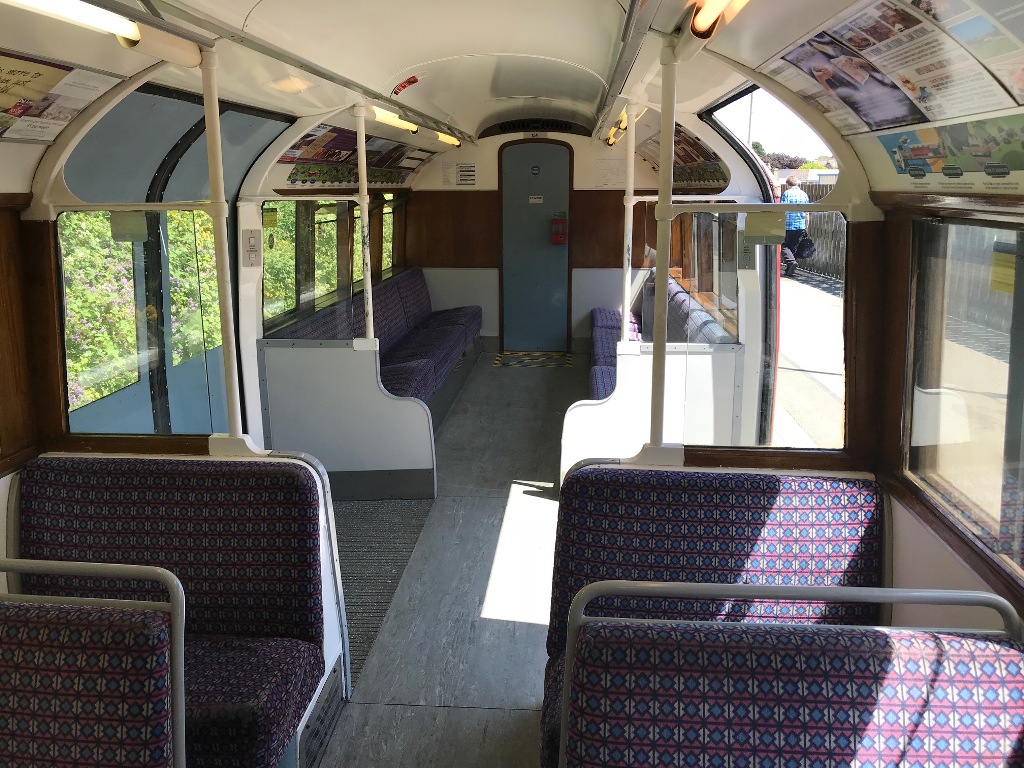
While the train was stopped at Shanklin I got a photo of the interior of one of the cars without people in it. This can be compared with the interior photo of one of the 38 Stock cars at Acton that I took during our visit there; other than repainting, different moquette, and fluorescent lights, not much has changed.
The guard has this control panel at the interior end of the cars with various door control and PA system buttons. Note on the left side that he can monitor the brake cylinder pressure from a gauge that is still labeled LT for London Transport!
We rode the train back to Smallbrook Junction and got off there for our visit to the Isle of Wight Steam Railway. I got a nice shot of the train departing northbound towards Ryde.
As previously mentioned, I'll focus on our visit to the steam railway in my next post. Suffice to say we spent a few hours enjoying ourselves visiting that operation, which is on the alignment of one of the island's abandoned railway lines. The island had a whole network of railway lines up until the Beeching cuts in the 1960s but the Island Line is the only route still in service as part of the national rail network. By late afternoon, we had finished seeing the IoWSR and returned to Smallbrook Junction by steam train. The next train on the Island Line was southbound, so why not? We rode back to Shanklin and then traversed the length of the line again returning to Ryde Pier Head. En route I got this photo out the window of the original signal box at Brading, which has been restored.
And here's the yard at Saint John's Road. Originally nine married pairs of 38 Stock cars were sent to the island from London (plus a tenth for parts). Since they arrived in the late 1980s three pairs, plus the parts cars, have been scrapped to keep the remainder running while another pair is being cannibalized, leaving them with only five pairs on a line that requires three pairs for peak service. For newer cars this might be fine but with this old equipment it's supposedly a struggle keeping service levels up. But they had a set in the shop being repainted when we rode past so they're certainly putting work into these old cars. We rode the same set, 124-224, in the afternoon that we did in the morning; there was one other set in operation (that wasn't quite as rusty as 124-224!) but I didn't see what its numbers were.
Once we got back to Ryde Pier Head it was back to the ferry and back to Portsmouth. We walked over to the naval yard hoping to see HMS Victory but the yard had closed for the day and unfortunately they won't let you get anywhere near the ship if you don't have a ticket. Oh well. Our ride back to London was delayed because large sections of the rail network in the south of England that day seemed to be in meltdown. The primary reason was slow orders that had been imposed due to the scorching heat: in Fahrenheit it was 87 degrees out!! Yeah, we were a bit surprised at the marked effect this had on operations, but I suppose that's how the Russians would look at each other when Metra has problems when the temperature in Chicago drops below zero. By English standards it was awfully hot so there were many, many delayed trains. But we still got back to London in time to see Big Ben (albeit through scaffolding), Trafalgar Square, and have a rather nice pub dinner on our last evening in the UK. Click here for Part X of our trip - the Isle of Wight Steam Railway.
This post describing our recent trip to England is Part VIII and follows the previous post, which covers the first part of our visit to Didcot Railway Centre, here. It's submitted by our official West Country correspondent Zach Ehlers.
When we left off in the last post, the branch line train was coming across the level crossing at the Didcot Railway Centre. Did everyone submit their guesses for the motive power of the train?
The answer is not what you may expect. This gem is 'Captain Baxter,' built by Fletcher Jennings in 1877. This engine spent its entire working life at the Dorking Greystone Lime Company, roughly 20 miles south of London. It was then preserved at the Bluebell Railway in 1960. The engine has been on loan to Didcot for the season, and this appearance makes it the fourth Bluebell engine we've seen under steam on our travels.
The branch line demonstration line has the distinction of being fully signaled. There are two signal boxes, which can communicate and despatch trains via Absolute Block Signalling (more about this shortly). As part of the festivities for the signaling center, tours were being offered of the signaling system along the branch line. Here we see some of the point rodding for controlling the signals as well as the crossing gates seen in the previous photo.
Our tour guide is seen here explaining the facing point lock on this set of points (switch in American terminology). Facing point locks have been required over routes traversed by passenger trains in the UK almost as long as railways have been around, The intention is to lock the points so they do not accidentally move while the train is passing, causing a derailment.
The contraption on the right in this photo is an early semaphore signal utilized by the GWR in the mid 1800's. This was one of the first signals to display a "positive proceed" indication. It is showing a stop indication with the red bar. Proceed would be a white hoop. Previous incarnations of signaling only displayed a signal if the train was required to stop, and the absence of a signal meant proceed (Egad!). A few accidents induced by a lack of stop signal brought about the relatively more fail safe method.
Following the branch line signaling tour, we had an appointment to see a Lady. If you've been keeping tabs, I mentioned earlier that the GWR utilized no less than nine different classes of 4-6-0. Of those, we have so far seen four, a pair of Castles, a Hall, a Modified Hall, and a Manor. Two will not be seen in this series, an example of the first 4 cylinder engines (the Stars) and the largest (the Kings). Three don't exist anymore, or at least they didn't. All three "missing links" in the GWR 4-6-0 evolution are currently being built/rebuilt in one form or another in the UK. This engine is the first we see, No. 2999 'Lady of Legend'. The Saints were GJ Churchward's first foray into the 4-6-0. They were constructed beginning in 1902 when it was apparent that the GWR was going to need something larger than a 4-4-0 for express passenger workings. Eventually, 77 examples were built. These engines were extremely successful, and pretty well set the pattern for GWR locomotive development for the next 40 years. Unfortunately, none were preserved when the last were withdrawn by BR in 1953. This is no obstruction to preservationists in the UK however. As mentioned in a previous entry, the Hall class was an evolution of the Saint class (the first Hall even being a direct conversion from No. 2925 Saint Martin). It stands to reason then that a Hall could be transformed into a Saint, and that is indeed what has happened. No. 4942 'Maindy Hall' was another engine rescued from Barry Island. Due to the fact that there are 11 Halls in preservation, it was decided in the 1970's to transform 'Maindy Hall' into a Saint. Most of the work is completed at this time, and it is expected to be in steam within the next year.
Photo by Les Summers
And here is the obligatory group photo of the American tourists shot in front of 'Lady of Legend'. L-R is Pete Grandson, Zach Ehlers, Greg Kepka, and Frank Hicks. Les Summers and his wife Barbara had previously visited the USA and IRM, and were kind enough to arrange for us to see 'Lady of Legend'. We were shown the engine and the workshop in general by Pete Grandson, who is one of the gentlemen who oversees the shop.
Moving on into the workshop, we see here the second new build GWR 4-6-0. This is No. 1014 'County of Glamorgan.' The Counties were built in 1946 by Frederick Hawksworth, then the Chief Mechanical Engineer of the GWR. These engines departed from typical GWR practice by utilizing an London Midland Scottish Railway designed boiler, which was first produced at Swindon as part of an order of LMS 8F 2-8-0's built for the War Department during WWII. These 30 engines became the most modern 4-6-0 built by the GWR, but none were preserved. This engine is being constructed as a combination of the frames of Modified Hall No. 7927 'Willington Hall', and the boiler of LMS 8F 48518. This project will require significant work to reach completion; currently there is no timetable for operation. For curatorial sake, the 3rd GWR 4-6-0 new build is No. 6880 'Betton Grange', of the Grange class. The Grange is being built at the Llangollen Railway, not part of our agenda for this trip.
Upon completing our tour of the workshops, we wandered toward the main event occurring at Didcot on this weekend, the opening of the signaling center. On display in this new exhibition was a pretty complete evolution of signaling in the UK with plenty of interactive displays. This mechanism shown is a miniature version of the apparatus found in a typical signal box. This forms the previously mentioned absolute block signaling. The levers at the bottom control all the points and signals in block which the signalman controls. Above all the levers are the bell block mechanisms, which allow the signalman to communicate via bell and electrical signals with the boxes on either side of his block for accepting and relaying authority for trains to occupy the blocks. Above that is the model board, indicating the layout of this signal box's block. Since this is a junction, as indicated on the board, there are three bell block mechanisms, one for each box beyond the authority of this box. The layout is indeed a real location, in this case Cowley Bridge Junction, near Exeter in the far southwest corner of England.
If you thought Cowley Bridge Junction was complicated, here is something worse. This is the model board for the east approaches to Bristol Temple Meads station. This display is set up to show all timetabled movements moving across the board indicator lights on an accelerated clock for a typical day (for what year I failed to notate). This box would have had multiple levermen on duty at any given time to accommodate all the necessary movements.
The most modern signaling apparatus on display in the signaling center is this push button panel from Swindon. These panels are a variant of CTC, which replaced individual signal boxes over much of the western region in the 1960's and 1970's. This panel is fully interactive, allowing visitors to path individual scheduled trains through the infrastructure of the board. We were unable to get an exact measurement, but we estimated that this panel controlled 20+ miles of railway.
Let's step outside and take a ride on the branch line with 'Captain Baxter'. We made a point of riding in each carriage for each leg of the branchline trip. The brake 3rd as noted previously is a four wheeled carriage. This was the only time in the trip that we rode such a carriage (forsaking the opportunity at the Bluebell for the Metropolitan Railway carriages). I can speak from experience that the ride quality is not much better than that on our own Vera Cruz 19!
At the far end of the branch line is a transfer shed to the third demonstration line at the centre, the broad gauge line. Brunel originally chose a 7'-¼" gauge for his Great Western, citing superior riding qualities at high speeds. Much of the GWR was built to this gauge, but eventually they relented to the standard "narrow" gauge being adopted elsewhere in the UK of 4' 8-½". The last broad gauge lines of the GWR disappeared in 1892. The GWS has chosen to replicate this unique gauge as a part of the general history of the GWR, and they have two engines specially built to operate on it. The first is this engine, 'Iron Duke'. It was constructed in 1985 as part of the 150th anniversary of the GWR using components from a pair of Austerity industrial tank engines.
The second engine is 'Fire Fly', a replica of a 2-2-2 class of engines built by Daniel Gooch in the 1840's. This replica was completed in 2005. Unfortunately at the time of our visit, both engines are out of their boiler tickets. It is unknown when either will be steamed again.
Here's 'Captain Baxter' and train departing for another trip on the branch line. It is nice to see another train that is over a century old, especially with an engine from the 1870's.
And here comes yet another local train from Oxford to Didcot. Gee, they sure run on a frequent timetable out here!
Then we stepped into the visitor's center/museum. Like the Bluebell, this little museum has a number of great displays. Here is a typical GWR Station Master and Office. He looks happy for some reason. It must be the pride of working for the Great Western Railway.
For most of the day we had seen a sign pointing to a used bookstore. We finally figured out where exactly it was, hidden out of the way. The store proper is in the luggage van seen in this shot, but also noteworthy is the engine, 5205 class No. 5227. These engines were built specifically for short haul coal traffic out of the Welsh coal fields. This example was built in 1934 and lasted until 1965 in regular operation. At that time it became yet another engine to enter the Barry Scrapyard. It managed to stay there until 1990, and became part of the final 10 engines to leave the island. Components of this engine are being used on another GWR new build (Churchward "Night Owl" 2-8-0 No. 4709) while the boiler is to be used on a new-build County class 4-4-0 (not to be confused with the new-build Hawksworth "County" 4-6-0 mentioned above).
Adjacent to the used bookstore and 5227 is the "Railmotor Shed," a building specifically meant to house the GWR railmotor and trailer. Since both are out in the yard, there are two other carriages in their place. One such carriage is 190, a typical GWR Autocoach. As mentioned previously, these were meant to be control trailers for specially equipped engines. 190 was a typical Collett diagram built in 1933. The end facing the us in the photo is the cab end. Visible in the left window is the vacuum brake stand, and above the windows is the signal gong.
By this point in the day operations had wound down, and both service engines were shunted next to the coaling tower. Visible above the cylinder on 4144 is "STJ". As with "DID" in No. 5900, this is the engine's shed allocation. In this instance "STJ" is Severn Tunnel Junction near Bristol.
It was then time to exit the Railway Centre. I had mentioned in the previous section that there was one entrance to the Centre besides rail, and this is it, in the middle of the Didcot Parkway Station. Literally everything not rail bound goes through these doors.
But there was little time to contemplate the implications of those doors, as our train had arrived. We made our way to the Slough station, where we could transfer to the Windsor Branch. The Windsor Branch is only 2-¾ miles long, and very specifically serves Windsor Castle. Those are Class 387 Electrostars which brought us from Didcot.
Upon arriving at the Windsor & Eton Central station, we found another GWR engine. This is a replica of GWR's Achilles class of 1891, No. 3041 'The Queen'. None of these engines survived past 1916, well before the preservation movement took hold. So this engine was commissioned in 1982 for display at Windsor & Eton Central. Fun fact: The one large driving wheel is not a driving wheel at all on this engine, in fact it doesn't touch the rail or exist above the running plate! Parts from a tender originally paired with this replica have since gone on to provide components for the tender of previously seen LB&SCR Atlantic 'Beachy Head'.
Then there was time to take in Windsor Castle itself. Some of this castle dates back to the 11th and 12th centuries. Most recently it was the site of the Royal Wedding, and this was very much in evidence at the time of our visit.
Upon returning to Paddington in the evening, we were greeted with Class 43 No. W43002 'Sir Kenneth Grange'. W43002 was the first production unit from 1975, and in 2016 it was painted in the original British Railways Intercity livery. The unit is named very appropriately for Sir Kenneth Grange, the industrial designer who was responsible for the stylings of the HST in the 1970's.
To close this day on the Great Western Railway, it is appropriate to take a moment to mention this man, Isambard Kingdom Brunel. He was born in 1809, and by the time of his passing in 1859, he had accrued an impressive roll of engineering feats, from bridges and tunnels to steamships and railways. Indeed, he was the brainchild behind the Great Western and many of his engineering choices would shape the character of the railway for years to come. It is fitting that this statue resides in Paddington as a tribute to man who built God's Wonderful Railway.
Frank writes... Sunday was the 28th Annual Vintage Transport Extravaganza, and as usual it was a great event with a lot to see. There were something like 500 cars and other vehicles on display, plus we were running a full schedule on the railroad. Dispatcher Dan Buck did an excellent job of keeping everything moving like clockwork; for most of the day there were four trains on the main line (two three-car electric trains, the Zephyr, and the steam train), an 'L' train running shuttle trips out of 50th, and three streetcars on the car line.
It's not often that we run three-car CA&E wood trains in revenue service, and usually when we do it's for the Trolley Pageant or Showcase Weekend. But last year for VTE we just had two-car trains on the railroad and they were turning customers away, so we figured the capacity was needed. And we were right! The train was 36-308-319, with the 309 left behind since we're trying to limit its use until we can get its motor armature bearings replaced (you can help!). When we left the barn it was overcast but the sky mostly cleared by noon.
I was conductor on the wood train while Greg Ceurvorst was the motorman. You may note a slightly unusual destination sign... that's an homage to Geoff Thorne and his crew at Acton Depot who are working on London Underground Q-stock cars. When we first went into service we left on our first trip from 50th Avenue, but after that - once the 2200s went into service as the shuttle train - we ran through Station 1 for the rest of the day. The other electric train on the main line was a three-car train of 4000s, with Bob Opal running and Thomas Slater conductor.
We ran a total of six trips and the first five were very full - certainly more people than we could ever have fit into two cars. The Zephyr was turning people away most trips and I heard that even the steam train had to turn away some customers on one trip. Overall it was a great crowd and I think that the vast majority of visitors went away happy. It was also great to see the railroad running so smoothly; thanks to Dan and all of the operating crews, trains were leaving right on schedule and we had several running meets at Johnson Siding.
One problem we had was crews: we just didn't have enough people sign up. Besides motorman Greg, I was the only crewman on the CA&E train. So in order to have all three cars open I had to draft people as car hosts. Victor Humphreys helped out for our first trip and Mark Hoffman for our second. For the following three trips, Blake Bushue from the Steam Shop (on the right in the above photo) served as car host and watched the passengers in the 36. His help was invaluable - thanks Blake! Jeff Calendine from the Steam Shop, on the left in the above photo, was going to help with a trip too but by the time of our last trip the crowd had died down enough that we only needed one car open.
With four trips on the main line, each train ran hourly which meant we didn't have much time between trips. I barely had time to snap a photo of some of the cars arrayed behind the depot.
What a nice looking train! The B&G crew recently spread some gravel on the old bookstore car site and set out some baggage wagons, so that makes for a nice display. It was a hot day, with temperatures in the 90s in the afternoon, so walking across this pad was kind of like our own little slice of Orange Empire. But I digress. The only hiccup in operations was in the afternoon when the sub dropped, but Richard sped over there and got it reset in less than ten minutes. It was a reminder that this was a much more common occurrence in the old days; even 10 or 15 years ago I feel like the sub would drop out (at least once) on more special event days than it didn't. Nowadays it's a rare thing.
We put the train away at around 5pm. For more destination sign silliness, during the last couple of trips the 319 wore a destination sign which is a favorite of our friend from the mountain states, David Wilkins.
At the end of the day I found the 68 on the pit, where the crew was working on rebuilding some brake linkage parts. The car does run but isn't quite ready for revenue service, however Joel and the other car shop guys are working to fix that.
Frank writes... My wife and I went out to IRM for a quick visit today - but first, a public service announcement: Help help help! We still need 1-2 additional crew for the CA&E wood train tomorrow. We are in need of a car host or two to help with the passengers on the three-car train. Even if you can only spare enough time to help us for one or two trips, it will be much appreciated. Just meet us at the depot! And now back to your regularly scheduled blog post.
I may not have mentioned this on the blog before, but my wife Bevin is expecting our first child in October. And I insisted that she visit IRM because, why else, superstition and family lore. Legend has it that my grandparents visited some follow-up to the Chicago Railroad Fair shortly before my father was born, and we know that my parents visited the Railroad Museum of Pennsylvania just before I was born, so obviously the railfanning trait must be absorbed from the air prior to birth. Hence, Bevin and I stopped out on an unusually hot day to ride the 3142 and the steam coach train. A good time was had by all three of us!
Dave and the B&G crew have been busy getting ready for the big car show tomorrow and the property was dotted with placards and other signs of preparation. Up at the depot, a group from Ohio had brought a portable G gauge track and some live-steam locomotive models. One of them, shown above, was a model of our very own 1630, meaning two different Frisco 1630s of two very different sizes were steaming away just a few feet from each other. This setup will be operating tomorrow for the car show as well.
It was in the 90s, hot enough that I didn't want to subject my wife to too much wandering around, so I didn't get a look at everything happening. I did run into Thomas, who was doing some final inspection work on CTA 4410 (seen above) prior to it running tomorrow. I also saw Tim Peters and Ed Waytula who I presume were working on the 1754 and 4223 respectively.
And finally, while I'm discussing family expansion, my father sends his regards from Arizona. He won't be at the Vintage Transport Extravaganza for a very good reason: he's visiting his first grandchild! My nephew Noah was born about four weeks ago now and is very glad to get a chance to spend some time with Grandpa Hicks in from Chicago.
IF you like what you see, you can help by sending a tax-deductible donation to the Illinois Railway Museum. See the "fundraising" box at the top of this column. Thanks! And if you're a member, we can always use more hands-on help, too!
The "Hicks Locomotive and Car Works" banner at the top is taken from original artwork of the company, which was in business from 1897 to 1911. The picture behind it shows the four restored CA&E wood cars at the Museum, starting with #309, which was built by the Hicks Locomotive and Car Works in 1907.
This is not an official website for the Illinois Railway Museum. It represents only the personal views of the authors.
It has been developed and tested using Chrome, Firefox, and IE7 with the screen set at 768x1024. If any other browser gives you a problem, please let me know.
Any reproduction or other use of the material posted here for personal or commercial profit or financial gain would be a miracle. So don't try it.
Our Current Projects
CA&E 36, 308, 309, and 319
For 2026, the 309 and 319 will be available for revenue service. The 308 may be used as a trailer. The 36 has broken leaf springs, and fixing this will be a priority.
CA&E 451, 453, and 460
The 460 has been reupholstered and is in regular service. The 451 is currently in the shop for interior restoration and mechanical work. New third rail beams are being made for all of them.