Tuesday, June 23, 2020

Prelude for Four Horns

The weather was just perfect today, with a good breeze, so with doors open at each end of the barn it was not too hot up on the roof of the 451, as it often is.

The main task was to install the horns.  The 451 had dual air horns at each end, and when installed it looks like this, complete with the horn guard to keep a trolley pole from hitting the horn and breaking it.  Installation took longer than expected because I hadn't realized the horn castings need to have wooden shims underneath, so they had to be made.  And there's a lot of painting on installed parts that still needs to be done.


Now if I only had a compressor, the prelude could be followed by an actual fanfare.

Incidentally, the 451 was delivered with these dual horns, but as far as I can tell it was the only one of the ten that had them; the others were all single horns.  But I could be wrong about that.  There are lots of pictures of these cars, but it's often hard to tell about the horn arrangement.

I was also able to install the grab iron for reaching the roof at the #2 end.  The car needs to be wyed, or moved to another track, before the one at the other end can be safely attached.  This is another one of those things that just has to be right.


I was too busy to get any actual action photos, but here are some views of progress that was made today.  On the 306, Gerry did more welding and grinding: 


And John continued installing the floor.  At this end, completion awaits some more welding on side panels.


And Tim finished installing the anticlimbers on the 1754, and painted them black.


And while work was going on, I recharged the batteries, and later retested the MG set on the 451.


So this was another rewarding, productive day.

Meet Me At The Opera


Our friend Ray Piesciuk has been scanning CA&E bulkhead advertising cards (the ones hung in the bulkhead windows between the cars' smoking and main compartments) from the Julie Johnson collection. A few duplicates have been passed along to us so that we can either use them in the cars or easily get them copied. The batch he's working on currently seem to mostly be from 1939-1940. These will all eventually end up on the fascinating www.irm-cta.org archive site Ray and Julie manage.

Randy adds: That's an astounding list of names -- some of the greatest artists of all time.  I wish I could have been there.

Monday, June 22, 2020

In dire bearing straits

Frank writes...

As my father described, we brought the 18 out again on Sunday after putting new waste in the bearing that had been running warm for its initial outing, which was the #4R journal. The goal was to wye the car as it was sitting in Barn 7 back-to-back with the 4391. This meant that the two cars were playing "trolley pole jousting" which is undesirable if you can avoid it! So we took it around the wye, the 18's first voyage under power through Station Track 1, and then over to the pit lead for checking on motor armature bearings. Unfortunately a second journal started singing a little just as we got to the pit lead. Aargh!

One bit of good news is that Zach found the car's headlight, which had been stowed for safe-keeping when the 18 was acquired. We need to check the wiring to make sure the headlight circuit is good but it looks nice on the car as shown here. Anyway, it turned out that the #2L journal was the one now acting up. It had the same marginal-looking waste as the #4R journal had started out with, so I got to work on quickly making up some new journal bundles and soaking them for a few hours in journal oil. Below you can see what was pulled out of the box. We've seen worse, but ideally you want your waste to be in cohesive bundles so that the strand ends aren't trying to grab and ride up in between the axle and the bearing.
We also started looking at motor armature bearings and ended up replacing the waste on the first one of those we found, too. So replacing waste could be an ongoing project for a while on this car! But we will see. I owe a big debt of gratitude to Joel, Richard, Greg, and Thomas, all of whom spent quite a bit of time helping with bearing work and other tasks on the 18. I also brought out a couple of windows that my father replaced and put them in the car, but I didn't have enough time to sand and prime them like I had hoped.
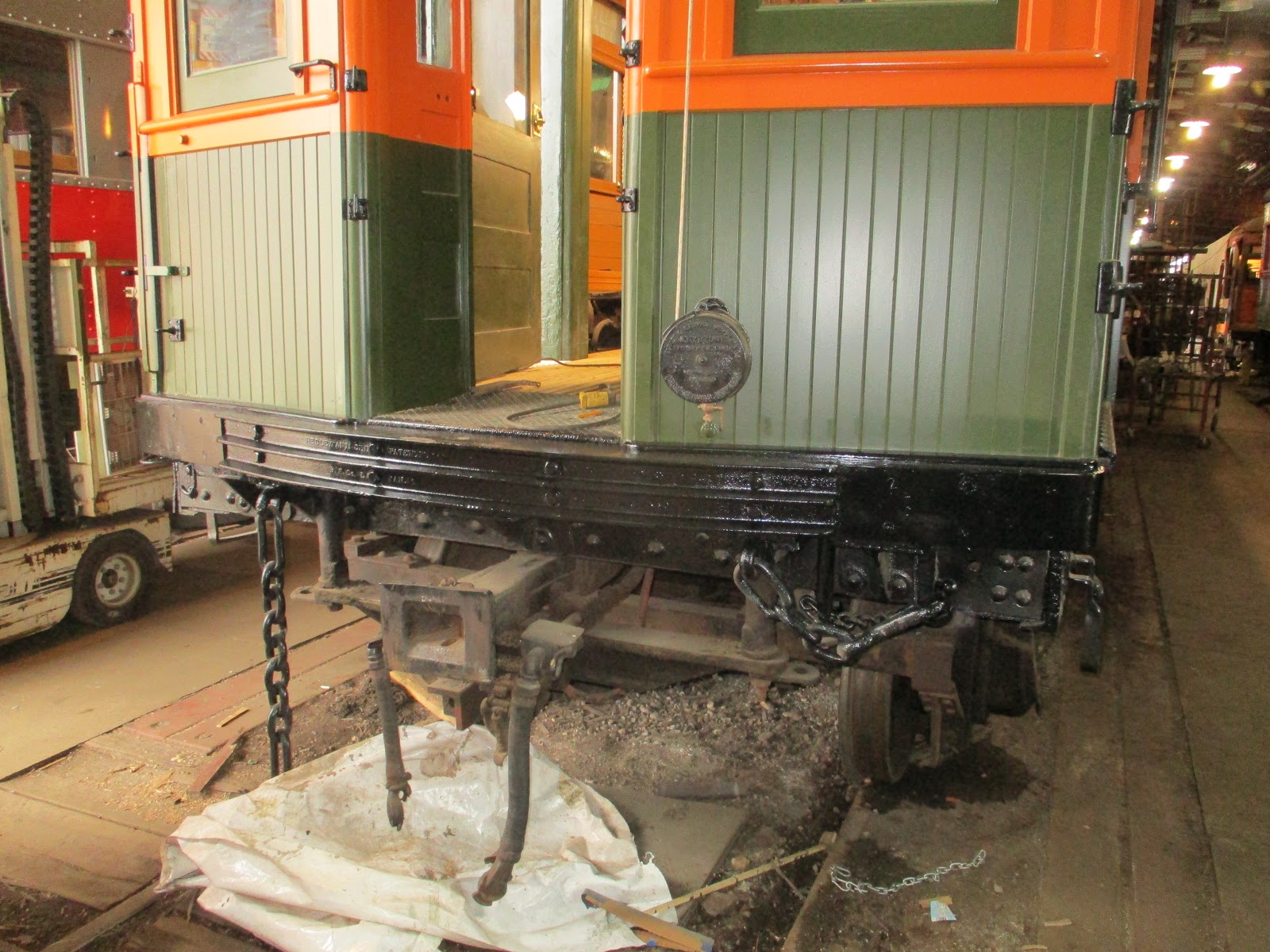
It occurred to me that I wasn't sure I had posted any recent photos of the rear end of the car, so here it is. We haven't been able to open up the marker lights because the cast rings that hold in the lenses are rust-jacked into place. That will be a project at some point.

In other news, a big Thank You to Steve Heister and Walt Stoner of the Northern Ohio Railway Museum for sending us paint mix formulas for the grey and cream. This livery was known on Shaker Heights as the "Bankers scheme" because an earlier version sans red belt rail was instituted in the early 1930s when the line went bankrupt and came under the control of the banks. NORM has matched the colors to good-quality original samples so this ensures that the car will look right when we repaint it. But car 18 needs your help! We are out of money, even for relatively inexpensive things like paint, and we need donations to keep this car's restoration moving along! Donations can be send to Shaker Heights Rapid Transit 18 - and thank you.

Other projects were being worked on too. Besides the 'Liner guys over in Barn 7 and Zach (and others) making good progress on the 757, Thomas was working on the revenue 4000s for most of the day. He got 4410 and 4412 made up into a train and then brought over some leaky air system components from the 4290 to overhaul those. Richard, Greg, and Joel seemed to be spending most of their time running new wiring to the controller at one end of the 1268. This failed a little while back due to a short in the conduit, so new conduit has been run and now the controller is wired back up. And if that isn't enough progress, mid-afternoon Scott Greig showed up and was working out in the barn doing metal work on the CTA steeplecab, S-105. Joel pointed out that every car in Barn 4 right now is in active restoration, a few of them - like the 451, 28, and 306 among others - seeing more work than they have in years.

And finally, this week's quiz: what is this thing? Hint: it's not homemade, it was commercially available.
ANSWER: Olin was correct - the mystery object is a fuse puller. It was made by Brush Electric, not to be confused by the Brush Electric in Britain that made electric motors and control equipment.

Sunday, June 21, 2020

Father's Day Visit

For Father's Day this year I got to take a road trip, as we often do, and this time my wife and I wound up at IRM.  Surprise!  I got a chance to visit a couple of active projects that I usually don't get a chance to see when I'm working.  So here are some progress reports:

First is North Shore 757, in charge of Zach Ehlers.  The smoking compartment has been completely disassembled and is being restored.  Zach proudly showed us the new linoleum that's being installed.  The company that made the original pattern is still in business and was able to reproduce it for us.  It's an exact match to what's in the main compartment.


When gluing it down, it helps to have this professional-looking roller!  


And Zach took a break from other Car Dept. activities to do some more gluing.


Meanwhile, work continues in the Electroliner.  Ed has all the parts and tools stored in the C section, and explained what they're doing.


And he took us on a tour of the dining car, the B section.  


Meanwhile, in the A-1 section, Kevin Kolar and John Arroyo are continuing the complete rebuilding of the interior.  It's really going to look nice.


Several other of the car experts brought out the 18 again to check bearings and other mechanical parts.  We got to ride it around the wye, making my wife the first actual passenger on the 18 in Illinois, apart from working members.  This car should be very popular with the public.


Frank brought out his cylinder player to show the guys, something that dates back to the Wilson era. (Frank: this one actually dates to the Theodore Roosevelt era but the model debuted during the McKinley administration!)


So it was nice to spend some time on campus without having to do any actual work for a change!

Stereo Slides

Just when you think you've seen it all in this business, something new comes along.  A friend of the blog sent me a handful of stereo slides and writes:

These stereo slides were shot by Richard Hartweg.  He died about ten years ago.  His landlady, in Evanston, had me clean out his apartment.  Instead of disposing of the slides, she let me keep them as my pay.  I have at least 1,000 slides which might be of interest to IRM -- let me know what you think.

Here's what the stereo slides look like.  The holders are about 1 1/2" x 4", and the images themselves are slightly less than 1" square.  They are all carefully labeled front and back with details on time, place, subject, exposure, etc.   All of the ones he sent me are from the CTA.


My slide scanner is not designed for this, but here's an example of one image, although maybe this particular example was overexposed.  It's the S-365 from the upper slide in the above picture.


In order for this to be effective, you need a special stereo slide viewer, of course, and I see that these are a collector's item on eBay, for instance.  The format was evidently a Kodak standard.

As to the question of whether we're interested, that is a definite "yes"!  We are always grateful for donations like this, so thanks!!!

Update:  The man who rescued the slides from the dumpster has replied; he gets out towards Union every so often on business, so he'll arrange to drop off the slides sometime soon.  This is great!

Saturday, June 20, 2020

Trolley Bases Installed

Today was another busy day at the Museum, so I didn't get much of a chance to report on what all the other volunteers were doing.  But with some help, I got the trolley bases for the 451 fixed up and installed on the roof.  At various times, I got some temporary help from Jon Fenlaciki, Gregg Wolfersheim, John Sheldon, and Mike Stauber.

Gregg found the right die for chasing the threads on the adjustment rods, so the bases finally got permanently assembled, with the new hardware that we got many years ago.  After some lubrication, they're ready for service.


And here is the base bolted to the running boards at the #2 end, with the eerie green color again.


Meanwhile, of course, other projects were going on.   Here John is continuing on the floor of the 306, and Jon was working on the roof of the 65.  And so on....


Then I drilled the holes for the #1 end base, found some more bolts and other hardware, and put it in place.  Lifting it up onto the roof with the big power lift is actually quite easy.  In this picture, it isn't bolted down yet, but the power connection has been made.


Finally, here it is with the bolts in place.  Now we just have to figure out where the two trolley poles that came with the car are stored.


During a lunch break, I wandered over to the Marengo depot.  The east end has had its windows removed, since this is how it looked when the east end was the baggage room.  And the benches have been set up for eventual use by visitors when we can reopen, and they can wait for the next train at a safe distance from each other.


And the Track Department was at work, and so on.  We're making good use of the available resources during the pandemic, so stay tuned.

Friday, June 19, 2020

In Memoriam Bill McGregor

Bill McGregor was one of the most memorable people I've ever known, and he died in 1989.  I still miss him, and I know a lot of other people do too.  At one time we could all start telling "Bill stories" for hours - but we can save that for another time.  The funeral was held in Marengo, attended by a large number of people, and afterwards we all went back to the property for a group photo.  Behind us is the Matchbox, probably Bill's crowning achievement out of several.  


I believe this photo was set up by Jim Johnson, who among his many other interests had several antique and specialty cameras of various sorts.  Anyway, here we all are, and the challenge is to name as many people in this picture as we can.  Frank started the process, with some help from me, and if you want to play along you can use the version below for the numbering system.  Corrections and additions are welcome! Thanks to Harold Krewer for submitting several in both categories.


This photo was scanned by Ray Piesciuk and is copyright by the Johnson Collection.

1 - Jon Fenlaciki
2 - Alan Choutka
3 - Ken Jamin
4 - John Humiston
5 - Rex Litchfield Sr.
6 - Steve Hawley
7 - Harold Krewer
8 - Laddie Vitek Sr
9 - George Campbell
10 - Victor Humphreys
11 - Greg Heier
12 - Jerry Kozinski
13 - Jerry Saunders
14 - Jim Kehrein?
15 - Ken Flobeck?
16 - Jim Nauer
17 - Al Simms
18 - Bill Wulfert
19 - Tim Peters
20 - Chris Buck
21 - Rick Fenhouse?
22 - Dan Buck
23 - Roger Hewett
24 - Mike Stauber
25 - Bob Rayunec
26 - Larry Goerges
27 - Bob Kutella
28 - Tom Opolony
29 - Frank Sirinek
30 - Dick Lukin
31 - Nick Kallas
32 - Warren McGregor (brother)
33 - Bernadine McGregor (sister-in-law)
34 - Ed Arnold?
36 - Harold Wind
39 - Joe Jonas
40 - Les Ascher
43 - John Naglich
44 - John van Kuiken
45 - Dave Harrold?
47 - Denise Tendick
49 - Ken Tendick
50 - Randy Hicks
52 - John Dowdall
54 - Norm Krentel
55 - Joe Reuter
56 - Jeff Brady
57 - Jim Johnson
58 - Joyce Heier?
59 - Dave Dote
60 - Bill Thiel
61 - Carol Schossow
62 - Pete Vesic
63 - Kristina Vesic
64 - Olin Anderson
65 - Bob Konsbruck?
67 - Ray Cook
70 - John Hurkes
(58/70)

Abandoning the Community

More preservation history from Bill Stewart.
(Note: in the following, "IRM" stands for Indiana Railway Museum!) 

5]  In June 1965 the Anderson Railroad Club operated another excursion on the same NYC division, this time to the north of its home city to perhaps Goshen or even Elkhart, where turning facilities were available.  This photo shows the train at Warsaw.


In 1964-65 I was a high school senior in north suburban Indianapolis and a dues-paying member of the Indianapolis Railfans Club – and yet I knew nothing about either of those trips until years later (which is still a source of some irritation, because I would have eagerly purchased a ticket for each!). 

The 1968 Penn Central merger spelled the end for the southern half of that NYC division, because all Louisville traffic was rerouted to the former PRR main line through Indianapolis.  Abandonment of the segment through Westport occurred in 1971.  I rode the last train, the clean-up run from Westport to Greensburg, which consisted of the PC Geep dispatched as a light engine from South Anderson Yard, 0-4-0 saddle-tanker 11, two Erie Stillwell coaches, some PRR X29 express cars, the heavyweight all-room Pullman Night Star and perhaps some other freight equipment I’ve forgotten. 

By then there was no love lost between Westport and IRM; in the early Sixties the village had envisioned itself as a future tourism mecca, thanks to the museum, but now it was, in the words of the city fathers, “abandoning the community,” despite the inability of a small, all-volunteer organization to influence national commerce or the affairs of a bankrupt Class I railroad. 

After the trains stopped running, but prior to clean-up operations and track removal, the village unwisely paved over the Main Street crossing with a heavy (perhaps twelve inches or more) overlayment of asphalt, intended to smooth an irritating dip in the roadway.  When the PC Geep arrived to retrieve the IRM equipment it sliced two clean flangeways through the week-old asphalt.  About twenty minutes later, when the assembled train was departing, the low-hanging firebox of 0-4-0 11 took out most of the remaining asphalt, leaving a deep trench between the rails.  Once again the village paved the crossing, only to have to do it a third time after the rails and ties were removed weeks later.

Thursday, June 18, 2020

Doodlebug Windows

Gregg Wolfersheim writes:

Today I got the last window installed and adjusted in M35.  All six windows in the smoker section, along with lower wall rebuilt. Next will be the sill woodwork.


More Pictures from Indiana

Bill Stewart continues with archival material from Indiana:

3]  Here is the 318 in its awkward Westport role as a “steam road” coach trailing its tiny companion, 0-4-0 11.  The 11 came from a sand and gravel company in western Indiana.  (Ed.: The 11 is still on display at French Lick as seen here.)


4] And now the scene of greatest interest to people at IRM: the September 20, 1964 Anderson Railroad Club excursion from Anderson to Westport and return.  The nearest of the North Shore cars in the train is the 172, the other is the ill-fated 154, and the third (left) is said to be a 250-series combine, its later ownership or circumstances of demise unknown.  (Ed.: That must be the 250, which was later acquired by IRM and scrapped for parts at Union in 1995.)  Barely visible behind it is box motor 228, now at East Troy.  The NYC GP-7, still in its original pin-striped paint scheme, would itself qualify today as a worthy railroad museum artifact.  The president of the Anderson Railroad Club, Bill Somebody, was a local Chamber of Commerce official and railfan.  He died suddenly at a young age and the club folded after only three years (1964-67).


Wednesday, June 17, 2020

Friends Helping Friends

Another busy day at the Museum saw a lot of cooperation on various projects, subject to the usual limits on groups and distancing and so forth.  I'll start with the 451 again.


I installed the grab iron at the #1 end of the car, as seen above on the left.  That required drilling lengthwise through the running board, but once again all went well.  This is one of those things you are essentially betting your life on, so it has to be attached securely.


Then I marked out the holes for installing one of the trolley bases, using a home-made template.


And that is an exact 10" square.


I got some valuable help today from Lucas McKay, seen here working on one of the trolley bases.  The threaded shaft is badly corroded, and he spent some time wire-wheeling it, but it will require a 7/8" tap to get the threads clean again.  The shaft is the part that allows us to adjust the tension on the trolley pole, so it has to be right.


Next, we brought in Contestant #2 from the barn.  This one has the same problem.  The large nut on the end of the shaft was frozen.  But if you need heat, Gerry is the man to ask.   He quickly turned it red-hot for me.


And I think you can see what the threads on the shaft look like, after the nut was carefully removed.


Lucas also helped me with fishing the final roof cable through the roof of the car; it's the one at far right above.  It was certainly a two-man job, and I was starting to worry it might be impossible.  But with some patience, we got it done.


I then connected a fuse box temporarily to make sure we had enough cable to connect everything.  Next time I'll also want to check that the power connections all work properly, there are no shorts to ground, etc. 


Lucas also spent some time helping Gerry with his welding work on the 306.  


It will look good once they're finished.


Gregg stopped in to adjust some new parts for the doodlebug.  I seldom get a picture of him at work.


And then, for some reason, Bill Wulfert and Ray Pieschuk decided to use the car shop to scan in old documents and pictures for posting on the IRM-CTA website.  I guess it's OK as long as they're not too noisy or disruptive.


And on a historical note, I looked at this electrical box that Frank had mentioned last time.  I suspect it's part of an early manual signalling system, though I'm not sure it even has a name.  Boxes like this would be set each end of a siding, and when a motorman arrived at a siding he would throw the SPDT switch at each end.  The bulb is in series with another box at the other end of the single track, which then indicates whether a car is occupying the single track.  This system works as long as every motorman always remembers to throw every switch correctly.  The best you can say for it is that it might reduce the number of head-on collisions.  And it's certainly cheap.  Personally, I'm hoping we stick with our current ABS block signals.

Update:  I knew I'd read about this somewhere:  Hilton & Due's interurban book!