Few heavy industries have had a shorter life cycle than the electric interurban railway. When the Chicago Aurora and Elgin was built in 1902, the industry was in its infancy, and the CA&E was among the first lines to be designed for heavy duty, high-speed trains of up to eight cars. Less than forty years later, on the eve of WWII, most interurban lines were long gone. Most of the ones that were left, including the CA&E, were now doing business completely differently than they had at first. Many switched to hauling freight; the CA&E was forced to become almost entirely a commuter line.
The problem with commuter service is that most of the company's cars were needed for only two trips per day: east into Chicago in the morning, back west in the evening. Still, by 1940 business was good enough that the company needed more cars, and although it was in receivership, the receiver approved the acquisition of new equipment.

Interurban car development had essentially come to an end in 1930, with the development of high-speed lightweight cars such as the C&LE and IRR high-speeds. These were not applicable to the CA&E, in any case. The line needed new cars that could operate in trains with the older steel equipment, placing stringent requirements on size and overall design. As a result, for instance, coupling and uncoupling were still labor-intensive operations, requiring one or more extra people to connect two air hoses, the control jumper, bus jumper, and buzzer jumper.
The new cars were designed by a team from CRT, basically the same people who had designed the Electroliners, and incorporating some of the same ideas. These were H. A. Otis, Glenn Britain (ex-Cincinnati Car), and Charles Keevil. The design was basically complete by late 1940.

The new design had many features not seen on earlier CA&E car orders.
Ten cars were ordered in November, 1941 but due to the start of WWII construction did not start until late 1944. By October, 1945 the first three cars of the series (451-453) were ready for delivery and arrived at Wheaton on October 3rd. The final cars, including 460, arrived on December 8th. After delivery, plans were made for ordering eight more identical cars, but these plans were eventually cancelled.
Unlike most previous orders, the new cars came with a ready-made variety of interior paint schemes: three cars had coral walls with red seats, three had blue walls and seats, and four had grey walls with brown seats. The exteriors were all a new scheme of brilliant red on the ends and sides below the belt rail, with grey over the side windows and letterboard. This was later applied to nearly all of the older cars before the end of CA&E service.
During their relatively brief service life, the St. Louis cars were a prominent part of operations on the CA&E. As the newest and most advanced of the cars, they were in constant use on all parts of the system, both for the long commuter service trains, and as single cars on the western branches of the railroad.

In the first few years, there are pictures of solid trains of St. Louis cars, but this became less common as time went on. They were commonly seen trained with Pullman and/or Cincinnati cars in whatever combination was most convenient.

Because the cars were only service on the CA&E for 12 years, relatively few changes were made during their service lives.

After the end of service on July 3rd, 1957, the ten cars in this order were stored on the east side of the shop, and minimal maintenance was done during the next five years. Since these were the most modern cars, there was hope that they might be purchased for use on some other electric line, such as the Philadelphia Suburban Transit (Red Arrow), but this never happened.
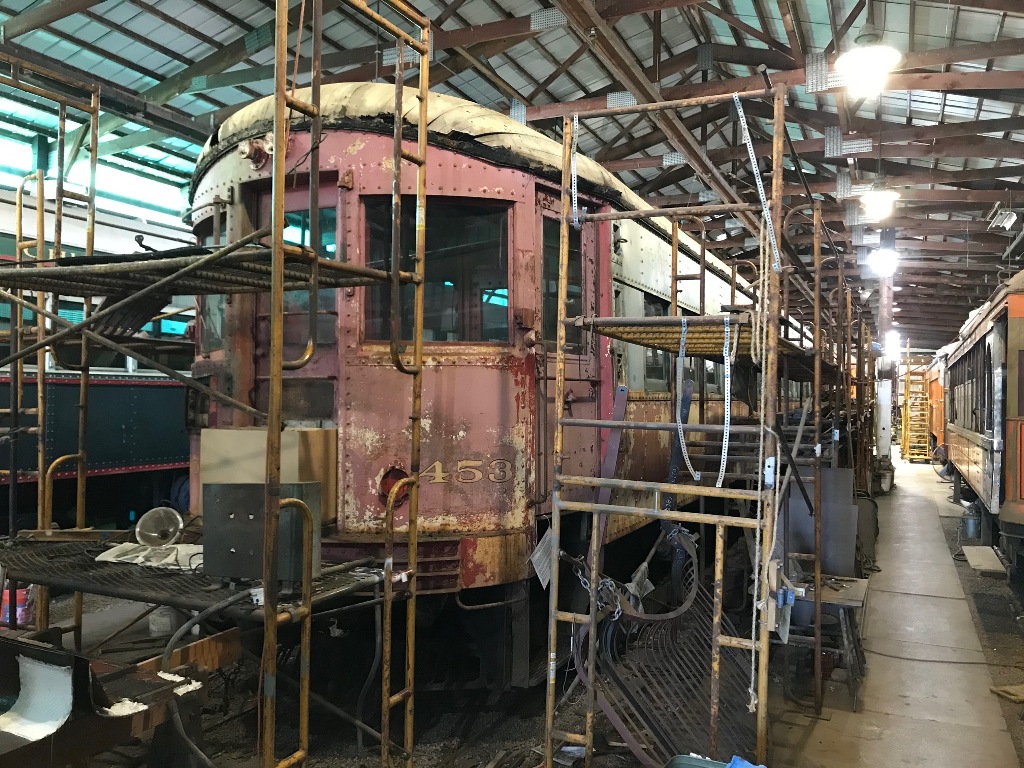
Finally, after all of the other museum cars had been disposed of, in early 1962 Gerald E. Brookins arranged to purchase four of the 450's for his operation at North Olmsted, Ohio. Cars 451, 453, 458, and 460 were selected, made up into a train, and left Wheaton on their own wheels in (July?) 1962, as seen above. The other six cars were then scrapped at Wheaton.


By 2009 all hope for continued operation of the Trolleyville electric cars had evaporated, and plans were made to dispose of the collection. The Brookins family graciously arranged for everything in the collection that could be saved to go to various trolley museums around the country. All of the CA&E St. Louis cars found good homes, as follows: the 451 and 460 went to IRM; the 453 went to the Electric City Trolley Museum in Scranton, and the 458 went to the Fox River Trolley Museum in South Elgin.
The 451 and 460 arrived at IRM in January of 2010, along with several other cars, and were unloaded, placed on trucks, and stored inside. The exteriors of both cars were needle-chipped and prepped, and painted in the red paint scheme. Since the 451's roof needed serious work, it remained in the shop, but the 460 was completed and lettered so that it was ready for the Trolley Pageant on July 4th of that year, and it operated with the 409 and 431 in a three-car train.



Interurban car development had essentially come to an end in 1930, with the development of high-speed lightweight cars such as the C&LE and IRR high-speeds. These were not applicable to the CA&E, in any case. The line needed new cars that could operate in trains with the older steel equipment, placing stringent requirements on size and overall design. As a result, for instance, coupling and uncoupling were still labor-intensive operations, requiring one or more extra people to connect two air hoses, the control jumper, bus jumper, and buzzer jumper.
Design
The new cars were designed by a team from CRT, basically the same people who had designed the Electroliners, and incorporating some of the same ideas. These were H. A. Otis, Glenn Britain (ex-Cincinnati Car), and Charles Keevil. The design was basically complete by late 1940.

The new design had many features not seen on earlier CA&E car orders.
- Curved sides, most recently used on the Electroliners, but dating back to early Cincinnati designs, to make the body six inches wider at seat level.
- Roller bearings on the main journals
- Rotary shock absorbers on the truck bolsters
- Arched roofs, with forced ventilation
- 300V motors wired in permanent-series pairs.
- Speedometers
- Cloth-covered seats
Construction
Ten cars were ordered in November, 1941 but due to the start of WWII construction did not start until late 1944. By October, 1945 the first three cars of the series (451-453) were ready for delivery and arrived at Wheaton on October 3rd. The final cars, including 460, arrived on December 8th. After delivery, plans were made for ordering eight more identical cars, but these plans were eventually cancelled.
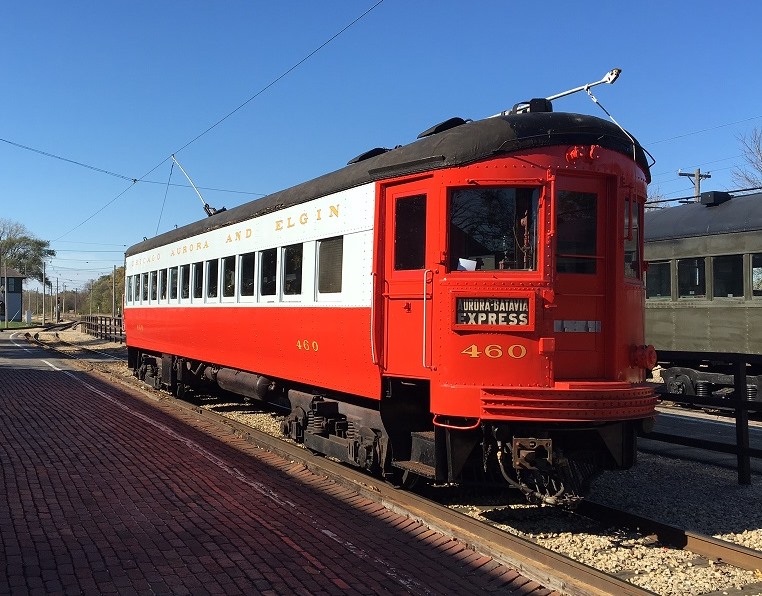
Unlike most previous orders, the new cars came with a ready-made variety of interior paint schemes: three cars had coral walls with red seats, three had blue walls and seats, and four had grey walls with brown seats. The exteriors were all a new scheme of brilliant red on the ends and sides below the belt rail, with grey over the side windows and letterboard. This was later applied to nearly all of the older cars before the end of CA&E service.
Service History
During their relatively brief service life, the St. Louis cars were a prominent part of operations on the CA&E. As the newest and most advanced of the cars, they were in constant use on all parts of the system, both for the long commuter service trains, and as single cars on the western branches of the railroad.

In the first few years, there are pictures of solid trains of St. Louis cars, but this became less common as time went on. They were commonly seen trained with Pullman and/or Cincinnati cars in whatever combination was most convenient.

Changes During Service
Because the cars were only service on the CA&E for 12 years, relatively few changes were made during their service lives.
- Linkage on the trucks to reduce sway did not work very well and was disconnected (1946)
- The metal drop sash windows in the side doors were changed to wooden sash, like all other cars (c1946)
- Black liquinoleum (tar) was applied over the light grey canvas paint; rooftop fixtures and the tack molding, which was originally red, were painted black (c1946)
- Sheet metal shields were installed in front of the horns (c1947?)
- Flag brackets were relocated lower down on the platform corner posts (c1947?)
- Wooden wheel guards on the trucks were removed (c1947?)
- The Futura lettering was replaced by the same Roman lettering as all the other cars when the 450's were first repainted (c1950)
- The windows, originally left bare brass, were painted over during subsequent repainting in the mid-1950s, though cars with toilets seem to have had their toilet window sash painted over c1950
- The speedometers did not work reliably and the generators were removed, but the indicators were left in place in the cabs (year?)
- Leather antimacassars were added to the seat backs (year?)
- Bus jumper access steps on ends replaced by different style (year?)
- Roof board cladding was removed and beveled saddles (cleats) were replaced with more typical curve-ended saddles (mid-1950s)
Preservation at North Olmsted

After the end of service on July 3rd, 1957, the ten cars in this order were stored on the east side of the shop, and minimal maintenance was done during the next five years. Since these were the most modern cars, there was hope that they might be purchased for use on some other electric line, such as the Philadelphia Suburban Transit (Red Arrow), but this never happened.
 |
| A diagram of the St. Louis cars made for PST in 1961 |
Finally, after all of the other museum cars had been disposed of, in early 1962 Gerald E. Brookins arranged to purchase four of the 450's for his operation at North Olmsted, Ohio. Cars 451, 453, 458, and 460 were selected, made up into a train, and left Wheaton on their own wheels in (July?) 1962, as seen above. The other six cars were then scrapped at Wheaton.

- Car 451 was repainted in a yellow and green paint scheme (based, we think, on colors used by the Cleveland and Southwestern) and lettered for Columbia Park and Southwestern. It remained in this paint scheme until acquired by IRM. The car was kept operational and it was occasionally used for passenger service.

- Car 453 was not repainted. In the early days it was operated occasionally.

When the 450's were shipped by rail to North Olmsted, the coupler on the #1 end lost some of its parts so that a knuckle coupler adapter could be mounted. That has not yet been fixed.
- Car 458 was never repainted, or operated as far as we know. It served as a source of spare parts and was kept in the shop.

- Car 460 was kept in the CA&E paint scheme (although the lettering was changed somewhat) and operated occasionally.

In 1979 the 451, 453, and 460 were joined with the 409 to make a four-car train, which was operated for a traction convention held at North Olmsted. And a week or so later, a small group from IRM visited the Brookins museum, and we got to run the train around the layout.

Cleveland
Gerald E. Brookins died in 1983, and Trolleyville continued for many years with the support of his family. By 2000, however, they had decided to sell the property, and the entire trolley operation needed to find a new home. The plans for the collection provided for occasional operation of the CA&E cars on Cleveland's modern rapid transit system.
In 2002 all of the CA&E cars in the Brookins collection were moved to Cleveland and stored on yard tracks of the Cleveland Rapid Transit system. Some modifications were made to allow them to operate on the RTA. The 460 had its trolley pole at one end removed and replaced with a pantograph. Test runs were made, but the only actual passenger service attempted was with two wooden cars, and lasted just one day. Otherwise the cars mostly sat in the subway.
In 2002 all of the CA&E cars in the Brookins collection were moved to Cleveland and stored on yard tracks of the Cleveland Rapid Transit system. Some modifications were made to allow them to operate on the RTA. The 460 had its trolley pole at one end removed and replaced with a pantograph. Test runs were made, but the only actual passenger service attempted was with two wooden cars, and lasted just one day. Otherwise the cars mostly sat in the subway.
IRM
By 2009 all hope for continued operation of the Trolleyville electric cars had evaporated, and plans were made to dispose of the collection. The Brookins family graciously arranged for everything in the collection that could be saved to go to various trolley museums around the country. All of the CA&E St. Louis cars found good homes, as follows: the 451 and 460 went to IRM; the 453 went to the Electric City Trolley Museum in Scranton, and the 458 went to the Fox River Trolley Museum in South Elgin.
The 451 and 460 arrived at IRM in January of 2010, along with several other cars, and were unloaded, placed on trucks, and stored inside. The exteriors of both cars were needle-chipped and prepped, and painted in the red paint scheme. Since the 451's roof needed serious work, it remained in the shop, but the 460 was completed and lettered so that it was ready for the Trolley Pageant on July 4th of that year, and it operated with the 409 and 431 in a three-car train.

451
From its acquisition in 2010 to sometime in 2011, restoration of the 451 included sand-blasting and repainting the exterior, and rebuilding the roof, as far as installing new canvas. Side windows were also removed, stripped, polished, and reinstalled. But then work on the car stopped due to other priorities. In late 2019 it was moved into Barn 4 for completion of the roof work and fixing the remaining mechanical issues. This car will be restored to its configuration as delivered in 1945. A complete interior restoration was started in early 2026.

453
The 453 was acquired by the Electric City Trolley Museum in Scranton, and it was stored inside. However, no real restoration work was started, and in 2019 it was made available to IRM for purchase. It was moved to Union in September and stored in Barn 6.

In August 2020 it was moved to Barn 4 and work on restoring the roof started. In the fall of 2021, with the roof completely rebuilt, the car was moved to Barn 13 for storage. It is in need of a full paint job and mechanical overhaul before it can be put into service.
458
The 458 was moved to South Elgin in 2010. Since that time it has been repainted and has been restored to operating condition; as of 2025 it has been used on a regular basis in revenue service.

460
The 460 was repainted and has been kept in operating condition since 2010. It was moved into Barn 4 in the spring of 2022 for a full roof rehab. Since that time it has been used quite frequently in revenue service. In 2025 the seats were completely reupholstered. The car has been restored in its configuration at the end of service in 1957.
Specifications as Built
Builder: St. Louis Car Company, order #1717
Length over anti-climbers: 55' 4-1/2"
Width at side sills: 8'8"
Width at window sills: 9'2"
Height, rail to top of roof boards: 12' 7-1/2"
Weight: 85,000 lbs
Exterior colors: Crimson red, sides light grey above belt rail, roof light grey (changed to black c1947), lettering red on grey or imitation gold on red, outlined in black
Interior colors: Coral, grey, or blue, about one-third of the fleet each (which cars were which color is uncertain - 451 and 460 both seem to have been blue, for instance)
Seating capacity: 54 (cars 451-455) or 52 (cars 456-460)
Seating type: Karpen revolving tubular-frame
Lighting: Luminator beam control, 32vDC run off 40v battery through Safety Car Heating type S 1050w carbon-pile regulator
Heating: Coil-wound resistors (baseboards), two circuits, and Chromalox strips (overhead), two circuits, with Arcostat control
Heating: Coil-wound resistors (baseboards), two circuits, and Chromalox strips (overhead), two circuits, with Arcostat control
Trucks: GSC 7'3" wheel base, 31" nominal wheel diameter
Journals: 5"x9" Fafnir roller bearing
Couplers: Ohio Brass Tomlinson form 19
Motors: 4 x GE 739A, 100hp, 300v
Gear ratio: 52:19
Control: GE Type M, KC2-19 master controller, magnetic contactors with pneumatic reverser
Line breaker: JM5 magnetic with pneumatic safety relay to prevent operation without air pressure
Batteries: Type A4HW Edison, 24 cell storage
Battery charging: GE type GMG-131 motor-generator set
Air brake schedule: WH type AMU, U4 universal valve, M-23 motorman's valve, C-8 feed valve
Brake cylinder: 14"
Pneuphonic horns: WH AA2, roof mounted