IRM is always grateful for donations of historic photographs, records, and other documents. Recently we were gifted a small collection of documents from the W.T. Van Dorn Manufacturing Company of Chicago by donor Larry Larson. Van Dorn held a number of patents and was best known for their couplers, particularly their automatic link-and-pin couplers that were very popular with interurban and rapid transit lines in the 1890s and early 1900s. Among the users of Van Dorn couplers were the Chicago Aurora & Elgin and Chicago Rapid Transit, and IRM probably has more cars equipped with Van Dorns in regular use than any other museum.
But most of the photos and documents in this collection date to the 1910-1920 era, by which time interurbans were failing quickly and most new interurban cars sported Tomlinson or MCB couplers. One of Van Dorn's new ventures was to offer all-steel boxcar ends. Boxcar technology had rapidly advanced as the popularization of automatic air brakes in the 1890s made longer, heavier freight trains possible and heavier, stronger freight cars became necessary. Steel center sills around the turn of the century were followed by the advent of all-steel underframes in the 1905-1910 era and then, in the 1910s, by the development of steel car ends. Boxcar structures failed most commonly in their ends, with heavy loads shifting during sudden movements and breaking through boxcar ends from the inside.

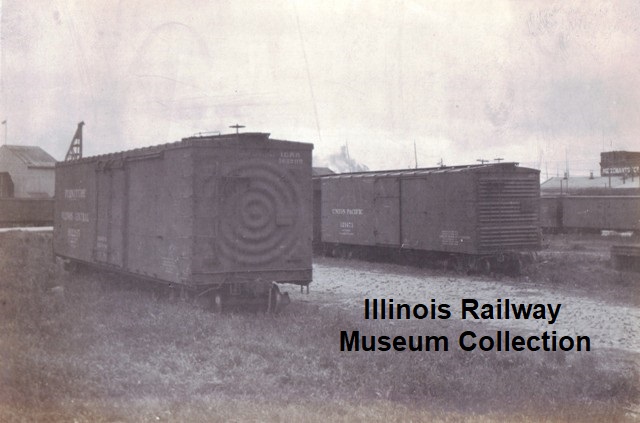
So Van Dorn developed an all-steel boxcar end that was one of the most bizarre, recognizable, and rare designs ever put on rails in this country: the Van Dorn Target End. Recognizing that formed ribs would make a car end stronger while saving weight, Van Dorn eschewed the straight ribs that every other car builder ever used and instead used a series of concentric circular ribs. The design was developed around 1906-1910 (
patent link) and several railroads tested out handfuls of sample cars. These included, at a minimum, the Rock Island, Illinois Central, Pennsylvania Railroad, and Southern Pacific. The only railroad to order a large number of cars with Van Dorn ends was the Central of Georgia, which ordered 500 boxcars that had "double target" ends that were slightly less striking.
The collection donated to IRM consists of photos from the Van Dorn sales department. Most of the photos are adhered to heavy card, to make them more durable in transportation (and for passing around a table of railroad men, presumably). Some have airbrushing modifications. There are also photos of boxcars with wooden ends that have failed, as an example of the problem Van Dorn was looking to solve.
A note on this collection: all photographs are the property of the Illinois Railway Museum. Reproduction is strictly forbidden. IRM management has recently enacted new policies regarding the online publication of museum-owned photographs, so the photos in this article are at relatively low resolution and feature prominent watermarks. Sorry.
Here we see a Van Dorn Target End at the factory prior to any installation work. This photo dates to 1914. Regarding the advertising copy near the beginning of this article, that's Pennsylvania Railroad class XL boxcar 63837 with the lettering airbrushed out. The original photo appears below. The address of the W.T. Van Dorn Manufacturing Company, 2332 S. Paulina Street in Chicago, is just south of Blue Island Avenue and is today a scrapyard.
Here's what a Van Dorn end car looked like from the inside. The cars for which these were designed were still effectively all-wood cars.

Here you'll note that the steel car end wasn't just bolted onto the end of the car where it could easily fall off. Tie rods were installed going back to the second or third body post for added strength. This one looks a bit more like an illustration than a photograph.

And here's the inside of a Van Dorn car after some interior sheathing has been applied. Boxcars were often used for grain shipment during this period, especially on Midwestern "granger roads," and one of the advantages of double-sheathed cars over single-sheathed was that they were more "airtight" and less grain was likely to escape through cracks in the car sides.

The other type of Van Dorn end from this period was this type, which I'll call a "double target" end. This seems to have been
patented in 1913. It's thought that the only railroad that had boxcars with this design was the Central of Georgia, but they ordered 500 of them, far outnumbering the handful of "full target" end cars built. That said, this car is labeled as "box #71102" (which isn't a CofG number) and I'm not sure the CofG cars had lumber doors (this design features a flat lumber door instead of the contoured ones on earlier cars). So this may be a prototype or example installation. Hey, you dropped your coupler.

These may be dies used in forming the "double target" ends on the C of G boxcars.
This is a three-panel Van Dorn end, built and assembled as a demonstration, but it is not thought that any boxcars were ever equipped with this variant of the design.
Railroads with Van Dorn end cars

The
Central of Georgia ordered 500 boxcars in 1914 that were equipped with "double target" ends. The stencil over the coupler reads "Van Dorn Patent End - Patented Aug. 12-1913."
Here's the inside of CofG car 51220 looking at the Van Dorn end. It appears that the insides of these ends were not sheathed in wood, though it's also possible that they just took this photo before that work was done. The steel roof framing is kind of interesting.

The
Chicago Rock Island & Pacific had a small collection of Van Dorn-equipped cars. These were 40' cars from the railroad's 31000-32999 class, built in 1906 by American Car & Foundry. It's thought that the cars modified with Van Dorn ends (the quantity is unknown but is likely around 6-10 cars, give or take) had this installation done sometime around 1910.

These cars are kind of interesting to begin with because each has four truss rods, which is typical, but they're not evenly spaced. Two are side-by-side along the center line of the car and one is about halfway between the car's center line and the side sill, with no truss rods under the side sill. Car numbers visible in these photos include 31385, 31722, 32033, 32111, 32556, and at least one other.

The
Illinois Central had at least four (maybe more) cars fitted with Van Dorn ends. The boxcar shown, IC 141781, was one of 2,999 cars built in the 14000-142998 series by American Car & Foundry. This was a Harriman standard design used by the IC, UP, Alton, and others and featured a modern steel underframe rather than a wooden underframe with truss rods.
The car on the left in the above photo is IC 162205, a 50' long automobile car with a fish-belly center sill built by American Car & Foundry in 1913. It's possible that this car was built new with a Van Dorn end. There was also IC 162099 and 162101, a car of the same series also fitted with a Van Dorn end,
shown here. It's doubtful that this entire series of car was fitted with these ends but how many cars got these ends is unknown.

The
Pennsylvania Railroad had at least one or two cars in their XL series that were built with Van Dorn ends. The XL was possibly the most-built boxcar ever, with some 37,000 of them being constructed over a decade or so. This car, PRR 63837 (lettered for the PRR Anchor Line), was built at Altoona in 1912 and looks to have been equipped with a Van Dorn end from the start.

This is the photo that was used for the Van Dorn advertisement at the top of this article.
Another photo of car 63837. How long this lasted in service, either with or without its unique end, is unknown. As unique as these car ends were, nobody in the 1920s or 1930s was taking photos of freight cars for the purpose of taking photos of freight cars, and in-service shots of cars with Van Dorn ends are extremely rare.

The
Southern Pacific had one - and quite possibly only one - car equipped with a Van Dorn end. SP 84977, shown here, was a B50-2 class car that was constructed around 1909 as part of the 84930-85279 series. This is another example of a Harriman standard steel-underframe car. Car 84977 was rebuilt in May 1910 with Van Dorn ends following an accident. For whatever reason, the Van Dorn sales department really liked this car and they tracked it for a decade.

Here's car 84977 in 1910 with its new Van Dorn ends and an impressive "Ogden Route" herald.

By 1915, when this photo was taken, the car had worn its steel ends for five years and was showing some wear and tear. But of course the ends of the car were holding up nicely.

Here's another photo of car 84977 in 1915. It's still got its nice Ogden Route herald.

And now, enter the 1920 Van Dorn Sales Department. It's not thought that any of these car ends were sold this late, but apparently not for lack of effort. The wording at the top says "The same car after ten years of continuous service. Steel ends in same good condition. A record of merit well worthy of consideration." And at the bottom, "S.P. box car 84977 - Van Dorn Steel Ends applied May 23, 1910 - Photograph taken at Monon, Indiana, May 22, 1920. This car was in service less than one and one-half years before the Steel Ends were applied, the wooden ends having been entirely destroyed in service."

The wording at the bottom is the same as in the previous photo. You may need to open up the photo to see, but this car had lumber doors that were formed to match the contour of the car end. They were sliding doors, so I'm not sure exactly how that worked, but it looks like they just hung from a top track and could hinge out slightly to be opened. The later "double target" end apparently switched to flat lumber doors.

Another nice photo of car 84977 in Monon, Indiana in 1920. I have no idea how late this car lasted in service.
The Chicago Milwaukee St. Paul & Pacific (Milwaukee Road) also had at least one car with a Van Dorn end, boxcar 501983 which was a 40' car built in 1913. I've found one photo in print showing the car but have not found any pictures online. It's possible that there was more than one but I just don't know.
Sales Tools
It appears that Van Dorn briefly entertained the dubious idea of building an all-steel boxcar almost entirely out of sections formed using circular ribs. The illustration in this flyer looks like a toy, and in fact it was: the flyer states that a one-tenth scale model of the proposed car can be inspected at the company's offices at 1076 South Paulina (this site, which borders the CTA Douglas Park line, is today the UIC power house). Of course the idea sounds great (save 35% on the cost of rivets? Sign me up!) but mercifully was never built to full scale.
Van Dorn employed a bit of darkroom trickery to include cars in its catalog that never actually existed. Its "double target" ends, which were applied to CofG boxcars, were designed so that a single panel could be used as a gondola end. It's not certain whether any gondolas were ever fitted with these. Don't less this image fool you; it's an image of a Van Dorn end grafted onto a different photo of a gondola.
The same is the case with this photo, which appears to show a boxcar with a three-panel end. In fact this is a modified photo of Pennsylvania Railroad 63837; the car's protruding end sill, which was rare in boxcar construction by the 1910s, betrays its origins.

Along with the photos of Van Dorn car ends, the collection that was donated included several "don't let this happen to you!" type photos of cars with wooden ends that had failed in service. Amusingly, they all have the reporting marks airbrushed out, presumably to save the owners the embarrassment. All of these photos were noted as having been taken in 1920 in Chicago. This car is also shown in the following photo and in that one they didn't do a very good job of airbrushing out the reporting marks, so I can tell you it's a Pere Marquette automobile car built in 1918 by Haskell & Barker. In the background is a CB&Q boxcar.

Here's a photo from the other side of the previously shown automobile car. That's some nifty lettering, a typeface with a bit more dash than your usual run-of-the-mill Railroad Roman.

There's a lot of this neat Spencerian script in the donated Van Dorn files. This is another boxcar whose load has decided to exit the hard way. The railroad is unknown but it's an older car, as shown by the arch-bar trucks with outside brake beams. Over the couplers it's stenciled "Imperial Release Rigging" so make of that what you will. The car on the left is probably a PRR XL boxcar, judging from the protruding end sill and wooden ladder.

Here's a top-down photo, probably taken from atop the XL in the previous photo, showing the lumber load that has pushed the end of the car out.

Here's an inside-stake wooden gondola that similarly had its lumber load try and self-unload through the end of the car. A lot of railroads had cars like this, but another un-retouched version of this photo surfaced in the Van Dorn files that identified the car. It's Big Four (CCC&StL) 35383, a truss-rod-equipped, hopper-bottom wood gondola built around 1900-1905.

And here's another gondola that has failed in service, but this time it's an all-steel gondola. By the mid-teens all-steel gons were becoming very common, especially among Midwestern and western railroads that tended to use them for hauling coal (while eastern railroads preferred the hopper cars that had started to appear around 1900). I'll confess that I'm not sure why showing a picture of a failed steel gondola end helps you to sell steel gondola ends. I suppose the argument is that the ribbed Van Dorn product is stronger than the flat (albeit reinforced) end on the car shown.

Don't spend your day jacking - buy a Van Dorn Target End instead! It's May 1920 in Chicago and this railroad worker is attempting to repair some significant damage to Frisco boxcar 32811, a typical 36' long boxcar that was part of a series of 950 cars constructed around 1905. The car is old enough that its outside brake beams are hung from the car body. It looks like the entire draft gear at this end of the car was ripped out, taking part of the end of the car with it. That will ruin anyone's day.