Tuesday, June 8, 2021

Monday Manifest

 Monday saw most of the regular weekday workers in Barn 4 again, and we managed to get quite a bit done.

With some help from John Sheldon, I removed all of the screws holding one baggage rack in place, and we were able to get it down with damaging anything.  These things are long and very heavy.  I finally gave up on trying to get it out the east end of the car, and we carried it to the west end.


But with the baggage rack out of the way, the upper wall panels are easily accessible for stripping.


These are the "before" pictures, but I didn't get around to the "after" pictures.   Sorry.


During the day, I also painted the roof fuse box, installed it, and attached one of the cables.  The other cable needs its connector soldered back in place.


Speaking of baggage racks, the racks for the Electroliner were sent out for stripping to a place that does this sort of thing.  Much easier and more effective than trying to do it ourselves.  Here Pete and Ed are looking over the results, with satisfaction.  These baggage racks are in sections that are much smaller and lighter than the ones on the 453.  Just my luck.


Tim continues to remove parts from the 2872 to prepare it for restoration, but I didn't get any pictures today.

Finally, we have arrived at the point where the 306 is getting new paint.   John spent much of the day painting the lower parts of the north side with primer, and it looks great.  By the end of the day he had finished the entire side.


Finally, while it was too hot to work on the roof for very long, I found time to put some more canvas paint on the extra pieces for climbing, which needed it.


As usual, it won't be nearly so outlandish in natural light, after drying.


Monday, June 7, 2021

More fresh paint

Frank writes...


Sunday was a short day at IRM for me but I still got some noticeable work done. The primary goal was to paint the right side of the 18 from the belt rail down and aft of the doors.
Thanks to Zach for getting this photo of me in action with the trim roller.
Here's the final result. This side of the car, which conveniently is the side seen by the public walking through Barn 7, now wears fresh Bankers Grey paint for most of its length. I still need to do most of the rear end (you can see a bit of the recently-applied Bondo in this photo), the doors, the panel between the doors, and of course the letterboard and window posts. I also brought over the four most recently-painted windows. One of them was lightly wider than the others and I wasn't able to get it into the car, but it came out of the car (at a different slot) so I just need to fiddle with that. The other three got installed on the car's left side.
Speaking of Zach, this was his project for the day. The headlights on the 749 stopped working during night operations on Memorial Day Weekend, so the car's headlight resistor box was removed and brought into the shop. The fault was traced not to a resistor but to one of the wires, so that's good. We won't be so lucky when it comes time to repair the 319's headlight resistor box, which has a couple of resistors that failed. I should probably start working on that sooner rather than later...

Friday, June 4, 2021

Just a Typical Friday

... except YOU are there, thanks to the wonders of digital photography.  Today's subjects are the 453 (natch!) and the 2872 (likewise!).

I started by moving the roof cables more or less into place on the roof, and verified that indeed every wire will connect to whatever it's supposed to.  I also spent some time fastening down the trolley boards some more.  Not much to see there.

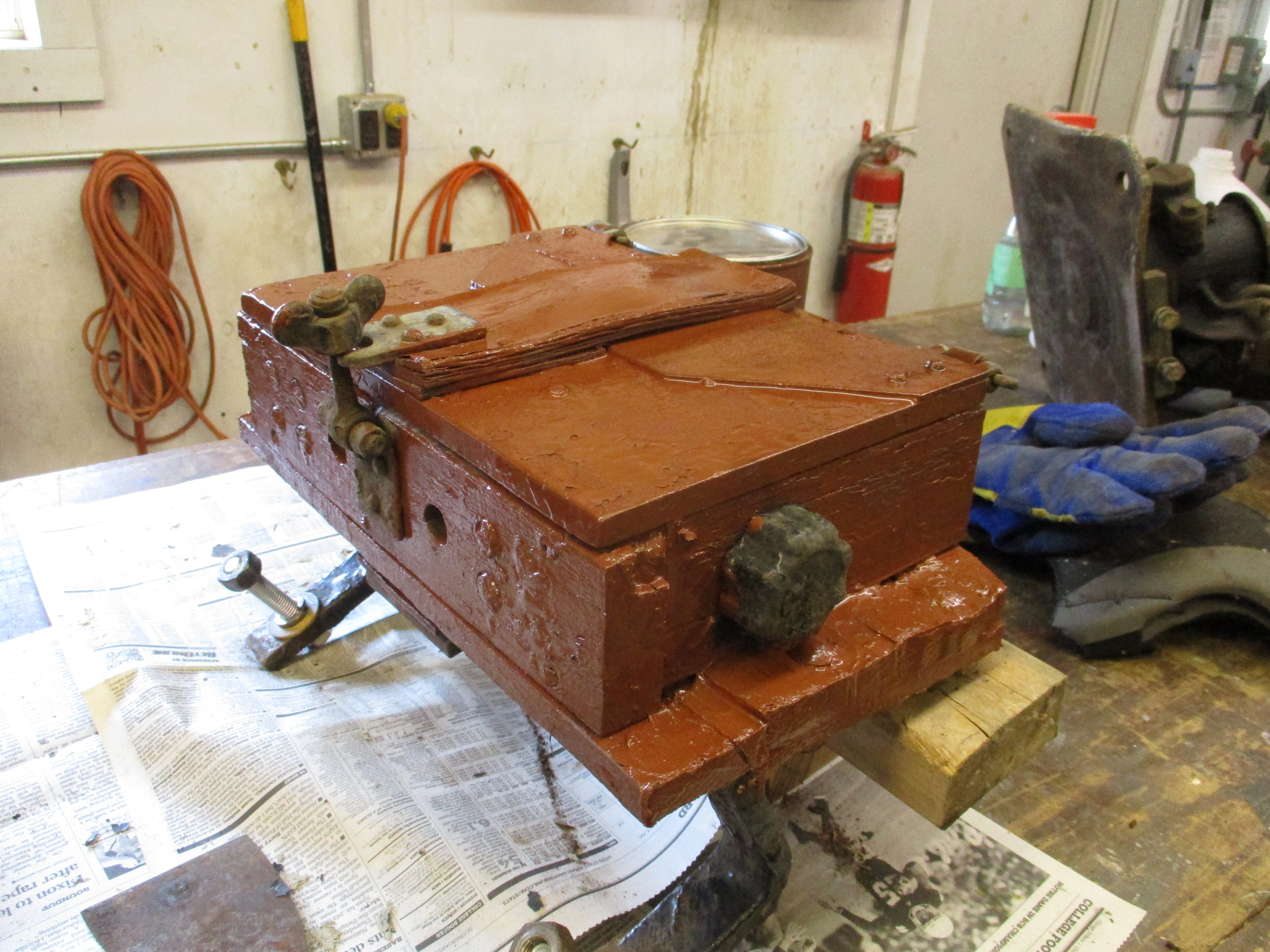
I then took the roof fuse box to the shop.  It's in pretty good shape as fuse boxes go, but the lower plate needed some patching with solid epoxy.  Here you can see it setting up, with clamps.


After a few hours, it was ready for primer.


One unusual thing about these cars is that the roof fuse box is connected to the cable between the bus jumpers, so it only functions when power is flowing through the bus line.  And we don't do that except as a last resort.  Still, we need to have the fuse box provide protection.

And since it got rather warm up on the roof, I spent some time on the interior.  The upper wall panels have loose paint which needs to be cleaned off by wire-wheeling.  Before:


And after:


This takes some effort, but it will be worth it.  All of our St. Louis 450's have similar problems with the interiors.  Wire-wheeling can be tiring, but I find it works best to do it for a few minutes, then find something else to do and come back later.


Actually, the 453 probably has the best interior of the three cars.  The ceiling in the main compartment is pretty good.  The upper wall panels on the north side are peeling badly:  


But on the south side it's OK.  I can only think that this must be due to storage outside, with one side facing south and the other north.  So the problems with the interiors might date back to the period from 1957-62, before the cars were acquired by Gerry Brookins.


I would think that the interior in the above picture would be acceptable for regular service, at least on a temporary basis.

On the other hand, the baggage racks are all pretty bad:


I'm thinking it will be best to remove the baggage racks, one or perhaps two at a time, and clean them up outside.  At the same time it will be easier to strip and repaint the upper wall panels.  I started loosening the machine screws that hold the first baggage rack in place, and it's certainly not impossible.

Meanwhile, work continued on the Met car, 2872.

Doug, who is usually part of the Barn 10 crew, came over to Barn 4 to needle-chip the exposed side sills on the Met car.  I can't tell you how grateful Tim was for this help.


Tim, however, is disassembling one end of the car.  You may guess at his general attitude:


Of course, if we had live recordings of his comments, the blog would be shut down by the censors.


And on the other hand, I suspect that if anyone other than Tim had started on this project, it would have been abandoned by now.

While the ends of the car are challenging, to say the least, the interior isn't too bad.


To follow this story to its exciting climax, you'll just have to tune in again.   And again.   And again.


Meanwhile, let's take a break and see what's happening out west where urban development is underway.  Luckily, I ran into my old friend Al Choutka who explained exactly what's planned.

Here I'm standing near the current west end of Central Avenue, looking due west.  At this point, the street will take an abrupt turn to the left.


Here I'm standing in about the same place, looking southwest.  You can see straight ahead where the street will go.  As for the street trackage, it will take an abrupt turn here.  I think they will put in a piece of curved track on each side, and then follow that with several straight sections in parallel, until they get closer to the edge of the table.


Here I'm standing alongside the west wall of the MPB, looking southwest.  The new North Western building will be rectangular, and set at an angle to the cardinal directions.  I think you can make out its footprint.  Running across the picture is a north-south "road" which will be removed.  Between the MPB and the North Western building will be a drainage ROW.   


We are open for regular operations all week now, of course.  Today the 749 was providing service.


 Well, that's all the exciting news we have for today.  But there will be more, we can assure you.

Thursday, June 3, 2021

Westward Ho

Jeron has sent us more photos with a focus on Buildings & Grounds progress. This time it's a batch of photos from Wednesday, June 2nd, showing the very start of groundbreaking work on the next building to the west of the Multi-Purpose Building. This, presumably, is the C&NW Historical Society building announced in April.


View from Olson Road during the day:

And some photos from the evening. 


I'm not certain but I think that I was told that this building will be on an angle. Main Street was always intended to have a bend in the middle, turning west-southwest about halfway between Railroad Avenue and Olson Road, so that you can't look down the block and see the cornfields out the other end of it! This last photo suggests that the C&NW building may indeed be the first building on the angled portion of Main Street. Many thanks to Jeron for sending along these photos.

Wednesday, June 2, 2021

Buildings & Grounds update

Thanks to our intrepid cub reporter Jeron Glander, who has submitted a series of photos taken over the weekend detailing progress in the B&G Department.


First, progress on the floor of the 50th Avenue station house:

Then it's over to the Multi-Purpose Building, where lights have been installed on the outside of the facade. I think this is a portion of the Milwaukee Road Historical Association's section.

And here's a walking tour of the inside of the MPB. (You can follow along on the floor plan here.) In no particular order, we start with the IRM storage room, buried right smack in the middle of the structure:

Here's the Model Railroad Exhibit at the northwest corner of the building, looking west/southwest:

Here's a view of the MRHA library/museum area, at the east end of the building, I think looking east:

At the northeast corner, alongside the MRHA library room, is a pair of display rooms fronting onto Main Street that are also part of the MRHA's space:

Taking up the entire east-west length of the building along the southern edge is the Pullman Library space. This view is looking east:

And finally, just north of the IRM storage room and located in the middle of the Main Street frontage between the MRHA section to the east and the Model Railroad Exhibit to the west is this gallery/meeting/exhibition space:

Thanks again to Jeron for sending along these photos - it's going to be fantastic to see this building in use once it's ready for occupancy.

Tuesday, June 1, 2021

Sunday shop update

Frank writes...


I was at the museum on Sunday too. Originally I was going to be conductor on the wood train, but plans change and I ended up spending the day in the shop.
I started out by putting a coat of Bankers Cream on another four windows for the 18. Three are seen here in the shop. On my next visit these will get put in the car.
Next up was more surface prep on the 18. This is pretty interesting: when the side sheets over the rear truck on the right side were sanded down, it became obvious that four different numbers could be made out: 1218 on top, applied by Trolleyville in the 1960s; under that, two very slightly offset versions of 18, applied by Shaker Heights when the car was painted in grey/yellow in the 1950s and in later Bankers colors in the 1940s; and lower down than the rest, an older 1218, presumably applied by Cleveland Interurban Railroad in the 1930s or early 1940s. For the time being, these will all still be there under the paint.
After completing the work of sanding down the side of the car aft of the doors, I took a wire wheel to the rear end of the car on the right side. What I thought was just some surface rust popping through the paint turned out to be a series of pin-holes in the end sheet just over the dasher. Bondo to the rescue. Lower down, towards the bottom of the dasher, there's some real rust jacking and I want to needle-chip that before trying to use body filler at that spot.
Here's the right side of the car after being washed down and spot primed. Next time I'm out, hopefully, this will get painted grey.
As it was getting close to dinnertime, I also drilled and tapped the two additional 3D printed latches we ordered. These will get installed on the 308 to hold the end signs up. They'll just need some plastic primer and then they, and the first one we got printed (visible top left) for the 309, can be painted blue and installed.
Dinner was a cookout, courtesy mostly of Joel Ahrendt and Thomas Slater, so a huge thank you to them and everyone else who supplied food. It was delicious, and I got a chance to yak for a while with Nick Kallas and with Dave Conrad, who is in town working on the Ingersoll-Rand engine. Hey, we need help: Dave is looking for info on GE 840G traction motors, specifically how much they weigh. If you know, drop us a line. But anyway, one of the car shop regulars, Jack, is shipping out to serve in the Air Force so Joel baked him a cake.

But let's back up earlier in the day a bit and see what else is happening in the shop.
It gets worse before it gets better: one of the early stages in any Tim Peters restoration is removal of rotten wood, and on Met car 2872, there's a lot of rotten wood. This is like the inverse of those early gate cars where one-third of the platform was an enclosed cab and two-thirds was open platform.
The big shop project for the day involved two of the Metra Highliners. IRM got four of these gargantuan cars in 2015 and in 2016 three of them were made operational. Two even ran briefly in revenue service, the only time I'm aware of that any Highliners have carried passengers anywhere other than the IC. But they hadn't been fired up in more than four years, so two were brought over to the pit lead to get them going again. "Sit-itis," that affliction affecting electric railway cars that haven't been used for an extended period of time, is especially hard on equipment stored outdoors and/or that is more modern (read as: complex). A group of guys including Richard, Greg, Nick E, Jeron, Nick D, and "Metra Dan" worked for the better part of the day to fix issues that arose on the first car, 1637, which is shown above with 1630 behind it.
How do you know the car is not quite ready for revenue service? The first clue is the "if you open this door it will break the air system" sign. But never fear, once an air strainer of the correct type is sourced this particular issue will no longer be a problem. Other challenges included stuck brushes in the MA set and at least one balky relay. But sometime around 10:30pm, the car ran!
A couple of test trips back and forth on the pit lead, towing car 1630 (not motoring but with brakes fully operational), were made. They even let me run a trip!
This was under close supervision, of course. These cars are very different from what I'm used to. Besides being huge, there are some unusual quirks, like a foot pedal dead-man you have to keep depressed, an "electric holding" spot on the brake valve, and a "coasting" point in the controller which doesn't appear to have any function not filled by "off." They are very quiet cars other than random air noises from the pneumatic suspension. Many thanks to Richard, Nick, and the others for the opportunity!

And finally, just a bit of railfanning: the CA&E wood train returning from its last trip of the day as the Shay and its caboose train departs from Station Track 1 to short-turn at Car Line Junction and head down to the south yards.