Paris Traction
by Stephen M. Scalzo
Headline image: Open car 55 is southbound on Main at Wood Street in downtown Paris, IL, sometime in the 1910s. All photos are from the Stephen Scalzo Collection of the Illinois Railway Museum except where noted.
Paris, the county seat for Edgar County, was originally surveyed and laid out in 1823 after Samuel Vance donated the land. It was named after Paris, Kentucky, which was named after the French city. Until the building of the railroad through Paris in 1854, it was just a small village.
The Paris Horse & Steam Railway Carrying Company was incorporated on March 30, 1869, with $20,000 of capital, but never built anything. In 1873, Robert G. Hervey incorporated the Paris Street Railway, and after receiving a franchise in 1874, the company opened a one-mule, one-horsecar line from the Illinois Midland Railroad depot on Austin Street down Middle (Washington) Street to Main Street. The line was unprofitable and it closed down during 1876. For a short time afterward, the trackage was used by a steam locomotive to serve a coal and lumber yard on the street, but that service only lasted a couple of years. The rails were eventually removed for scrap.
The Enterprise Electric Railway was incorporated in January 1897 by Captain M. Evinger of Terre Haute, Indiana, to build a streetcar line in Paris. The company asked for a franchise and 100 shares of $100,000 stock were delivered to the company. The Interstate Railway, Light & Power Company was incorporated on February 13, 1901, and requested a franchise from Paris to build a line. However, these companies never built anything.
In 1902, preliminary surveys were begun for building the Paris & Terre Haute Railroad. Construction began on the interurban line in 1906, with construction finished in October 1907. The city of Paris would not permit trackage on Wood Street, but required the trackage be built on Washington Street, where a station was built at 115 East Washington. The first interurban operated into Paris on October 27, 1907, with regular service starting on November 14, 1907. The interurban was later leased to the Terre Haute Indianapolis & Eastern Traction Company, and eventually passengers could travel all the way to Dayton, Ohio.
In 1904, construction began on the Paris Interurban Car Company (later known as the McGuire-Cummings Car Manufacturing Plant). By early in 1905, eight buildings were completed and machinery installed so production could begin.
The Paris Traction Company was incorporated on February 1, 1905, with $15,000 of capital (which later was increased to $50,000), with mostly the same officers as the Paris & Terre Haute Railroad. After receiving a franchise, it proceeded with plans for a four-mile line. By July 1906, enough capital had been raised so that construction could begin. Rails, ties, and poles were ordered in August, and surveying of the line began in October. Four 10-bench open streetcars were delivered in early May 1907, two closed cars were delivered in August, and a third closed car was delivered in November.
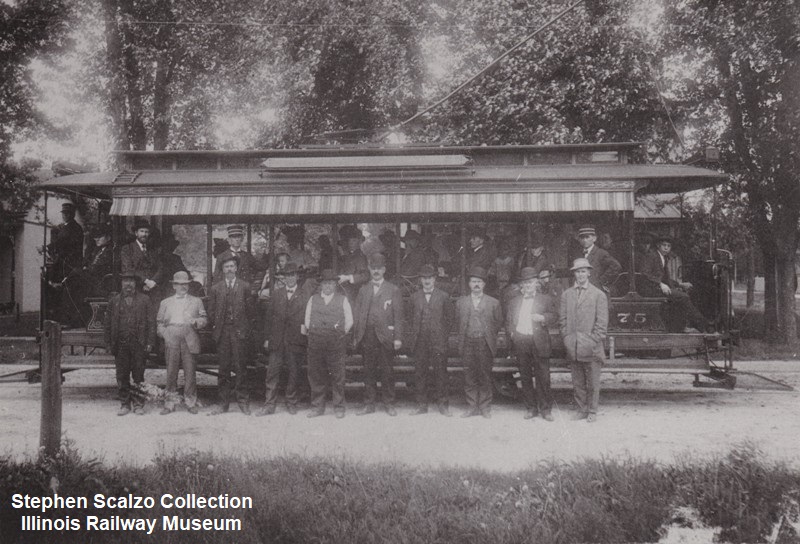
Open car 75 poses on the first day of streetcar service in Paris, May 25, 1907.
Streetcar service started on May 25, 1907, and the next day thousands rode the line. A small frame carbarn with corrugated galvanized iron siding containing two tracks (one track with a pit) was located on Main Street at the south city limits next to the Vandalia Railroad tracks. The 15,077 feet of trackage ran on Main Street from the pumping station at Reservoir Park to the interurban car factory at the Vandalia Railroad (later Pennsylvania Railroad) tracks, with three passing sidings. Reservoir Park was the city's principal recreation center, formed when Sugar Creek was dammed to create a lake. It became very popular for camping, parties, and picnics. Beginning in 1904, the Chautauquas were held there, and the 10-day program annually drew thousands of visitors.

One of the deck-roof single-truck cars is shown at an unknown location in Paris. The sign on the dash - "Pay as you enter - have correct fare ready please" - may suggest that this was in the early days of streetcar service in the city. Bizarrely, the car is numbered 55, the same as one of the open cars pictured elsewhere here - why this may have been done is a mystery.
Open car 3 is seen at the north end of the line, at Reservoir Park, in the 1910s.
On July 1, 1912, Chicagoan Marshall E. Sampsell, president of the Central Illinois Public Service Company and the Central Illinois Traction Company, purchased $40,000 of the $50,000 of capital stock of the Paris Traction Company in the interest of the Central Illinois Public Service Company, which was developing plans of extending its interurban system from Charleston to Paris. Plans were also contemplated on building an extension 13 miles north to Chrisman. However, because of the tight money situation during the era that followed, nothing was ever built. The original streetcars were still in service, and during the Chautauqua and county fair week additional equipment was leased from the interurban, with the cars being transferred back and forth over a track connection. By 1917, earnings of the company were $17,277 with 328,531 riders. In July 1919, two new four-wheel Birney streetcars were received and placed into operation in hopes of improving service.

Arguably the most attractive of the streetcars in Paris was car 30, shown here. This Stephenson design was popular with several systems in Massachusetts; one nearly identical example, from the Middlesex & Boston, is currently being restored by the Seashore Trolley Museum.
Car 11 or 12 is in operation on Main Street in Paris, date and location unknown.
During 1920, earnings started to decline as the popularity of the automobile increased. Passenger traffic fell off, and with the expansion of Paris, the streetcar system became too small, because newer factories were scattered all over the town. An additional Birney streetcar was received during 1925 from the company's
Anna-Jonesboro system when it was closed down; however, only one streetcar held down the schedule on weekdays, with two streetcars being used on Saturdays. The streetcar system began operating at a loss, and in August 1925, CIPSCO applied to the city for permission to abandon streetcar service and substitute buses. However, the city insisted that all of the rails had to be removed as a condition, which was an expensive project the company did not want. Thus, streetcar service continued to operate, even at a loss.
A fire destroyed the carbarn which housed the three remaining streetcars and a Mattoon-Charleston-Paris bus on the evening of January 23, 1928. Because the temperature was 22 degrees below zero, the firemen could not do much to put out the fire, and the loss was $27,000. CIPSCO said that the streetcars would not be replaced, and permission was received shortly thereafter to abandon the system. In May, CIPSCO paid the city of Paris $15,000 cash in order to be released from the obligation of removing the tracks.
Interurban passenger service, also greatly affected by the automobile and paved highways, and operating at a deficit, was discontinued (upon approval of the Illinois Commerce Commission) by the Indiana Railroad Company on January 24, 1932.
This article was edited and laid out by Frank Hicks. Thanks to Ray and Julie Piesciuk and to Richard Schauer for making available the materials from the Stephen Scalzo Collection that were used to publish this history.
Equipment Roster
3, 49, 55, 75 (four cars) - ST DE DR 8-bench open cars, purchased secondhand in 1907 from the Electric Railway Equipment Company of Philadelphia (original numbers were kept; probably ex-Holyoke Street Railway) - 31' long, Brill truck, 2 x GE 800 motors, K-2 control, hand brakes
11, 12 (two cars) - ST DE DR closed cars, purchased secondhand in 1907 from the Electric Railway Equipment Company of Philadelphia (original numbers were kept; probably ex-Holyoke Street Railway) - 27'7" long, Bemis truck, 2 x GE 800 motors, K-2 control, hand brakes
30 (one car) - ST DE RR closed car, purchased secondhand in 1907 from the Electric Railway Equipment Company of Philadelphia (original number kept; probably ex-Holyoke Street Railway) - 30'9" long, Bemis truck, 2 x GE 800 motors, K-2 control, hand brakes (
in-service photo here)
#s unknown, 125-134 series (three cars) - ST DE AR Birney cars, built 1919 by Cincinnati (order #2395) - one car transferred from Anna-Jonesboro in 1925
# unknown (one car) - ST unmotorized work flat, 19' long, Brill truck
AR=Arch Roof; DE=Double End; DR=Deck Roof; RR=Railroad Roof; ST=Single Truck
Note: Newspapers at the time stated that the company's cars were originally from Holyoke. A roster of that system is unavailable, but details of open cars in Paris match closely a photo here of a Holyoke open car - notably the unusual fenders and the guards at the ends of the running boards. The closed cars, at least, are suspected to have been built by Stephenson. A photo of one of the deck-roof closed cars, thought to be 11-12, shows it numbered 55, but the story behind this is unknown.
Car 30 is pictured with its crew. The Bemis truck and four-sided rooftop destination signs were much more common in New England than in the Midwest.
Open car 55 proudly wears The Paris Traction Company across its letterboard.
This postcard of car 3 and one other open car passing each other in front of the courthouse comes from Mark Sims. The note reads "Now don't you say we don't have street cars in Paris."
Route Map
Black is Paris Traction Company; red is the interurban line to Terre Haute. The carbarn was on the east side of Main Street just north of the Vandalia Railroad.
Sanborn fire insurance map from 1916 showing the carbarn in Paris