Sunday, June 1, 2025

Calling All IVDIV Fans

We recently received a query from a collector who had acquired these metal signs, and wanted to know more about them:


They're about 30" x 4".  I told him I'm pretty sure these are route signs for display on the front end of interurban cars on the Illinois Valley line.  But I don't know how far back in time these might date.  Does anyone know of pictures of a car with signs like this on it?

Thursday, May 29, 2025

Exciting Thursday

Today had a lot of interesting things going on, with pictures I'm sure you'll enjoy.  Apart from the interesting things, I worked some more on one of the bearings for the 309 which needs to be remachined.  I wound up taking it home.  But let's see what other people were doing, as that will be a lot more exciting!

First of all, Dave wanted me to show the amazing work that is in progress in the Central Diner.  Contractors (one of whom is seen below) were hired to reproduce the corrugated metal panels behind the counter as seen here, and they have now been installed.  It looks fabulous!  Of course, there's lots more to be done, but this will eventually be a central part of our Main Street city.


Next, Phil and Gerry continue their thorough restoration of the 306's interior.  Here we see Phil installing molding strips in the ceiling.  When he ran out of the correct screws, I was able to help with some of the right type that were left over from the last interior job I did.


And the wiring for the (single) interior light circuit is nearly complete.


Also, the floor of the smoker has been primed.


As Frank mentioned before, the horse car is now in Barn 4 temporarily, which gave me the opportunity to get some good pictures of the interior.


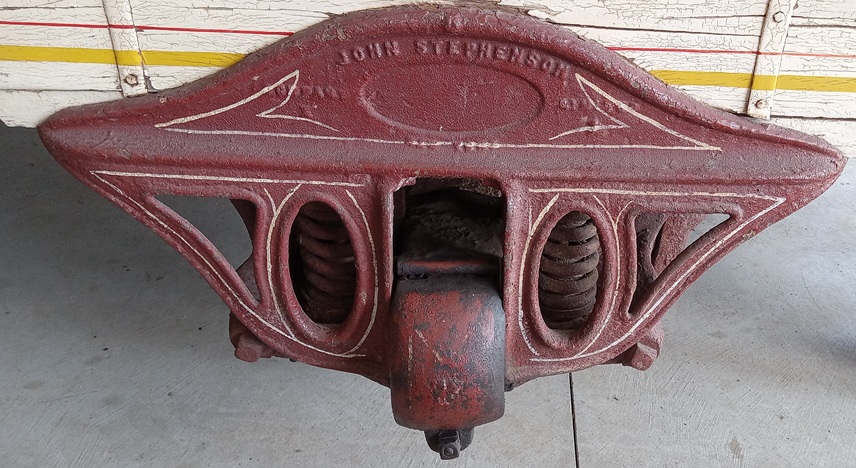
A Stephenson pedestal bearing.


And here's the artistic interior, with its hand-painted scenery.  I'm certainly glad we don't need to restore this:


The metal channels are for collecting coins from the passengers:


This car is in incredible condition for something built in 1859.  It will be a stunning centerpiece for our new Visitor Center, when that gets built.

Finally, I'm afraid that vandalism is a constant concern in this business.  While I was in Barn 4, some miscreant with a portable jackhammer drove in and started breaking up the concrete floor near the pit, as seen here.  It went quickly, and before I could get his picture for the FBI, he drove away and made a clean break of it. 


Well, I guess there's nothing to be done now but to shovel out the fragments and pour new concrete.  That may actually be an improvement.  But I hate it when people get away with things like that!

Be that as it may, you'll want to buy your tickets for Day Out With Thomas soon, before we're sold out!

Wednesday, May 28, 2025

Unexpected New York Central

Unexpected New York Central
by Art Peterson
All photos are from the Krambles-Peterson Archive

Frank’s recent, outstanding coverage on the NYC S-motors sent me back into the NYC photos, to see what other locomotives there were photos of that he had also mentioned in his piece. In addition, there were a few other images of a few cars that one wouldn’t normally expect to find in a Class One railroad roster. I hope you find these of interest.

NYC Coaches 1219-1220 – High Bridge – ca. 1913
It seems like “all God’s children” had ex-New York City elevated cars (think of interurbans in Ohio using them as line cars, or the yeoman duty ex-New York cars did during WWII on the Richmond Shipyard Railway, etc.). So, when I first saw this print of NYC 3436 (Alco, 1911) sitting on the electric division trackage at High Bridge, that’s what I thought looking at the coaches on the Putnam Division embankment in the background.

How wrong I was! Posting the shot on the “passenger car site,” I asked about the history of cars 1219-1220 and found out that they had been built new by Gilbert in 1888 for the New York Northern. In my excitement, I had managed to overlook the fact that the cars clearly had sets of steps to load/unload at low-level platforms (a definite “doh!” moment). The cars later worked for the New York & Putnam before becoming part of the NYC&HR roster.

Dating of this image is helped by the fact that the steam-to-electric (or vice versa) changeover was made at High Bridge until about 1913, when that was relocated to Harmon.

NYC Tri-Power Locomotive 1525 – Alco-GE – February 1928
Frank talked about the tri-powers in his piece, and here’s a shot of the distinctive styling of the prototype, when new at Alco-GE. This locomotive was equipped with a 300 hp Ingersoll-Rand engine and also accommodated a 218-cell battery. This unit was converted to a hump trailer in 1945. The balance of the tri-powers used a boxcab body design, slightly more squared off, compared to the Alco-GE-Ingersoll-Rand oil-electrics that would follow.

NYC MT-9 – Fort Wayne – June 19, 1939
So, this is one of those “unexpecteds.” NYC bought four of the ex-Michigan Railway, St. Louis Car-built, 1915 combines and converted them to trailers for use with gas-electric cars. The MT-9 was originally assigned as CCC&StL MT-1212 and had previously been MRy 803. This car was scrapped in the 1940s.

NYC Q-Type 1251 – Alco-GE – March 1926
As noted in Frank’s piece, the Class Q steeplecab type locomotives were bought in anticipation of the electrification of the West Side Freight Line. The 1251 would later be renumbered as NYC 121 and would finally be scrapped in 1955.

NYC R-type 1201 – Alco-GE – October 7, 1926
Here’s one of those great Alco “paster” shots – this time showing the prototype for the R-types at the builder’s plant. The R-type design evolved into the single-unit version familiar on the Detroit River Tunnel and New York City electrifications and later on the South Shore. These prototype units were converted to diesel hump trailers in 1945. Frank adds: This prototype R-motor was electrically identical to a pair of Q-motors with a drawbar between them, featuring the same trucks, motors, and control. Of course, as shown, it had boxcab instead of steeplecab car bodies.

NYC R-1-type 7500 – Alco-GE – May 1910
For this Alco “paster” the darkroom technician has blanked out all the cab windows on this R-1 locomotive for the Detroit River Tunnel (DRT) operation. DRT had been formed in 1905 to build and equip the tunnel. Seven locomotives to this style were delivered in 1910 (7500 was the grand-daddy of them all), with another four following in 1914 (increased to 123 tons) and a pair of 125-ton locomotives which were delivered in 1926. The R-1s were equipped with four GE 209 (300 hp) motors and could develop a maximum of 67,000 lbs. tractive effort. Through 1924, the first two orders of steeplecabs were reported to have repair costs of just $0.09 per locomotive-mile. Frank adds: Note that this is something of a larger version of ComEd 4, with its two trucks pinned together in a B+B rather than B-B arrangement that avoided transferring buffer forces through the car body frame.

NYC&HR 11 – Circa 1911
Although the photo is undated, the car is still lettered for the NYC&HR, which it wore until at least 1912. The car (homebuilt by the Boston & Albany in 1904) operated on the 1.2-mile Riverside-Newton Lower Falls service until late April 1930. The electrified passenger operation on the branch began in January 1904.

NYC 825 – G.C. Kuhlman Plant – January 26, 1906
NYC used this car to test a gas-mechanical car design at its Collinwood, OH shops (east of Cleveland) in October 1906. The tests were not successful. George’s notes on the print indicate the handsome little carbody found further employment as a yard office in Seneca, NY.

Acknowledgements: Thanks to Rich Stoving of the NYCHS for some of the commentary on the High Bridge shot. In addition, WD Middleton’s “When Steam Railroads Electrified” was an invaluable resource.  Several on-line sources were also used.

Monday, May 26, 2025

Memorial Day

Frank writes...


Happy Memorial Day! It was a gorgeous weekend at IRM and there's plenty of news to share.
The plan for Sunday was to run the 319 and the 308, the latter running as a control trailer. My father and I were conductor and trainman with Larry Stone as motorman. Above, the train is shown in Yard 8. Isn't that nice? This consist was very common before the 308 had a motor short out in 2019. Anyway, things didn't go to plan. We got up to the depot and were loading for our first trip when Greg, who was hanging out on the Station Track 2 platform alongside ComEd 4, noticed that the 308's compressor was "barking" when starting up. Inspection suggested there was some arcing at startup, so out of caution, we decided to take the car out of service. We brought the 308 back to track 84, dropped it in the barn, and Larry and my father headed back up to the depot to run the 319 solo.
Here's the 319 coming up to the depot (more about the construction zone later!). Later in the day, Ashtin was able to quickly inspect the 308's pump. The brushes are wearing very unevenly and there's some discoloration on the commutator, so we definitely need to look at the brushes and see whether they need replacement or whether we need to repair the brush holders. But it doesn't look like anything irreparable, and the pump isn't grounded - it was still running when we headed back to the barn. Stay tuned!
Since I was out of a job, I went along for a ride. Above, our conductor listens for westbound orders as we speed through the countryside.
My father also remembered to break out the 48-star flags in honor of Memorial Day.
After that, I went for a "railfanning" trip aboard ComEd 4 with motorman Zach and "pole hop" Nathan. The "Edison engine" was pulling the caboose train for the day. Above you can see Zach, who is always authentically attired no matter his assignment, is backing the train westward at Johnson as the North Shore train speeds past on the main.
There was also ample evidence around the property that the Buildings & Grounds Department has been hard at work. They're doing concrete replacement inside the front (west end) of Barn 6, though I didn't get a picture of that. Perhaps the most visible work was shown earlier, where the east berth platform of Station Track 1 has been taken out for replacement. And above, these little concrete pads on the east side of the office have been there for a number of years as places to put benches. They seem to be going away.
Also, in exciting news, work has resumed on Barn 15! Last we knew, half the barn post footings were in on the north side of the barn. As of this past week, the other half along the north side have now been completed, as shown above.
Here's a shot of the southeast corner of Barn 7, just inside the front of the barn. Something's missing...
...of course! The horse car! Sure enough, North Chicago Street Railroad 8, our oldest piece of equipment, was requisitioned for use in filming for a WTTW (PBS) program. I believe it was pulled out of the barn on Wednesday and filming took place on Friday. To get it out of the barn, we used the rubber-tire dollies that the CTA built for this thing way back in the 1940s or 1950s, and extracted it right out the front door of the barn. After filming, it was deposited in Barn 4, but it will soon go back to its usual home in Barn 7. Above, it's shown behind Barn 4 on the dollies.
And this afforded an extremely rare opportunity to get a nice, clear three-quarters shot of the cable trailer, Chicago City Railway 209. The line between "heavy restoration" and "replica" can be a bit murky, especially 100 years on, but according to what records we have, the cable car is basically original (to some extent), albeit heavily restored in the early 1900s, while cable trailer 209 was a replica built around 1933 using some surviving original components. Electric car 4, behind the cable trailer, is much more original (at least to its end-of-service condition), and seems to be pretty much the same as it was when removed from service c1918 except for paint.
After I was done railfanning, I put a couple of test patches on Shaker Heights 63 to see what the most efficient way of applying the maroon striping will be. I would love to get this paint job completed, or mostly completed, this year. I also spent a bit of time helping Nick, Greg, and Ashtin move spare 'L' car parts out of Barn 4 and into storage.
A welcome sight late Sunday afternoon was the Shay, making test trips around the streetcar line and then out on the main line.
And finally, I stopped out briefly on Monday with my daughter. The weather was just as fantastic as Sunday, and trains in operation included Veracruz 19, the North Shore cars, the Shay with the coach-caboose train, and a diesel-hauled coach train (all shown above) as well as IT 1565-518-234, Chicago Elevated 1754, and the 3142. The "Tangerine Limited" was missing its motor car because the 277 is in the shop for brake work, but that work was in progress over the weekend in the form of brake levers and brake heads being drilled for just-delivered bushings.

EDIT: Thanks to our intrepid freelance photographer Buzz Morrisette, who sent the below photo and caption from Monday:
Chris of the Steam team is "exercising" the water pump used to put fires out. If you can't fix it with a hammer, you have an electrical problem.

Thursday, May 22, 2025

Busy Tuesday

I just got back from a two-week trip to Massachusetts to visit my grandchildren and their parents, but Frank was able to do a super (with a capital "S") job of keeping the blog going.  

My main task for Tuesday was to check the compressor on the 308 and verify that the brakes are working correctly on the two-car train, along with everything else.  It was raining, but if the train can move 50 feet without issues, I'm pretty sure it can move five or six miles.

I wasn't alone in Barn 8: Paul Hough and Steve Smunt were hard at work on the interior of the 277.  They're doing an excellent job, and they promised to send me some pictures of the restored walls and ceiling in the main compartment.  Here's Paul sanding down the lower wall.


And a lot of work has been going on inside the 306.  Here are some of the partition sections for reconstructing the toilet compartment.


The window on the right side in this view has been removed, of course, since that's where the compartment will go.  Just one of many tasks involved with undoing all the Shakerisms.


Gerry and Phil were working on installing the center ceiling light fixtures.


And I met Steve Keller, a new member who is seen here painting parts.


This car is really going be good as new when these guys are done!

Monday, May 19, 2025

One for Four, Two and a Half of Four

Frank writes...


Some days you get the bearing, and some days the bearing gets you. First, a big THANK YOU goes out to the crew that worked on the 309 axle cap bearings on Saturday. This involved taking the car out for a test trip, during which the #1L bearing ran hot; bringing the car back; doing a bit of reprofiling of the spots on the bearing where there was evident wear; blueing the bearing surface; and taking the car out for another test trip, during which the axle ran hot again. It seems that although the bearing has been machined true, the axle itself has high spots, leading to point loading and spots where the clearance is too tight.
The axle cap above shows some of the uneven wear, though also keep in mind that the entire surface of the bearing was not blued, only the middle parts. Anyway, this will require more trial and error in terms of getting the bearing surface to match with the axle, but more cars need to use the inspection pit, so that work needs to be put off. I worked with Will and Ted to remove the axle cap, pull out the new bearings shown above, and put in the old bearings.
After service ended, Joel had the 309 hauled out to live overhead and we took it down the main line at low speed to test out the last of the three new bearings. Unfortunately, this one started running warm, too, though not as hot as the other bearings. Rats. We brought the car back to the inspection pit and, later in the afternoon, Will and Ted removed that axle cap as well, as shown above. We then put the old bearing back in this axle cap, too. So, for the moment, we are one-for-four on the new axle cap bearings -  the one we installed last year is still working just fine but these latest three will need some sort of additional work to be serviceable. This is a project we plan to work on over the course of this summer.
In other news, in between all the 309 activity, I also made good progress on the 319's grid box. Joel ordered new mica tubes during the week, and Ted helped me assemble the grid box on the bench and get it all bolted together. We then took it over to Barn 8, removed the grid box with the failed element, and installed the rebuilt grid box, as shown above. After dinner, Greg, Good Nick, and I successfully tested the car with the new grid box and then coupled it up to the 308, completing this grid box rebuild project. The CA&E wood cars are on the operating schedule for this Sunday, so our current plan is to run the 319 towing the 308 as a control trailer. The 309 should be ready for service - we haven't tested it since reinstalling the old bearing in that last axle cap, but we don't anticipate any issues - so we're back to having "two and a half out of four" cars available for service. The 36 still needs leaf springs replaced and the 308, of course, is in service but is sans motors.

I didn't have too much time to take photos, but let's see what else is happening on this fine Sunday!
The indefatigable B&G Department will have someone pouring concrete inside the west end of Barn 6 during the week, so track 61 had to get pulled. When I arrived, the IC MU cars were spotted in Yard 5, as shown. Jimmy has been working on fixing some minor issues with these cars, so later in the afternoon, they were towed over to the main line across from the depot and operated back and forth to test them out. As I understand it, no problems were found, which bodes well for these cars making more appearances in service.
And the South Storage Building continues to make rapid progress. Other than doors, the exterior looks to be just about complete.

This coming weekend is Memorial Day, so there will be some unusual equipment out. The 24 is scheduled to run Saturday, CA&E wood and steel trains on Sunday, and the IT "orange cars" on Monday. Tell your friends!