Monday, June 27, 2016

Traction Weekend


Traction Weekend (July 4th Weekend) will not include the usual trolley pageant this year, but there will be many interesting trains running for passenger service, with lots of photo opportunities.  In particular, Sunday, July 3rd will be CA&E Day.  We will be commemorating the historic abandonment with a bigger and better re-enactment than ever.  We should have seven operating CA&E cars for you to ride.  These cars are from seven different builders and span the entire history of Third Rail equipment, from the earliest (#36, 1902) to the last (#460, 1945).  Be there by 11:30 to take a ride into history!


Progress aplenty

Frank writes...

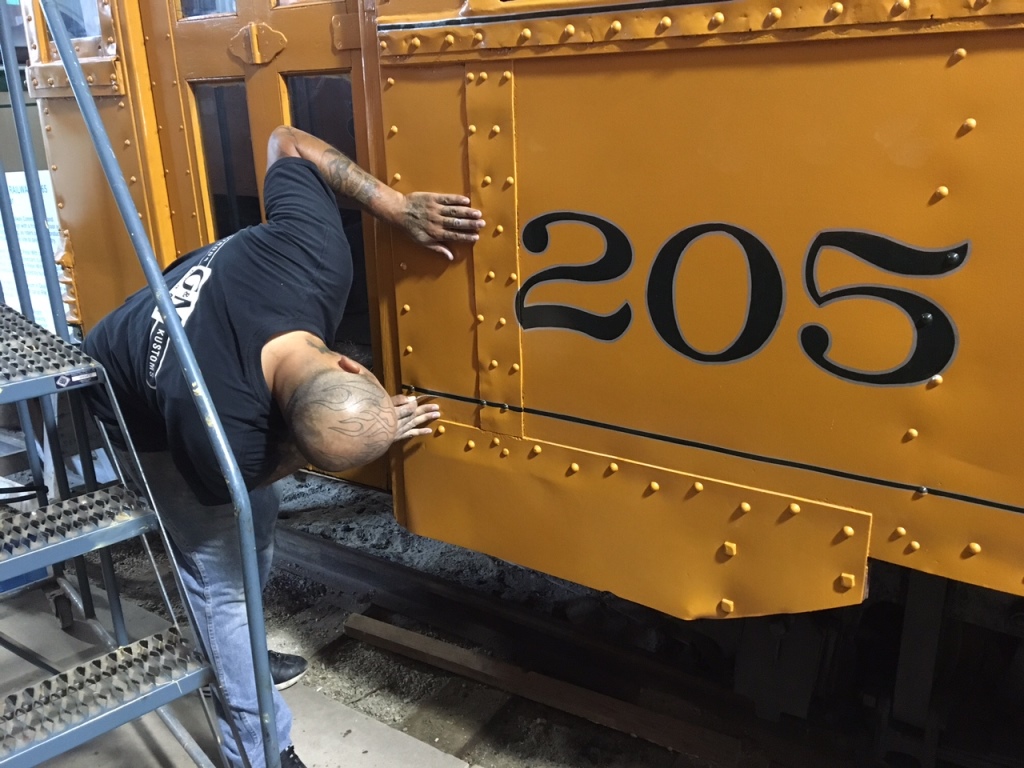
Sunday was one of those days when a lot got done, and on a number of different fronts too. The big news involved the 205. Professional sign painter Ron Coy (the same guy who painted the lettering on the Trolleyville CA&E cars back in 2010), came out along with his understudy Jerry and completed all of the silver outlining and striping on the car.  Painting on the 205 is now done!
Ron gets started on one of the numbers...
...while Jerry works on the pin-striping.
The silver outlines really make the lettering pop, especially when you add a little daylight. As with the 65, the 205 has dark (very dark) green lettering with silver outlines.
And here's Ron and Jerry after completing the car. They did a beautiful job!
But while painting might be done I should mention the project isn't completely done. The silver outlines were the largest and most obvious part of the job not previously finished but I still need to strip a little Portland paint off one of the car's window frames, add canvas-backed rubber to the folding door edges, and wash down the seats. But that's about it!
And the rest of the day was devoted to the CA&E cars. First, Phil (pictured above) and another guy from the Steam Shop whose name I neglected to get brought over the new tank for the 36 after it successfully passed its hammer and hydro tests. Thanks to the Steam Team for working on these tanks and getting them approved for service!
And while Ron and Jerry were at work, I switched the order of the cars. We started with (from the door) 309, 308-319, 36 on track 84. Since we want the 36 in the middle of the 308 and 309, a few switch moves resulted in the order being changed to 309-36-308-319 with the 309 still at the door and the 319 now fourth in. And more importantly, in the afternoon I brought the 36 and 309 over to the pit to finish up inspection work. They're shown above on the tail track.
Earlier in the day, Richard, Greg, Joel, Dan and Nick (not that Nick!) finished annual inspection work on the 2000s, so after that the pit was clear for the 36. My father had already finished most of the inspection work on both the 36 and 309 but we needed to do pit work (motor and truck inspection, mainly) on the 36 and roof inspection on both cars. Above is the view of Barn 4 from the roof of the 36. On the far track (43), L-R is the 306, 810, 4223, 300 and 19; on the center track are the Toledo steeplecab, 4146, 28, and 24/1024. Next to us on the pit track are a couple of Electroliner sections.
I had quite a bit of help on this inspection work. Joel completed the roof inspection on the 309 and also did the armature bearing and axle cap lubrication on the 36. Doodlebug Dan helped with brake adjustment and also helped retrieve our newly-tested air tank from the steam shop. Greg helped me fetch the other air tank from Barn 8 for priming and, speaking of that, Richard primed both of our air tanks (shown above) and offered to paint them black tomorrow - thank you! Nick Espevik also helped with switch moves to get the cars put back in the barn in the right order. It's truly a team effort. By the end of the day all of the cars had been inspected and all were back in Barn 8, in the correct order, and all trained together. While the Trolley Pageant may have been officially canceled for next weekend, we will be reenacting the abandonment of the CA&E on Sunday the 3rd in impressive fashion with all (or nearly all, depending on crew availability) of the museum's operating CA&E cars out on the railroad. There will also be a lot of other interesting electric cars running over the weekend plus the 1630, which if rumors are to be believed will be pulling some rather interesting consists.
Mark next weekend on your calendar - official shop mouser Mr. Socks says you'll regret it if you miss it!

Sunday, June 26, 2016

Nightmare Scenarios

You ever have nightmares?  I generally don't, but I just had a doozy.   Must be something I ate.  It was all about IRM, and it kept getting worse and worse.  It's 3 AM, and I just gotta tell somebody.  As with most dreams, a lot of it was pretty implausible, and the details are sort of fuzzy, but as best I can remember, it went like this:
  • We didn't own our mainline; instead, we had to lease it from some government agency, part of the county or something.  The people in charge hated our railroad and wanted to replace it with a bike trail/snowmobile path.  So they kept raising the rates, making new unreasonable demands, and finally decided to lock us out and keep us from running anything on the mainline.  That pretty much stopped us from operating anything except streetcars.   Bummer!  The bureaucrats were going to start tearing up the track, when it turned out that:
  • We didn't even own the land our main campus sits on.  Overnight, the town of Union had turned into a large city, and we were occupying land belonging to the Union Park District.  Again, the politicians we had to deal with were trying to get us to leave.  They kept complaining about eyesores of one sort or another, and threatening that they could evict us if they really worked at it.  Now we do a remarkably good job of keeping up the property and making improvements, but anyone who wants to find something to complain about can always do so.  Relocating is beyond the realm of possibility, even in a dream.   What could we do?
  • It then appeared that key parts of our collection, such as the Zephyr, the 1630, and the Electroliner didn't belong to the Museum, they belonged to private owners.  The Board had to negotiate with these owners to provide fuel and water for the locomotives, determine who was going to run the trains, how they would be staffed, whether and when volunteers would be allowed to work on them, and so on.  It was a constant headache.
  • Boot Creek was no longer a small creek, it was a large river that flooded on a periodic basis with disastrous results.  Now we've had some problems with flooding in the past, but these have been limited and are being alleviated by new storm sewers, retention ponds, and so forth.   But in this awful nightmare there was no way to stop the flooding.  Effective controls were impossible due to the cost and environmental regulations.   You want waist-high water in all the barns?  It happens every few years, and then a lot of our restored equipment is ruined.  It's very discouraging, to put it mildly.  Solving all these problems would be hard enough, but....
  • IRM was really one organization in name only.  It was the merger of two previous groups, one oriented towards electric lines, the other towards steam and Diesel.  The two groups hated each other and would hardly even try to communicate.  One half wanted to leave our current location to escape all the problems, the other was dead set against it.  Then there were some smaller splinter groups.  The next annual meeting promises to be a horrific affair....
Luckily, at that point I woke up.  Thank goodness it was a dream!

Saturday, June 25, 2016

Oil's Well That Ends Well

It was hot today, and humid, so I was careful not to work too hard.  But everything that needed to be done got done, so things worked out well.  In the morning, Bob Opal helped by moving the 309 back to Barn 8 for me, and lubrication took most of the rest of the day.  I carefully pulled out the waste bundles on all of the axle caps on the #1 truck, and at least partway down on the #2 truck, to make sure we're lubricating the axles properly.


And all four cars got a fresh bag of crater in every gear pan, and the main journals were topped off.  By the end, I was really dirty, and it took a while to clean up, but the results are worth it... I keep telling myself.

A lot of switching was going on today; Jamie and Jeron were at work for a long time.  The steam leads were completely shuffled, the Zephyr was brought back from 14 to track 92, and the steam shop was partly reshuffled.  


This is one of the engines from Monee.  I believe it's still for sale, and certainly not part of the permanent collection, so make us an offer we can't refuse.  The switching put the streetcar into "ping-pong" mode, but provided some interesting views for the visitors as equipment was being pushed back and forth.


But the main benefit was that the Shay was pulled out of the shop and put on display on the lead into Yard 1 (or 50th Avenue).  It's been a long time, well before this blog started, that I've had a chance to take pictures of this interesting mechanism outside.

The triple threat: three cylinders with their valve gear.

A view of the center gearboxes, under the cab.

The smokebox, with its shiny new tube plate, flues, and superheaters.  Very professional looking.

The blind side, I suppose I'd call it.

The rear end, with its adjustable-height coupler.

The gearboxes under the tender.

A closeup of one of the flexible couplings between gearboxes.  These things could probably negotiate a roller coaster.

The double-expansion air pump, with cardboard to protect it from I don't know what.

As you probably know, the 1630 developed a problem with its front truck last week, and the steam guys were hard at work fixing it.  That's all I can tell you, but the news will probably appear on the department blog when it happens. 

And then the CA&E steel cars were holding down electric service on the main line.

Friday, June 24, 2016

Visit to Warehouse Point


We recently had a chance to visit the Connecticut Trolley Museum at Warehouse Point, north of Hartford. The centerpiece of the museum is the visitor's center, seen above, which houses a large number of cars on semi-permanent display, as well as other displays and a movie theater.


Let's look at just a few of the cars on display.   There are many more, most of which are outside.
This is car 1, built as 1299, a Cleveland center-entrance car, of the same type as our 1218.


This is the "Black Maria", a very early electric locomotive built by General Electric in 1894 for industrial use.  It's probably been heavily modified since, but is still quite interesting.


Springfield Railway #10, a 1901 product of Wason, is one of the oldest interurban cars in existence.  By the way, CTM has a large number of cars built by Wason, a carbuilder you never hear of in the Midwest.


Nicely done displays on how trolley poles work, and on methods of fare collection. 


This is one of the most interesting items, to me: the body of the Northern Ohio Traction & Light parlor-obs car Northern.  This was a Niles car, built in 1909.  The carbody was reduced to a decrepit shack, but it has undergone a significant amount of restoration, and looks much improved.   The restored sections are nicely arranged.


Well, if you get bored with looking at old trolley cars, we have some coloring books for you.


I like this little single-truck line car.   They don't get any more compact than this! 


We were short on time, and my wife wanted to go for a ride.  The next service car was Springfield Terminal #16, a 1926 Wason combine.  


Some of the original barns are spread out along the mainline.  I really don't know what's stored inside.


But it's a very pleasant ride.