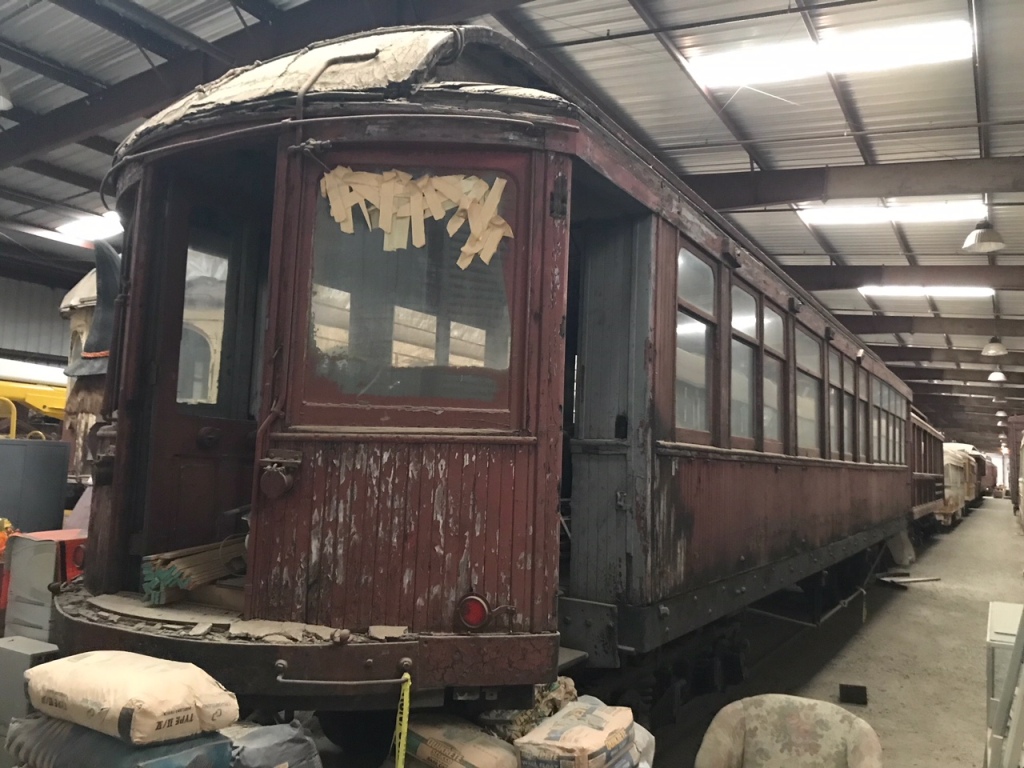
Oh, and by the way, from a couple of weeks ago we'll include Bob Albertson's pictures of the Pennsy bobber, which was outside during switching. They're quite nice. But I think we'll show only the car's better side.
News and views of progress at the Illinois Railway Museum
Wednesday, February 14, 2018
Emergency? What Emergency?
Oh, and by the way, from a couple of weeks ago we'll include Bob Albertson's pictures of the Pennsy bobber, which was outside during switching. They're quite nice. But I think we'll show only the car's better side.
Posted by
Randall Hicks
at
7:03 PM
2
comments
Tuesday, February 13, 2018
Visit to Orange Empire - Part II
Frank writes...
Continued from Part I, after touring the LARy shop and the two largest barns at the museum, it was on to the older traction barns. First up was Abbenseth Carbarn, which is the main operating barn for the standard-gauge collection.
Here's a hometown favorite for David - Bamberger 127, one of the famous Brill "Bullet" cars originally built for the Fonda Johnstown & Gloversville in New York in 1932. Retired in 1953, its body was a worker dorm at the Utah Pickle Company until OERM got the car in 1971. This car was largely cosmetically restored in the 1990s and early 2000s but restoration work is currently on hiatus. Parts are on hand, though, to recreate correct-type trucks for the car.
This is San Diego Electric Railway 508, a 1936 St. Louis-built PCC car that is currently undergoing a major restoration. (And in the doorway that's Dennis, the volunteer docent who showed me through the car barns.) This is the car whose trucks are currently in the machine shop. It looks absolutely gorgeous and will be a real showpiece when complete. Off to the right is Pacific Electric 1624, a steeplecab homebuilt by PE in 1925 to a Baldwin design. Out of view to the right is Yakima 297, the only other surviving Baldwin-Westinghouse B-1 steeplecab besides IRM's own Cornwall 14.
The interior of car 508, with all new paint and upholstery. It's an impressive restoration.
After this it was back to narrow-gauge land with a stop at the main LARy car barn. This is the famous street railway funeral car "Descanso," homebuilt by LARy in 1909. It's a beautiful car and was a rare LARy car with a railroad roof. It was retired in 1940, sold to the Pacific Railroad Society, and moved, complete save motors, to Cajon Pass where it was used as a clubhouse for railfans and photographers. There it stayed until coming to Orange Empire in 1967. It's still owned by PRRS.
Car 1559 is the only surviving example of the K-type LARy car, a development of the earlier H-type, of which several examples still exist. It was built in 1925 in the LARy shops. Note the "California car" design with the open section. Anyway, this car seems to have a double identity at the moment, as it's mostly painted in 1920s-era LARy yellow and brown but retains its 1940s-era Los Angeles Transit Lines skirting on the end.
A better exemplar of the ungainly LATL look is car 1160, the only surviving F-type car, rebuilt by LARy in 1923 from an earlier 1899-vintage car (note the omnibus sides). When LATL took over from LARy in 1945 they introduced the yellow/green/white "fruit salad" livery in place of the yellow/silver/black LARy livery then in use and introduced this end skirting and drop-down catchers in place of the old Eclipse fenders.
An oddity among a barn full of Los Angeles streetcars is Kyoto 19, a 1910 single-trucker from Japan. This car has run at OERM and is quite original, complete with all of its advertising cards in Japanese.
Behind it is Los Angeles Railway 9209, built in the company shops in 1913, which is what LARy called a "power car." Basically it's a two-cab-on-flat utility motor and would have seen a variety of uses. These cars had a very unusual cab design, with an extra-height "tower" cab at each end that presumably gave a wider field of vision. This car has been semi-disassembled for many years but is generally complete.
Next to the power car is LARy 936, C-type center-entrance car built by St. Louis in 1913. Like so many cities Los Angeles flirted with center-entrance cars in the mid-teens but, like most other cities, decided they didn't like them much. The C-type cars were nicknamed "sow-bellies" for their drop center appearance and were retired early, 1945 in the case of car 936. Its body was acquired by Orange Empire in 1979 and appears to be in decent condition as bodies go.
Just to the north of the LARy barn, on the other side of the streetcar line (which is dual-gauge at this point), is this impressive archives building. It also houses some historic materials pertaining to the Fred Harvey Company. It sounded like the building is not normally open; my docent had never been inside.
And then there's the famous Grizzly Flats collection of 3'-gauge equipment obtained from the Ward Kimball estate. Some of this equipment is very impressive and most of it is very old. It's almost all housed in a beautiful, relatively new, exhibit building north of the depot just off the museum's main line.
I'm not a big narrow gauge fan but a couple of things caught my eye. One was this car body, which dated to the 1870s if memory serves, which when acquired had suffered significant damage at one corner from woodpeckers. Well that's different.
The pride of the collection is the Nevada Central's "Emma Nevada," a beautiful little 2-6-0 built in 1881 by Baldwin which at the moment is an 0-0-0 because it's up on blocks for some sort of wheel work.
They've thoughtfully put a light in the firebox which the docents can flip on, and there's a sign conveniently placed where it will appear prominently in a lot of visitor photos, not usually signs of a quick turnaround restoration. When this engine does run, though, it will be a thing of real beauty.
Dennis, my tour guide, had to head off and show another group of visitors around so I decided to wander around by myself. Of course I had to visit the "body farm" at the back of the property. OERM has done a very good job of keeping most of their car bodies tarped, and their Visalia Electric wooden interurban car even had something of a building built around it, visible on the left. The car in the center, though, defies tarping due to its condition - but probably wouldn't benefit that much from it anyway. It's the only preserved "hobbleskirt" car: Fresno Traction 51, built by Brill in 1913. These cars were most famously run by New York Railways in Manhattan, where they operated using the conduit system there, but a couple of other cities - including Fresno - also ran them. It's a fascinating car; the expansive drop center fills nearly all of the space between the trucks, which themselves are pushed out towards the ends of the car, making for rather high-mounted cabs. Space under the car was so limited that these cars had no main air reservoirs but just had large-diameter pipes going back and forth in the ceiling to hold air. Car 51 may look sad but it sure is historic.
OERM has three "Huntington standard" LARy streetcar bodies, 744, 807, and 860, of which two were tarped. This is the third - anyone know what its number is?
This is an H-class LARy car built in 1924 by St. Louis. It has a strange history; retired by LATL in 1959 it was purchased by an individual but moved to Orange Empire. In 1975, apparently, OERM changed their policy regarding storage of privately-owned equipment (sound familiar?) and while most affected equipment was subsequently donated to the museum, this car wasn't. Instead it was shipped north where it hit a bridge which partially scalped it. It ended up at Muni, which stripped it for motors and control equipment to be used on a Johnstown streetcar, and then went to Lake Tahoe where it sat in the woods there until 1999. For a while it was stored in downtown Los Angeles until it finally returned to Orange Empire in 2016, this time owned by the museum but little more than a shell. The museum, which has three other H-class cars, two of which run, evidently plans to scrap or sell the car.
Orange Empire runs Day Out With Thomas, as does IRM, and as for us it's a big money-maker. However when they started running the event they didn't have the large fleet of passenger coaches that we did, so they had to scramble to find cars with enough seats to handle the crowds. This meant acquisition of a Lackawanna MU trailer, a couple of lightweight commuter coaches from Montreal, and most recently no fewer than ten "Comet" commuter cars from New Jersey Transit. Of those, four are coaches which are in use while six are less-than-pristine cab cars which were not really wanted but came along as part of the deal anyway. Anyone want a cab car?
One of the unique pieces of equipment at OERM is this steeplecab, Hutchinson & Northern 1, built by GE in 1921. GE only built a couple of these locomotives with inside-bearing trucks; the Lackawanna actually had one that they used at their Wallabout Terminal in New York (a different solution to the same problem our Ingersoll-Rand diesel solved for the DL&W) while two others ended up with the H&N. Both H&N locomotives still survive, the other at the Kansas Underground Salt Museum in Hutchinson, which sounds like a rollicking good time.
Here's a shot looking north/northwest up Broadway. It's a nice street scene, sparsely lined with buildings by Midwest standards but more typical for the Los Angeles area I think. The 3'6" gauge line coming in from the right isn't service trackage; it goes up to the car barn, on the east side of the street in the distance. The streetcar loop crosses Broadway at two points, right about where I was standing and again just north of the LARy car barn, and stops behind the depot off behind that white building on the left.
And we're right about back where we started in Part I, at the center of the museum, at the corner of Broadway and Central Avenue. The southeast corner of this intersection is where that road construction equipment is on display, and just south of that, the city park with the caboose; on the northeast corner is this "signal garden" and a frame building which houses the museum office. Confused yet? You'll just need to go to Orange Empire and see for yourself.
Many thanks to Hank and Dennis for the tour and to John Smatlak for helping set things up!
Posted by
Frank Hicks
at
9:18 AM
0
comments
Labels: Trip Reports
Monday, February 12, 2018
Chicago 1939
We received this photo from a friend, who writes:
Hey, I'd like to help! I'm sure I've seen those huge piles of white stuff before...
Posted by
Randall Hicks
at
10:35 PM
0
comments
Sunday, February 11, 2018
Visit to Orange Empire - Part I
Frank writes...
I'd been hoping to make it out to IRM today but the snow has other ideas. So I'm reduced to sitting at home and wistfully thinking of warmer times. Like a week ago, when I had a chance to visit the Orange Empire Railway Museum during a business trip to Los Angeles.
This was my second visit to Orange Empire; my first was a brief stop about 13 years ago. This visit was also brief, and I was there on a Thursday when nothing was running, but it was very enjoyable and interesting. Orange Empire is probably more similar to IRM in terms of appearance, and perhaps visitor experience, than any other museum. It has a large "campus" layout with numerous exhibit and storage barns plus it is the only other museum besides IRM that has significant collections of electric cars, steam engines, and diesel locomotives. That said, it's much smaller than IRM - I think the collection is about half the size - and has some unique characteristics such as three different track gauges. But let's get started with the tour
Behind the depot is a small park and then you find Broadway, the museum's street scene - more on that in Part II. On the east side of Broadway is this imitation city park, complete with caboose (SP, I assume) and some playground stuff.
On the street corner in the middle of the museum along Broadway is this display of what looks to be road construction equipment. They're interesting artifacts but your guess is as good as mine as to exactly why they're here.
The museum's full-time General Manager, Hank, was kind enough to take a few minutes and show me around some of the shop areas. The museum's machine shop, shown here with Hank on the right, is quite impressive. It's housed in a building which I believe was already here when the museum arrived and includes a wide variety of machines, virtually all of them usable according to Hank. He said that he only wished they had enough volunteers to keep these machines busy. If there's one thing that's consistent across all railway museums, it's that we never have enough money or volunteers!
In fact the machine shop was so large it had its own ride-on floor cleaner, this Zamboni-looking thing. What do you think Joel, a new item for the shopping list?
These trucks, which I think Hank said were for the San Diego prewar PCC (stay tuned), were in the shop also. Note the crane in the background which was installed by the museum complete with its own foundation. Hank also showed me the wood shop but that was a smaller space and not as photogenic.
After that, it was off for a tour of the equipment barns. The first stop was the Los Angeles Railway shop building. LARy was one of two major U.S. street railway systems (the other being Denver) to use a gauge of 3'6". At Orange Empire, which has an unparalleled collection of LARy equipment including at least one example of every significant type of streetcar the system ever ran (!), they have a 3'6" gauge streetcar loop located east of the standard gauge main line. There's a fair amount of dual-gauge trackage at the museum too which is something to see. Anyway, the car above is LARy 665, a "Huntington Standard" car built by St. Louis Car Company in 1911 which was retired in 1948. It was bought by 20th Century Fox and used as a movie prop until the museum got it in 1967. It's long been in service at the museum, restored to its 1920s-1930s LARy appearance, but is currently undergoing a "sprucing up."
Behind it on the same track is LARy 9550, a single-truck shop switcher of the "flying brick" variety. This one is rather attractive, though, with a nice deck roof. It's been mostly disassembled for many years. Behind it on the other track is Los Angeles Railways 9351, an open line car. This is an interesting piece, basically a two-cab-on-flat car with an adjustable-height platform tower in the center and an overall roof. Other than the line car features it's rather close to the original appearance of our own Milwaukee Electric D22.
Next to the 665 is Los Angeles Transit Lines 2601, a double-ended Peter Witt built in 1930. This was a unique prototype and it's amazing it survived intact. It has been the subject of a long but steady restoration project over the past decade or two. It's also one of the most modern pre-PCC streetcars in existence, sharing some modern features with the Baltimore Witts built at the same time such as Westinghouse VA control.
Next up is the "new" barn, the behemoth Barn 7 built about a decade ago. This building, which has a steel frame and concrete floors, is a real blimp hangar at 600' long and six tracks wide. Most of the "front" (south) half of the structure is taken up with steam railroad equipment while the back half is largely unrestored electric cars. Up near the doors is this, the current big project of the OERM diesel division: Santa Fe FP45 108, identical to our own 92. I believe this unit runs (unlike ours, it was retired operational) and it's been the focus of a stunning restoration project that has seen its body panels replaced and a lot of work done to backdate it to as-built condition. It's also received a beautiful paint job. They've been busy painting diesels at Orange Empire; there was also an SP U-boat and a UP E-9 in this building that had recently been repainted.
Another locomotive duplicated at IRM is this Alco RSD-15 "Alligator," of which OERM has two. However theirs are ex-Southern Pacific whereas IRM's example is ex-Santa Fe. I'm not sure whether or not theirs run.
I've developed a slight interest recently in early freight cars and Orange Empire has them in abundance. This nicely painted example is Butte Anaconda & Pacific 22, a 1906 Pressed Steel-built car acquired in 2009 complete with its original Fox trucks.
And of course the pride of the steam road collection: Virginia & Truckee 20, built in 1907 by the Hicks Locomotive & Car Works. More information here.
This classic is Denver & Rio Grande Western 552, an open-platform combine built by Pullman in 1891. Those steel panels on the sides are kind of weird.
And here we are 600' away from the Santa Fe FP45, at the back of the blimp hangar with Key System "Bridge Unit" 167. There are four of these two-car articulateds in existence, this one and three at Rio Vista. Two of the Rio Vista ones run but I believe this one has a blown motor.
On the next track over is a real interurban classic, Pacific Electric 993. The PE 950-series cars were built in 1907 by St. Louis for the Los Angeles Pacific and, as built, were "California cars" with a large open section. This was later closed in, of course, as shown. But these cars eschewed the five-window Huntington end preferred by PE and LARy and ran their entire lives with the more Midwestern-looking appearance shown here. None were preserved intact.
Orange Empire has no fewer than four Pacific Electric "fives," 500-series suburban cars built in 1909 by St. Louis Car Company. Three of them are in Barn 7. This one is PE 524, which was partially restored by Richard Fellows before his death and was acquired by OERM in 1996.
San Diego Electric Railway 528 is a very early PCC car, dating to 1936 and one of the first handful of orders for PCC cars. This isn't the car whose trucks are in the workshop; Orange Empire has two cars of this series that were acquired straight from San Diego. Car 528 still wears two different service liveries, or what remains of them, including a white-with-black-belt-rail livery on top and underneath it the obvious remnants of its original olive green with red roof color scheme. The museum's other San Diego PCC has been repainted to that latter color scheme.
Along with four PE "fives" the museum also has five PE "Hollywood" cars, and of those three are stored all in a row in this barn too. For many years the two cars shown here, 716 and 637, were prominently displayed along Broadway; unfortunately that didn't do any favors for their paint so they're a bit tired looking now. But they're indoors and well taken care of. Car 5123, barely visible on the right, is unrestored.
This double-truck Birney body is Fresno Traction 83, built by St. Louis in 1925. Fresno gave all of its Birneys this unusual "swollen lip" extended bumper for some reason.
Here's the second PE "Five," and the only one preserved complete, car 538. Unfortunately it was a victim of an unfinished restoration at some point but I believe there are plans being developed to reassemble this car and complete it. This car was retired extremely early for an intact survivor, 1937, which is when Warner Brothers acquired it for use as a prop. The museum got it from the movie studio in 1959.
Pacific Electric 1000, the "Commodore," was the line's business car until supplanted by steel car 1299 (also at Orange Empire - stay tuned). It was built in 1913 by Jewett as a coach, one of the "Tens," and rebuilt as a business car the next year. It was retired in 1947 but the body was acquired by OERM in 1964.
And here's the third PE "Five," car 530. This one was retired in 1937, like car 538, but unlike that fortunate example it became a house. The body was acquired by Orange Empire in 2007. As bodies go it's in pretty decent shape, actually, though with three other examples on the property - including two that are arguably closer to "restored" condition - it's hard to say what will happen with it.
In the far back corner of the blimp hangar is this unfortunate looking specimen, Pacific Electric 00150. It's a cab-on-flat wire greaser and was rebuilt by Los Angeles Pacific in 1898 from a flatcar. Unfortunately it suffered from decades of outdoor storage but when this barn was built it was stabilized using rails atop the deck and moved into the barn.
Next to it is this horsecar, which is odd because the museum has no idea where it's from or who built it. It was acquired from Knott's Berry Farm where it had been something of a playground attraction for many decades.
This is a neat car: Pacific Electric 179, built in 1912 by Pullman. These center-entrance suburban cars were rather unique. They used some aspects of Harriman passenger car design including steel roofs, unusual for electric cars. They weren't terribly loved by the PE - most center-entrance cars weren't after that fad ended - and this one was retired in 1935. The museum got it in 1974. It's really in pretty good shape overall, with very little body rust evident, but of course would need a huge amount of work to ever run again. Still, it's a fascinating artifact.
This is San Diego Electric Railway 167, a center entrance car body of a design used almost exclusively by that city.
This is an intriguing piece: a 1910 parlor-observation car built by Pullman for the Santa Fe (of course - note the exposed side sill) and later sheathed in steel. Later yet it made it into MOW service and eventually found its way to Orange Empire. Boy would this look neat next to our Santa Fe lounge and combine!
So that was it for the new blimp hangar - next it was over to the next-newest barn at the museum, an operating building at the south end of the property. At the front was this attractively-painted Pacific Electric "blimp" coach built by Pullman in 1913 for the Interurban Electric Railway. It's hard to believe this car is a year older than our own CA&E 319.
And behind it on the same track was "blimp" combine 498, also built in 1913 for IER, and just recently painted in later PE colors. This car has been the focus of a long-term restoration and it looks like they're making excellent progress.
This car is a favorite of mine: PE 1001, the only "Ten" surviving intact. It was built by Jewett in 1913. The PE liked wood cars and would have continued to build them if it hadn't been for a bad wreck shortly after these cars were delivered; with that they went to steel cars for the "Elevens" and "Twelves." Anyway, this car was retired from passenger service in 1948 and made into a rail grinder, which preserved it until acquired by the museum in 1954.
Just like our cars, PE 1001 has a J-type governor. Unlike ours, it's mounted outside the car. I guess when it never freezes, you don't have to worry about putting the governor inside the car to keep it working properly. I think that mounting J-governors vertically like this was recommended, but on the CA&E at least they put them under the nickel seats so there wasn't room to do this.
One of the car's trucks was heavily modified for rail grinding and those modifications are still very obvious. There's a lot of extra steel in this truck!
This is the only existing PE "Twelve" that is complete, office car 1299. It's not a "true" PE "Twelve" as it wasn't from the series built for the PE; those were all scrapped. This car was built in 1914 by Pullman for the Portland Eugene & Eastern and came to the PE in 1929, when it was rebuilt as an office car. Retired in 1958, it was on display at the Pomona fairgrounds until OERM got it in 1998.
And next to that high-stepper is a horse of a very different color: Hill of Howth Tramway 2 from Ireland. Built in 1901, it ran until 1959 when that line shut down. It's one of four Howth trams in existence; a car of a different series at the National Tramway Museum in Crich is preserved in overall varnished teak, which is quite striking.
Another member of Orange Empire's impressive collection of old freight cars is this boxcar, Tonopah & Tidewater 111, built in 1885 for the Lackawanna as their 20460 (later DL&W 32474). It came to OERM in 1983 as a body and is one of very few 1880s boxcars in existence.
And Ventury County Railroad 22, a 2-6-2 built in 1922, is Orange Empire's main operating steam engine (and I think the only steam engine to have operated at the museum). I believe it's operational but I'm not sure when it was last steamed; it was in use as recently as 2014 at least. It's a pretty ideal engine for a museum like OERM, small but with good pulling power. It's not too dissimilar from Tuskeegee 101 that IRM used to run.
And that's it for Part I... stay tuned for Part II from Perris.
Posted by
Frank Hicks
at
2:12 PM
12
comments
Labels: Trip Reports