Tuesday, May 22, 2018

In Memoriam: Bill Thiel

Word has come to us that Bill Thiel, longtime IRM regular member and volunteer in the Electric Car Department, died on Sunday. Bill worked for many years with Frank Sirinek and others on the Chicago streetcars in the collection, notably the 3142 and 141. Bill's specialty was the electrical systems and he was instrumental in wiring up both cars, as well as helping to maintain the service fleet. He was an active motorman until last year, running cars on the streetcar line several times a year including during the Thomas event. He was always a friendly face in operations and a valuable resource in the shop. He will be missed.

A wake is planned for Friday and a service for Saturday; this post will be updated as more information becomes available.

Monday, May 21, 2018

Rainy Sunday

Frank writes...

Sunday was the first public day of steam operation at IRM, and I didn't even get any photos! But there are some nice photos on the Steam Team's Facebook page here, and you don't even need to register to see them. It was very rainy in the morning so the crowds were small, unfortunately. The 1630 was in service all day regardless, with a very nice-looking train consisting of the Santa Fe combine and a Rock car (no "water bottle") that looked like it could have jumped off of a Frisco branch line in the 1930s, while the 749 running solo held down electric service on the main line and the 3142 went in circles.

When I arrived in the early afternoon the rain had stopped and a Car Department switch crew was down in Yard 13 at work. Above, they've just pulled the Detroit Peter Witt out of track 134 for the purpose of retrieving cabooses stranded behind it. The cabooses will be needed next weekend for the caboose train, of course. The Witt is waiting for its slot on track 131, which will be opened up when the crane is repaired and Shaker Heights 18 can be moved to Barn 7, but in the meantime it's in the way. The Witt has narrow wheels and is prone to derailing so a bunch of people were watching the wheels at frogs and switch points.
I decided I wasn't helping much in switching cabooses so I went back to the car shop to get some tools. While I was there, I saw this Ohio Brass trolley catcher disassembled on the bench. Last weekend this was discovered while we were going through spare parts. It's exactly what the 205 needs (though of course the 205 needs two so we're still short one); what it has now are OB retrievers which are much bigger. Over the previous week Richard and the other guys had disassembled this catcher, cleaned it up, and primed it.
After that I spent a while sanding down the belt rail of the 18. I managed to do the entire right side of the car. I'm a bit conflicted on whether to strip or just sand the window posts but I'm leaning towards stripping them, which will mean breaking out the heat gun. After that's all done it will be ready for some primer along the windows. While I was working on this Greg was stripping duct tape residue off of the car's windows and posts. Of course in my usual negligence I failed to get any photos of this work, but I did snap a photo of Joel happening by with a makeshift "bumping post." This was modeled after the one we use to keep the CA&E cars from running into the 150 on track 84. With the Peter Witt now buried behind a string of cabooses on track 134, Joel decided that we might not want anyone trying to couple a caboose to it through its headlight. So this will help keep the cabooses in their place until the Witt can be moved to its permanent home on track 131. We'll have to add "track bumper" to the Van Dorn uncoupling devices and CA&E trap lifters already on the list of patent-pending Hicks Co inventions.
Anyway, I headed back over to Barn 4, and what did I find there but a bunch of crooks! Well these crooks are actually light poles for 50th Avenue 'L' station, which Greg was working on priming. They get bolted to the wooden poles spaced out along the length of the platform and have pie-pan lights attached to them to light the platform.
Joel said he had something to show me in one of the storage cars, so I went along and got to see this interesting bit of history. It's a panel off of a Kansas City Public Service streetcar (or bus, or something) and has the intricate KCPS "The Scout" logo on it. You never know what you'll happen up on at IRM. And that takes us to the infamous material yard.
"Where unrecorded names and navies rust, and untold hopes and anchors rot..." Richard does his best Captain Ahab from atop a set of stairs in the material yard, pointing out among the piles of iron. The Track Department, among others, has initiated a major cleanup of the material yard. Typically "cleanup" plus "piles of rusty iron" equals "scrapping" so Joel sent Richard and me out to start marking with spray paint anything the Car Department wants to ensure doesn't get cut up. There's a lot of interesting (anyone looking for a pair of Brill 27A1 trucks?) and/or useful (spare GE 73 motors for the 604) stuff out there so it was a pretty fascinating expedition. I think these stairs may have been used so that visitors could get into the cab of L&A 99 when it was on display just east of the depot on the now-gone pocket track.
While I'd been sanding on the 18, Richard reassembled the OB trolley catcher and got it working. So that's one thing on the 205 that will be fully serviceable! I put a first coat of Indiana Railroad orange on it; once it's all painted up I'll install it on the car. Bob Bruneau would be happy: it always bothered him that we didn't have the correct OB catchers for the 205.
Besides the cabooses being switched around in Barn 13 there were other things going on. Notably, Nick and Thomas took the 251 for a couple of trips around the car line to further test out the new main journal bearing, which had been scraped by Zach following earlier unsuccessful tests. Unfortunately it will still need more work but progress is being made. Doodlebug Bob was also doing some machining work and John, back from Florida, was doing upholstery work in the wood shop. Tim wasn't out but he's continuing to make progress on the 1754; above is a shot of it in the evening, by which time the sun had come out.

Sunday, May 20, 2018

Turn-of-the-Century IRM

I can only hope these pictures make you feel as old and out-of-date as they do me!

Someone named Ludwig Kotnik sent us this:

Of course, this was before the current rules on personal electronic devices took effect.  Harold might not think this was so funny nowadays.


Bob Bruneau sitting in his office, evidently working on a window shade part.  Mr. Socks watches with rapt attention. 


George Clark working on part of the 810.  


Ed Oslowski hard at work on the floor of the 749.


Barb Lanphier and Bob Kutella looking at a controller, presumably for the 68.


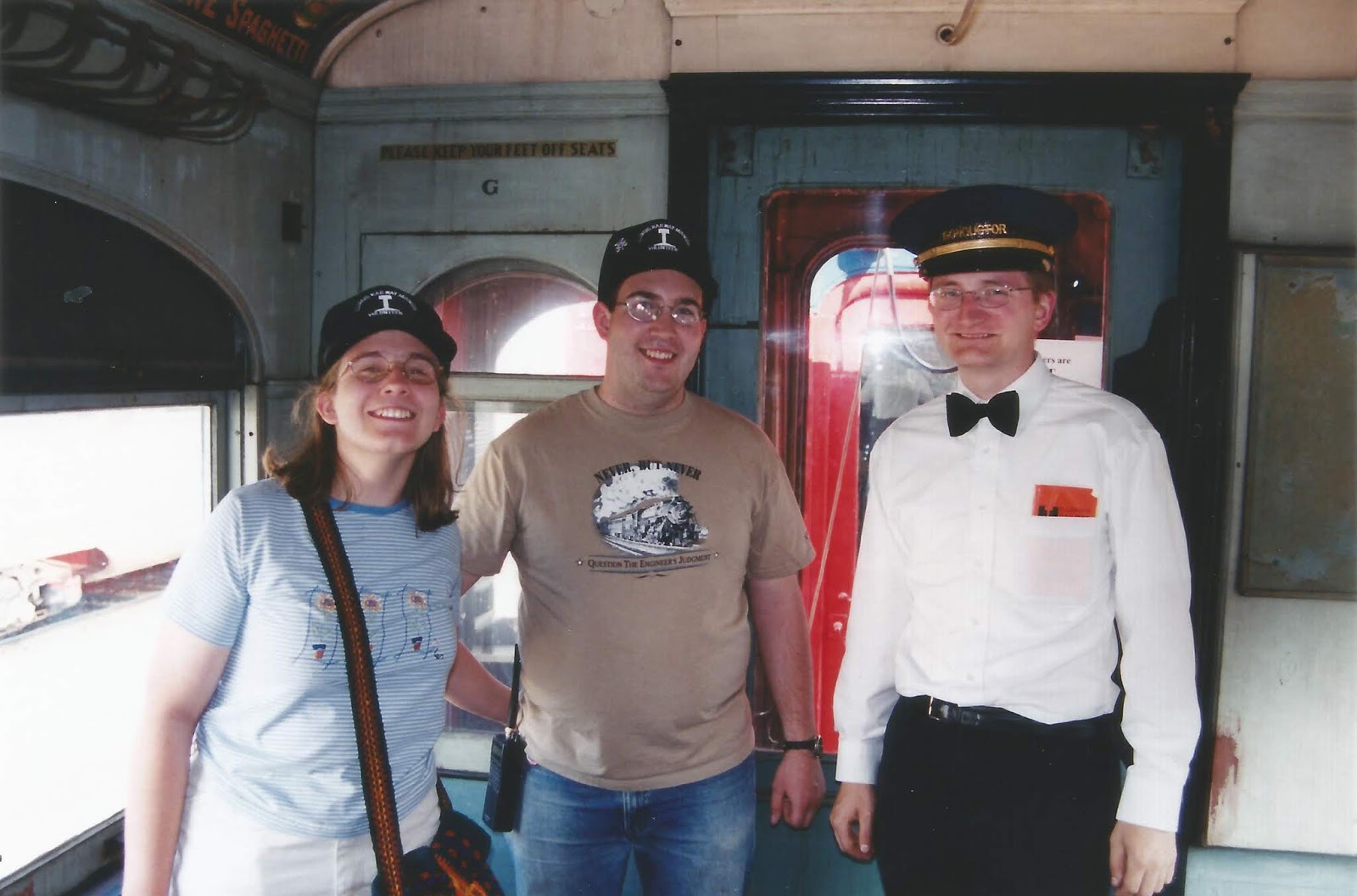
I'm not sure who took these next few pictures with Frank in them.  Maybe it was me!


Andy Chmura, Joe and Gwen Stupar, and Frank


Collecting tickets.  The 308 was in service, but still with its decrepit interior.


The 1630 needed maintenance work, as always.


Work on the new drainage system had started.  This is in front of Barn 4.


When it arrived, the UP turbine was stored on track 51.  Repainting of the huge thing was badly needed.


Buzz Morisette had just started a long, long project!

Friday, May 18, 2018

Restoration of the 308

Frank just handed me a box of pictures that he took back around the turn of the century.  They cover a lot of different subjects, but the first one that jumped out at me was the restoration of the 308.  It was much better documented in pictures than I had thought, so I have scanned most of them.


When the car was acquired in 1996, most of the #2 end vestibule had been removed, and the original wooden floor had been replaced with a thick steel plate welded in place.   That took a lot of work to get rid of.  We closed up the end with Masonite panels while working on the rest of the car.  Restoration started in 1998.  Meanwhile, we amused ourselves with painting one of the panels.


I guess the ersatz folding sign never got lettered.


The entire body needed to be stripped of paint.   Above, a window frame has collapsed.   Many of them needed replacement.


All of this work was done in Barn 8, which had no lighting at the time, of course.  c. 1999


 Several views of the interior.  There was a lot of water damage to the wall panels.


And this is the #1 vestibule.  By 2001 the exterior had been repainted, and work concentrated on rebuilding the #2 end.


This is the #2 vestibule platform, after the metal plate had been removed and all the corners ground smooth.  We're looking down towards one corner of the bumper.  Summer of 2001.


The car was then towed over to the east end of track 41 for replacement of the vestibule.  Notice that this is the open end, behind the Army engine.


A good view of what the end looked like before work started.


The first step was to make and install the various wood parts of the floor.  There are several layers.


Here I'm using a brace and bit to insert the wood screws holding the wood in place.  Fall of 2001.


Then new posts were patched in, followed by the braces for the walls and siding.  Early 2002.


Photo by Joel Salomon

By the summer of 2002 the end was more or less complete, and the car was made operable.  Above, we have Frank, me, and Bruce Moffat. 


The vestibule was still pretty ugly, though.  Don't touch that headlight switch!

To make a long story short, it was about this time that a new member, Jack Biesterfeld, joined the team and did most of the interior restoration over the next few years, even while the car was being used in revenue service with the 309.  Restoration was completed for the its 100th birthday in 2006, and it has been in regular use ever since. 


Summer of 2003.

Thursday, May 17, 2018

New Bearing Project

Chicago Aurora and Elgin car 309 was the first interurban car from that railroad selected for preservation by IRM, and has been running on a regular basis for many years.  However, some of the motor bearings are badly worn and need to be replaced.  These bearings are large bronze castings and are quite heavy, so this is an expensive proposition.  The unfinished castings will cost about $4,000.


Below we see the axle's bearing surface, which was turned down to a smaller diameter by the CA&E.  The outer half of the bearing and the axle cap casting have been removed.  


However, this project would cost much more except for two things.  First, we were able to easily make our own patterns using older, worn bearings, with a plastic pipe glued inside to represent the new material that is needed.  Having a pattern of this complexity made from scratch would be expensive.


And secondly, the raw castings need to be carefully machined to perfectly cylindrical surfaces.  That could easily double or triple the cost if done by an outside shop, but we have the tools and volunteer expertise to do this at IRM.  


So we're asking you, the members, to contribute to the CA&E wood car fund to make this possible.  The bearing project should be on the Buck-A-Project page in the next issue of Rail & Wire.  Or you can send a donation to the office with the magic words "CA&E Wood Car Fund" or words to that effect.  You'll be glad you did.  Once we have the new bearings, the 309 will be available for frequent passenger service once again.  Thank you!

Wednesday, May 16, 2018

Getting Ready

It's only ten days until the first big operating weekend of the year, and the CA&E wood cars are due up, so there were a few tasks to complete today.   Not many pictures, I'm afraid, because I was busy, but things went well.


The first thing was to do all of the lubrication on the 36.  The armature bearings on the GE 66 motor are of a very archaic and inconvenient design.  However, on the 36, they are somewhat easier to access than on the other cars, because the 36's motor truck has smaller wheels.   So I can even take a couple of pictures.

Here's what the motor looks like from the side.  To the right, we have the wheel, and you can see the top of the brake shoe.  The wheels have picked up dust from crossing the streets and deposited it on the shoes.  Behind that, though, is the cover for the armature bearing.  It's a cast plate with a part number, and a small handle for lifting.  It rotates around a bolt out of sight to the left, and is sprung to keep it closed.  You can easily pinch your fingers.

When the lid is open, there is an open chamber divided into two vertically.  You can just see the top of the divider.  To the left, the chamber is filled with waste, and this goes down to the bearing surfaces about 8" down.  It's nearly impossible to see anything.  The right-hand chamber is empty, so we push the dipstick down until refusal, and then check the oil level.  If it's less than about 2" or so, add more oil.  It's that simple!  

But then there's the main bearings, the axle caps, the gears, and the compressor.  They're all much easier.  The armature bearings are the only place where you need to be careful not to add too much oil.

The 36 was coupled up to the 319 and the train air was tested.  No leaks, and the brakes work as advertised.  After some investigation, I determined which control pipe glad hand was leaking between the 308 and 309, and moved it to an end we won't be using.  And then the 308 was pumped up to test the train, and everything appears to be OK there also.  There was a slow leak under the 308, due to a loose union.  Luckily it was over the trailer truck, so it was easy to get to, and that's been fixed. So both two-car trains are ready for revenue service.   

Most of the Car Dept. regulars were at work on their various tasks.  Here is John Faulhaber working on the windows for the Sand Springs car.


But I was busy for most of the day, and had to leave early, so that's it for now.  But keep in touch, we'll have more historic photos to put on display soon!