Wednesday, July 24, 2024

Heavy Lift Department Update

Many thanks to our friend Paul Krot, who sends along an update from the IRM Heavy Lift Department!


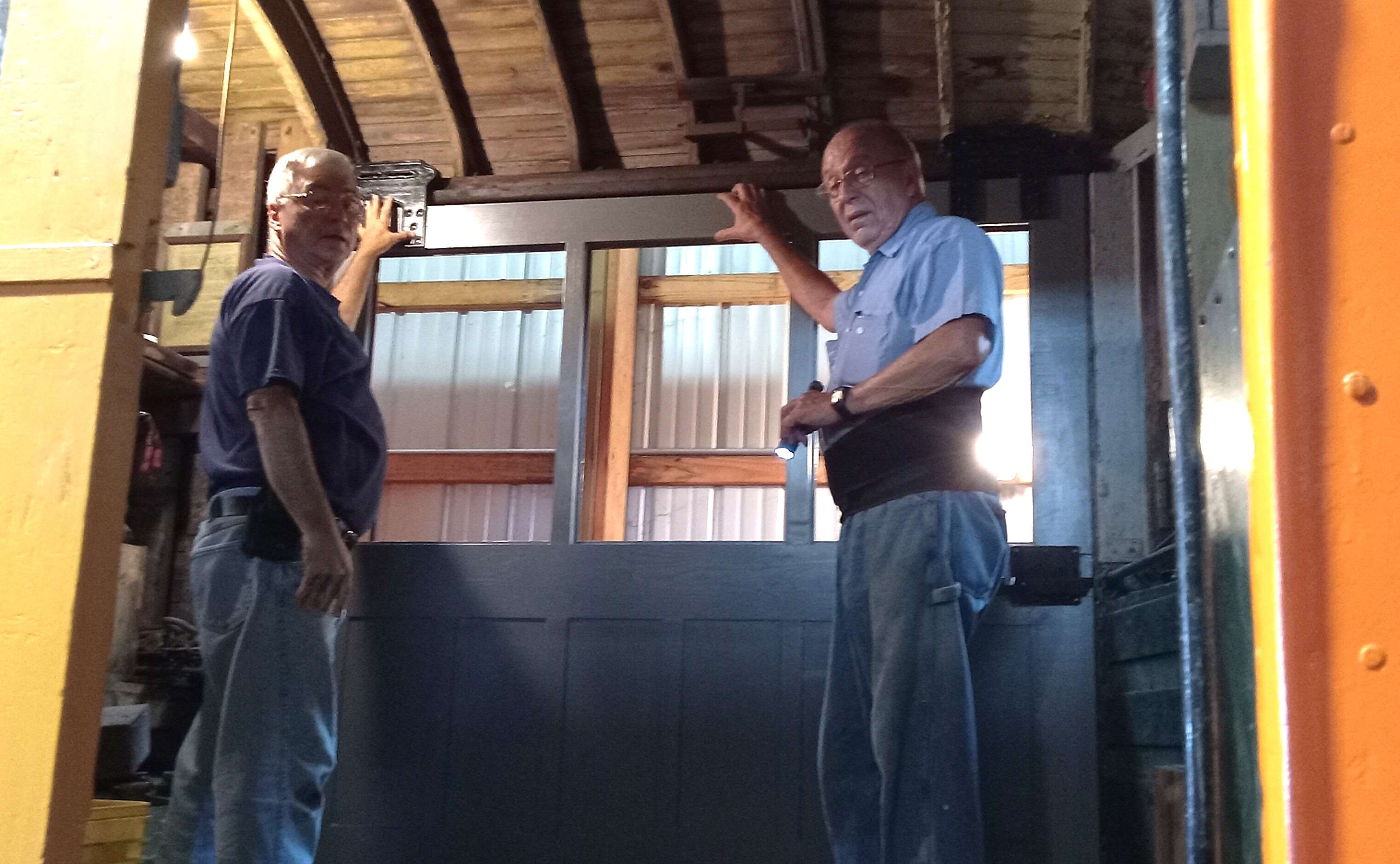
The Heavy Lift Department's CNW tool car is receiving some long overdue cosmetic maintenance.  Pictured from left to right are Jeff, Steve, Ralph, Crystal and Paul behind the camera.  We are looking at having this car finished by the end of July and have the wrecker’s boom idler flat in for work as soon as the space is vacated. [Ed. - this is a very historic car, one of only a couple of survivors of the 1936 City of Denver train that was jointly operated by the UP and C&NW. More history here. IRM's two ex-CofD cars are rare examples of cars built in UP yellow and brown, before they switched to yellow and grey.]
I found this “vintage” ad while doing more cleanup inside the tool car and found it pretty amusing.  It may be in poor taste to share but I thought I’d throw it out there.

Tuesday, July 23, 2024

Take a Step Back...

Frank writes...


...back in time, in this case. You've read about Monday's news, but what about Sunday's news? Those suspicious characters with day jobs who were alluded to in yesterday's post (ha ha) are guilty of taking too much time to get their photos posted, so you'll just have to make do with yesterday's news tomorrow. Or something.
Sunday was the last day of Day Out With Thomas 2024, and once again I found myself going in circles. Fortunately, it was aboard a streetcar, in this case the 3142. Above, our two operating CTA streetcars are ready to leave the barn in the morning.
And here's the 3142 in Yard 7. Everything went smoothly, the crowds were happy, the weather was beautiful - what more could you want? I ended up doing 30 trips around the car line, so I certainly kept busy.
Someone else keeping busy was Joel, who spent the day inspecting the 308! As with the past few years, we've scheduled the CA&E wood cars to operate for Vintage Transport Extravaganza. But we need three cars to handle the crowds, and with a broken leaf spring under the 36, we're short a car. Enter the 308, which of course still has its motors out for repair - but is serviceable as a trailer, or "coach" as the CA&E called them. A huge thank you to Joel and to our switch crews for bringing the 308 over to Barn 4 on Saturday night and extracting it Sunday evening. I helped couple it up to the 309 and 319 and run it back to Barn 8, but managed to forget to grab a photo - oops. You'll just have to join us on August 4th for the 308's first time carrying passengers in more than five years.

Thanks, too, to Bob Olson for sending along some additional news photos! First, this is the crew that brought the 213's door over to Barn 8 and hoisted it up into the 213. You saw "the rest of the story" in the Monday update. L-R that's Jimmy, Greg, Brian, Richard, and Zach.
Below, Marcus and a younger Track Department volunteer I'm afraid I don't know are in Barn 3. Our hardworking track volunteers have finished the complete rebuild of track 34! This was a marathon of a job that took a few months. Next comes some Buildings & Grounds work, so the freight train isn't coming back into this space quite yet, but this is a huge step forward.
That folks! Below, Bob on the left, Marcus, and ____ (help!).

Monday, July 22, 2024

Are You Busy?

Weekday operations resume their usual peaceful character, now that Thomas is over.  Monday was another relatively relaxing day at IRM, and given a choice, I was able to run the 431.  Everything went well.  We had two school groups visiting, and they chose to take the same trip at noon, so the car was jam-packed with kids, but everyone had a great time.  Later in the day, Harold stopped by with some of his friends, one of whom got to run one of the trips.  It helps to be friends with the boss!


But the problem is that we need more weekday operators during the summer.  We would really like to have two cars in operation on weekdays, one mainline car and one streetcar.  Our visitors deserve no less, and we need help.  Obviously, that's not possible for most of you who have to work for a living, but retired people such as myself and college students on summer break could make a big difference in improving our visitors' experience.  And if you don't already know how to operate these cars, here's the oldest joke in the book:  we'll TRAIN you!  If you can drive a car, you can run a train.
(End of public service announcement)

I didn't have much opportunity to see what was going on in Barn 4, but over in 8 Fritz and Pete were busy installing the new sliding doors they've made for the 213.


This is really an interesting car, and it would be great to make it operational.


Saturday, July 20, 2024

More Thomas

Another day of Thomas went well.  A lot of people put in a lot of effort to make these four busy days a success, and I certainly can't begin to list them all.  A great deal of thanks is due to everyone who helped; most of them spent a lot more time on Thomas than I did.  One sad note: our old friend Larry Stone was planning to fly in from Nevada for a second weekend, but his flight yesterday was cancelled due to the airline computer snafu, so he had to stay home.

Just a few more pictures:


Meanwhile, deep in the mysterious caverns of Barn 4, a few of the regulars continued on their chosen projects, trying to avoid being dragooned into picking up trash or something.  Here Tim was getting ready to apply numbers to the 1808.


Bill was cleaning the group covers.


And Ed was working on parts for the Cleveland PCC.


Last names have been omitted to protect the guilty.

Friday, July 19, 2024

Thursday Update

                           We know there's trouble and turmoil these days, everywhere you look.


  But you don't need to lose your head.  Or whatever.

Anyway...  at IRM the rest of us are still at work.  Here, for instance, we see Tim painting rattan seats.


And here are more interior trim pieces ready for installation in the 306:


John was working on wiring:


And he wanted to show off the soldering iron he's using.  Probably older than the car itself.


One of our main projects right now is replacing the upholstery in the three CA&E St. Louis cars.  I was working in the 451.  New seats have been received and are still in their plastic bags.


It turns out to be much easier to remove the backs from the frames that rotate.  The seat frames that are set against the bulkheads are more challenging, but it can be done.


And after some work I was able to get all of the remaining seats out of the smoker.    Since the main compartment has just as many stationary seats, and I now have the necessary tools and experience, it should take just part of another day.

Thursday, July 18, 2024

Unbridled Optimism - About the Lake Erie Bowling Green & Napoleon

Unbrided Optimism
- About the Lake Erie Bowling Green & Napoleon
by Art Peterson

All photos are from the Krambles-Peterson Archive

The first building boom for interurbans occurred in the period between 1901 and 1904. Easing of the money markets around the turn of the century (no less than two dozen bankers/brokers/investment houses were advertising for electric railway business in the 1899 edition of the “American Street Railway Investments” publication) allowed several interurban projects to move into construction.  As Hilton & Due noted, this era was characterized by a frequent tendency to overstate earnings potential. Tightening of credit following the “rich man’s panic” of 1903 (the Dow had dropped 46% by November 9, 1903) accounts for the end of that first boom.  

No less than 1,521 miles of new interurban line were constructed and began operation during 1903 (total mileage for that first building boom was 5,706).  One of the lines included in that total was the Lake Erie Bowling Green & Napoleon (LEBG&N) in Ohio, promoted by several residents of Bowling Green. Their ultimate dream was to build a 65-mile line from Port Clinton to Napoleon, Ohio. Wood County granted the first franchise for this line on September 14, 1901. By early November, work on the line between Bowling Green and Pemberville was underway.

After a decade of construction, they would build less than half the proposed mileage. More significantly, their chosen route had some serious competition, with three companies proposing to build along this general route. Another concerning factor was that on the portion they did build, there was only one town of any size – Bowling Green boasted 5,067 residents in 1900 and would grow by 3% by 1910.  The other on-line towns were significantly smaller (example – Pemberville with 1,081 residents in 1900) and all lost population in the period 1900-1910.

If you look at CERA Bulletin 96 on Ohio, the page on the LEBG&N notes the road to have been “one of Ohio’s smallest and weakest interurbans.”  The entry in Hilton & Due opens with the phrase “a major example of an ill-conceived” project.  With these stellar reviews, you might wonder “why consider the road at all?” Fair question, but despite its limitations, there are some decent photos of the road and even in its short (15-year) life, it managed to have an interesting history. In addition, it can teach us some interesting lessons about “this thing of ours.”

In the context of 1901, the “Street Railway Journal” noted that “progressive farmers have special rooms set up for conferences with railway promoters.” As H. Roger Grant wrote in his 2016 book “Electric Railways and the American People,” farmers were frequently avid supporters of the interurbans. Access to the new services meant that bad roads no longer had to cut them off from nearby towns. These lines also increased the mobility of the labor force, meaning that workers could get to a farm to provide the needed work. Still, there were some over-optimistic accounts; a 1907 article mentioned the certainty of financial gain by linking two cities via a route that served good agricultural land in between. Certainly, the LEBG&N fits into the context of having met that “criteria” but failing to have a stable long-term earnings picture.

Not your typical Ohio interurban – LEBG&N car 100 had the honor of making the first revenue trip on the 11.5-mile section of line from Bowling Green to Pemberville on Thanksgiving Day, November 26, 1902. Pemberville offered the possibility to connect with the Toledo Fostoria & Findlay. This was the only California-type car on the road’s roster, until being destroyed in an April 30, 1906, carbarn fire, which consumed all five LEBG&N passenger cars.  The trucks under this car look to be the Barney & Smith C type. 

The road next built east from Pemberville, heading for a connection with the Lake Shore Electric (LSE) in Woodville, six miles distant.  Grading on this section of line began in August 1904. However, the Pennsylvania Railroad stood in the way.  Ultimately, the LEBG&N would get its LSE connection, but it would take a federal court decision (rendered on August 25, 1905) to get the road the right to cross the PRR on a bridge to forge that connection. At this point, things weren’t looking so bad for the LEBG&N: it managed to post a profit of $51,000 for the year 1905.

Headline image: Typical of the four closed-body passenger cars on the LEBG&N is car 104, a 1903 Jewett, built to the firm’s Plan 112K design. Surviving Jewett records show that the LEBG&N paid $4,972 for this 45-foot combine.  Exterior colors were Pullman Green, while the interior was finished in Oak. Freight charges to deliver the car from the Newark, OH plant totaled $45. This photo was in Scotch Ridge, where Ohio Routes 105 and 199 meet. This location is about 3.5 miles (as the crow flies) south-southwest of Pemberville. Even today, this community consists of no more than a dozen or so structures, one of which is a converted church. The milk can at the car’s step reminds us of the importance the interurban represented for rural communities to quickly get perishables to urban customers. 

Here’s a mystery – this looks to be the same car 104 as in the previous image. The location is again Scotch Ridge, though looking the other direction from the previous image. You can see the shadows of the baggage door on the other side of the car (consistent with the previous photo). This car is riding on Peckham 36 MCB trucks, which were used by the THI&E and others in this era.  Where the mystery comes in is that car 104 was one of the five cars supposedly destroyed in the April 30, 1906 carbarn fire. No accounts indicate any of the original cars were rebuilt. Yet, if you look at the banner on the car side, it clearly advertises a July 1908 baseball game. (A word about the “Weiss All Stars” – Alta Weiss made her semi-pro debut as a pitcher with the Vermillion Independents on September 2, 1907. Known as the “Girl Wonder,” in 1908, her father bought a club, which he renamed the “Weiss All Stars.” They played throughout Kentucky and Ohio during 1908-09. This image reminds us of the difference that the interurbans made in providing rural residents access to leisure-time activities.)

The loss of the five cars in the carbarn fire meant that the LEBG&N had to turn to the Toledo Fostoria & Findlay (TF&F) to borrow a couple of cars to meet its schedule requirements.  The LEBG&N returned to Jewett for a pair of new cars, receiving these on June 23, 1906 (according to some accounts – seems very quick action considering the fire wasn’t until the last day of April 1906).

One of the 1906 Jewett-built cars is shown in this view looking west on Main Street, Woodville, from Bridge Street. The two-story building to the left of car 106 still stands in 2024. Those two cars that the LEBG&N received were part of a lot of 13 cars built for three customers. Jewett records note these cars as being 47’-8” combines. The contract price for these cars was $4,230.79, about 15% less than what was quoted for car 104 a few years previous. A look at how material prices behaved between 1903 and 1906 does not show a universally downward trend, leading to the conclusion that the volume order and the timing of that order allowed Jewett to offer the more-favorable pricing.

Around the same time as the LEBG&N was receiving cars 105 and 106 from Jewett, there was some interesting correspondence in the Jewett files showing what the car builder negotiated to pay for various components.  In a January 23, 1905, letter, Peckham quoted a price of $425 for one 14D5 maximum-traction truck, while 36 MCB trucks ranged between $625 and $950 each (depending on wheel and axle diameters). Germer Stone offered 11 variations of their “radiant” hot water heaters to the car company, with unit prices from $50 to $100. December 1905 correspondence from Christensen Air Brake noted the car builder received a 5% discount, while unit prices for equipment were between $300 and $360. Air whistles were available for $3 each.

The final extension of the LEBG&N was a six-mile one from Bowling Green to Tontonagy, which offered a connection to the Ohio Electric’s Lima-Toledo line. However, in this case the LEBG&N stopped short of the B&O tracks in town, so passengers wishing to ride the Ohio Electric made a walk over to that road’s station.  Cars on this line began running on August 13, 1908. This brought the road to 24.5 miles of track.

The world had changed for the LEBG&N and it was not kind to the traction line. Incurring a deficit of $11,021 in 1911, the road defaulted on a bill of $325, and was thrown into receivership. Receivers were appointed May 2, 1911, including AE Royce, who had been one of the original backers of the LEBG&N. A fundamental factor in the outlook for the LEBG&N and similar roads was that auto registration in Ohio had exploded in this era. Where just 1,390 autos were registered in the state in 1902, by 1911, there were now 44,240 registered autos – a 31.8-fold increase. By 1916 (see paragraph below for the significance of this date to the LEBG&N), auto registration had increased more than five-fold to 234,431 vehicles.

On August 6, 1916, the road was sold to the TF&F.  Cars 105 and 106 joined that road’s roster, trading their Pullman Green for a coat of TF&F maroon, and being renumbered to cars 24 and 25.  TF&F retained only the Pemberville-Bowling Green line segment, finally abandoning this on May 15, 1925.

Car 108 is shown taking layover at the LEBG&N Bowling Green station. These buildings still exist, with the old station being located at 131 W. Wooster. In addition to the traction line, the company had a power business as well as a hot water heating plant in Bowling Green. By 1911, these services were earning nearly $32,000 annually, against the railways’ earnings of $28,000. The utility services increased their earnings by 8% for 1912, while the railways’ earnings decreased 2% over that same period.

The Eastern Ohio Chapter of the NRHS published Joseph A. Galloway’s “Interurban Trails” (undated). That document included the following information for the LEBG&N – total cost to construct the 24.5 miles of road through June 30, 1914 was $530,689. In addition to the passenger car fleet, the road owned one baggage-express car, as well as 11 service/work cars. This is the only photo of the service/work cars to have surfaced. Many interurban companies turned to AC&F, Haskell & Barker, or Hicks Locomotive & Car Works for their service/work cars. In addition, there were also second-hand equipment dealers. In the absence of any roster info, all we can do is speculate at this point. Even the motor hauling this work train has design features (that train door, for example) which don’t match any of the other cars on the LEBG&N roster (at least those of which photographs exist). Unfortunately, there is no back-up information as to the location or date of this image.

This piece would not have been possible without the assistance of Ms. Rene Dix, Branch Manager of the Woodville Public Library, as well as her colleague Matt Hammer. In addition, the 1960 book by George Hilton and John Due “The Electric Railways in America,” H. Roger Grant’s 2016 book “Electric Interurbans and the American People” and the NRHS’s undated “Interurban Trails” were extensively consulted. Jewett Company records preserved by Willis McCaleb and George Krambles, also provided substantial insight.

Map is not to scale. Article layout and map by Frank Hicks.

Tuesday, July 16, 2024

A Sunday on Sodor Tramways

Frank writes...


I spent the first Sunday of 2024's Day Out With Thomas event on the streetcar line. I started the day running the 3142; due to volunteer shortages we began with just two cars out, but additional volunteers arrived around lunchtime and that allowed us to reallocate resources. I moved to the 144, which I ran for the rest of the afternoon, and the 144 crew took out the 4391. It's always nice to see this many Chicago cars out.
Above, here's the 144 on its way back into Barn 7 late in the afternoon.
And here's your requisite crowd shot. Overall, the event seemed like it ran very smoothly on Sunday.
While I was grabbing lunch over by the future site of the gas station, I happened upon our new Visitor Center display board. Pretty nice, eh? You can learn more at www.irm.org/visitorcenter.
After operations wound down, Zach brought out a sign that was just discovered among some miscellaneous items. It's a wooden sign proclaiming "Green Road," which of course is the terminus of the Shaker Boulevard line on Shaker Heights Rapid Transit. Lo and behold, it fits perfectly in that mysterious little sign bracket between the doors of the 18. Eureka! The question now is, what role exactly did this sign fulfill? Zach speculated that when these cars ran as a five-car set, the platforms may have been too short to accommodate the entire train, so riders may have chosen which car to board based on their destination - indicated by these little signs. Or maybe it was something else. Anyone know?
After that, Zach and I loaded up the newly reupholstered seats for the CA&E curve-siders and used the new Taylor-Dunn "golf cart pickup truck" to move them to temporary storage in the 451. Above, Zach has the first load leaving the car shop.
Door-to-door, "last mile" service! Here the Taylor-Dunn takes the second load down the aisle in Barn 8. Thanks also to Greg and Bob for helping load these into the 451. As soon as time permits, I'm hoping to start installing these in the 460.
So, what else was going on? Joel was working on some maintenance items on North Shore 749 during the day. Above, one end of the car has been jacked up a little bit, just enough for the center bearing to clear the truck. The purpose was to put grease "cookies" into the center bearing to keep it lubricated.
Over in Barn 7, I saw that when Steve was out a couple of weeks ago, he got three new center doors installed on Kansas City PCC 755. This is really coming along! Three of the center doors and two of the front doors have now had their Philadelphia plywood doors replaced by correct steel doors that match the profile of the car side.
And out behind Barn 4, a number of pallet rack stringers were laid out on the tracks. At some point these will be painted, and then we'll start assembling pallet racking in the new Barn 4 extension so that we can store large items like motors, air compressors, etc., inside.

Monday, July 15, 2024

Thomas with Pictures

(Technical issues have been resolved, so here we go!)

Saturday was the first day of Thomas for this year, and everything seemed to go very well.  Ticket sales have been very good, so the first trip of the day was moved up to 9:30.  Operations went smoothly, due to the expertise and experience of our Operating Dept. members.  It's always nice to see the campus crowded with people.  And Barn 3 was open so visitors had some cars to go through.

Percy

Percy's helper!


Thomas


By the way, here's a stack of reupholstered seats for the CA&E St. Louis cars.  Jon Fenlaciki has been doing yeoman work transferring these to and from the upholstery shop:


Since I was on Streetcar Relief, I had some free time.  And I visited the C&NW Historical Society building for the first time.  

Inside the visitor's center


Just a tiny fraction of the documentation they possess

Ticket window from the old North Western terminal in Chicago


  The people there were very helpful and friendly, and I got a tour of the back rooms.  There are some nice displays of various sorts in the front, but behind that are the archives, with an astounding amount of historical documents, much of it going back to the 19th century.  There are photographs, detailed maps of every town the C&NW went through, accounting ledgers, and more.  In some cases they documented every tie that got replaced.  The volunteers are in the process of cataloging and organizing all this material.

Anyway, it's an interesting place to visit.  Right now, it's on the west edge of town, so they don't get as many visitors as they ought to.  But urban development is headed that way!