Saturday, October 3, 2009

I Think We Won

World War II, that is.

Here the re-enactors gather in the morning by the flagpole for a safety briefing.

There was a good crowd of visitors, but not huge. This re-enactment was not widely publicized, but more of a test run, as I was told. I believe it went well, and they would like to do this again next year during Memorial Day weekend. In any case, I think we all had a blast!


The uniforms were all very authentic, and there were many period vehicles such as these.


They also set up several interesting and informative displays of WWII items.


The Battle of McHenry County.


Those Germans. What a bunch of comedians.


This is part of the final climactic battle for the rail yard. Unfortunately, this picture just doesn't do it justice.


I got a few compliments on my outfit. Others thought I looked like a member of the Gestapo -- or the Mafia.

"Nice little diner ya got here, Nick. It'd be a shame if anything happened to it..."

Friday, October 2, 2009

We Win!

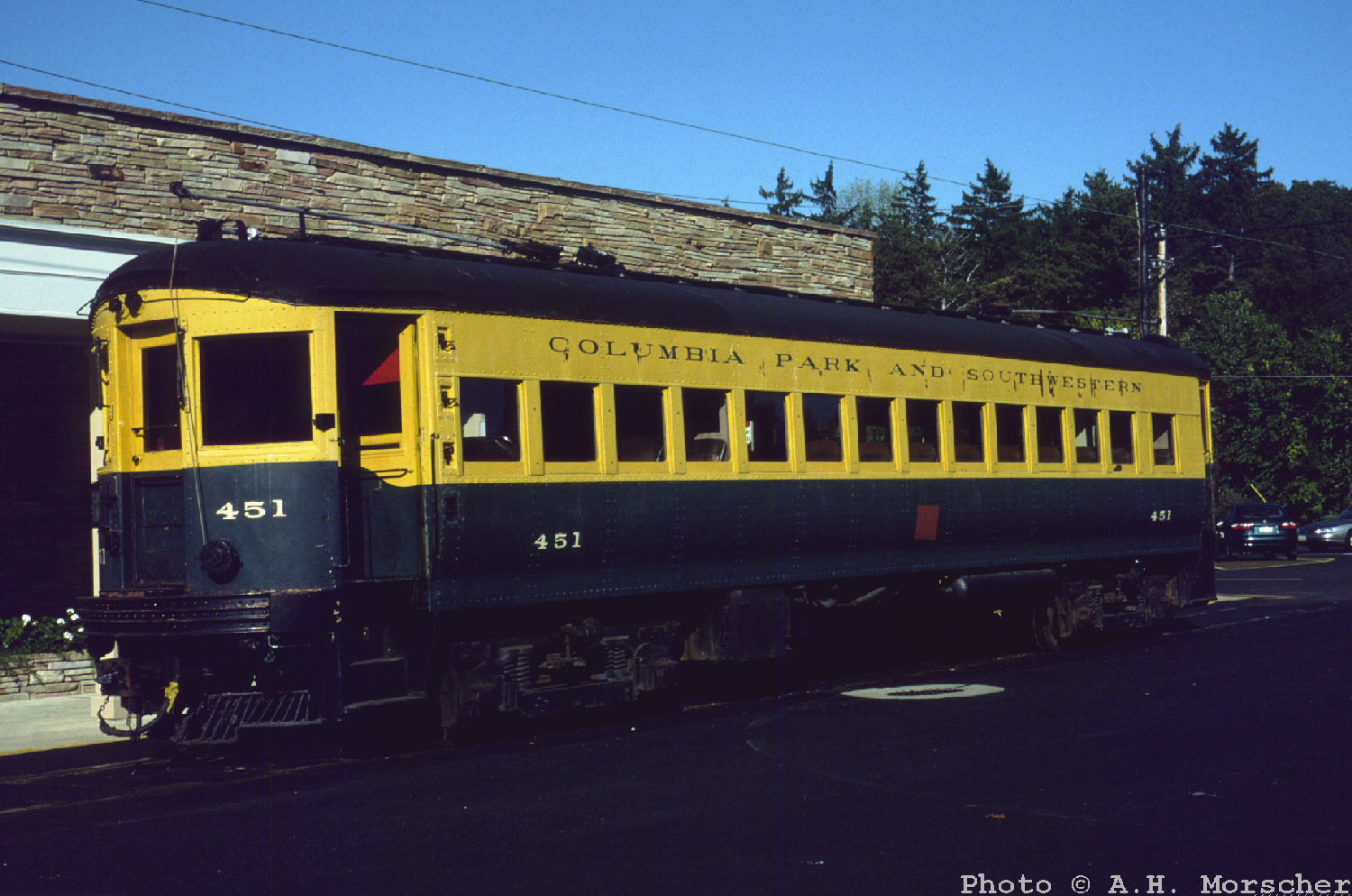
It's just been announced that IRM has been awarded six cars from the Brookins collection at LSE in Cleveland. These include the five CA&E cars we wanted, plus an open car from Vera Cruz.
  • CA&E #36: Stephenson, built 1902. This is the only surviving car from this order, and one of only two from the first generation of CA&E cars.
  • CA&E #319: Jewett, 1914. This car was identical to our 321, but less modified over its lifetime and in far better condition.
  • CA&E #409: Pullman, 1923. The only surviving car from the first order of steel cars.
  • CA&E #451 and 460: St. Louis, 1945. (Curved-sides) Two of the final order of passenger equipments.
  • Vera Cruz #19: Brill, 1914. An open car from Vera Cruz, Mexico. The lack of an open car has been a significant gap in our collection. Unfortunately, there just aren't any open cars from the Midwest in existence, so this car will be a welcome addition.
Huge thanks are due to Julie Johnson, Nick Kallas, Stan Wdowikowski, and everyone else who contributed to this cause. They made this possible -- and they even did it without the help of high-profile politicians or celebrities!
By the way, I'd like to know where the other CA&E cars are going, if anybody knows.

Update: Thanks to John and Joe for updates on where the other cars are going:
CA&E 303 to Connecticut Trolley Museum
CA&E 453 to Electric City Trolley Museum
CA&E 458 to S. Elgin
Fox River 304 to S. Elgin (this is the better of the two)
Fox River 303 to Northern Ohio Railway Museum

We'll add some more info later, I'm posting this from work. Hoorah, hoorah!

Filling the Gaps

IRM has long had the best collection in the country of Chicago streetcars, Chicago rapid transit, North Shore, South Shore, IT, TM, etc. But this hasn't been true of the Chicago Aurora and Elgin -- until now.

With the recent acquisitions from the Brookins collection, we will have for the first time a (nearly) comprehensive collection of all the cars built for the CA&E. They purchased cars from eight different builders, and we will have, by design, examples from seven of them, starting with one of the original 1902 cars built by Stephenson. (The only "missing link" would be one of Kuhlman cars, 311-315; there's just one in existence, and it's in good hands at the Rockhill Trolley Museum in Orbisonia, Pa.) I'll start updating the CA&E photo album as I get a chance to illustrate our new acquisitions.

In the meantime, you can still help with the transportation of these cars to Union, and with paying for the indoor storage space they need. This will be expensive, and any contributions will be most welcome!

Wednesday, September 30, 2009

Nail-Biting Time

... but rather than just sit at home and worry, I went out to IRM and did some more work on the 277.
First, though, I went to R&B in Woodstock and picked up the steel channels which they made for the 205. Now Frank should be able to make more progress on the cosmetic restoration.

On the way there, I noticed that the old Manufacturer's Junction caboose was looking worse than I remembered it, so I stopped to take a picture.


Then I spent some time painting ventilators for the 277, and finished two windows, as seen here. I also worked on cutting and preparing parts for fixing the hole in the roof of the 518, as pictured last time. And one 518 window was missing its hardware, so the correct parts were located and installed.

Sunday, September 27, 2009

Structural repairs

I spent much of today making structural repairs to the 205 with Bondo - or, at least, they might be called structural repairs considering how much Bondo is holding the car together these days! I did Bondo and sanding work on the second wide window post from the west end as well as the letterboard at the east end and southwest corner post. I got enough done on the wide window post that by the end of the day it was ready to prime, as show at right. I also primed half of the letterboard at the east end of the car, which is a marked improvement in appearance. (Unfortunately the east end still doesn't look "right" because the MU jumper receptacle and headlight have yet to be installed.)

In other news, I spray-painted one and a half of the HL switch group boxes under the car with a first coat of black paint before running out (below left). I also figured out that there is enough room at each end of the 205 to allow the poles to be hooked down - when the 205 was switched back into Barn 8 the poles were swung off to the side since they stick out past the end of the car a few feet. I hung a block reading "look up" at approximate coupler/floor level from the trolley wheel at the east end of the car to ensure any switch move ground personnel won't miss seeing the trolley wheel (below right, block circled). For the information of anyone who might be doing switching in Barn 8, the 205's pole can simply be unhooked and moved off to the side if needed.

It's War!


World War II will be coming to IRM next Saturday, Oct. 3rd. Most of the information you need can be found here. We're expecting a large crowd, so more help with crowd control and so on will probably be needed. Contact the office for more information. This hasn't been tried at IRM before, and I've heard opposing opinions, so we'll have to see what happens.

Incidentally, General Rosengren let me have a top-secret map of the battlefield, with a schedule. Don't let this fall into the wrong hands!

Saturday, September 26, 2009

277 Update

After all the excitement during the Museum Showcase weekend last week, today seemed rather quiet by comparison. Sort of a calm before the storm.

I installed the last ventilator on the south side of the 277, as seen here. Later, I got the rest of the ventilators from storage and started painting them with brown primer. I also put some spare window glass that had been in the 277 into storage, and did some other sorting.

And I painted two windows from the 277 and varnished two from the 518.

Finally, I started fixing the roof of the 518.

The roof is generally in very good condition, but it had one hole for some reason, as seen here. Also, the top grab iron was loose, which isn't good. There's also one missing, which I'll need to replace. I can use the ladder at the other end to get on top of the car, fortunately. The roof is entirely canvas (with some small spot patches) and no tar paper, so it's much better than the 277.


I cut away the canvas to check the condition of the wood. The wood that needs to be replaced is limited, as I had hoped, so this should go pretty fast. I have some tongue and groove boards and canvas left over from the 277 project, which I can use here.

And I showed Wally and Les the inside of the 277, which they hadn't seen for at least 20 years.

Dave's Depots -- Lead Belt Edition, Bonne Terre, Missouri

Friday afternoon was shaping up to be a quiet one around the office, then an emergency hit. The powers-that-be needed a lawyer of my ability and skill to drive down to Farmington, Missouri to argue a motion before the Circuit Court of Saint Francois County. "My ability and skill" means I was the only attorney in the office wearing a suit that day. Wearing a suit and tie on a casual Friday sticks out like spats at an Iowa picnic, and is certainly one way to get noticed by the boss.

Saint Francois County is the heart of the old "Lead Belt," an area dotted by abandoned lead mines and the resulting waste. Other than that, the area is actually very beautiful, with tree-covered hills. The weather was nice, which made the drive fun. On the way back to town, I stopped in Bonne Terre, and snapped a photo of the Frisco Depot.

Bonne Terre was the heart of Missouri's Lead Belt, and the Frisco even ran a passenger train called the "Lead Belt Special." The depot is in good shape, owned by the proprietor or the local abandoned lead mine, which is open for tours. Part of the mine is flooded, and is quite a popular attraction for scuba divers in the midwest.

Tuesday, September 22, 2009

Showcase Weekend Roster

Let's see if we can list everything that operated on Showcase Weekend this year. I'll need your help, so email or comment with your additions/corrections.

Electric Cars:
CA&E 308, 309, 431
Com Ed 4
CNS&M 160, 714 (Sunday only)
CRT/CTA 22, 41, 1268, 4290, 4412
CSL 3142, 4391
IC 1198, 1380
IRR 65
IT 234, 277, 518, 1565
NYC 7926,7927
SS 68
On display: CSS&SB 803

Trolley Buses:
441, 633, 4020, 9553

Diesels:
BN-3
CB&Q 504, 9255, 9911A, 9976
C&NW 411, 6847
Joy 2
WC 7525

Passenger Cars:
Nebraska Zephyr
Inglehome, DM&IR 84, 2 Lack, IC 2804, Bessemer 25, CB&Q 1923
C&NW "6", 151

Cabooses:
CRI&P 19135, IC 9792, CMStP&P 1984, CB&Q 13572, ICG 199458

Freight Cars:
BFIX 520, CB&Q 220100, 220145, CPVX 101, DOTX flat, GATX 75470, IRCX 1277, SHPX 42, TTX 470902, URTX 37190, UTLX 17222

And the Signal Display!

Total: 67 or so. No other museum could come close.

Sunday, September 20, 2009

Hail to the Orange, Hail to the Blue

This year's Showcase was an unqualified success from every point of view. I couldn't possibly list all of the equipment that operated, so naturally I'll concentrate on the IT and CA&E cars. My co-conspirators can probably fill in the rest. I was too busy to take many pictures.

The IT orange cars ran all day Saturday to everybody's satisfaction. David was the conductor on the 277. Meanwhile, Frank and I were operating the blue cars with Jeff Fryman as the conductor. We also made a couple of trips after dark


Here we see the 234 on the rear of the IT train. Thanks to Stan, Joel, Dan, and everybody who helped with the inspections and getting the three cars ready. The mainline was so busy we ran in sections several times, as indicated by the green flags.


On Sunday I was out again and served as a conductor on the heavyweight train for one trip, then was transferred to work the bilevels for the rest of the day, with Ray Weart as engineer. Among other things, we had what seemed like a mile-long freight train with three units and five cabooses to contend with. Again, I believe everybody went away happy.

Everyone associated with IRM can be proud of what we accomplish!

Frank adds... I finally got a chance to upload some of the photos I took. We started off the day at 50th Avenue (Stan Wdowikowski was nice enough to run the 308-309 over to 50th so that I could delay signing in, so as not to "go dead" before night operations!) and over the course of the day got a chance to run a variety of different "routes" from both 50th and East Union. Many thanks to Chris and Dan Buck who dispatched the railroad on what was certainly one of the busiest and most varied operating days anyone has ever seen at IRM. Below left, 308-309 share the 50th Avenue platform with the IC MU cars on the west track while Charlie Strong washes down South Shore 803 on the west leg of the wye. Below right, the scene at Car Line Junction at the height of the action.


Things were certainly busy. Below left, the CA&E cars sit on Station Track 1 while the Class B brings a caboose train into Station Track 2, followed by Indiana Railroad 65 approaching in the distance. Below right, before the start of night operations the IC MU cars and the 308-309 share the 50th Avenue platform.


Below left, Kirk Warner snapped a photo of us trying to light the markers with alcohol after we ran out of lamp oil. We soon switched back to good old kerosene, provided by Charlie Strong, who also spent a while fiddling with the markers to get them to work better. Thanks, Charlie! Below right, Randy Hicks and David Wilkins (with hand lanterns) on the platform at East Union during night operations.
David adds.....
My weekend began on Friday when I arrived at the museum just after 6:00PM. After signing in, having a job briefing, I assisted Stan and Joe Stupar in helping to arrange and stage equipment for Saturday. This included staging the IC MU cars at 50th Avenue. After finishing switching operations at around 11:00PM, we signed out and headed to dinner.

Saturday was a great day weather wise, and conducting on the IT train really made me realize I was riding a "time machine." Here I was, conductor on a 3 car IT train, traveling down interurban right-of-way, with the "steam road" railroad off to one side, corn fields all around and even under IT-style catenary wire. It was as close as I'll ever get to riding the real IT, and it was a pretty close copy. Of course, the illusion was furthered by Stan wearing traditional motorman garb, and the other three members of the crew also wearing authentic conductor garb. I furthered the recreation by wearing a pair of Shuron Ronsir eyeglasses, appropriate for the era.

One one of the trips, I talked to a gentleman from Gillespie, Illinois who rode the IT many times in his youth. He even traveled on the IT to take a high school science project to Illinois State University, using the combine to carry the project. He told me that riding in the 277 was something he never thought he'd do again. Overall, it was a great weekend.

Randy adds: Here's a link to a good picture of David, if you're a member of the Illinois Terminal group.
David Responds to Randy's addition: I contend that "looking the part" is an essential part of railway preservation. Even a shirt and tie on warmer days, with the conductor hat would look thousands of times better than a white polo shirt. I further feel that looking the part is essential for special museum days, like showcase weekend. Okay, I'll get off of the soapbox now....

Thursday, September 17, 2009

Have a Seat!

Dan Fenlaciki gave me a lot of help yesterday. First we spent some time checking the compressors on the 277 and 233 with the megger, to test the status of the insulation. The car has two compressors, which are needed to provide air for a multi-car train, and we need both of them to operate.

Then we spent a couple of hours installing the rest of the seats in the main compartment of the 277, so it could be ready for service. Here Dan is relaxing in the newly-finished section. He also helped with removing some of my tools and larger items, such as my vacuum cleaner and fan.

We also paid a brief visit to the Art Train, where Fred Ash is making good progress on the displays. The car currently has a display on Burnham's Chicago Plan, and it looks very professionally done -- "just like downtown!" Burnham's plan was an amazing, very grandiose document, so it bears a striking resemblance to IRM's own Main Street plan. Good work, Fred!

Wednesday, September 16, 2009

205 What is it / Where did it come from?

It's time for a new feature: 205 What is it / Where did it come from? There's a wide variety of parts stored inside the 205, most of which come from the car itself (mainly interior fixtures and trim) but some of which most certainly don't. We'd like help in identifying some of these items so that, hopefully, a good home can be found for them. Please comment or e-mail if you have any ideas on what this stuff is - thanks!

For our first entry, the "where did it come from?" question has already been answered. Written in marker on this piece is "#2 end car 21," which refers to Yakima Valley Traction car 21, a Master Unit built by American in 1930. Car 21 was owned by Bob Hively, the same person who owned the 205, for years and it's likely that at least some of the mystery parts inside the 205 are from this car. The 21 is currently located in Yakima, WA, so it would be nice to return this item to that group - but what in the world is it? Any ideas? (And does anyone have a contact with the Yakima group?)

Our second entry is opposite of the first: we know what it is (is it a door? or is it ajar?) but have no idea whatosever where it came from. It's a rather aged wooden door with one rail detached; from the size it certainly appears to have likely come from an interurban (i.e. it's really small) but we have no idea what car it might have come from. It's certainly not from a Yakima Master Unit; other equipment stored along with 205 at one point or another include interurban cars from BCER and Pacific Northwest Traction, as well as the ex-Interstate sleeping car and a line car from Portland Traction. Any ideas?

Here's our third entry. My best guess is that it's a sand filler spout, but does anyone know? And what might it be off of?


For our fourth entry we have this cast junction box-looking thing. Cast into its face are "RALCO" / "CAT No 21" / "30 AMP 250 V". Any ideas? I have no idea whether this is off the 205 (quite possible) or not.


I have no clue about this one. It's a small piece of brass painted white on one side and light green on the other, shaped like a quarter circle, with a groove cut in the radius. The penny is included for scale.