Sunday, August 16, 2020

Saturday Report

My favorite Greek philosopher (apart from Anaxagoras of Clazomenae, Heraclitus, and several others) lambasted me yesterday for going off on vacation and neglecting all the current news.  So I'll have to try to make up for it with more pictures.

I continued working on the roof of the 453, and was able to remove two more of the running boards, plus the removable sections of the roof cables.  And I was also helped by Greg Kepka:


and Zach Ehlers:


who volunteered to remove all of the drip rails, the rope guards, and the ventilators.  You will notice that we enforce social distancing by having them work on opposite ends of the car.  Their help was much appreciated.  In the middle of the roof we're now down to the saddles.


At the west end, it looked like this after removing the drip rails and rope guard.


Pulling off the canvas, we found this unexpected sheet metal plate:


This was probably installed at Wheaton.  Tim Peters came along to look at the tack molding.  Replacing it would be a daunting task, and we think that it can probably be reused.


Pulling off more canvas:


And this is what was hidden by the patch plate:


That can be fixed, although it will take some time.  I spent much of the afternoon removing the tacks from most of the rest of the tack molding on the north side.


Meanwhile, of course, several other Car Dept. projects were in progress.  Here Ed Woytula is working on the PCC truck as Eric looks on:


John Sheldon is progressing steadily on the interior of the 306:


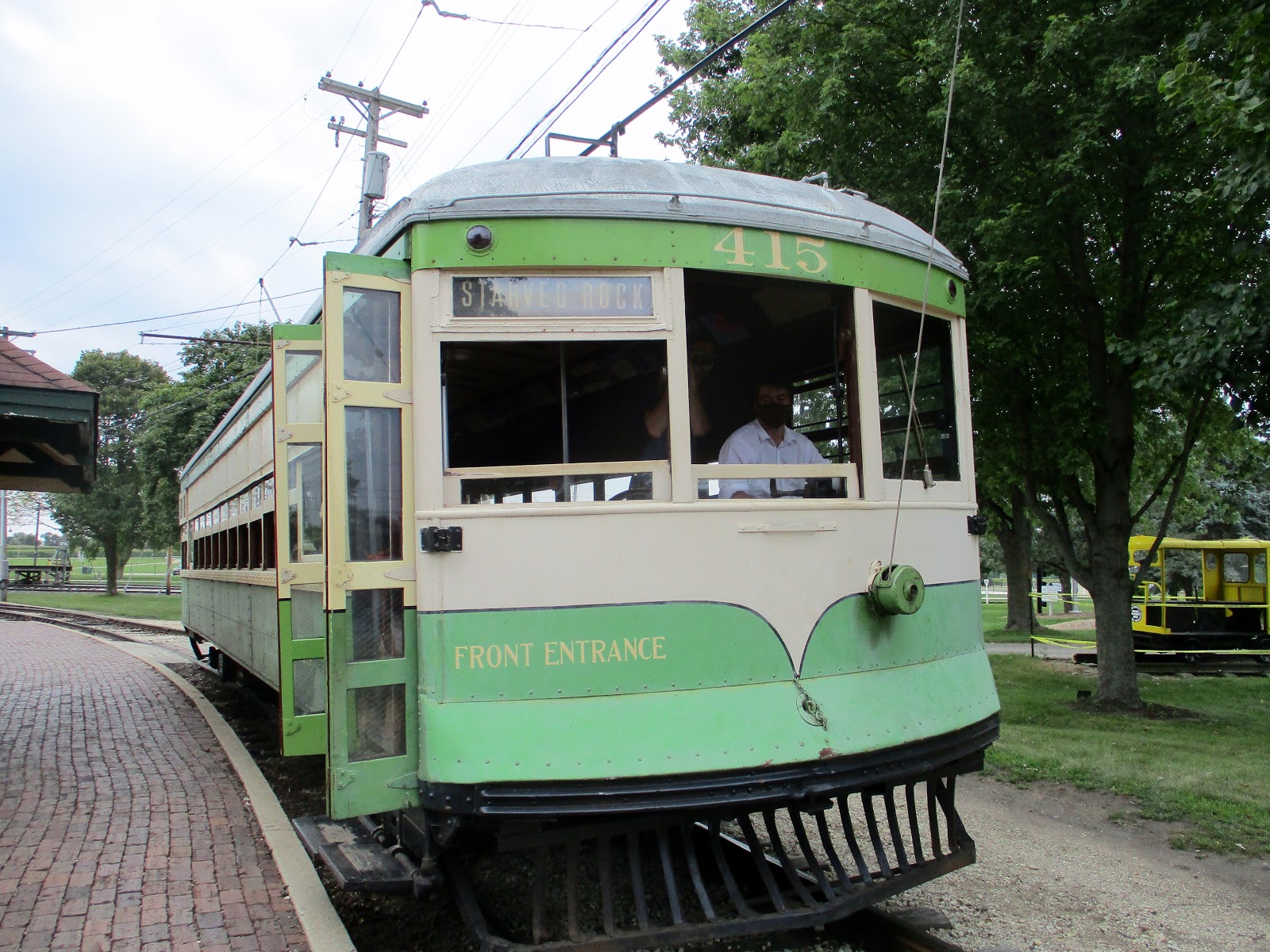
Public operation continued, and we seemed to have a relatively large crowd for 2020.  Old reliable 415 was in operation on the car line.  This is new member Joey Ferrito.

The Shay was pulling the coach train.  It's great to have steam in revenue operation again.


Larry Stone and Paul Cronin ran the 409 and 431.


Back in Barn 4, Keith Letsche was helping on the 1754:


Frank and Vivian even stopped by for a quick visit and a ride:


Finally, Zach has completed installing the seat frames in the restored smoking compartment of the 757.  It's going to look great.


And that was yesterday.   Who knows what today will bring?

Thursday, August 13, 2020

Rough Roof Rubs Railroaders Wrong

It's been two weeks since I last posted, as I was on vacation to visit my latest grandchild.  He's a cute little fellow, three months old, and the trip was well worth while.


But now it's back to work, and to make up for the delay, I have lots of progress pictures to show.

As you have read, the 453 is now in the roof booth on track 42, and I'm sure the neighbors must think it's depressing property values.  So it's up to me to start at the top and work down.


Before work begins, let's take a quick preview of the situation.  Here's the #2 end, with the horn still in place.  The car had two layers of canvas, but much of the second layer was already gone.


And then the remaining layer on the north side of the car blew off while it was in transit from Scranton to Union.


A view of the running boards and cables, still in place.


On the south side of the car, the canvas was still there, although in bad shape.  Both sides are structurally sound.


But the ends of the car have problems.


Both ends, it appears, have holes where a streetcar managed to poke its pole through the roof.  This seemed to happen a lot at Cleveland.  You may remember that the 460 had the same problem, as documented here.  I patched it up, but on the 453 I'll be able to do a better job since the entire roof is being recanvassed.


More along the south side.


And look, there's Gerry showing his work on the 306 to Al Choutka.


This is, in theory, a before and after sort of picture:


I started by removing what was left of the canvas on the north side, mostly just the folded-over strips at the tack molding.  When removed, they look like miniature versions of the nail strips that police use to catch speeders.


On an historical note, this handy shelf was built by Glenn Guerra about 25 years ago when he was working on the Talisman.  It's still useful.  And I have my own air conditioning.


By lunch time, I had cleaned up about half of the tack molding on the north side.  I could keep going, but I'm starting to have second thoughts about reusing the old molding.  It might be better to replace it, and I'll wait for some second opinions from experts before continuing.


So instead I started removing the running boards.  I detached and removed the two in the middle, and started on the #1 end.


Then I removed most of the canvas on the south side.


And also the canvas at the #1 end.


And continued on the running boards.  And that's it for Day 1.


Meanwhile, here's the nicely painted air tank for the 451.


And I take it this is the compressor which needs to be overhauled for the 36.  Much thanks to the car shop guys for all their work on various projects like this.


Norm Krentel and Rich Castagna were working on the 28.  Here Norm is drilling holes on the front panel assembly.


Here Rich is also drilling some.  He spent much of the day threading rivets, which I still don't quite understand.  But they must know what they're doing.


And outside, two steam locomotives are now nicely staged in front of Barn 9.


But back in Barn 8, you have your choice of destinations:  Peoria, Toledo, or Detroit.  I just hate having to make decisions like this....


Wednesday, August 12, 2020

Doodlebug Update

Gregg Wolfersheim sends us another update on the UP doodlebug:

It's been a busy summer at IRM, but occasionally I find a little time to work on the doodlebug. In June I retrieved some parts from storage and reworked them. These are the trim pieces that cover the joint lines between ceiling panels. They are curved near the outer ends to match the curvature of the roof/ceiling area.


  Here the two strips have been primed. Later they will get a coat of ivory to match the ceiling.

These are the window sill trim pieces. Three of them go on top of the steel sill, where your arm would rest of the window was open. The others go below in a horizontal position. 


The sill trim is in place. Top is black, and the side is in matching brown to the lower wall area.


Another view of the window area. Yes, the seats will need to be reproduced, as they are all very rotted out like everything wood in this car.

More History of the Other IRM

Our friend Bill Stewart sends us some more pictures and stories from early railway preservation in Indiana:

When my friend John Fuller forwarded these images this morning I thought we had perhaps stumbled across a small pot of gold.  It turns out there were only a few silver coins in the bottom, but coinage worth snatching up in any case.  To explain:

You will recall that in 2007 Jan Girardot and I chartered IRR 65 for an IRM excursion in memory of the then recently deceased Dr. Howard Blackburn, one of the original 1953 contributors to that car’s preservation and arguably the man responsible for whatever success the Noblesville museum enjoyed in its earlier years.  Now 13 more years have gone by, Doc’s widow has passed away, and his daughter has entrusted John with 60 trays of 35mm slides for review and preservation.  Here are some with CNS&M and CA&E connections that I thought might be of interest to you.

These pictures document some scenes along the 1964 or 1965 Anderson Railroad Club fan trips we discussed earlier this year.  Those trips originated in Anderson and operated south at least as far as Westport (possibly North Vernon) and north at least as far as Warsaw (possibly Goshen or Elkhart) on the New York Central’s Michigan Division, once an important secondary main line that was by then entering its final years of usefulness.  Passengers on the Anderson Railroad Club trips were accommodated in North Shore cars 154 and 172 (finding images of the 172 in this deck would have created the metaphorical pot of gold mentioned above; alas, we see only the 154).


This is the magnificent Big Four/NYC depot and division office building at Wabash, where steam helpers once pushed freights up a long grade out of the Wabash River valley.


Next is a scene at Knightstown, later home to a landlocked, ill-fated tourist railroad that operated for a few years following abandonment of most of the Michigan Division south of Anderson. 


The last two show the train at the NYC and Nickel Plate depots in Rushville.  It’s remarkable that all of those structures were still standing even then, and of course each was demolished not many years afterward.

Of perhaps greater interest is the image below.  It’s the best view I’ve seen of CA&E 318 and the North Shore combine and MD car parked together at Westport.  The track to the right is the NYC Michigan Division main, looking north toward Greensburg and, eventually, Anderson, Marion, Warsaw and Elkhart.  The IRM equipment is parked on the last few feet of the former Milwaukee Road Indiana line (Chicago-Westport).
 

In weekend operations 0-4-0 No. 11 hauled the 318 southwest about a mile and a half, then backed up to complete a round trip.  Looming in the background is the former NYC tower from Greensburg, stripped of its first-floor stilts and transported by flatbed to Westport, then dropped on the ground to serve as a bare-bones ticket office.  In this scene Mrs. Blackburn is keeping an eye on her kids clambering about on the handcar.

One weekday afternoon in the summer of 1966 I took a circuitous route home from Cincinnati to inspect the “museum” at Westport.  All was quiet in the village, and I saw not a soul as I strolled around the grounds.  Within ten minutes, however, a car pulled up in the parking area – not a police car, but a new Cadillac coupe.  Out stepped friend Dick Simons, future co-author of Railroads of Indiana, the capstone volume on the subject, and a former colleague of my mother’s on the editorial staff of the Indianapolis Star.  Of course we were amused that we had each undertaken a similar mission that day.

After completing inspections of the equipment, we came to the little orange speeder you see parked in front of the handcar.  Without hesitation, Dick began tinkering with the engine and the controls.  After about two minutes it fired, filling the air with the “pop-pop-pop-pop” exhaust common to such machines.  “Ready?” Dick asked.  “Sure!”  And off we went, a fortysomething gent (Dick) and an 18-year-old college student (me) leaning into the breeze as we rocked along, westbound on a two-man fan trip over two miles of the Milwaukee Road -- in Indiana. 

The weekend IRM trains stopped at the east end of a pile trestle out of safety concerns, but we flew right over that structure at top speed and kept going over the remaining mile or so of track, trimming the weeds along the way.  On the way back we stopped to take a closer look at the trestle, then completed our excursion and left the speeder where we had found it about twenty minutes earlier.  Looking at this Doc Blackburn slide from that same era makes me wish I had taken a camera with me for that “routine” trip to Cincinnati and return.

Monday, August 10, 2020

Advancing on multiple fronts

 Frank writes...

Sunday was a productive day for a few different projects with which I'm involved, not to mention progress on other projects with which I am not involved. Unfortunately I didn't get any photos of the most photogenic part of the day, but I've got an excuse explanation and I'll get to that.

First we'll start with the 451. A bit THANK YOU to the guys in the Steam Shop, who UT and hydro tested the outboard air tank that was removed from the car a couple of weeks ago. This happened sooner than we expected and we really appreciate it. As shown above, the air tank was already returned to Barn 4 (the chalk marks indicate different sectors which were UT tested for thickness). There were no problems with the tank and it seemed to be in excellent condition.
Above, Greg is shown putting a coat of primer on the tank. This will be followed by black paint and then it will be stored for the time being until the replacement for the 451's inboard air tank - the one with the hole in it - is acquired. Then both tanks will be put back on the car and we are all set with that part of the project. These are both main reservoir tanks, of course, and befitting a car built after WWII they are welded with convex ends, rather different than most of our interurban cars.
Then in the afternoon I spent a while needle-chipping on the 451, including finishing the step well at the southwest corner of the car. Well, I need to pull off that sign and remove the paint right around it, but the step well is pretty much ready for a quick wire-wheel cleanup and then primer and paint. For the "before" image you can see last week's post.
From progress on the 451, we now move along to progress on the 36. "The 36?" you ask quizzically. "I didn't think anything was being done on that car." Well you would have been right, but that is now changing. The 36 was semi-retired last summer with a bad knock in its air compressor. It can still run with its pump cut out, but since the whistle (of all things) feeds from the main reservoir, it can only be in the middle of the train. That's why we used it a few times towards the end of the season last year as the middle car in a three-car train. Anyway, the 1754 also has a D3-EG type air compressor that had a knock, so Dan F rebuilt a spare pump of that type and on Saturday the rebuilt pump was fitted to the 1754. That frees up the 1754's air compressor - shown above in the lean-three - and the plan is that in a few weeks Dan will start working to rebuild this one. Once it's ready to go, it will be installed on the 36 and the car will be back and ready for service. So that's exciting.

And then we get to progress on the third CA&E car for the day, and the section for which I have no photos. The plan for the 451 is to remove the inboard air tank (for replacement) and the car's air compressor (for valve and bushing work), but once that work is done - currently scheduled for next weekend - there's not too much that can be done on the car itself to advance it closer to running. On the other hand, my father is quite interested in starting to work on the roof of the 453, the car that we acquired last year from Scranton. So a plan was hatched to swap locations between three cars: the 451, which has been at the northwest corner of Barn 4; CTA 4146 (the "Baldy"), which has been in the "roof booth" on track 42; and the 453, which has been on display in Barn 6. The plan was to move the 453 into the roof booth, the "Baldy" to the northwest corner of 4, and the 451 into Barn 6. And over the course of only an hour or two late in the day on Sunday, that's what a large crew of volunteers did. The 451 actually ended up just west of the pit on track 41, so that its air tank and pump can be pulled next weekend, but it will then go over to Barn 6 where it will make a much more attractive display piece than the 453. The 453 is now in the roof booth, where work on its roof will commence shortly, while the "Baldy" is on track 41 which may actually make it easier to work on the car's exterior without all of the scaffolding. The switch move involved a lot of moving parts, but a rainstorm was headed in and so I wasn't able to take any time off to grab photos. But many thanks to everyone involved, particularly Greg, who organized the entire thing. Others working the move included Joel, Nick, Jeron, Jack, Richard, and Thomas.

Next up for the 453 project will be ordering canvas - donations are always appreciated!
And of course there's been plenty of progress on other cars in the shop. Here you can see one of the dash panels on Michigan Electric 28, which has acquired framing pieces and rivets.
Our General Manager of Collections, Phil Hehn, stopped by and happened to be present when a donated B&O hand lantern was brought in. Naysayers in our midst suggested that it wasn't worth keeping due to some rust, but Phil spent a few minutes cleaning it up and got it working and lit in short order. It will go over to the Steam Shop for potential use by the steam engine crews on night operations. Thanks, Phil! In the background here you can see our two green-and-orange projects, the 28 on the left and the 1754 (over the pit for its pump replacement) on the right.
Our iconic and unique "butter dish" milk car, which rarely sees the light of day, has been sitting in Yard 3 the last couple of weeks. I'm not sure whether it's just on display or intended to go inside on track 34 to join the freight car exhibit.
I'll tell ya, Bruneau Drive is a rough neighborhood...

Wednesday, August 5, 2020

Flying X Rodeo

Our friend Ray Piesciuk has been scanning CA&E bulkhead advertising cards (the ones hung in the bulkhead windows between the cars' smoking and main compartments) from the Julie Johnson collection. A few duplicates have been passed along to us so that we can either use them in the cars or easily get them copied. The batch he's working on currently seem to mostly be from 1939-1940. These are now hosted on a special page on the fascinating www.irm-cta.org archive site Ray and Julie manage.

Monday, August 3, 2020

Smoke in the air

Frank writes...

Sunday was a productive day. The weather was a bit odd - warm and humid, with the occasional cloudburst moving through to spice things up a bit. But there seemed to be a decent crowd of visitors and some interesting train operations (more on that later).

When I arrived, Greg (shown above) had gotten most of the 451's outboard air tank wire-wheeled so that our friends in the Steam Shop can hydro and UT it. But he got pulled away to help with the 4391 so I spent a while finishing up the work on the tank. It's now ready to send over to the steam guys to get looked at, and if its condition is okay then we have one new air tank to order (if not, we have two). As for the 4391, there was some brief excitement when the magic smoke got let out of one of its baseboard heat ducts while it was in service. The motorman handed the situation quickly and ably, getting the passengers off and shutting down the car. After towing the car over to the pit and looking it over, it appears that somehow the auxiliary heat circuit was powered up which set some paper debris in the heat duct to smoldering. No damage was done.
Since I was already dirty from wire-wheeling, why not up the ante and do some needle-chipping? A job well suited to my minimal talents is chipping the paint (and overspray) off of underbody equipment. The 451 looks gorgeous from the floor up but as seen above its under-floor equipment still needs a bit of cosmetic attention.
I didn't get as far as I had hoped because I was pulled away but I did make some progress. In coming weeks I will try and continue along with this so that we can start to get step wells and other equipment under the end of the car chipped, primed, and painted. What I was pulled away to do was take a megger look at the motors of the 453 but stuck brush issues got in the way of that. Thanks to Jack and Lucas for all of their help with the project though!
Public operations were a bit more interesting than last weekend. There was once again a CA&E train and a diesel coach train, but the diesel train had to be towed (including the diesel) by ComEd 4 for one trip. Unfortunately I didn't get a photo of that though you can see it on the webcam time-lapse page as the 1:45 departure. Then later in the afternoon, the Shay came out! It was undergoing its annual test for the FRA inspector and ended up making a trip out to Kishwaukee Grove, its first voyage that far east this century, or so I'm told. I was back by Barn 4 when it departed but grabbed the above video.
And when it returned it was on Station Track 2 with its short caboose train. The first day of revenue steam operation is currently scheduled for the 15th, so make sure to tell your friends and family to buy their tickets now. I'm told we were pretty close to our capacity limits this past weekend so tickets for steam days may actually sell out.
And while I was over by the steam shop on an errand I snapped a photo of SP 975, which is looking quite smart these days. I believe they are working on creating lettering stencils for it. While I'm thinking of it, many thanks to the car shop crew for pulling the line car out and fixing the wire insulator on track 84, which had been causing some issues.