Thursday, May 8, 2025

A Visit to IRM in 1971

A Visit to IRM in 1971
all photos from the Krambles-Peterson Archive

Art Peterson has sent along a treasure trove of photos taken at IRM, with some taken July 17th and other taken by George Krambles and Art Peterson during a visit on October 16th.

ComEd 4 is shown on the West Wye in an October 16th photo. The depot and CSL 144 are visible in the left background, with IT 518 on the right.

This July 17, 1971, photo by Tom Desnoyers shows (left to right) CRT 1808, 1268, and 1024. They're sitting at the current site of the Depot Street stop on the East Wye, and if the photographer were standing in this spot today he'd probably be in the middle of the playground.

It's July 17th and CSL 144 is coming into the depot, about to pass the Station 1/2 switch. On the left is the west leg of the wye with the switch to Yard 1 visible.

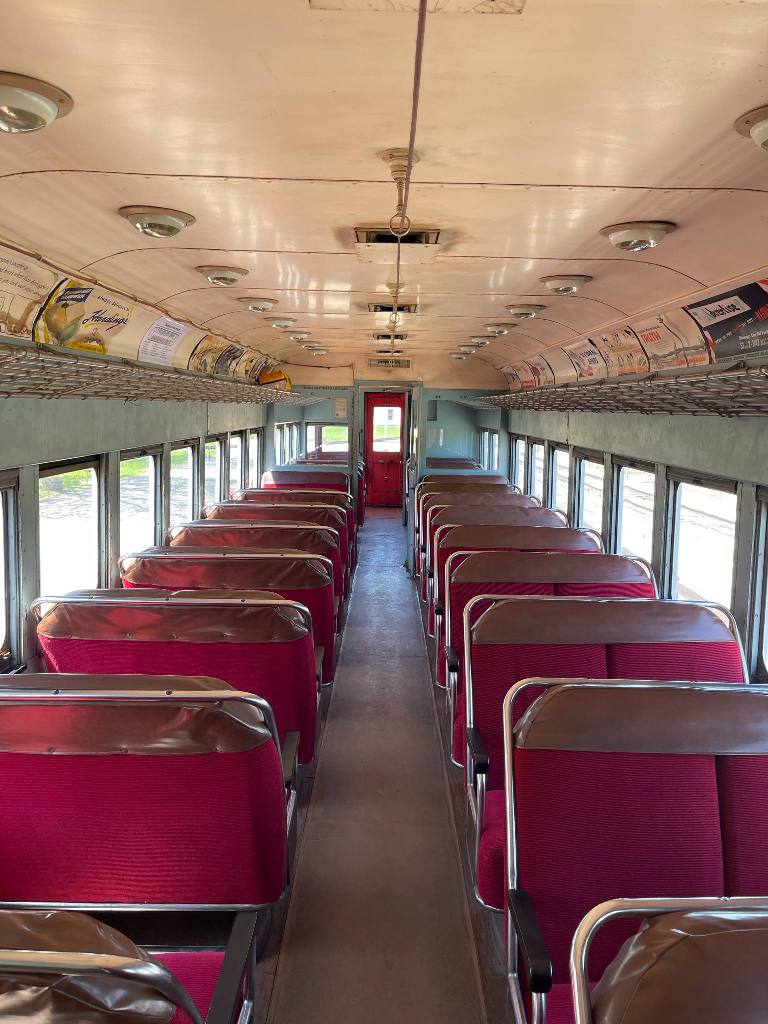
This interior shot of the 144 was taken the same day. The car looks about the same inside today.

This Tom Desnoyers photo from July 17, 1971, focuses on CSL 9020, which is in the midst of receiving a "quickie" paint job that has ended up lasting until the present day, and CSL 4001. In the left background is North Shore 202, and off to the right is one of the Milwaukee GMC buses.

This photo is from October 17th and shows the 65 with what appears to be a fresh coat of orange. This car, likewise, has not since been repainted, though it has received a LOT of other work.

IT 234 is pictured on October 17th. This must have been when Bob Bruneau was rebuilding the back end of the car, including installation of new corner posts.

IT 415 is coming into the station on October 16th. At the time, it still wore its in-service paint, complete with "scare stripes" above the anticlimber.

It's July 17th and Tom Desnoyers has snapped this photo of freshly painted IT 518 sitting in Yard 1. The windmill barely visible at far right was located, I believe, roughly where the C&NW Historical Society building is today.

Tom Desnoyers shot J. Neils Lumber 5, at the time still lettered for St. Regis Paper Company, coming into Station Track 2 on July 17th. It's pulling two CB&Q day coaches and the "Inglehome;" the Lackawanna coaches wouldn't arrive until the following year.

If this looks familiar, it should. Art Peterson: "My recollection is that they were shooting the photo for the 1971 calendar and we tagged along to get this shot." Sure enough, differently framed version would appear as the 1972 calendar photo. The date was October 16, 1971.

It's the same occasion but with just the interurban train. You'll notice that for a time after it was painted, the 160 lacked its "lobster trap" roof mats. Well, the same was true of the 714 behind it, but it was for a slightly longer time!

Here, it's July 17th and Tom Desnoyers has gotten a photo of North Shore 251 (with the 749 behind it) at the southwest corner of Yard 1. On the right is either 1002 or 1004, our cupola-less North Shore cabooses. The caboose sits roughly where the 50th Avenue station house is today.

It's true - the "Inglehome" ran as the "Chief Illini," in Pullman green and with Pullman lettering, for a time at IRM. Here it is trailing the coach train on October 16th.

Monday, May 5, 2025

Pullman Weekend

Frank writes...


This past weekend was our first-ever Pullman Weekend event. It seemed to be well attended and well received.
I briefly stopped out on Saturday and snapped the above photo, in which every car visible was built by Pullman. The heavyweight train was out, pulled by two E-units (someone pointed out to me that we may be the only museum right now that can operate a two-unit set of E-units - can anyone offer a dissenting opinion?), while the C&NW F-7 pulled and pushed a three-car train of Pullman-built bi-levels. North Shore 749 was on the main line, Northwestern Elevated 24 on the 50th Avenue Shuttle, and CSL 144 on the streetcar line, all Pullman products. CA&E 409 and CTA 2153-2154 were on display at the 'L' station, too.

Then on Sunday, though the event continued out on the railroad, in the shop it was back to work.
A huge thank you goes out to the shop crew, who late on Saturday night took the 309 out to test the newly repacked #1L axle cap. The good news is that there was significant improvement: it, and one or two of the other new axle cap bearings, ran at about 75 degrees (versus about 55 degrees for the old bearings on the other truck), but didn't rise any higher. The bad news was that the #2R axle cap started acting up. It was fine headed east to Seeman Road, but coming west it heated up to about 120 degrees. We're going to try repacking this one, too, in case the issue is that not enough oil is getting onto the axle. So my first job was to pull the waste, clean it, and start it soaking in journal oil. The #2R axle cap is the one on the right in the above photo; you can see the "dust cover" waste bundle up against the chock. That goes right under the lid of the axle cap to prevent any crud from getting down into the box.
Of course our other CA&E wood car in need of work is the 319, which has a grid box being rebuilt. Joel was hard at work using the surface grinder to even out the contact surfaces on the grid elements, as shown above. I did a few more grid elements myself later in the day. Using this machine gets old after a while!
In other news, there's been remarkable progress on the South Storage Building, located just east of the Southwest Storage Building, aka the "U-Store-It" building. (If you like Google Maps as much as I do, the South Storage Building is being built here.) Early in the week, the posts went up, quickly followed by bracing, and by the end of the week the roof trusses were going up.
Also at the south end of the property, they've started work on lettering the Swift reefer located behind the B&G Barn. This reefer is closer to Olson Road than any of our other equipment and is pretty prominently located if you're driving up from the south, so it's nice to see it being cosmetically restored. This car is SRLX 25004, for those following along at home with their new printed rosters.

As usual, other work was going on, including fabricating replacements parts for the Electroliner and rebuilding brake valves for the IT Class B. Now, if you remember me mentioning that the Saturday night test trip with the 309 was a nighttime trip as opposed to a late afternoon trip, there was a reason for that. Saturday afternoon, a broken feeder connection was reported, so the DC Line Department went out with the line car to fix it. Many thanks to Brian LaKemper, who supplied the below photos of the outing.
Above is our trusty "line car train" with North Shore line car 604, which can't propel itself until motors are rebuilt for it, and ComEd 4 acting as the "horse."
Above, here's Joel investigating the problem.
And here's a nice shot of Will, Jimmy, and Joel on the 604's platform. Unlike some line cars, the 604 has a long "diving board" platform that can rotate out to the side, allowing the workers to walk out to the line pole alongside the tracks. It's a pretty useful feature for work like this.

Saturday, May 3, 2025

Progress on Seats, and More

On Friday I drove to Bellwood with a museum van to pick up the next shipment of nicely reupholstered seats for the 451.  Thanks to our friends at Kustom Seating, we're making good progress.  They certainly do good work, and have helped us immensely.


And since I had the van, I stopped at home on my way back to the property, and picked up the Jewell Road sign I made several months ago.  (Since it's 8' long, it wouldn't fit in most available vehicles.)  It's now stored inside the shelter.


Tim was working on the interior of the 1268, as usual.  He too is making good progress.


And we had a large number of schoolchildren visiting.  There should be a lot more of these visits once our new Visitor Center gets built.   And you can help!


Tuesday, April 29, 2025

Union Pacific M35 Update

Thanks to our intrepid investigative reporter Gregg Wolfersheim for sending along an update of what he's been up to on the doodlebug, Union Pacific M35:

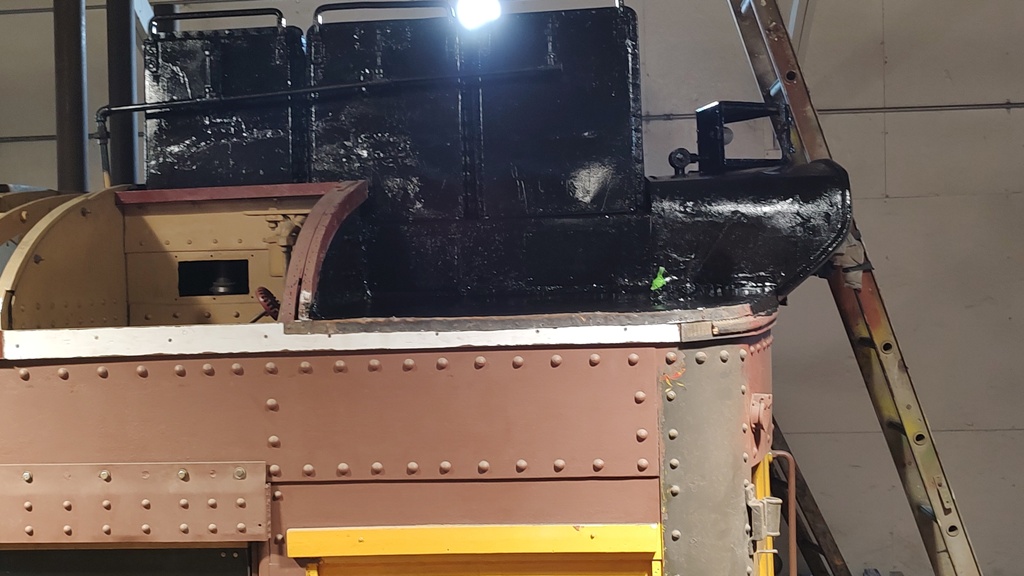
Recent activity on the doodlebug has focused on the roof. Some clean up of the radiators and the flat roof sections near the front. The gray primer is slowly getting covered in black.
The same area now covered in black.
The number board box is open for painting. You can see the single bulb used for illuminating it.
View from the right side. The flat roof is made of copper. You can see the folded over section on the tack molding which is in white primer.

Sunday, April 27, 2025

Meeting Day

Frank writes...


Saturday was a day of meetings, from the operating rules test in the morning to the safety meeting in the afternoon and the annual IRM membership meeting in the evening. Before we get to all that, though, let's start with some train stuff!
Mid-afternoon, after the safety meeting, Joel and the car shop guys worked on getting the 309 out for some testing to try out the new axle cap bearings. Ted and Ashtin reinstalled the air compressor strainer, which had been disassembled and cleaned out, and then Brian, Jimmy, and others (I'm sorry, there were a lot of people there and I'm having trouble recalling who all was involved) pulled the car outside for oiling. Ted drew the short straw and, with help from Joel, crawled under the car to oil the new bearings. The 45-tonner crew then pulled the car out to the car line where the pole could be raised.
Here we are at Depot Street. What a beauty! Anyway, we made it as far as Karsten's, with a few stops to check bearing temperatures. It became clear that one of the bearings was running hot, even at relatively sedate speeds. We made sure it didn't get hot enough to cause any damage, but we'll need to take a look at it. The bearing isn't too tight, so it's not clamping the axle; our hope is that it may be as simple as the waste making poor contact with the axle and not spreading oil effectively. The 309 was put back on the pit before the annual meeting so that this can be examined during the week (for the record, the bearing in question is the #1 axle, L side).
After the annual meeting, I was able to spray a coat of black paint on the end castings and through bolts for the 319's grid box. A huge THANK YOU goes out to Greg, who during the week sand-blasted the end castings and then primed everything.

And with that, on to the meetings! It's always nice to see people that I don't run into very often, and this time I got a chance to chat with Steve Iversen, Randy and Betty Anderson, Charlie Strong, and a few others. I also spoke with Buzz; we're going to try and pick back up with the project to get vinyl masks cut for the Futura lettering on the 451 so we can (hopefully) spray that this summer.
Above, the safety meeting was held in the cafeteria at Marengo High School, as has been the case the last couple of years. It's a very nice venue. The annual meeting was also held in this spot.
Above, Nick points to his preferred candidate's yard sign. Congratulations and condolences to the winners of the director elections, Bob Olson, who was reelected, and Lee Evans III (aka Lee 3), who is the assistant curator of the Diesel Department and was elected to his first term on the board.

The other matter that came up for a vote at the meeting was taking the 321 off the Permanent Collection list, which we discussed here a few weeks ago. The membership approved this measure, meaning the car is now no longer on the Permanent Collection list. But that said, there seemed to be some confusion around plans for the car. So, what's next for the 321?

First, the car is not in line to be scrapped; in fact, it hasn't even been deaccessioned in IRM's understanding of the word (i.e. it has not been slated for disposition). The authors of this blog are in favor of making the car available to a good home as a static display piece, but that decision will be up to the Board of Directors and will, of course, be dependent on someone being interested in taking the car. For now, the car is still part of IRM's historic collection, just not the core, or "permanent," collection.

If the car is made available to other organizations, it will not be as a complete car. IRM is retaining the trucks, motors, and control equipment in accordance with the original donation conditions for the car. As such, we don't really expect another trolley museum to be interested, though I'd love to be surprised on that count.

STOP THE PRESSES: Thanks to Matthew Kalnins, who was working in operations on Sunday and sent some photos of the 460. This was the public debut of the new seats! He said there were numerous favorable comments.


And on a related subject, Jon reported that the batch of seats recently taken to the upholstery shop - these comprise the first 1/3 of the seats that will go into the 451 - are already done! IRM recently acquired a cargo van, so we are hoping to use it sometime soon to take the remaining two-thirds of the 451 seats to the upholstery shop and retrieve this latest batch.

Thursday, April 24, 2025

Two Days in One

I was out on Tuesday, and moved the 309 westward so I could start on replacing the bearings for the #1 machine.  That was easy enough.  


After moving the car, however, things became more difficult.  The #1 case was too far to one side (north) to fit the replacement bearings, which have much thicker flanges (as designed) than the old worn-out ones.  I tried a couple of different methods of moving the machine, but none of them worked.  


Here we see the nice shiny bearing section of the axle.  (This is the gear side.)  But my inability to get the new bearings inserted was rather aggravating.  The other weekday guys were succeeding with their usual tasks, apparently.  So there was no post for Tuesday.  

But on Thursday things started to go better.  Having pondered the problem, I rigged up a better system for moving the motor case, and parts began to fall into place.  Here we see the two halves of the gear-side bearing in place, before reattaching the cap.  It was still a lot of work, but when progress is being made you just gotta keep going.


I have observed that when trying to insert the bearings, as in the picture above, there are exactly two possible situations.  Take your pick:
1) The bearing is so tight that repeated pounding with large hammers has little effect.
2) The bearing is so loose that it rotates under gravity and tries to jump out of the machine.

Towards the end I was somewhat tired, but Phil Albamonte wandered by to see what I was doing, and helped by finishing up tightening the huge bolts that hold the caps in place.  Thanks!


The car should therefore be ready to move itself outside, where we can check the waste bundles and lubricate the motor caps.  Success!

Sunday, April 20, 2025

Under the 309

On Saturday, a lot of work got done on the 309.  I was busy most of the day and only got a chance to take two pictures.   The main thing is that we got the next bearing for machine #2 installed.  Dan Fenlaciki was an invaluable help here, as he can keep pounding parts into place longer than anybody I know.  In the picture below, you can see the bright outer surface of the bearing flange, but unfortunately that's about it.  But in any case the car can now move under its own power again.


We also had a lot of help from Ted and Ashtin, who did most of the inspection work on the car.  I was glad to assist them, of course, but it's always good to have new people participating in the inspection process.  They often notice something I've overlooked.


Joel said that the 309 will be staying over the pit this next week, so I'm hoping to install new bearings on the #1 motor if I can.  Stay tuned!

Saturday, April 19, 2025

Indiana Railroad Work Car Variety

Indiana Railroad Work Car Variety
by Art Peterson
All photos from the Krambles-Peterson Archive

With four substantial component predecessors and an extensive interurban network from Day 1 of Indiana Railroad (IR), the work car fleet at IR offered a wide assortment of car types, each with interesting “back stories.” Here are just a few of the members of that elite club, showing the diversity of car types, etc. The cars are presented in numerical order, using their IR numbers.

Much of the car equipment data comes from the car data sheets that IR prepared for this rolling stock. This was a carry-over of the UTC practice. The extensive swapping of components between cars was not unique to IR, but the fact that these details have survived to the current day is a fortunate circumstance!  As Roy Benedict observed “IR was cash poor, but component rich.”

IR 761 – East Strawn Siding – Photographer and Date Unknown
Representative of the cars coming into the IR work car roster from the Terre Haute Indianapolis & Eastern (THI&E), line car 177 had been built in the company shops during 1913. However, those arch windows and the doorway all speak to something significantly older having been used in the construction of this car.  They look reminiscent of the details on some of the Indianapolis & Eastern or Terre Haute Electric cars, but those specifics are lost to history. The car rode on Peckham 14B trucks and was equipped with two GE 73 motors.  Control equipment included one L-4 and one K-64 controller.  

Renumbered to IR 761, at the time of a September 10, 1932 survey, the body was recorded as being “very loose.” Despite this, the car remained active into the late 1930s, being retired on May 23, 1938. The body was sold on July 19, 1938. East Strawn was on the Indianapolis-Richmond-Dayton Line, the old “Eastern Division” of the THI&E. The siding was located 8 miles west of Dunreith, IN.

IR 769 – Arrow Avenue, Anderson – ca. 1936 – G Krambles Photo
The handsome passenger car that eventually would become IR line car 769 was built for the Marion-Wabash line by John Stephenson in June 1905. Almost immediately after receipt, the car was involved in an overturn accident on Anderson’s west side at Arrow and Nichol. Restored to service, the car joined the UTC roster and was rebuilt into a three-compartment configuration during 1915.

Selected for rebuild to a line car in 1927, the car retained its Stephenson trucks, along with GE 73 motors and K-14 control. Under IR, the car was again rebuilt in June 1931, at which time it received the trucks from UTC car “Butler,” along with GE 205 motors from “Windsplitter” 414 and GE K-34 controllers from interurban cars 424 and 425.

During the time when George Krambles was working for IR at Anderson Shops, he caught the car at work doing some serious tree-trimming on Arrow Avenue. In addition, the car and the photographer have collected an audience. IR retired the 769 in March 1938; the car was burned at Anderson on March 9, 1938.

IR 1152 – Columbus Shop – 1936 – GW Niceley Photo
This 1908 Jewett-built car had one of those interesting, complex paths finding its way into the IR work car roster. Glenn Niceley shot this fine down-on view of the car during the period when it was assigned as the tool/wreck car at the Columbus Shops on the former Interstate Public Service (IPS) Louisville Line.

Originally built for the Western Ohio Railway & Power (WOR&P), the car was initially assigned to the joint WOR&P-Lake Shore Electric Cleveland-Lima through car service. By August 1912, WOR&P had sold the car to IPS, where it was renumbered 149. By the time of the 1932 IR equipment survey, the car was equipped with Standard trucks (likely C80P's), GE 205B motors, K-64 control and a D2-EG compressor. IR retired this car during 1939.

IR 1162 – Anderson – 1933 – GW Niceley Photo
Although IR had city operations in a dozen cities from “Day 1,” there were no active cars dating back to the turn of the century, at least not in the revenue city car roster. The “why and wherefore” of UTC’s purchase of this 1903 Brill-built car from Cleveland is another of those lost, historic details.  

The roster in CERA B-102 indicated that UTC had bought car 198 from Cleveland in 1919, but that conflicts with the roster data in CERA B-108, which lists the 198 as having become Cleveland Railway’s welding car 0695, which remained active in Cleveland until 1954. Regardless, UTC 1162 continued to function as a welding car on the IR roster.

On April 6, 1931, the 1162 received the WH 93 motors from car 195. However, by the time of the November 30, 1932 car survey, the car was stored at Anderson, where Glenn Niceley later caught it. IR both retired and sold this car on December 15, 1933.

IR 1186 – Anderson – January 1, 1939 – JF Cook Photo
There were a couple of crane or hoist cars on the IR roster, but only one could trace its lineage back to the Muncie & Portland Traction Company (M&P). The M&P had been leased by UTC from October 25, 1912, at which time this then-six-year-old car became UTC 1167.

Eventually renumbered to 1186 on the IR roster, as the 1930s progressed the hoist cars were frequently engaged in ripping up abandoned rail routes. For example, the “Grays” and “Jackson” station signs adorning the 1186 were both stops on the Indianapolis-Kokomo-Peru line, which last had rail service on September 11, 1938.

The hoist on the 1186 (removed for salvage in this view) was powered by a WH 93 motor and controlled through a K-10 controller. IR had shopped this car in June 1931, at which time the Westinghouse motor replaced the GE 1000 motor previously used.

IR 1193 – Kentucky Avenue, Indianapolis – ca. 1939 – RH George Photo
IR did find occasions to add to the work car roster; weed cutter 1193 is an example of this. Built on a St. Louis 72 truck, and equipped with two GE 75 motors and a K-10 controller, Anderson Shops completed the weed cutter car in June 1939. Here, it’s traversing the Kentucky Avenue freight house lead track. The tracks in the street belong to the Indianapolis-Terre Haute line.

Acknowledgements: Many books were consulted in the preparation of this piece including numerous CERA Bulletins. In addition, this piece would not have been possible had not many of the Indiana fans ensured that the IR Car Data sheets were preserved.

Wednesday, April 16, 2025

I Had Better Luck With This Last Time

The 309 has been moved over the pit for inspection, and I would like to take this opportunity to replace three motor bearings.  One was done several months ago, when the car was still in the barn.  It ought to be easier over the pit, but you never know.

Here are some progress photos taken under the car.  We start by removing the motor cap on the gear side of motor #2.  You can see where a small jack has been placed to take the weight off the bearing.


Then the three bolts holding the motor cap in place can be loosened.  The cap is carefully pulled out and placed on wood blocks, then slid out of the way to the left.  Be careful not to knock it over, it might land on your foot.  When it's removed, we see the half of the bearing that has the opening for lubrication.  That's where the waste bundles press against the axle and keep it wet.


Then, the other old bearing half can be removed, and we see the axle.  It doesn't appear to have any scoring or uneven wear, so that's good.


The problem now, however, is that there's not quite enough room between the motor frame and the inside surface of the wheel to fit the new bearing in place.  That's because the old bearings were all very worn, allowing too much slack action for the motor, side to side.


I tried to move the motor frame somewhat to the left, but so far without success.  I'm hoping the shop guys can rig up something better, or maybe just put more muscle into it.

Of  course, several other weekday guys were hard at work, but I didn't take time to photograph them.  You just have to be there in person.