AN ILLUSTRATED HISTORY
This narrative is based on information from Nick Kallas and Charlie King,
former members of ERHS, plus information from the late Glenn Andersen provided by Roy Benedict.
All photos are courtesy Charles S. King and may not be reproduced without permission.
Documents from the Nick Kallas collection.
___________________________________________________________
The ERHS was a Chicago-area group that was started about 1952 to publish historical documents about electric railway history. For 15 years, from about 1958 to 1973, they had their own collection of Chicago streetcars. Although there were never more than about seven active members, they managed to accomplish a great deal, and preserved many important pieces that are now in the IRM collection.
Unfortunately, the exact origin of the society is lost in the mists of the twentieth century. The first two bulletins have no date; Bulletin #3 is dated December 1952. This is well before Howard Odinius organized the Illinois Electric Railway Museum to preserve one car, Indiana Railroad #65, in late 1953. Bob Gibson was probably always the driving force behind ERHS.
In the early days, the Illinois Electric Railway Museum (i.e. Howard) had established a policy of only acquiring one car from each of the local electric railway companies. When the last Chicago streetcar lines were abandoned in 1958, Howard decided that they were only going to get one car, the 144. (Dick Lukin, who is still active at IRM, purchased CSL snow sweeper E223 and moved it to North Chicago at his own expense -- see below.) Bob Gibson, Bob Selle, Glenn Andersen, and Bill McGregor were all members at that time, and they were very unhappy about this, saying to Howard that one or two cars really couldn’t represent a system that had over three thousand cars and so many different types of equipment. And so the mission of ERHS grew from just publishing historical bulletins to preserving CSL equipment.

Here is the E223 being unloaded at North Chicago. Behind it is one of the CNW wooden baggage cars we inherited from Frank Sherwin.
In late 1957, Bob Gibson had gone to the 77th Street barn thinking that all of the old red cars were gone. To his great surprise there was a small group of work cars in one corner of the barn; these had been converted from the older types of streetcars. He realized that this was the last chance to save something besides the 144 and E223. Bill McGregor had a friend whose mother, Mrs. Lena Gnas, owned a farm south of Downers Grove on Plainfield Road, so they talked to her about bringing a streetcar out to the farm. She said okay, and so Bob Selle and Bob Gibson and Glenn and Bill went and bought the “Bowling Alley,” the 1467. That was the first car in the collection of the Electric Railway Historical Society. And after the 1467 was acquired in early 1958, a new member joined the group: Nick Kallas.
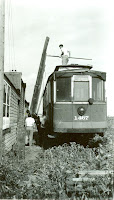
Sunday, Aug. 10, 1958: the very beginning of construction. CSL 1467 was the first car acquired, and here it is being used as a platform by Bob Gibson to help raise the first pole of Bill McGregor's new barn into place, using only muscle power.

Jan. 1, 1959: unloading rattan seats from the dump truck into the 1374, the second car acquired.
In the first few years, work concentrated on acquiring new pieces and then building a barn to house them. The second piece was the “Matchbox,” the 1374; the third piece was the 2846, then the 2843 and the West Towns car, the 141; then the PCC (4391), the 3142 and the F-305; and finally the trolley bus, 84. ERHS actually owned more cars than were at Downers Grove; the other two cars they owned were the 9020 and the X-4. These both eventually came to Union also.

Saturday, Dec. 6, 1958: The 2846 (renumbered as AA-98 when it was in salt service) has arrived at the farm on a trailer.

A week later, the body is off the trailer, and ramps are in place to unload the trucks and move them under the body. Behind the 2846 is the Matchbox. Note how poles are going up at the rate of about two per month.
 A time sheet recording some of the people who helped load the cars at 77th & Vincennes. Among the names on the list are Nick Kallas, Bill McGregor, Bob Gibson, Bob Selle and Charlie King.
Most of the equipment was purchased with money that Glenn Andersen loaned the group. ERHS would then publish monographs and sell them to railfans and libraries. There were a lot of libraries that had standing orders for all the ERHS publications. The money that was raised by selling books was used to repay the loans from Glenn.
The barn was built to a unique design by Bill McGregor. He planned it out by drawing sketches of the barn on the sides of the cars with soapstone, then supervised the construction. The building was entirely supported by a grid of telephone poles, many of which had become surplus during construction of the nearby interstate. The poles and then the roof trusses were raised into place by block and tackle, using a combination of muscle power and members’ autos to raise them. This was still a working farm, and the streetcar barn was hidden from view behind the farm’s barn, machine shed, chicken coops, and so on. Wiring for the lights was run on crossarms still attached to the poles, through the barn. Most of the work was done with muscle power. The work force in the 1958-1964 period was basically Bill McGregor, Bob Gibson, Glenn Andersen, Bob Selle (until 1960), Nick Kallas, Bill Richmond, and Charlie King.

April 28, 1960: The F-305 was one of the last cars to arrive at the ERHS site. Two years later, the framing of the barn is complete, but no roof or siding yet. The F-305 was unloaded by Bill, Bob Gibson, Nick, and Charlie.

Later that day, a wider view of the ERHS barn. The corn crib is to the left and the farm barn to the right.
While IRM was amassing a collection in North Chicago, stored outside, ERHS actually built a building over all of the cars. It was completed about 1963, almost ten years before the first carbarn was built at Union. It was quite a feat for very few people. ERHS was a very small organization; there were only enough members to satisfy the Illinois Not-For-Profit Act, namely five. Each year they had to submit paperwork to the state, and because there were no formal meetings, the president and vice-president were just chosen at random for one-year terms.
 Two years later (Oct. '62) the roof is in place and the siding is being finished. Bill scrounged up the materials for the barn from a number of sources.
Because it always was an informal organization, there was no need for formal meetings. They would gather in Gibson’s basement on Wednesday nights and fill book orders. Glenn would pick up the mail and bring it to Gibson’s, and they would fill orders and answer questions. So Wednesday night at Gibson’s was the ERHS “money night,” and then Saturdays and Sundays were the work times out at the farm. ERHS made no attempt to publicize its collection and tried to keep its location a secret. And in this they were very successful. (I was growing up in Downers Grove about five miles away at that time and never heard about it. - RH)
 The X-4 was the last piece of equipment to arrive at ERHS, and because the barn was not planned for it, it sat outside. This side of the barn looks much more professional than the end seen above. It just depended on what was available.
ERHS eventually published 49 monographs. A lot of them were reprints of Brill bulletins; some of them were reprints of other publications, but there were a lot of originals, mostly by Jim Buckley, a devoted and hard-working historian. Some of these are still available in the IRM bookstore. Bob Gibson’s intention was to eventually raise enough money to buy a warehouse of some sort in the city and have all the cars on display there, with pictures on the walls, lights on in the cars, and have school groups visiting this museum of Chicago transit. This never happened, but the book publishing went on, as did some work on the equipment.
This continued through the sixties, until it was necessary to move the collection. Lena Gnas had died, and her son Bud was running the farm, and was also a successful water-well driller. Along came the Texas oil boom, and drilling oil wells is basically the same as drilling water wells, so he decided to move down to Arkansas and went into the oil and gas well drilling business. He seems to have been quite successful at it down there. Meanwhile Bill was living in Illinois and he would watch the farm, until Bud decided to sell the property in Downers Grove to a developer for a substantial sum.

 Little restoration work was done at ERHS. These pictures are somewhat distressing; they show Bill McGregor looking at the inside of the still-complete 1467, and starting to disassemble the car by removing the tongue-and-groove siding. He single-handedly reduced the car to a skeleton, which is now on display in Barn 8.
So ERHS had to move, and a decision had to be taken on what to do with the collection. That created a big schism between the five members. When the crisis came Bill McGregor happened to be the president of the organization, and Bob Gibson was vice president. At the first formal meeting, the members voted three to two to give the collection to IRM at Union. Voting in favor were Bill and Glenn, who were still IRM members, and Nick. Bob Gibson had left IRM and wanted to move the collection west to some similar location farther out and build a new barn. Jim Buckley preferred to concentrate on the book operation; he wanted to sell the collection to the highest bidder and put the money into the publishing business.
 The meeting notice which was sent to Nick Kallas and signed by Bill McGregor, who was president of ERHS at the time.
So at the first meeting, Bill, Glenn, and Nick voted to give the collection to IRM. ERHS had about $12,000 in the treasury, so they would pay all the expenses of moving the cars to Union and any money left over then was split up evenly amongst all of the cars, into their car funds. And the only thing the Illinois Railway Museum had to do was to accept the ERHS members as Members. That was contrary to IRM’s bylaws, so at a special meeting they voted to make the ERHS members, upon the payment of dues, regular members at IRM without having to go through the probationary period. Bill and Glenn were already members, and Bob Gibson and Jim Buckley were opposed to the merger, so Nick was the only person who joined in this way.

 These are the minutes to the meeting that decided the fate of the ERHS collection. (Evidently there were no formal minutes for the second meeting, described below.)
Bob Gibson was furious at this decision, so not long after the first meeting he called another meeting in his garage. He was so mad he wouldn’t let the others into his house. Obviously it wasn’t a legal meeting – the vice president doesn’t call a meeting, the board calls a meeting. Bill was the president and so was supposed to be chairing the meeting, but he was hard of hearing, tended to mumble, and was often in a world of his own. So Gibson essentially ran the meeting himself. He had invited two friends of his to attend, and first he said “We’re now going to take nominations for new members to ERHS.” Glenn objected that the whole procedure was not legal, but Bill was still talking, and so although the vote tied at two to two Gibson declared these two friends of his elected as new members. And then Bob Gibson made a motion to throw out McGregor, Andersen, and Kallas, and the new majority of four voted to throw them out of the organization! All along Glenn was objecting to the procedures, and Bill was mumbling. As Nick says: “It was a stitch.”

So the three IRM members left and proceeded to move the cars to Union. This was possible because the farm still belonged to Bud Gnas, Bill McGregor’s old friend. The new ERHS brought suit against them in DuPage County court to cease and desist, but the suit did not succeed, and the equipment transfer took place. They took it to court again to appeal, but by the time it came up in court, the move had been completed.
After the cars had been moved and the land sold, all structures on the farm were demolished. (Bill’s barn turned out to be more indestructible than it looked!) The property was then redeveloped, and there is no trace of ERHS at the Plainfield Road location today.
After that, ERHS was allowed to continue on as an organization. IRM got the cars and the cash, and the remaining members of ERHS got the rights to the name and the inventory of books and the books in process. And so Gibson and Buckley took over ERHS as an organization, but they never did publish anything after that. So all they did basically was sell down the inventory, and Gibson wound down the affairs of the organization. After his death, the remaining books came to IRM and are in the Used Book Store.
Bob Gibson died in 1999 of a sudden heart attack, the same day the 3142 was operated for the first time after its restoration. Charlie says that later on, after all that had happened, he was pleased to see our dreams for the cars finally come true.
The major legacies of ERHS are of course the series of books which are still highly regarded, and the equipment, all of which is now preserved at Union. Cars 1374, 3142, and 4391 are in regular operation, and the others are on display. West Towns car 141 has been restored and is operational, and trolley bus 84 is being restored. The ERHS cars form a core component of IRM’s electric streetcar collection.
Finally, Charlie King says: “The story had a happy ending. All the stuff found a good home at Union. It continues to educate the younger people about the Chicago Surface Lines as well as delighting us older folks who fondly remember the cars and riding on them all over Chicago in our youth. Also, a wealth of information was saved and recorded for all time in the bulletins. Every one who had a hand in ERHS can be proud of what was accomplished. I know I am. It will be a source of joy the rest of my days.”
APPENDIX A
ACQUISITION OF INDIVIDUAL CARS

 Correspondence from 1958 between ERHS and the CTA outlining a purchase agreement to buy several cars now in the IRM collection: the Matchbox, both of the "green cars" (2843 and 2846) and snow plow F305. Note that ERHS mixed and matched trucks on the Matchbox, presumably to obtain the best set available, and also that they acquired GE 800 motors for the mail car, which they never owned.
CSL 84 (Trolley Bus)
Charlie King: This bus was acquired in the summer of 1962. Glenn (Andersen) mentioned that the last of the old cracker-box type TBs was at 77th and going to be scrapped. I immendiately wanted to save it even though Glenn thought it was junk and too far gone. It was a basket case to a degree, but it was complete as far as motors, control, and compressor. It was unusual for a trolley bus to still have the “guts”; work busses were normally motorless and towed from site to site. They must have been in a hurry and no time to take the stuff out. I went to the Merchandise Mart where the CTA offices were, and our dear friend and helper Mrs. Benson sold me the BL (“bus locker”) #1306 for $100. It cost me another $100 to get it towed to Downers.

The interior of CSL 84 at Downers Grove.
CSL 4391
Glenn Andersen (via Roy Benedict): The 4391 was one of the last of the 600 Green Hornets (postwar PCC streetcars) to be sold. A few had been wrecked in streetcar service, one had gone to Pullman and one to St. Louis for examination whether the bodies could be reworked as rapid transit cars, 570 had been shipped to St. Louis Car Company for salvage of components to be used with entirely new body shells as rapid transit cars, and that left twenty-some of the Green Hornets stored at the South Shops.
CTA offered for sale a group of 18 cars believed to be in operating condition and two cars not in operating condition, and invited bids on all or part of these 20 cars. For the price which a buyer offered, the shop would load the car on a railroad flat car and secure it ready for shipment via the track connection to the Belt Railway of Chicago.
The ERHS wanted to purchase one, and Glenn could assess which one would be the most promising. First he looked at the maintenance record, and that ruled out about half of the 18 cars as good candidates. Then he went under each of the other cars where they stood "on the flat" (not over inspection pits) in the yard at the South Shops, dropped the equipment covers and checked to see that all the components were intact and in good condition. His inspection ruled out some more cars, such as if an electrical fire had burned out any of the equipment compartments. The result: the 4391 was the best available car.
ERHS did not have railroad access, but preferred shipment by truck as had been done with the cars already at Downer’s Grove. ERHS used Helders, which was a heavy machinery trucking service on 26th Street. They didn't normally handle rail cars but could do it with assistance from Willie McGregor of ERHS, a practical man who could determine how to lift, load and secure streetcars, even by use of jacks without any cranes if necessary. Therefore there would be no need for the shops to load a car for ERHS. Glenn found out how many man-hours it took when the shops loaded one, so they could judge the basis by which an ERHS bid for a car on its own wheels would be compared with anyone else's bid for a car aboard a flat car.
When bids were submitted, the two high bids were ERHS's bid for car 4391, and a bid by a dealer for all the cars (which of course included 4391). The dealer hoped to resell the 18 operable cars for operation in Mexico City. His bid was higher (after adjustment for loading the car) by ONE DOLLAR per car! Glenn went in to see Miss Benson, who received the bids on behalf of CTA. She couldn't do anything for him. The dealer's bid was higher, even though by only a dollar, and the rules of the game were that the high bidder wins. But she told Glenn who the winner was and suggested that he contact the winner.
Glenn phoned the dealer and had a good conversation with him. Glenn cautioned him that the Chicago cars were probably too large to fit the clearances in Mexico City, which the man apparently hadn't considered. The dealer said he would get back to Glenn if the Mexico City deal didn't work out. After six months Glenn called the dealer again. It turned out he was right about the size of the cars, which didn't hurt his standing with the dealer! But the fellow had another idea for sale, this time components. Again he said he would get back to Glenn if he didn't make the sale.
Another six months, and the cars still were clearly visible to any passerby along 79th Street. Glenn dropped into Miss Benson's office. She said that CTA was about to remind the dealer to get his cars off the property. But before Glenn could reach the dealer, the dealer phoned Glenn. He did indeed need the whole 20 cars for components to be resold to a customer of his in Belgium. But the rest of the car didn't matter for that purpose; he was going to scrap them (which eventually was done at 67th and Cicero by Merchants Steel & Supply Co.). So he proposed a trade to Glenn: If ERHS could buy another wrecked car, it could be an even-steven trade. ERHS could have the 4391, and Belgium could have the components from that 21st car. It turned out to be another St. Louis-built car, maybe 7118.
Back to Miss Benson. There's another car that was never on the bid list. Can we buy it? She said she'd talk to Graybiel: "I'm sure he'll let you have it for the price of the others, less the loading cost."
So the deal was made. Bob Selle at ERHS very much wanted the car and did some quick and ambitious fund-raising. Glenn paid a little more than half of the price out-of-pocket as a contribution to ERHS. The ERHS treasury paid approximately the shipping cost. Willie McGregor got the carbody onto a Helders trailer.
One reason why the 4391 (or some others) was a good selection was a byproduct of its assignment over the few years of its life. It was a pure two-man car; hadn't been retrofitted for part- or full-time one-man operation as some had. Much of the time it had been assigned to 69th station, which supplied half of the cars for the 49-Western line. That was a long line, but didn't have the extremely heavy loads for much of the day and night the way Clark Street did. Moreover, Western Avenue at that time was operated on weekends with one-man buses, and 69th had plenty of indoor storage space. Even after Western was all one-man in 1955, the 4391 was over at 77th station because it could no longer be used on Western, so again it was indoors all weekend. Therefore it was a fairly low-mileage car and had been well protected from weather. Had it been at Devon with more than half outdoor storage, it might not have been so desirable.
Like all of the Green Hornets, the car had been delivered in Mercury (or Colorado spruce) green with a swamp holly orange belt. Like some others, this one had been brush-painted at South Shops in the new, darker Everglade green covering the Mercury and the orange on the lower sides, belt and the band through the standee windows. But because the Croydon cream top was in fairly good condition, it came to ERHS still with the original paint up there. It also had mostly the original leather seat covers, all but a few that had been replaced with vinyl because they had gotten cut or something. Bob Gibson and McGregor went out to South Shops and swapped out the vinyl seat backs and bottom cushions into other cars, getting enough leather ones for a full car set for 4391.
CSL 7001
(Note: This was a one-of-a-kind experimental streetcar built by Brill in 1934. It was not preserved.) Charlie King: In the summer of 1959, Bob Gibson and I went to 77th and sat in the 7001 and debated getting it. It was complete except for motors and seats. It had a controller, original trucks, CSL logo, and was still in “Blue Goose” colors. The handle and key were even there and I cranked up the controller. It was a drum type in a cabinet like Milwaukee #972. We decided not to get it, as it was not complete. We agonized for an hour or so. Bob said, “Well, Charlie, what do you think?” The ‘incomplete’ was the final judgment. So we got the F305 (a CSL snow sweeper) instead. Later, of course, we got the 4001 which was far less complete than the 7001.
APPENDIX B
MOVING THE ERHS COLLECTION TO UNION
by Dennis Storzek
When the ERHS voted to give their collection to Union, IRM's "body snatchers" went into high gear. Obviously Glenn, Nick, McGregor, and the IRM Board of Directors had been aware of what was going on for some time, but when the news was announced to the active IRM membership, it was presented as… "They gave us the cars, but there is a lot of sour grapes, and some of the ERHS members are going to court. We need to move these cars NOW, because if they get an injunction, the developer will likely scrap or burn them to get them out of his way."
The decision was made to truck the cars to the museum and unload them in two separate locations; one with access to the back of Barn 4, and the other on what was the proposed alignment of the lead to future higher number barns (this plan was subsequently changed, and that track alignment was never used). In retrospect it was not the wisest decision, but hindsight is always 20-20.
Dave Shore and I were put on the payroll to move the cars; Dave to provide the brains… me the brawn. Nick just borrowed a bit more time than usual from his day job to make arrangements and negotiate the oversize load permits, and McGregor was present for his expertise and as a source of never ending irritation for Shore. Red Top trucking of Hammond was hired for the trucking; they had a low level deck telescoping trailer that we had used before, it had air bag suspension and three axles at the rear of the trailer.
The order of loading was worked out to move the most significant pieces first, constrained only by the order which the cars stood on the tracks at the farm; we only had access to one end of the building, and there was no track to switch things around; the only track at the farm was what was under the cars. An appeal went out, and about a dozen members gathered at the farm on a week night to build a ramp in front of the PCC. The next morning the truck showed up, and we were off and running.
Nick had not been able to get the route he wanted, which would have made use of a county road; the county engineer hadn't signed off on it, and we were stuck using all state routes. I don't think a longer route could have been found. We went from Downers Grove to Union by way of DeKalb, first making a stop on highway 31 in front of the R.E.L.I.C. museum in South Elgin. The drive alone must have taken five hours.
The next morning we didn't get one truck length off the museum service road before we were royally stuck, it was late spring, and the new gravel that had been spread for access was not up to the task. We spent about a half a day with a wrecker to fight the trailer into position at the unloading ramp. It never did get any better; we just learned to call the wrecker, or a Cat, or both in advance to meet us at our ETA. At least subsequent moves went via Virginia Road in Crystal Lake, and our transit time fell to about two hours.
When we hit our stride, we were moving two cars every three days. Nick was organizing work parties as needed to move the ramp from track to track at the farm. When the court date arrived and the judge asked where the cars were presently, the attorney was able to state that they were all secure at IRM, which is where the judge ordered they should stay until the legalities were sorted out.


 Here is a closer view of Stan inspecting a motor. His right hand is pointing at the commutator and one of the brush holders. His feet are resting on the motor case; to the right of his shoe is the gear case, and below it, one of the axle caps. This is so much easier than on the interurban cars.
 After the 3142 was done, I did most of the lubrication on the 309 over in Barn 8. I also did some more interior work on the 277, as seen here. (L)
 In other news, Tim Peters was painting the letterboards on the 1268, and they look great.


