Monday, October 24, 2016

A Visit to St. Louis

David writes....


Back at the end of July, Katy, Alexandria, and I headed east to visit our families. We spent several days in Kentucky visiting my family, and then headed to Missouri to visit Katy's family. I was able to sneak away on a very hot and humid day and drive up to St. Louis to visit my friends at the Museum of Transportation. 
 

The main goal of my visit was to see St. Louis Public Service #1743 in operation. I had helped with the restoration work on this car before we moved and was excited to see the finished product. When we moved to Utah in 2013,out of the cosmetic work was complete on the car. The majority of the work over since then focused on the car's control system. MUNI, the car's second owner, had stripped a lot of the underbody equipment. 
 

IRM's own Richard Schauer consulted with the MOT volunteers and provided expert guidance. 
 

Needless to say, the car looks exceptional. I recommend a visit to MOT if you are in the area. 


Two steps forward

Frank writes...

Maybe that title should be "2-1/4 steps, a pilot, and part of a truss rod forward." Sunday I changed up my normal schedule so as to arrive early at IRM, so I brought the 36 and 319 over to the inspection pit lead around 11am to start needle-chipping. The first order of business was step wells, of which I ended up getting two and a quarter chipped. Shown above, one side of one sidewall of one step well on the 319 had never been done for some reason, so that was completed.

And then it was on to the 36, which has had very little work done so far on repainting its underbody equipment. I managed to do both step wells on the south (L) side of the car. Shown above is a before-and-after. It doesn't look much better quite yet, but with some primer and black paint it will look as good as new.
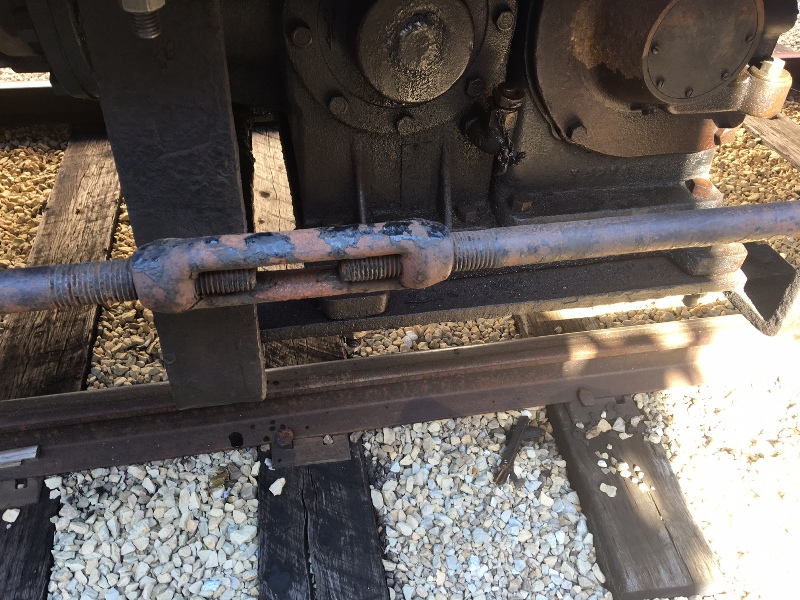
And then there was the truss rod on the L side of the 36, which I'd chipped for only about half its length at some point. This is the "before" view of the turnbuckle, which is a different style than the hexagonal cross-section ones used on the other cars. In the background is the car's trusty D3-EG air compressor.

And finally, I did the pilot at the #1 end of the car before I started to run low on daylight and had to put the cars back in the barn. Again, the before-and-after isn't tremendously illuminating, but it will look good once it's in black. I also did the MU sockets at this end. The feed valve on the 36 started acting up when putting the cars away, so it will probably need a cleaning, but it's nothing we can't handle.
So what else was happening? Well, here's something exciting. Thomas Slater, who volunteers with the "modern 'L' car" contingent, has designed and brought out a 3D printed prototype for a replacement handle for new-style ball-valve cut-out cocks. Our cars have tons of these cut-outs built with tapered valve bodies, so when they start leaking they're almost impossible to get lapped again. We've had to replace a couple with modern valves (like the one on the left in the above photo). The biggest problem with those is that the handles are these ugly sheet-metal things. So Thomas has designed a handle that looks like the old cast ones but will mate with the modern valve bodies. A plastic prototype is in the middle of the photo. To the right is a reverse key he designed using the same process, but this was 3D printed in brass (!) instead of plastic. The plan is to build a fabricate a few cut-out cock handles in brass to replace the sheet metal ones on our cars. The wonders of modern technology!
And say, what's that big silver loaf of bread-looking thing over in Yard 3? Why, it's the museum's newest acquisition, Western Pacific 801, better known as the "Silver Beaver." No snide remarks, now. This baggage car was built in 1948 for the California Zephyr as part of the WP's contribution to that train. I think it's the first piece of WP equipment at IRM though I could be mistaken on that. Anyway, this car was acquired in place of the scrapped "Olympus," a baggage car commonly assigned to our own Nebraska Zephyr, and just recently arrived in Union. Once it gets fixed up it may make the occasional appearance between the E5 and the "Minerva" but we'll have to see.

In other news, Norm Krentel and some guy from Ohio were doing more metal work on the Michigan Electric car, while the regular "L" car contingent was working on some trouble-shooting on the spam cans. I even got to ride along on a test trip and gawk at a current meter hooked up to the motors which showed how much current was being pulled at any given time. Interesting stuff!

Sunday, October 23, 2016

The Aurora Trailer


Aurora, Colorado has on display in its nice new History Museum a streetcar trailer from Denver Tramways.   The car was built in 1913 by Woeber, a Denver carbuilder that seems to have supplied equipment only to local Colorado roads.  This car was in use until 1932, and then stored until 1950, when it was purchased by a doctor in Aurora who built it into his new house for use as a bedroom.   By the time the body was acquired by the museum, it was in wretched shape, with doors and passageways cut into the sides.  It was restored in three years by a group of sixteen local volunteers, to the condition seen here.  And it even has its own picture window in the building. 


The restoration job was very thorough.  All of the interior seats were rebuilt, as many as they had remaining frames for.   Part of the front of the car has no seats, but most of it is complete.


A few pictures of the underframe follow.   The museum tour guide said that the trucks under the car came from somewhere in the state of Washington, but couldn't be more specific.  In any case, this car is certainly the local museum's centerpiece.


Saturday, October 22, 2016

Colorado Narrow Gauge

Idaho Springs is a small town in the Clear Creek gorge on the way from Denver to Winter Park.  Behind the city hall is a nicely preserved narrow gauge train from the Colorado and Southern, with a locomotive and one coach.  The signage is well written and informative.   


The seats are covered with rattan painted red.  That seems rather dubious.


Parts of the ceiling light fixtures, probably Pintsch, are still in place, though not complete.


I found myself wondering if the climate in Colorado is less harsh on preserved equipment than it is in Illinois for some reason.  They probably get less rain.

Friday, October 21, 2016

Division of Labor


Frank and I don't always agree on everything, you may be surprised to hear.  He doesn't like to do wire-wheeling, and I really dislike needle chipping.  But that's good.  When it comes to underbody prep, such as on the 319, he does the needle chipping and I do the wire-wheeling.  It's called division of labor.  The job gets done and, just as Adam Smith predicted, everybody is happy.

Frank recently finished most of the needle chipping on the north side of the 319, seen here from the south, so I pulled the car outside today to wire-wheel all those surfaces and give them a first coat of primer.


 If the car's outside there's better light, and I'm not depositing grit inside the barn.


I was going to trace the stencil for this ominous date, 5-57, but it'll have to be next time.


It would be hard to see the difference between before and after.   But this truss rod is ready for primer.   Behind it is the cover for the field tap control.   I'm thinking several of these covers, such as for the reverser, the motor cutout, and maybe even the contactor box can be taken to the shop and done there over the winter.


After painting, it looks like this.  Ready for gloss black.

Meanwhile, in our favorite urban improvement project, the B&G department are making real progress on the paver blocks going into this one section of the street scene.


Later in the day, I found Dave himself doing the work, helped by Andy Choutka.  Dave explained the complications involved in trying to recreate a lost art.   He's carefully looked at pictures and read books, and one of the best sources was Frank Sirinek, who remembered watching men install these blocks in Chicago about 1942.  It takes careful alignment, and just watching him started to make my back hurt.  But Dave wants to make sure the end result lasts a long time, so he's taking great care to get everything right.


Among other things, Tim is working on recreating the correct period third-rail beams for the 24, using photographs as a guide, since none from this era have survived.  The one shown here is incomplete.  There's more to come, such as the spring-loaded sleet scraper.


 And it was back to work in the vestibule of the 36.   This window sill, for instance, had very badly cracking paint, so it's down to Pullman Green or bare wood, whichever comes first.


And several parts of the vestibule pocket door have the same problem, so it's being carefully stripped with a heat gun.  It takes a while, but I'll have all winter.   When I'm not on vacation.  


There weren't that many people out today, but nearly every one I talked to commented or complained that there were so few blog posts while I was away in Colorado.   It's like withdrawal symptoms.  If that's happening to you, maybe it's time to see a doctor.  Or you can always try the over-the-counter medicine that comes in 1.75L bottles.  Tell them Dr. Hicks sent you.