Freeport Railway & Light
by Stephen M. Scalzo
Ed. note: For those not familiar with Freeport, IL, it is a city in northwest Illinois located about 30 miles west of Rockford. In 1910 its population was 17,600 people and it was the westernmost terminus of an interurban railway network that stretched, virtually unbroken but in a roundabout manner, 750 miles to the east to Little Falls, NY.
Headline image: A 1903 St. Louis-built single-trucker is headed east on Stephenson Street in Freeport, probably sometime in the 1900s or 1910s. All photos from the Stephen Scalzo Collection of the Illinois Railway Museum except where noted.
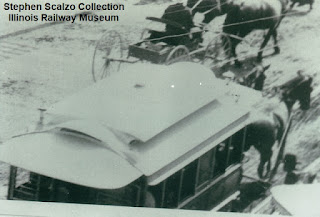
The Freeport Street Railway Company was organized on October 10, 1886 with $45,000 of capital. Shortly thereafter, four miles of horsecar trackage was constructed and service began on two lines on November 29, 1886 with eight horsecars and 48 horses. One line operated on Carroll, Williams, Chicago, Oak, and North Galena, and the second line operated on Stephenson and Taylor.
It's not a great photo, but it's the only available picture showing a Freeport horsecar in operation.
In 1892, the company was sold to local concerns, and on April 26, 1894, the R.S. Brown eastern syndicate purchased the company and the electric light company to form the Freeport Electric Company (FEC). C.E. Loss of Chicago was hired to convert the horsecars lines to electric operations, and construction began in August. Six miles of single trackage with turnouts was constructed; six electric streetcars, two 90 kW generators, and a 220 HP engine were ordered. The first electric car began operating 15 minute service on November 29, 1894. On December 1, the Freeport Electric Light & Power Company was purchased and consolidated with the FEC into the Freeport General Electric Company, which was incorporated on May 3, 1895.
Brill-built car 5, shown here likely around 1894 or 1895, was one of Freeport's first six electric streetcars.
The original Brill cars were supplemented in 1896 by four open cars built by Wells & French. These were delivered sans running gear, and in the summer four of the Brill closed cars had their running gear transferred to the open cars. The open cars were numbered 7-10 but were renumbered 21-24 in 1903. This photo dates to the 1903-1910 era.
The 1893 Depression took its toll on the city, and the Freeport Gas & Electric Company took over the operations on April 22, 1895. By 1897, the company had six miles of trackage, over which operated 10 streetcars and six trailers. However, the new company could not stem the tide of red ink, and on March 13, 1899, W.O. Johnson was appointed receiver.
Brill car 3 is shown in 1895 in front of the car house on Liberty Avenue. Early in the following decade this building was expanded and roughly doubled in size.
Downtown Freeport is shown, likely midway through the first decade of the century, with a 1903 St. Louis-built car headed east on Stephenson. Automobiles are nowhere to be seen.
The Freeport Railway Light & Power Company (FRL&P) was organized on January 12, 1903 by the Goddard family to acquire the property. After receiving a 20-year franchise, the new company built a loop track into the east and south section of Freeport, and by 1905 had 7.5 miles of trackage and 17 streetcars. There were numerous battles with steam railroads over grade crossings on the streetcar line that had steep grades. In July of 1905, the power plant was partially destroyed by fire, and power for the overhead was temporarily purchased from the Rockford & Interurban Railway until the plant was rebuilt. In 1907, the company received a 30-year franchise.
It's September 8, 1910, and President Theodore Roosevelt is in town to speak at a Brotherhood of Railway Trainmen picnic. Open car 9 (soon to be renumbered 23) is hauling a trailer, probably one of the cars bought in 1901 from Chicago Union Traction. This is taken looking east on Stephenson at Liberty; the building on the left still stands.
Car 8, shown in this regrettably distorted wintertime photo from sometime before 1910, was one of two built in 1903 by St. Louis
Earnings rose from $48,000 in 1903 to nearly $94,000 in 1909. The FRL&P and the Stephenson County Lighting & Power Company were merged into the Freeport Railway & Light Company (FR&L), which was organized on October 20, 1910. Four new single-truck streetcars were ordered and placed into service in 1911. By the beginning of 1912, Freeport was a thriving city with a population of 20,000. About 10 miles of lines were operated with 20 streetcars, and the company also operated the Highland Amusement Park.
Between 1903 and 1911, cars 7 and 8 were the most modern streetcars in Freeport and were frequently photographed. Here, one is shown on bustling Stephenson Street wearing a dash-mounted ad thoughtfully cut out around the headlight.
Four new turtleback-roof single-truck cars were ordered from Danville in 1911. Between these cars and a handful of similar cars subsequently ordered from McGuire-Cummings, the old 1895 Brill cars could be retired. Car 11, shown here, burned around 1914.
However, with the death of A.P. Goddard, the company was sold to Samuel Insull on August 7, 1912. In September, the company removed the several controversial steam railroad crossings after abandoning trackage on a portion of the southeast loop line. In May of 1915, a one-mile extension was built to the southwest part of the city, and in June an extension of the Galena Street line was built.
Open car 24, which began life in 1896 as car 10, appears to have come to grief over an under-construction sewer. This car was retired sometime prior to World War I.
Only two double-truck cars ever ran on the Freeport streetcar system, both 1904 St. Louis-built cars purchased secondhand from the Sterling Dixon & Eastern. One is shown here on an undated Fourth of July sometime after 1914.
In the spring of 1916, an application was made to the State Public Utilities Commission (PUC) for permission to merge the Tri-County Light & Power Company of Aledo and the FR&L with the Illinois Norther Utilities Company (INU) of Dixon. Permission was granted, and on August 1, the FR&L became a subsidiary of INU. Increased use of automobiles and concrete highways began to draw away passengers, forcing the company to institute numerous changes so that the streetcars could continue operating at a profit.
Birney car 25 was one of three identical cars purchased from Cincinnati in 1919.
Car 12, one of the 1911 Danville-built cars, is shown at an unknown location and date. Note that it has been converted for one-man operation and lacks rear steps. This car remained in use until the end of streetcar service in Freeport in 1933.
In February of 1919, the company applied to the PUC for increasing streetcar fares from five to seven cents. Three new four-wheel Birney streetcars were ordered and placed into service in 1919, and two additional used Birney streetcars were purchased from the abandoned Sterling system in 1925. However, between 1920 and 1932, earnings feel from almost $98,000 to a little over $34,000, with ridership dropping from 1,687,864 to 629,585. Outlying lines were converted to bus during 1927. The Depression soon brought operating losses, and the last streetcar operated on October 21, 1933.
This article was edited and laid out by Frank Hicks. Thanks to Ray and Julie Piesciuk and Richard Schauer for making these materials from the Stephen Scalzo Collection available.
Freeport Streetcar Roster
Number | Description | Builder | Truck
Motors | Notes |
1-6 | ST DE DR wood | Brill 1894 (#5942) | Brill 21B | Retired 1912, two cars rebuilt as utility cars c1912 |
7-10 | ST DE DR 9-bench open | Wells & French 1896 |
| Re# 21-24 c1903, retired c1917 |
? | four open trailers |
|
| Bought 1901, ex-CUT |
7-8 | ST DE DR wood | St. Louis 1903 (#425A) | Curtis | Scrapped 1919 |
9 | ST DE TR wood | Danville 1911 (#564) | Taylor | Burned 1919 |
10 | ST DE TR wood | Danville 1911 (#564) | Taylor
2 x GE 70A | Scrapped 1933 |
11 | ST DE TR wood | Danville 1911 (#564) | Taylor
2 x GE 70A | Burned c1914 |
11 (II) | ST DE TR wood/steel | McG-C 1914 | Columbian 2 x GE 247D | Scrapped 1933 |
12 | ST DE TR wood | Danville 1911 (#564) | Taylor 2 x GE 247D | Scrapped 1933 |
14-15 | ST DE TR wood | McG-C 1912 | Columbian 2 x WH 12A | Scrapped 1933 |
16 | ST DE TR wood/steel | McG-C 1916 | Columbian 2 x GE 247D | Scrapped 1933 |
22 | DT DE DR wood | St. Louis 1904 (#418) | 4 x AC 501 | Bought 1914, ex-SD&E 22, scrapped 1933 |
23-25 | ST DE AR Birney | Cincinnati 1919 (#2395) | Cinc. 139 2 x GE 258C | Scrapped 1933 |
25-29 | ST DE DR 9-bench open | St. Louis? |
| Bought second hand c1903, retired c1917 |
27 | DT DE DR wood | St. Louis 1904 (#418) | 4 x GE 70A | Bought 1922, ex-SD&E 23, then SD&E 102, scrapped 1933 |
28-29 | ST DE AR Birney | Cincinnati 1921 (#2480) | Cinc. 139 2 x GE 264 | Bought 1925, ex-SD&E 32-33, scrapped 1933 |
20 | ST DE AR sweeper | McG-C 1912 | 2 x AC 501 | Scrapped 1933 |
Abbreviations:
AR = arch roof
CUT = Chicago Union Traction
DE = double-end
DR = deck roof
DT = double-truck
FGE = Freeport General Electric
GE = General Electric
McG-C = McGuire-Cummings
SD&E = Sterling Dixon & Eastern Railway
ST = single-truck
TR = turtleback roof
WH = Westinghouse
This photo of car 22 was filed in the Scalzo Collection under Sterling Dixon & Eastern, but it was actually taken in Freeport. Car 22 was purchased from the SD&E in 1914 and in this view it's festooned with flags, banners, extraneous light bulbs, and portraits of Thomas Edison for "Light's Golden Jubilee" in 1929.
Route Map
The carbarn used by the first electric cars, shown in earlier in this article, was located on the southeast corner of Liberty and Spring. It is shown in this 1897 Sanborn Fire Insurance map.
By 1904 the barn had roughly doubled in size, as shown in this more highly detailed 1918 Sanborn illustration. A capacity of 14 cars, with a repair shop in the northeast corner, is noted, as is the fact that there are no outside storage tracks. Every streetcar in Freeport had a parking spot indoors.