Monday, March 25, 2013

Park Locomotives

 Here are a couple of Santa Fe locomotives on display in Arizona.

At Kingman, along the main line, is #3759, a 1928 Northern built by Baldwin.  It's an earlier and slightly smaller version of the 2900's such as our 2903.


Of course, the lettering is not quite right.  The tender has a message: "No Dogs Allowed" which I don't remember seeing elsewhere.  The retractable smoke lifter is interesting.  This engine is being very well maintained.


 It was donated to the city in 1956.


And behind it is a modern steel waycar.


In the town of Wickenburg, northwest of Phoenix, is this much older Santa Fe 2-8-0, built by Baldwin in 1900.  It was donated to the town in 1955 and has been on display along the line ever since.


Behind it is a wooden waycar of dubious ancestry.  The trucks have "PM RY" cast into them.  If this is a PM car, it's a long way from home!


Somebody thought these hardware-store light globes would look nice over the platforms.


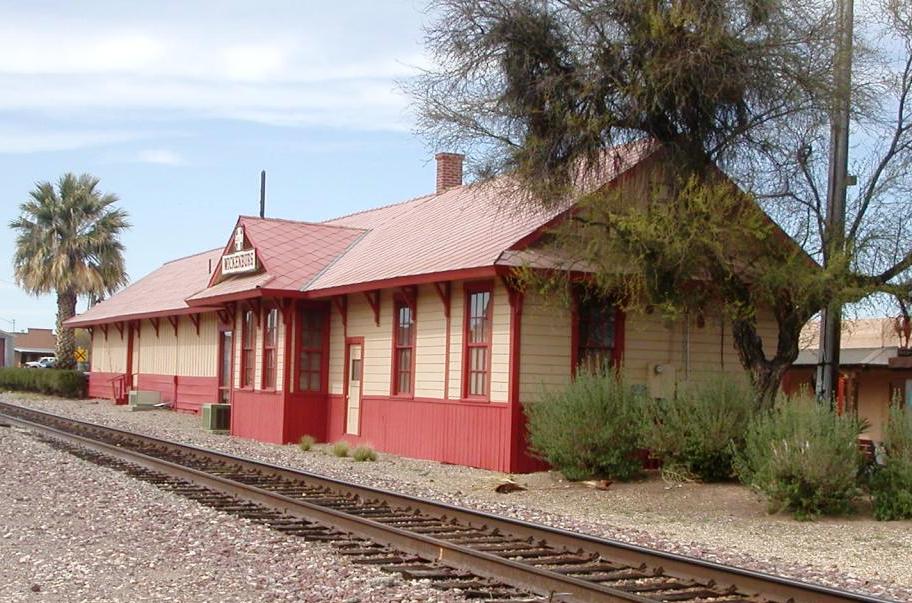
The town depot now serves the Chamber of Commerce and is well maintained.


In this climate the sun takes a toll on paint, but for the most part, things last a lot longer when stored outside.  As a friend put it: "We get 8 inches of rain a year.  But you don't want to be here on the day we get it!"

Sunday, March 24, 2013

Nevada Southern Railway -- Boulder City

Several trip reports from the Southwest will be coming along soon.  I'll start with the Nevada Southern, located in Boulder City, Nev.  This is one of several sites, all part of state-funded Nevada State Railroad Museum.  It operates excursion trains on several miles of what's left of the railroad built in 1931 to enable construction of Hoover Dam.

In Boulder City itself are the static displays, many of which are under a ramada which provides adequate protection in this arid climate.

There are two standard gauge locomotives here.  UP 264 is a Baldwin Consol built in 1907.  It is thus a later model than our #428 but has similar dimensions, such as 57" drivers. The one labeled NS Ry #35 was built for the Pacific Lumber Company; it's a 1923 Baldwin Mike, 48" drivers.  After retirement it passed through a couple of private owners before coming to the museum.  Both are in good condition cosmetically.  There's also a narrow gauge locomotive and other equipment in a fenced-in area down the line which I didn't have time to see.


There are several passenger cars, including an RPO that is open to the public, and this nice wooden waycar from the UP.


And most of the equipment on display has very detailed signs with interesting information.  Several are included here as examples. 


And probably everybody has mailed a letter at some time, so RPO's are always a subject of general interest.


 The most unusual item is this homemade inspection car which seats about six people on the rear platform.  It is used for special trips or when ridership is low.


The museum is a state facility and has several full-time employees, but volunteers do much of the work, including operating the trains.  On the day we were there the entire crew of the passenger train were volunteers.  I spoke with the conductor, Bill Thornhill, who gave us a lot of information and allowed us to visit the shop building (below).


The line does not normally operate on weekdays, but there was a school charter while we were there, so this was the operating train. 


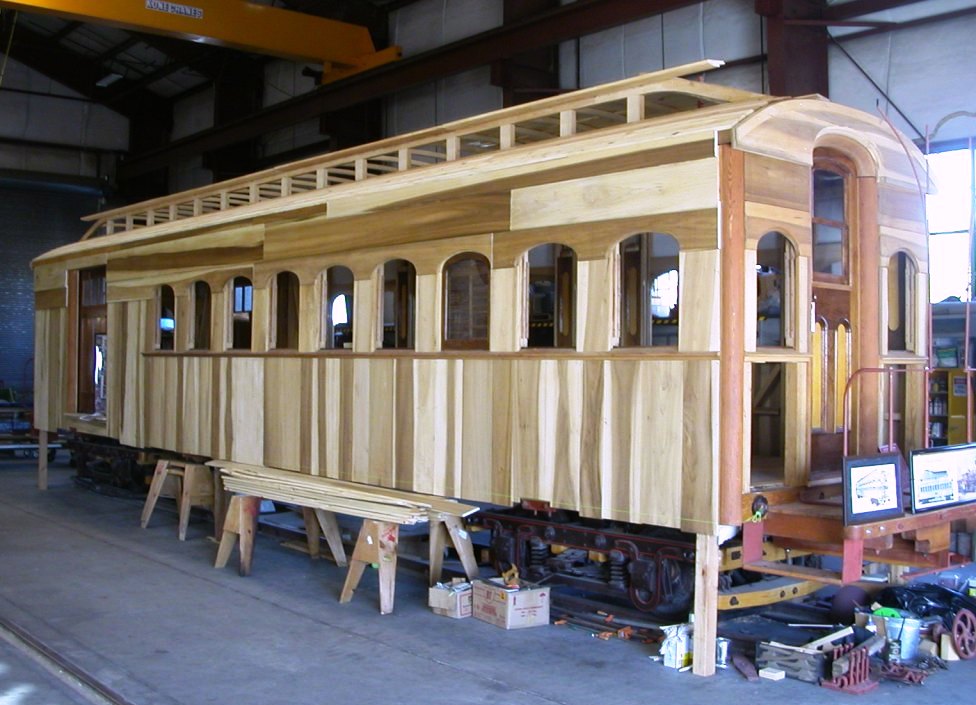
In the main workshop across the street, this replica of a Billmeyer and Small narrow-gauge combine is under construction, and nearing completion. This is being privately funded, as I understand.  The side panels will be finished with batten board strips; this method of construction predates the adoption of vertical tongue and groove siding, which is familiar from later wooden passenger cars.


The wheelsets came from a freight car, but everything else in the trucks was built new.  That in itself is a huge accomplishment!

So Boulder City is certainly a good place to stop if you're on your way to visit Hoover Dam (recommended) or even Vegas (where you're taking a risk, of course....). 

Thursday, March 14, 2013

Time and Tide

 Time and tide wait for no man.  Luckily for me, Barn 8 is slightly above mean high tide so it seldom floods.  But time is ever speeding onward, and the Museum will open for visitors on April 7th, at which time we need to remove our scaffold and all other stuff from the aisle.


So it seems wise to get as much done on the north side of the 36 while we have the chance.  I finished sanding down the middle section and painted the remaining four sectors with white primer.  So all remaining bare wood and traces of green paint are now covered.  Good riddance!


And that was followed by a first coat of Fleet Grey on sectors that were already primed.  It may be difficult to see in this dim religious light, but that's a light grey on the window posts and sills.  Of course, one of these years I'll have to remove and repaint all of the windows. 


Henry Vincent continues to work on the train door, and the outside is nearly done. It's great to have help on a project like this.  Of course, there are lots of other projects going on, and we can always use more help!

Monday, March 11, 2013

757 Progress

 We received some pictures from the North Shore 757 crew, who have been working on the smoker as mentioned earlier.  They were able to make good use of the old veneer clamp I had made for use on the 309 many years ago, and which we are willing to rent out at very reasonable rates.  Joe Stupar writes:

Here are some photos from over the weekend on 757 using the Hicks Car works clamp. We had to add some 2X4s because it was not quite long enough to span the car. We also used the 2X4 to span 3 of the splits in the veneer. One of the later photos shows the clamp moved over to the last remaining one, and the ones that we had repaired sanded smooth.


Sunday, March 10, 2013

Me Worry?


Want news of some of the happenings at IRM?  Be like this "average blog reader" and read the Hicks Car Works Blog.

Saturday, March 9, 2013

Spring Ahead

 The calendar says that winter is almost over, but outside there's plenty of nice heavy snow covering the landscape.  Mike Stauber took the opportunity to build a snowman near the office.  Is that an uncanny resemblance to Frank Sirinek or what?

When the Museum opens for visitors in April, I'll have to move the scaffold off the sidewalk in Barn 8, so I decided I'd better finish what I can on the north side of the 36.  I finished stripping and sanding as much as I could of the green paint, so it will be ready for painting when the weather improves.  


And then I did some more stripping and painting in the #2 end of the 319.  The new red paint can be almost blinding.

In other news, Joe, Gwyn, and Greg were working on the 757 some more; it's now just down the aisle on track 83.  They borrowed the old Hicksco veneer clamp to fix some veneer, so watch for pictures of 757 progress.  And we were visited by a new member who had been helping Roger Kramer all day with Miss Henrietta, so that's good news.  We can always use more help!

While stripping green paint off the outer window sills on the 36, I was once again impressed by how solid they are.  On the 308, 309, and 321 there were all sorts of cracks and checks due to the many years spent outside.  The Brookins cars, however, were put inside a barn almost immediately after acquisition.  As time goes on, anything stored outside gets farther and farther away from being fully restored.  That's why we need to act as soon as possible!   Ummm -- am I, by any chance, repeating myself????

Thursday, March 7, 2013

I've Got a Secret

You have to get up pretty early in the morning to stay ahead of the volunteers at IRM.  Henry Vincent, for instance, continues to make good progress on the train door for the 36, as seen here.  The new wooden parts and the various other pieces have all been painted and appear to be ready for installation.  I marked where the holes need to be drilled for attaching the new kickplate.  This part of the 36 project is progressing quite well.


Most of the time I spent stripping paint,  and then painting other surfaces in the vestibule of the 319.  The metal parts, such as the grab iron and the handle for the Armstrong window wiper seen here, need to be wire-wheeled down to bare metal.  There's now more red, and more white primer, than before.  The nice thing is that it's much easier to heat up these tiny vestibules than the whole main compartment.


But why is it so dark in here if the sun is shining?

I also worked on stripping and starting to repaint the next side door on the 36.  The door has the usual problem of alligatored paint, but the wood is in very good condition, better than the original doors on the 309, for instance.  Probably that's because it was stored inside a barn much sooner after acquisition.  Hmm, maybe there's a lesson there....


In fact, I'll let you in on a secret.  Don't tell anybody except two dozen of your closest friends, and any very rich people you may know.  We're getting close to building a new barn to house more of our historic artifacts, and we need your help.  We wouldn't ask just anybody, but you are special, so we're asking you!

Wednesday, March 6, 2013

CERA Blog

I should mention that the CERA recently started a blog, with announcements on upcoming events and historical articles with pictures.  The home page is here.

One nice feature is that scans of the first 30 CERA Bulletins are available in the archives.  They have some very interesting content.  Enjoy!

Tuesday, March 5, 2013

No Two Snowflake Specials Are Alike

Suffering from cabin fever?  Want to go railfanning, but IRM is closed for another month?  There's a solution!  David Fullarton reminds us that the Snowflake Special is coming up soon -- Sunday, March 24.

He writes: This year's big "selling point" is that we will have an eight-car train, the first on any Snowflake Special since the early 1970s (when the norm was eight 4000s). So there will be plenty of elbow room on the train. Additionally, the train will have four types of DC-propulsion cars in the consist - the 2200, 2400, 2600, and 3200 series, with build dates ranging from 1969 to 1993. As far as we know, this is the only time this has ever been done and with the impending retirement of the 2200- and 2400-series cars, such a consist will be impossible in the near future.

Tickets for the trip will be available from two different terminals: Forest Park on the Blue Line, and Midway Airport on the Orange Line. Forest Park tickets are priced at $55. A four car train of 2200s and 2600s will depart from that terminal at about 8:00am, and travel to Midway, where another four cars (2400s and 3200s) will be added. Tickets for Midway departures are priced at $47. After departing Midway at about 9:15, we will travel throughout the CTA system and travel through the "nooks and crannies" of the "L" not often seen by the traveling public. As usual, we will have narration, photo stops, restroom breaks, as well as time allotted for lunch on the loop. Midway riders will arrive back there at about 6:00pm, and Forest Park riders will arrive back there at about 7:15. Like previous Snowflake Specials run by the museum, proceeds from this trip will be put toward the acquisition of retired "L" cars from the CTA - in this case, one pair each of 2200- and 2400-series cars.


It's best to buy your tickets in advance, so go to the link above and order now!

Friday, March 1, 2013

319 Vestibule

 The first stage of repainting the main compartment of the 319 is essentially done for now.  When it warms up, I'll want to be able to pull the car outside for better lighting.  In the meantime, there's still a lot that can be done in the #2 vestibule.
 
New red paint was applied to several parts of the motorman's cab, as seen here. Red never covers very well, so it will need at least one more coat, but it looks a lot better than it did.

 And then I did some more stripping.  I believe the vertical piece (white arrow) was probably part of the cab door frame and went all the way to the floor.  The wood to the left of it would have been a short partition, perhaps with a narrow window.  When the cab doors were removed, these pieces were just sawed off flush, and a bottom rail added.


Later I did more white primer, including the metal pieces stripped last time.

Henry has continued to make good progress on the 36 train door.  The bottom pieces are now assembled and glued, and it looks great! He also did a nice job of cleaning up the metal kick plate, and was waiting for specs on where the holes go.  So I measured, then drilled and countersank (countersinked?) the holes for the screws.

I'm also working on preparing another side door on the 36 for repainting.  This one I may choose to do in place.