SHAKER HEIGHTS RAPID TRANSIT 18
An Illustrated History
by Frank Hicks
Car 18 is pictured in a Trolleyville postcard after it was repainted, likely during the 1960s. This is the paint job that the car currently wears.
FOREWORD
During the years immediately before and after World War I, the Cleveland Railway Company was at the forefront of street railway car design. While most street railway systems (including Chicago's) were building wooden double-ended Pay As You Enter streetcars whose design hadn't changed much in a decade, the newly-unified Cleveland system was embarking on a program of experimentation and modernization. It was among the earliest adopters of low-floor car design; of arched-roof cars; and of center-door streetcar design. The Peter Witt car design, developed in Cleveland in 1914, turned out to be so successful that it was used in thousands of PCC cars built as late as the 1950s.
One of the major stepping stones on this steady march of modernization was Cleveland's 1100-series and 1200-series center-door cars built in the mid-1910s. Not only were these cars distinctive and immediately identifiable as Cleveland cars, but many of them outlasted the Cleveland street railway itself. This was because the suburban streetcar route to Shaker Heights, barely on the drawing board when the center-door cars were built, bought a handful of 1200-series cars to hold down service when it was new. For years these cars were the backbone of service to Shaker Heights until the last of them were finally retired in favor of PCC cars in 1960.
Car 18 - originally 1218 - is one of these cars. Built in Cleveland by G.C. Kuhlman, it was first leased and later bought by the Shaker Heights line and operated in that service for longer than it ran on the streets of Cleveland. The car was fortunate enough to be saved by Trolleyville U.S.A. in suburban Cleveland and to be well cared for, even after the demise of that organization. At IRM it is unique: it is the only car in the museum's collection that was designed for Cleveland and the only center-door streetcar capable of operating at the museum.
ACKNOWLEDGEMENTS
Thanks go to author James Toman, who reviewed this article and offered corrections and clarifications as well as providing numerous in-service photos of car 18 and other similar cars. Thanks also to Art Peterson, Jim Vaitkunas and Bill Volkmer for providing photos for use with this article.
CLEVELAND RAILWAY DESIGN
This is what car 18 looked like for the first nine years of its life. Car 1190 is shown resplendent in CRC yellow and cream at the East 131st Street loop in 1930. James Spangler photograph from the James Toman collection, posted on Hicks Car Works with permission.
Cleveland Railway Company (CRC) was created in 1910 with the unification of Cleveland Electric Railway (CER) and Municipal Traction to create a single streetcar system. The new system was, from its inception, saddled with an unusually low three-cent fare imposed by the city - significantly lower than the five-cent fare formerly charged by CER. This made it very difficult for the new street railway to make a profit given that a typical streetcar only carried so many passengers and operated using a two-man crew of motorman and conductor. Relatively high traffic levels combined with strong union contracts to prevent the operation of one-man cars, which would have significantly reduced labor costs. So the question remained: how was CRC to decrease its operating costs per passenger?
The solution arrived at was relatively straightforward and yet unusual in the street railway industry. CRC would make two changes to the way it carried passengers. First, it would operate fewer, but larger, streetcars. Rather than operating 40- or 44-foot-long cars like most other cities, Cleveland would build cars over 50 feet long that could carry more passengers for the same number of crewmen. Second, Cleveland would use trailers as a way to cut crew costs. By pulling a trailer behind each motor car on heavily-trafficked routes, CRC could operate fewer trains and cut labor costs by 25% per seat since a trailer only needed one crewman, a conductor.
Under the direction of General Manager John Stanley CRC began building its new fleet of cars in 1912 with the 1000-series, designed by the company's master mechanic, Terrance Scullin. The 1000-series cars were a transition design, with a standard Pay As You Enter (PAYE) door arrangement but featuring steel sides and a high arch roof with a narrow ventilation clerestory down the center that was patented by Scullin. One of the cars was fitted with low-floor type trucks and motors, a successful application which paved the way for the next advancement: center door access.
With the delivery of the 1100-series cars in 1913, the iconic Cleveland center-door car was born. The 1100s were over 50' long, single-ended, with a low-floor profile and an expansive drop section in the middle of the car where the doors were located. This was based on the Hedley-Doyle "Stepless" car that had been developed the year before for New York Railways and was designed to enable quicker and easier low-level boarding. The 1100s had twin sliding doors with the conductor sitting between the doors where he could collect fares. Also located in the center of the car was the coal stove with electric blower that was standard on CRC. Unlike most center-door cars there was no door at the front for the motorman, who sat isolated in a glassed-in cab at the front of the car. The 1100s were fitted with Brill 27FE1 trucks with 24" wheels and their Westinghouse 307F motors were geared for pulling trailers. They seated 55, and when hauling a trailer the two-car train could seat 115 people with only three crew members.

Car 1262, identical to 1218 as built, is shown later in its CRC years with a slightly simplified yellow and cream livery. The short wheelbase trucks that all of the 1200s had originally are apparent. Bruce Young photograph from the James Toman collection, posted on Hicks Car Works with permission.
Cars 1100-1149 were delivered by the G.C. Kuhlman Company, a Brill subsidiary, starting in late 1913 and were quickly followed by 1150-1199 in mid-1914, a single car numbered 1200 soon after, and then 1201-1300 in four separate orders in late 1914. All 200 cars were essentially identical although the 1200s did have an improved door mechanism. Some of the cars also had a lower conductor station than others and some had longitudinal seating while others had a mix of transverse and longitudinal seats. As the most modern and high-capacity cars on CRC, the cars went into service on the system's most heavily-trafficked lines like Euclid and Superior.
However time would prove that the 1100s and 1200s themselves were stepping stones in the development of the streetcar type that would become most closely identified with Cleveland, the Peter Witt (nicknamed for its inventor, the city's traction commissioner, but formally known as the Car Riders Car). In 1915, when car 1218 and its brethren were only a year old, the first production Peter Witt-type car was delivered to CRC. It was essentially a 1200-series car with a set of front doors added for boarding, and with the center doors - previously used for both boarding and alighting - assigned as exit doors. This type of car would, over time, become the industry standard for streetcars and later also for buses. Virtually every city would use them, including Chicago, and with the arrival of the PCC in the mid-1930s cars built with this general arrangement would become the universal industry standard.
SHAKER HEIGHTS SERVICE
An inbound three-car train of 1200-series center-door cars lays over at the Lynnfield Road terminus of the South Moreland Boulevard line around 1923 during the early years of the Shaker Heights operation. The line was extended to Warrensville Center Road in 1930 and in 1950 South Moreland Boulevard was renamed Van Aken Boulevard. Shaker Historical Museum photograph, public domain.
The 1200s saw heavy use in their early years in Cleveland across the city's street railway system, though later they were allocated to lighter lines like Cedar, Clifton and East 79th. As CRC ordered more and more Peter Witt type cars, the 1200s were no longer the premier cars of the fleet. Car 1218 and the other cars of its type were still relatively new, though not necessarily modern, when the Cleveland Interurban Railroad came to CRC looking for rolling stock.
The Cleveland Interurban Railroad (CIRR) was created by the Van Sweringens as part of a real estate venture. The Van Sweringen brothers were an inseparable duo who had purchased large swaths of land in Shaker Heights, southeast of Cleveland, and intended to build a planned community there and profit from land sales. In order to make it possible for people working in Cleveland to live outside of the city, though, a public transit line was needed. The first streetcar line into Shaker Heights began operations in 1913, connecting to a long CRC line along Fairmount Boulevard, but this made for an extremely long and slow commute. So the Van Sweringens acquired a controlling stake in the Nicke Plate Road and allocated a strip of land along that railroad's right-of-way into downtown Cleveland for a direct, express route that CIRR cars bound for Shaker Heights could use to cut the commute time down tremendously.
This private right-of-way for Shaker Heights streetcars, constructed from downtown Cleveland east alongside the Nickel Plate towards Shaker Square with two branches continuing down Shaker Boulevard and South Moreland (later renamed Van Aken) Boulevard, opened as far as East 34th Street in 1920 (the final section from East 34th Street to Cleveland Union Terminal opened in 1930, and in the interim cars ran over city streets into downtown). At the same time the Van Sweringens began to operate CIRR trains on the Shaker Heights line and elected to lease CRC 1200-series cars for its operations. Initially 14 cars in the low 1200-series were leased; in 1922 three more cars were leased and another four joined them in 1923. The ex-CRC center-door fleet eventually totaled 32 cars plus another three acquired for use as trailers. Car 1218 was part of the 1923 group.
Car 1218 was assigned to CIRR and repainted from CRC yellow and cream into the Van Sweringens' carefully-chosen livery of green and yellow with a sunburst on the dash, selected to evoke the green space and sunshine of life in suburban Shaker Heights. It was heavily rebuilt mechanically, its Brill 51E1 trucks replaced with newer long-wheelbase Brill 68E1 trucks and fitted with higher-speed WEstinghouse 340A1 motors. It was equipped for multiple-unit operation and its K-35G controller was replaced with Westinghouse HL control with the contactors placed in a cabinet located just behind the motorman's seat.
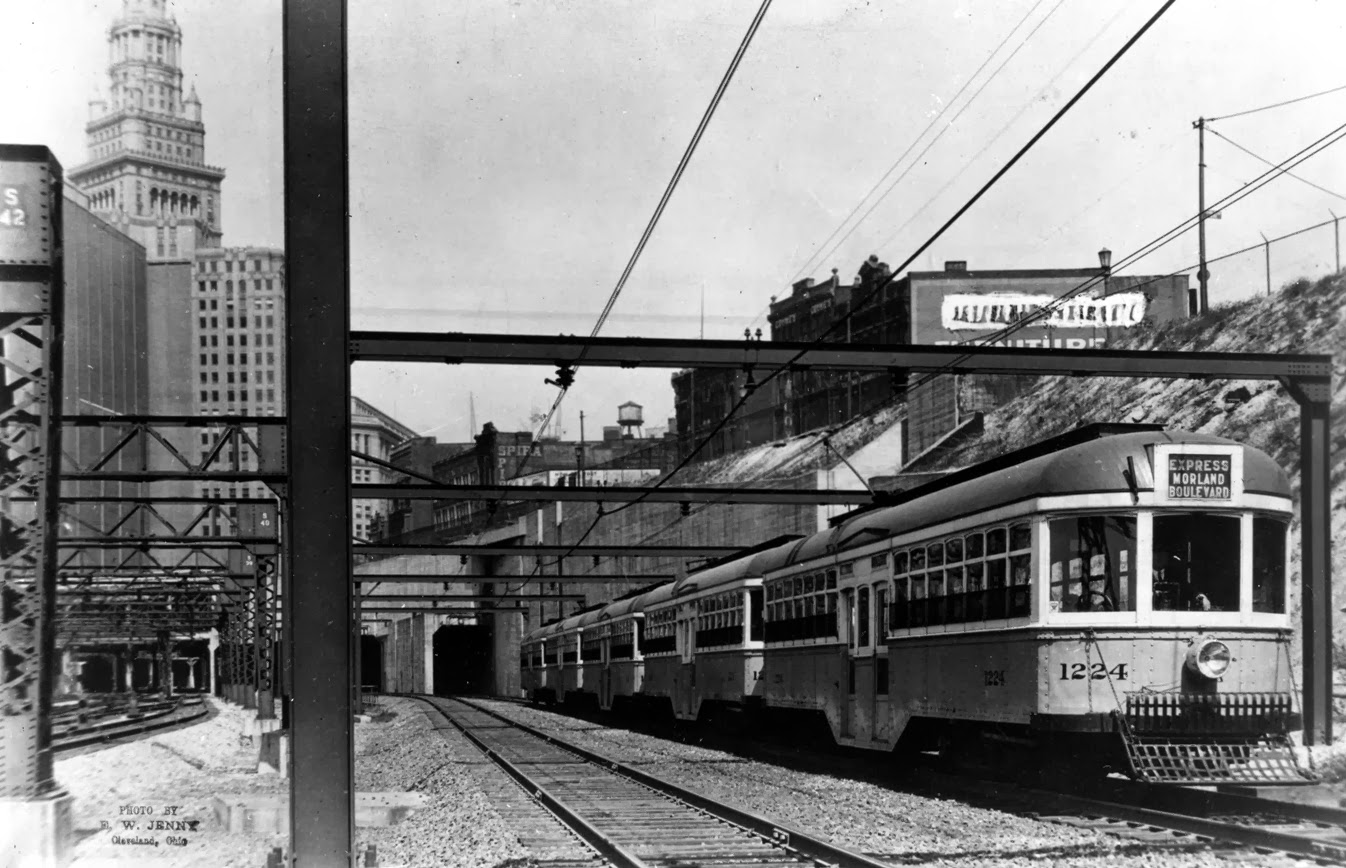
A five-car rake of center-door cars bursts forth from beneath Cleveland Union Terminal on its way to Shaker Square and the South Moreland Boulevard line in April 1934. This was the "rapid transit" image that CIRR wanted to portray. Harwood Collection photograph courtesy of James Toman, posted on Hicks Car Works with permission.
Car 1218 and its fellow center-door cars on CIRR operated in daily service between Public Square in downtown Cleveland and Shaker Heights through the late 1920s and into the 1930s. With the Great Depression, though, came changes to the CIRR operation. The fortunes of the line to Shaker Heights entered a period of decline as the Van Sweringen empire began to crumble. Some of the 1200s went into storage as traffic levels declined and then in 1935 CIRR went bankrupt and was taken over by the banks that were its creditors. The line continued in operation; lightweight cars were purchased from the recently-abandoned Fox River Electric near Chicago and in 1941 more lightweight cars were bought from Intercity Rapid Transit. In 1940 the center-door cars leased from CRC, including 1218, were purchased outright and over a couple of years were renumbered without the leading two digits of their CRC numbers. Meanwhile traffic continued to decline, and even by the middle of World War II it appeared that the line was destined for abandonment. Then, in 1944, the City of Shaker Heights elected to purchase the CIRR line in order to prevent it from being abandoned and scrapped. The 1940s was a period during which many transit operations nationwide were being conveyed from private to public ownership, and in fact just two years earlier CRC itself had been acquired by the City of Cleveland. CIRR was just the latest in an ongoing trend.
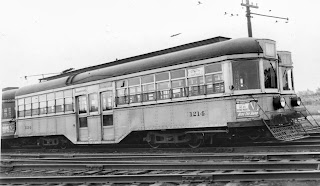
Car 1214 is seen in the yard during the early 1940s, as evidenced by the "V for Victory" dash sign. Note that it retains its original Scullin rooftop ventilator housing and that car 1214 has unusual Standard trucks rather than the Brill trucks most of the center-door cars had. James Spangler photograph from the James Toman collection, posted on Hicks Car Works with permission.
With the ownership change, CIRR became Shaker Heights Rapid Transit (SHRT). Operations continued largely as before for a time, but in 1948 major changes began to impact the SHRT operating fleet. A series of 25 modern PCC cars built by Pullman-Standard arrived on the system, permitting the sale of eight lightweight cars to Speedrail in Milwaukee. Another 20 secondhand PCC cars were purchased from Minneapolis in 1954, and this time over half of the fleet of center-door cars was retired and scrapped. Twelve center-door cars remained in service until late 1959, when a final 10 PCC cars were purchased used from St. Louis Public Service. After this 10 of the center-door cars - including car 18, ex-1218 - were retained for rush hour use in five-car sets. Car 18 was typically trained with four other cars similarly equipped with "button" MU connections in the couplers and operated in this fashion for another year until all of the center-door cars were retired in 1960.

A two-car train led by car 8 (ex-1208) is eastbound approaching Shaker Square on September 10, 1951. Note that car 8's pole is down and the train is running off of the rear car's pole. Henry M. Stange photograph from the Krambles-Peterson Archive, posted on Hicks Car Works with permission.
Car 18 is in fresh grey and yellow paint at the head of a four-car consist during the early 1950s. The cars are spotted in Kingsbury Run Yard with the SHRT shops in the background under the Sidaway Bridge. Harry Christiansen photograph from the James Toman collection, posted on Hicks Car Works with permission.
Car 18 brings up the markers on a four-car outbound stopped at Kenmore on the Van Aken Boulevard line during the early 1950s. The two middle cars are still in the older grey, cream and red livery. Harry Christiansen photograph from the James Toman collection, posted on Hicks Car Works with permission.
TROLLEYVILLE PRESERVATION
Car 18 was purchased by Gerald Brookins in July 1961 for his Gerald E. Brookins Museum of Electric Railways (better known by its later name of Trolleyville, U.S.A.) located in the Cleveland suburb of Olmsted Falls. Brookins was a real estate promoter and traction fan who had created the Columbia Park mobile home community. Columbia Park was intended to be a community where people wouldn't need automobiles; a shopping mall at the park entrance featured a grocery store and other amenities, and residents could reach the shopping mall on the streetcars that Brookins purchased to operate over a dogbone-shaped line that traversed the park. Though a nice theory, in practice people preferred their cars and the Trolleyville operation became more of a privately-owned museum than an active transit line.

Cars 25 and 18, the two center-door cars purchased by Trolleyville in 1961, are seen in Warrensville Yard on SHRT in August of that year just prior to being moved to their new home. Willis McCaleb photograph from the Krambles-Peterson Archive, posted on Hicks Car Works with permission.
This photo shows the interior of car 18 as it was in August 1961, just before the car was trucked to Trolleyville. The photographer is standing near the conductor's position looking towards the rear of the car. Willis McCaleb photograph from the Krambles-Peterson Archive, posted on Hicks Car Works with permission.
The first cars purchased had been several ex-Fox River Electric cars retired by SHRT in 1954; soon after car 18 was acquired in 1961 (along with fellow center-door car 25), two Mexican open cars and then several heavy interurban cars from the Chicago Aurora & Elgin joined the fleet. Both of the SHRT center-door cars, which had ended their service days in a two-tone livery of light grey and yellow, were painted in earlier liveries and returned to their original numbers. Car 1225 was painted in CRC yellow while car 18 was painted in the later version of the grey, cream and red "bankers colors," so called because CIRR was owned by the banks when the color scheme was adopted, that it had worn from about 1940 until about 1950 (it was, however, assigned its pre-1940 number of 1218). Both cars saw occasional use at Trolleyville and were well taken care of, stored safely inside the car barns built by Brookins. Gerald Brookins passed away in the mid-1980s and ownership of the traction collection, which was still growing, passed to his son.
In 2001, Trolleyville was hit with a bombshell announcement: the Columbia Park mobile home community had been sold by the Brookins family and the trolley museum had five years to relocate, cars, tracks and all. Much of that period was spent in discussions about the possibility of creating a new trolley museum on the Cleveland lakefront, funded by city tax dollars and connected to the Waterfront light rail line of the Cleveland RTA. In 2006, with the eviction date approaching, the Brookins family paid to have the entire collection of cars moved to downtown Cleveland. The heavy CA&E interurban cars were moved onto RTA tracks (two had already been moved to the RTA in 2003 and had been briefly operated) and the other equipment, including car 1218, was moved to a warehouse on the waterfront adjacent to Cleveland Stadium.

Car 1218 is seen in the warehouse on the Cleveland waterfront in 2007. This was its home from 2006 until 2010, when it was moved to the Brookpark Shop on the RTA. Photo by Jim Vaitkunas, posted to Hicks Car Works with permission.
The collection was placed under the auspices of an organization called the Lake Shore Electric Railway Museum (LSERM) but ownership of the cars remained with the Brookins family. In late 2009, with the economy in shambles and tax money scarcer than ever, the plans for a publicly-funded trolley museum were abandoned and the cars in the LSERM collection were sold off to other museums. All, that is, except for car 1218. An exemplar of the home-grown Cleveland streetcar, it was hoped that the car could be kept in its hometown as a static display piece. Plans were drawn up for a glassed-in display pavilion to be constructed at the Western Reserve Historical Society museum in Cleveland's University Circle to display the car.
But the display pavilion was never built. By 2013, when the car was about to lose its safe home inside the RTA's Brookpark Shop, it had become apparent that the pavilion had never advanced beyond the planning stages and construction was not imminent. The Brookins family contacted the Illinois Railway Museum, the home to several ex-Trolleyville cars, about acquiring 18. On July 8, 2013 the last Trolleyville car in the Cleveland area departed for Illinois. It was the first time car 18 had ever been more than 20 miles from Public Square in Cleveland.
BIBLIOGRAPHY
Curry, Donald G. "Cleveland Railway Center Entrance Motor Car 1227: A Trolley With Nine Lives."
Seashore Trolley Museum (2008). Accessed Online 20 September 2013.
Electric Railways of Northeastern Ohio: Bulletin 108. Chicago, IL: Central Electric Railfans Association, 1965.
Toman, James A., and Blaine S. Hays.
Cleveland's Transit Vehicles: Equipment and Technology. Kent, OH: Kent State University Press, 1996.
Toman, James A., and Blaine S. Hays.
Horse Trails to Regional Rails: The Story of Public Transit in Greater Cleveland. Kent, OH: Kent State University Press, 1996.
Toman, James A., and James R. Spangler.
A Shaker Rapid Album. Cleveland, OH: Cleveland Landmarks Press, 2005.
The distinctively Cleveland "face" of car 17 is shown in Warrensville Yard, at the east end of the Van Aken Boulevard line, on April 22, 1957. At over 40 years old the car is nearing the end of its life but still looks sharp in its grey and yellow livery. B.J. Misek photograph from the Krambles-Peterson Archive, posted on Hicks Car Works with permission.
APPENDIX A: MECHANICAL SPECIFICATIONS
Built: G.C. Kuhlman Car Company, 1914, order #583
Length: 51'
Width: 8'5"
Height: 11'8"
Weight: 50,000 lbs
Seating capacity: 60
Trucks: Brill 68E1
Motors: Westinghouse 340A1 (4)
Wheelbase: 72"
Wheel diameter: 24"
Master controller: Westinghouse 15E1
Control group: Westinghouse HL
Brakes: SME
Motorman's valve: M20A
Air compressor: National BB2
Governor: National R
Car 1222 is seen during the early 1940s with a "V for Victory" sign on its dash. Note that it has not yet been renumbered nor has it been rebuilt without the Scullin roof housing. Photo from the Bill Volkmer Collection, posted on Hicks Car Works with permission.
APPENDIX B: IN-SERVICE MODIFICATIONS
EQUIPMENT
1919 - Destination roll sign moved from front dash to housing over center window
1923 - Brill 51E1 trucks replaced by Brill 68E1 trucks
1923 - K-35G control replaced by HL-15E1 control
1923 - Motorman's cab modified with electrical cabinet behind motorman
1923 - Permanent headlight replaced with removable headlight
1923 - Seats on left side of car converted from longitudinal to transverse
1923 - Couplers with MU connections installed at both ends of the car
1923 - Marker brackets installed at the corners of the car
1923 - Amber rear end marker light added to two existing brake indicator lights
c1940-1943 - Scullin roof housing removed
c1940-1943 - Window guards removed
c1940-1943? - One rear end marker light removed, remaining two changed to red
c1940-1943? - Coal stove replaced with electric heaters
1955 - Installation of signal trip arms for upgraded signal system
Car 23 is in the SHRT yard sometime during the 1940s together with other center-door cars. Note that by this time the Scullin ventilator housing has been removed. Photo from the Bill Volkmer Collection, posted on Hicks Car Works with permission.
LIVERIES
1914-1923 (Cleveland Railway Company 1218) - yellow body, cream along windows, dark red windows and doors, light grey roof, cream trucks, black striping and lettering
1923-c1936 (Cleveland Interurban Railroad 1218) - forest green body, yellow along windows, yellow sunburst on dash, dark red windows and doors, light grey roof, black trucks, yellow striping and lettering
c1936-c1940 (Cleveland Interurban Railroad 1218) - medium grey body, cream along windows, black stripes along belt rail and over windows, cream windows, red roof, black trucks and lettering
c1940-1944 (Cleveland Interurban Railroad 18) - medium grey body, cream along windows, red belt rail, black stripes over windows and under belt rail, cream windows, red roof, black trucks and lettering
1944-c1951 (Shaker Heights Rapid Transit 18) - same as above
c1951-1961 (Shaker Heights Rapid Transit 18) - light grey body and roof, yellow along windows, yellow hourglass on dash, black trucks and lettering
APPENDIX C: OTHER PRESERVED 1200-SERIES CARS
1201 - acquired by Connecticut Trolley Museum in 1961 from SHRT, cosmetically restored and currently displayed indoors in inoperable condition as SHRT 1
1203 - flooded in 1957, motors removed, used as storage car by SHRT at Van Aken Yard until sold to Northern Ohio Railway Museum in 1968, painted in 1920s CIRR green livery and used on fan trips, moved to Trolleyville site for storage in 1974, moved to NORM site in 1979, currently stored indoors in poor condition as CIRR 1203
1212 - retained by SHRT after retirement in 1960 as a historic artifact, painted in c1940s colors and used for fan trips c1960s-1980s, conveyed to Northern Ohio Railway Museum in 2013, currently in regular operation as SHRT 12
1217 - heavily rebuilt by SHRT after retirement in 1960 as overhead line car 024, in regular use until c1980s, conveyed to Northern Ohio Railway Museum in 2013, currently stored indoors as Greater Cleveland Regional Transit Authority 024
1225 - acquired by Trolleyville in 1961 from SHRT, painted in Cleveland Railway yellow and cream, sold to Northern Ohio Railway Museum in 2009, currently stored indoors in operational condition as CRC 1225
1227 - acquired by National Capital Trolley Museum in 1961 from SHRT, sold to Trolley Valhalla in 1968, transferred to Buckingham Valley Trolley Association in 1974, sold to Buckeye Lake Trolley c1970s, sold to Seashore Trolley Museum in 1984, underwent complete restoration to c1920 condition and outshopped in 2007, currently on display indoors and operated occasionally as CRC 1227
1231 - rebuilt by SHRT in 1949 with the addition of front doors for one-man operation, rebuilt by SHRT in 1955 as wire greaser 031, in regular use until c1980s, body sold to private owner in 1992, body sold to Medina Hobby Shop in 1993, body sold to Northern Ohio Railway Museum in 1996, to be restored using parts from car 1211 (damaged by arsonists c2000 and scrapped), currently stored outdoors in poor condition as Greater Cleveland Regional Transit Authority 031