Friday, November 4, 2016

Electric Locomotives

More photos of cars in the IRM collection sent to us by Art Peterson.

All Images Copyright by the Krambles-Peterson Archive


First, a picture of our GG-1, PRR 4927, working North Jersey Coast train 1118 in Feb. 1966.  This appears to be a simplified paint scheme from the one to which it has been restored.


And next, several great color photos of our Charles City Western engine, the 300.  If anyone can provide details on where these pictures were taken, we'd appreciate it.  And unlike the GG-1, this locomotive should soon be running under its own power again.

Sept. 3, 1949  (BLS)   Behind the 300 is a wooden center-entrance car from the Atlantic Shore Line, unfortunately not preserved.  Gregg Wolfersheim says that the Oliver Tractor Works factory in Charles City is in the background of this view.


June 4, 1953  (GK)


Switching c. 1956  (WAM)


In 1964 the locomotive was renumbered to Iowa Traction #30.

Aug. 21, 1965. (THD)  While the identity of the locomotive is definite, we're not sure about  the North Shore MD car on the left.   The photographer identifies it as #31, in which case it's North Shore 216.  This car was destroyed in the same carbarn fire as the famous WCF&N observation-parlor car 100 in 1967.  But it might also be #33, North Shore 234, which is still in existence.


May, 1966  (TM)


Thursday, November 3, 2016

Party Like It's 1908

The 309 entered service early in 1908, the last time the Cubs had won the World Series until yesterday, so it's time to celebrate again!


The 24 is ten years older, and it's in on the party also.


Tim is mostly working on fabricating the correct style of third rail beams for this car as of 1913, the target date for the restoration.


And later in the day, he got Gregg W. to help him with this project.


I see that the interurban freight team of Gerry Dettloff and John Faulhaber have started rebuilding one of the doors for the North Shore MD car 213.   The restoration of the 810 is nearly complete, and the MD car looks like it may be their next project.


 The 3007 makes a rare appearance outside, due to the switch move for the Santa Fe sign festivities.  And the lighting was just about perfect.


Work continues on the new street scene area.   Here is Dave Diamond surveying for the paving process.   A lot of gravel was being dumped, leveled, and compacted today.  He hopes to start paving next Monday.


It's neat that we have our own road grading equipment.


And they were still working on this when I left.


 Finally, I spent all day working on the vestibule of the 36.  Paint stripping and sanding and other surface prep took up most of the morning and early afternoon.


Then I started with a first coat of blue on sections previously primed.   As before, you may notice that the coverage is somewhat uneven, and at least a second coat will be needed.  This continued until I ran out of blue paint.


So I switched to black and started painting the underbody equipment, such as the pilot and steps and truss rod on the 36.   I would have like to start putting primer on the recently stripped parts inside the vestibule, but I ran out of time.


So first I ran out of paint, then I ran out of time.   I would like to tell you what else was happening, but I seem to be running out of electrons.   That's strange, I'm sure I had another jar of them around here somewh

TM Cars - Part 2 Updated

More photos of cars in the IRM collection sent to us by Art Peterson.

All Images Copyright by the Krambles-Peterson Archive


Today we have some more TM work equipment.   First, the M-1 at an unidentified location, pulling a couple of freight trailers.  This is a classic picture of interurban freight service.


The M-15 served the Municipality of East Troy as a line car, a snowplow, and a locomotive, as seen here.  The date is March 23, 1941; I'd say it appears to be northbound somewhere south of Army Lake.  (JJB)


And here it is near the train shed in East Troy, on Oct. 20, 1945.   This structure was demolished, and a storage barn now occupies the site


Finally, the M-37 at Lakeside, on Feb. 17, 1953. (THD)   This is a container storage car, with no electrical equipment, so I'm not sure what was going on with the stinger and all the cables.


Update:   Gerry Dettloff sends us a recent picture of the M-37 with the container inside.   The car itself has recently been repainted by the Wednesday Special Projects group.


Wednesday, November 2, 2016

TM Cars - Part 1

More photos of cars in the IRM collection sent to us by Art Peterson.

All Images Copyright by the Krambles-Peterson Archive


Next, we'll start on cars from The Milwaukee Electric system.  IRM has the only comprehensive collection from this line, including the only existing interurban cars, two streetcars, locomotives, work equipment of several sorts, freight cars, and buses.


966 in Milwaukee, otherwise unidentified.


972 at Lloyd and 60th, on Oct. 12, 1941.


The 1128 and 1129 in a train on Aug. 8, 1932.


The 1135 (Menominee) at Gould St. on Aug. 20, 1933  (GK)


The L3 at Lakeside, Feb. 7, 1953  (THD)


The L4 pulling a train, unknown location, Aug 8, 1936.   (RVM)

Tuesday, November 1, 2016

Visit to East Troy

Frank writes...

Sunday was a field trip day; a bunch of Car Department guys headed up to visit the East Troy Electric Railroad in East Troy, Wisconsin, about an hour north of Union. The history of the line between East Troy and Mukwonago (muck-WAAN-ago if you were wondering) is a long and sordid one, but the brief version is that the Milwaukee Electric built a line from Milwaukee out to East Troy early in the century. The "TM" abandoned the line in the late 1930s but the village of East Troy bought the segment between their village and the railroad interchange in Mukwonago, operating it as the freight-only Municipality of East Troy Railroad. In the late 1960s a group called The Wisconsin Electric Railway Historical Society (TWERHS) started operating interurbans over the line but in the 1980s they were kicked off the line in favor of ETER, a separate group also looking to operate interurbans over the route (TWERHS dissolved and most of its cars ended up at IRM, though some ended up with ETER). Today ETER is part museum, part tourist line, but does a brisk business between the historic substation in East Troy and the "Elegant Farmer" restaurant/grocery, located near the Mukwonago end at a spot known as Phantom Woods. Just this year they've extended service east to the interchange, aka Indian Head Park, though most ridership is between East Troy and Phantom Woods.

They were operating two South Shore cars, 9 and 30, when we were there. Here's car 30 sitting in front of the historic substation at East Troy. In "TM" days the passenger station was a block west of here but today the building is used as the station/museum/gift shop. Across the tracks is an old-time ice cream parlor. Note the car has had its roof "humps" and pantographs removed. Although most of East Troy's operating fleet consists of South Shore cars, these have all been converted to trolley poles for ease of operation.
The 5-mile trip to Phantom Woods takes some 25-30 minutes. We rode all the way to Indian Head Park and back, then disembarked for lunch at the "Elegant Farmer." Like most museum/tourist operations that have traffic originating at different points along the line, ETER has a regular posted timetable. Trains depart East Troy eastbound and Phantom Woods westbound at the top of the hour, meeting at a siding along the line. Above, after lunch car 30 approaches the Phantom Woods stop from the east. The sign in the foreground discusses the acquisition of several South Shore cars from the National Park Service in 2010.
Some of the usual gang: here's Zach Ehlers, Nick Espevik, Greg Kepka and Richard Schauer riding in the box smoker on car 30. Thomas Slater, Joel Ahrendt, and diesel department volunteer Jeron Glander were also along for the visit. East Troy has stripped the interior walls of cars 9 and 30 (not sure about their other South Shore cars) down to bare wood, which looks pretty nice.
En route back to East Troy we met their president, Ryan Jonas, who very kindly agreed to show us through their car barns. Above is the East Troy barn; a pair of Chicago 4000s painted in 1920s colors is on the left, beyond which is Milwaukee Electric work car L6 and a homebuilt open car constructed by ETER back in the 1970s or 1980s. At the end of this track, the usual home of cars 9 and 30, is another South Shore coach. Ryan said that ETER currently has eight (!) operational South Shore cars.
Here's the dining car set: back in the 1990s ETER rebuilt a pair of South Shore air-conditioned "stretch" coaches as dining cars and ever since then has run a successful dinner train operation. There's no kitchen on the cars, the food being brought aboard for the trip.
South Shore car 33, shown here, was one of five acquired in 2010 from the National Park Service. This car is unique in that it was rebuilt by the NPS to more-or-less original condition, complete with square end windows, humpless roof, stained-and-varnished interior, and tile floors. It really looks nice and it is operational, but at the moment is having work done to get electric heat working in the car (these cars ran in service with coal-fired hot water heaters - not something ETER or anyone else, to my knowledge, is looking to use!).
The ETER line car is ex-Milwaukee Electric car D23, which is identical to our own D22. Theirs is in good condition and is in regular use.
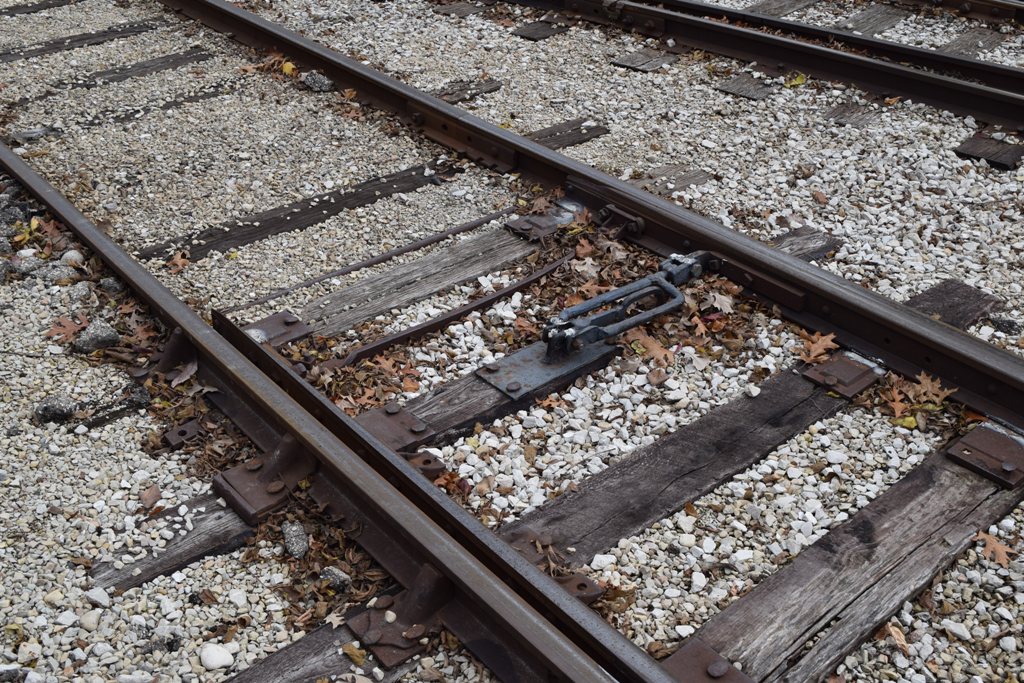
Here's something unusual out in front of the East Troy barn: a super-low-profile switch throw.
And then we all jumped in our cars and drove back over to Phantom Woods, where Ryan showed us through East Troy's new maintenance and restoration building. As seen above, it's a one-track, two-berth structure built alongside the old TWERHS Phantom Woods barn (left background) which today is used mostly for dead storage. The new building has a small office in the front corner, which is air-conditioned, while the entire structure is heated.
And here's the main bay with a Twin Cities streetcar over the pit. The building is extremely impressive; there's a between-the-rails inspection pit about 70' long, with a wide spot some 25' long in the middle, and plenty of work space all around. The track extends out both ends of the building and the plan is to eventually construct a parts storage building out behind (to the east of) the building. The pit is slightly deeper than ours, which is nice because you don't need to duck as much walking underneath the cars!
Along one side of the main bay are a couple of workshops separated by both regular doors and large roll-up doors. The idea is that these roll-up doors will usually be kept open, but in the winter they can be closed and the workshops heated individually without incurring the expense of heating the entire main bay. Pretty nifty! There are two workshops, intended as a metal shop and a wood shop, plus a restroom and the aforementioned office at the southwest corner of the building.

And then it was back to IRM, where CA&E 451 has returned to "traction land" after a long seven years, give or take, over in the Barn 2 diesel shop. The car is shown below following removal of the plastic sheeting that had been draped over it to limit the dust. We are hoping to pick back up with this project at some point. The doors need to be retrieved from the contractor who still has them, the roof boards need to be made and installed, roof hardware must be replaced, some final painting remains to be done, and then comes the mechanical inspection and replacement of the air compressor. But at some point this car should join sister car 460 in operation on our railroad. Looking to help? Contributions to the CA&E 451 fund are always appreciated!

Indiana Railroad 65 - Part 2

More photos of cars in the IRM collection sent to us by Art Peterson.

All Images Copyright by the Krambles-Peterson Archive


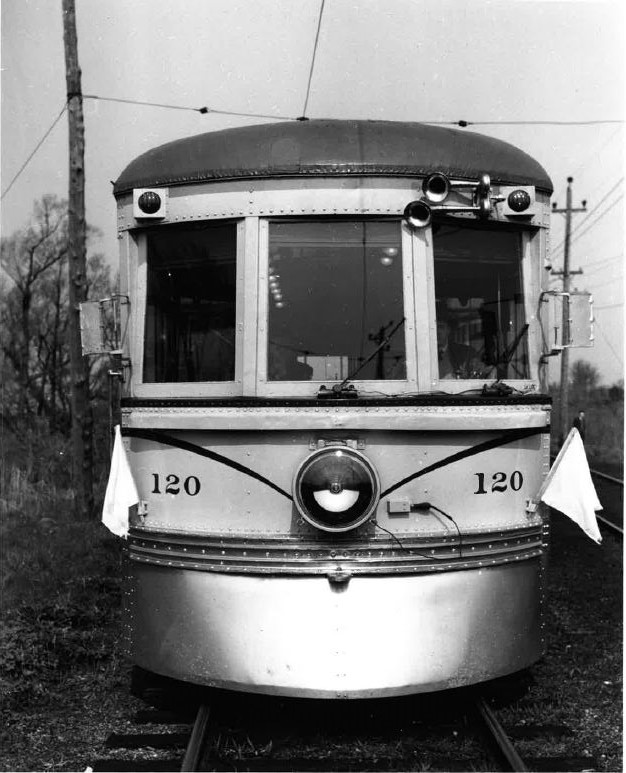
A few weeks ago we posted some picture of the 65 in Indiana, including a couple after the end of service.   Here we have several of the car in Iowa, mostly disguised as Crandic #120.   If we have any Hawkeyes out there, perhaps you could help us with identifying specific locations in Iowa City!


Photo by George Krambles, May 8, 1943.   The car has not yet been repainted.


Stored at the shops, next to a C&LE car.


A year later, May 7, 1944, the car is on its inaugural fantrip as #120.


In front of the Engineering building at the University.


Another location on campus during the same fantrip.


And in front of the North Liberty substation.