Friday, September 13, 2024

Ready for Showcase

Showcase Weekend, known as Member's Day in ancient times, is almost here, and we need to be ready!  There will be a large assortment of interesting equipment in operation, as always.  Among them will be the 309 and 319, so I checked and filled the oil in the compressors and journal boxes.  That's a dirty and annoying job to have to do in the morning of operations.  Now all is well.


Among other things, the guys found a pie-plate lampshade that could be used on the Jewell Road shelter.  I cleaned it up and took it home.  It will need some different hardware to attach to the conduit that will project out over the door, and I can do work on it at home.


Here for comparison is a closeup from 1949:


I suspect that the original lamps ran on 600V DC, but we won't want to try that here.

Meanwhile, Frank Kehoe was hard at work cleaning up various parts for the 1808.


Like these:


And tomorrow, we'll have a surprise (or maybe more) for you.  But you'll have to be there in person to see it.

Tuesday, September 10, 2024

In Memoriam Doug Oaks

Once again we must sadly post notice of the death of another long-time IRM member, Doug Oaks.  I remember him mostly from back in the 70's, when he was one of the earlier trolley bus fans. In later years he lived too far away to appear very often, but kept in close contact with the Museum.  And he was always a strong supporter of all the various projects on the property, and a good friend to everyone who knew him.

The funeral will be next Monday, Sept. 16 in Ohio.  The obituary is at this link.  Thanks to Richard Schauer for bringing this to our attention.


Monday, September 9, 2024

277 Progress Report

 Another dramatic submission from Gregg Wolfersheim:


The right side of the combine is coming together. Most of the painting is done. Baggage rack is back up.


The left side is another story. Previous water damage has turned some of the veneer into a peeling mess. Some of it had been treated with epoxy to fill in what was gone. Here I have sanded what painted surfaces I can get to.


Later, I primed most of it. The bare spots are where delamination has occurred. Next will be filling it in with epoxy. Hopefully most of the baggage section will be done by this weekend, as the train is scheduled to operate for Museum Showcase.


The lower wall area is getting transformed too.

Saturday, September 7, 2024

Light on the Motors: A Single-Trucker Comes to Grief

Light on the Motors
A Single-Trucker Comes to Grief
by Frank Hicks and Art Peterson

All photos from the Krambles-Peterson Archive

For a locomotive roster shot, “light on the trucks” is essential for a good portrait. FM switchers with their thick frames cast giant shadows and made this a challenge. Here’s a set of photos of a single-truck open car working on the Fort Smith (AR) Light & Traction, where the first shot is notable for having superb light on all the underbody components, thanks to the car lying on its side.

Fort Smith had mule cars from 1883, and by 1893 had moved onto electric cars; the population had nearly quadrupled over this period. All lines were electrified by 1899, at which time the track gauge was 3’-6” and the system had six miles of track. The listing in the 1899 edition of “American Street Railway Investments” noted that Fort Smith Traction Light & Power (FSTL&P) was one year into a 50-year franchise agreement. It was noted that six “Laclede cars” were used (Laclede had been established in 1883 and was acquired by St. Louis Car 20 years later), but no other information was given.

Conversion to standard gauge must have occurred shortly thereafter, as American Car records indicate that Fort Smith Light & Traction (the successor company to FSTL&P) received orders 274, placed in 1899 for three closed cars, and 433, for four closed cars, with order 433 being filled in 1902. Car 10 (preserved in Fort Smith) is a member of order 433. On March 24, 1905, American order 585 for 15 ten-bench open cars numbered 50-64 was received from Fort Smith Light & Traction (FSL&T). Exactly one year later, another order, this time order 642 for six ten-bench open cars numbered 65-70, was placed by FSL&T.  In 1908, FSL&T ordered six double-truck, semi-convertible cars from American on order 782, numbering them 20-25.

Fort Smith car 58 (a member of the March 1905 order) shows all its underbody details in this view. The motors may be GE 80s, 40-hp units which each weighed 2,850 pounds. Visible in this great light are the corner braces (diagonal members) as well as the two transverse floor timbers running across the width of the car either side of the truck. The two substantial members either side of the truck, straddling the centerline of the car, are the platform sills. These also provided an anchor for the drawbars. Both drawbars have slumped down once the car was overturned – the drawbar carry iron (an iron strap suspended from the underside of the car’s bumper beam) has retained the drawbars, exactly as it was intended to do. Also note the separate grid boxes and the various angles at which they’re mounted under the car – an unusual arrangement. No records survive to indicate why this had been done, unless somehow they were knocked loose in the accident, though the authors confess nothing else under-car seems to have been knocked about.

While the photographer noted the date of the incident, he didn’t note where in Fort Smith this happened, nor did he include his name on any of the prints. We also don’t have any info as to the circumstances that resulted in this car overturning. A head-on collision on the Denver & Rio Grande, which killed five that same day, pushed any coverage of this incident out of the surviving newspapers from the area.

This down-on view includes a bit more of the overall scene. The thin metal members running the width of the truck between the motors are the motor suspension bars. The longitudinal member running the length of the truck is the brake rod. The thicker members at either end of the truck are the equalizing lever (outermost member) and the brake beam (just inboard of it). The car must be hand-braked – typical for a smaller car of the era – as no air compressor, air tanks, or brake cylinder are visible. The “right” end of the car must have been the front when it turned over because the fender is deployed, or at least what’s left of it is. A close look in between the platform sills reveals the car’s gongs.

In his 1993 book “Breezers,” Steve Meyers noted that as single-truck cars grew longer they had a tendency to gallop at speed. The combination of a lightly loaded car traversing less-than-ideal track at higher speeds made conditions right for a rough ride and/or derailment.

From this angle, you can see the platform hood (the roof section on the end platforms). On most open cars, the platform hood was framed separately from the body roof, but joined to the roof without a break. Although this car is fairly new, there was a tendency for the platform hoods to droop as the car aged (perhaps you’ve seen photos of the Lancaster [OH] cars, which displayed this tendency in the extreme). Mounted to the underside of the hood is the “hood switch” or “canopy switch” that could be used to electrically cut out the motors. The fender appears to be an Eclipse, which was one of the more popular types of folding streetcar fenders of the era.

This close-up view of the end platform of the car shows the GE K-10 controller (moderate-capacity equipment, used on 2- or 4-motor cars up to a total of 160 hp) and the brake wheel on the end platform of the car. You can also see how the angle-iron bumper construction is suspended out from the car’s platform sills. The wheel-type hand brake is a bit unusual for a hand-braked car; gooseneck handles were more common. Just to be clear, the “Little Rock” reading is the line within Fort Smith on which the car was working; this was not an interurban trip to the state capital (one-way distance = 161 miles!). The poster advertises a "tent show" starring Rentfrow's Jolly Pathfinders, at one point advertised to be "the top traveling tent show in the country," at - where else - Electric Park.

With the car upright, at least we can see that the company name was on the running board riser and the pole has been tied down. The horizontal board just below the letterboard could be slid down to armrest height to block passengers from alighting from the street side of the car. In the foreground, you can see various rerailing accoutrements including click jacks, blocking, and ropes or cables. Of course, not only are a bunch of kids hanging around a wreck site, but they’re almost all barefoot!

FSL&T was managed by HM Byllesby & Co. out of Chicago. It was one of 17 utility operations (including electric, gas and railways) that the investment firm controlled. By 1914, FSL&T had 27 miles of track, required 43 motor cars to provide service and was carrying around 5 million riders annually. Birney cars (from Cincinnati) came to FSL&T from 1919. A repeat order for Birneys (this time, supplied by American Car) was placed in 1926. Two members of that order have been preserved in Fort Smith, car 221 as part of a house and car 224 as a fully restored and operational streetcar, while car 205 from the 1919 Cincinnati order is also preserved as a body at the museum there. The last streetcars in Fort Smith ran on November 15, 1933.

Several industry publications (as noted above) were consulted to put a little more meat on the bones of this piece. In particular, the 1911 “Electric Railway Dictionary” was used to provide some additional details on car components/construction visible in these unusual views. In addition, online sources were reviewed as were the production records of American Car and other car builders. As always, the willingness of Randy and Frank to publish this on the blog is most-sincerely appreciated! -Art

Tuesday, September 3, 2024

More from the Weekend

More pictures from Labor Day Weekend:  First of all, a couple showing how we light the kerosene marker lamps on the CA&E cars:


And then, the 1808 in operation.  It was pulled out of the barn so the 1268 could get its roof washed and repainted.  Then it moved over to 43 temporarily.


Early ERHS Bulletins

 Bill Wulfert showed me a couple of interesting flyers from the Dick Lukin collection.  First is an ad for early ERHS bulletins.


And then a flyer put out by Carl Gustafson for his self-published book on the E&B.


Order yours today.  Prices will never be lower!

Sunday, September 1, 2024

Night Train to Kishwaukee Grove

Frank writes...


It's been almost 10 years since IRM started running trains into the evening on Labor Day Weekend - I had to check, but the first year we did this was 2015 - and it's still a blast. This year, the CA&E wood cars were the "evening shift" train on Saturday. For most of the shift, my father was conductor and I was motorman.
We brought the train out at about 4:00pm, but had a bit of a wait on the tail track while a spot opened up in the rotation.
Fortunately, as you can see above, the train watching from this spot is pretty nice! Daytime service was held down by the 1630 with the coach train, Minnesota Transfer 200 (later replaced by CB&Q 504) with a caboose train that also added a couple of freight cars behind the engine, and the CA&E steel cars on the main line; Northwestern Elevated 24 working the 50th Avenue shuttle; and Veracruz 19 and the Green Hornet on the car line. All of those except the 1630 and 4391 were put away by dinnertime, but the C&NW bi-level set and, of course, our train came out to replace them.
We neglected to get a formal crew photo, but hopefully Carina Borst will forgive me for stealing a couple of crew photos she snapped when she joined us for our 7:45pm departure. Above, myself and Zach, who joined the crew for the last two trips (we departed on the 45's hourly from 4:45 to 8:45).
Above, my father and Zach on the 7:45 train; my father had to vamoose after this trip and Zach worked the final trip and helped get the train put away. Thank you, Zach!
Here you go, a couple of nice shots of the train in Station Track 1 before the 8:45 trip. We had a good crowd pretty much every trip and everyone seemed to have a good time. We've come up with a good system that involves carrying markers at all four corners and using the little "flippers" to flip them from white to red (or vice versa) when changing ends. We also carry a headlight at each end of the train to make changing ends easier.
Everything ran smoothly this year. We didn't even have any of the kerosene marker lanterns blow out!

So, enough CA&E photos - what else was going on?
When I arrived shortly after lunchtime, a crew was doing B&G work outside the electric car shop. They were working to extend a gas line, and I was told that by the end of the day, the new line was run, just not hooked up. Pictured above, Jimmy on the ground, Facilities GM Dave Diamond in the hole, Nathan taking measurements, and new volunteer Ashtin supervising.
During the day, before switching to join the CA&E crew as conductor, Zach was running NWERR 24 on the 50th Avenue-to-Jefferson Street shuttle. Here, the car comes into the 'L' station from one of its trips. This car truly is one of the most spectacular pieces of equipment we run and it's terrific to see it in operation.
And here we have the second bunch of seats for the CA&E curve-siders! For some reason, this batch didn't arrive "bagged," so we're going to pick up some garbage bags to protect them until they can be installed in the 460, which hopefully will only be a matter of weeks or months. This means that all of the full-width cross seats for the first car have been reupholstered; Jon is picking up the last half dozen or so seats, which are the slightly narrower seats that go against the bulkheads, on Tuesday and taking them to the upholstery shop. Exciting progress!

Friday, August 30, 2024

IT 277 Update

 Another progress report from Gregg Wolfersheim:


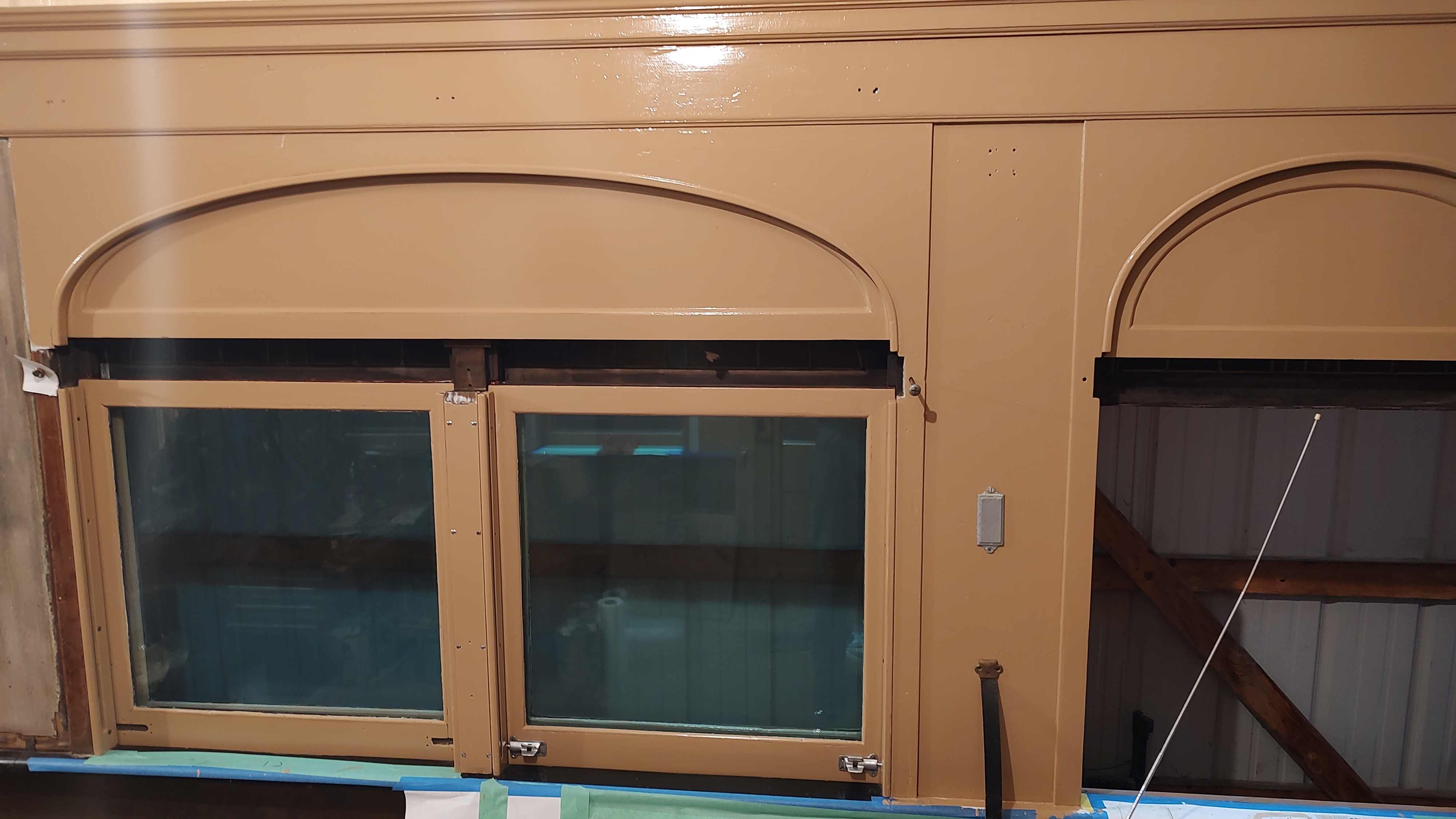
Slowly but surely the baggage room is getting transformed. This is the left side that hasn't had windows in it for over 10 years.


The right side is also getting attention! 


The gate for the baggage door is in the process of getting stripped. Soon, primer and then black paint will make it look like new.


I've pointed this out before: Gregg doesn't have to do anything special to get his project featured here.  He just sends us a few clear photos with brief, informative captions, and we do the rest.  For free!

Monday, August 26, 2024

Let's Shelve That for Later

Frank writes...


Sunday was very hot, but I still managed to get a few things accomplished. First, I removed the last couple of the seats in the 451 and also took the leatherette antimacassars off the seats my father had previously removed. This final batch of about half a dozen seats are now ready to go to the upholstery shop. And the exciting news from Jon is that the shop has finished the previous batch and they're ready to come back! So, there's a lot of progress on this front. I didn't take any photos, I'm afraid.
For your regular dose of vermilion, here's the latest on Shaker Heights 63. After I was done with 451 seats and we had closed for the day, I rolled orange paint on the last patches of the car that still needed a first coat. The only area that hasn't had its initial coat of orange is the rear bumper, which first needs some white primer. Anyway, this side got some orange on the doors. Joel is also ordering new Lexan to replace the full-height windows in these doors, which are hopelessly fogged up.
And this side got some orange on the skirts. I also finished painting the back end of the car with a first coat of orange. And after dinner, I checked the oil in the air compressors on the 309 and 319 and separated the hoses and jumper between the 319 and 308. We're planning to run the 309-319 for the "evening shift" this coming Saturday and the 308 won't be coming along this time. Mark your calendar and join us, especially if you've never gotten to see our authentic kerosene marker lights in action!
The exciting news, though, was that Nick and Joel were assembling pallet racking in the Barn 4 extension. These are new-to-us steel sections that have been restored by the weekday guys. Above, Nick runs down a rolling scaffold while Joel stands back.
The racks were built slightly out from the wall for ease of assembly - but how to shove them up tight to the wall? Aha! Let the machines do the work: Joel figured out he could use the motorized pallet lifter and a block of wood to shove the racking back.
And here's the result: a whole lot of storage space. We still need to add the actual shelves, which will be made up of whatever 2x4s/2x6s/2x8s we can scavenge or buy cheap, and these will also get bolted to the floor for security. The next step will be to build a mirror image of this line of shelves (well, slightly shorter) on the other side of this same wall, in the eastward extension of the shop lean-to. In the middle-left foreground you can see some of the grey-painted parts that will be used for that project. In the far left foreground is Bob.

In other news, ComEd 4 is back in service following a successful test of its rebuilt grid box on Wednesday; Gregg was working on painting more interior parts in the 277; and Jim Ward was showing around a couple of visitors from the Western Railway Museum.

Sunday, August 25, 2024

In Memoriam Paul Sprenger


We regret to announce the death of Paul Sprenger, a long-time Museum member and friend.  The funeral will be on Tuesday in Crystal Lake; the details are in the obituary notice at this link.


Friday, August 23, 2024

Thursday Activities

I worked on a few different projects on Thursday, but all CA&E -- as you might have guessed.

First was reattaching the molding strip in the smoker of the 308 that had fallen out earlier.  I acquired some more wallboard anchors and installed them, so all of the screws in the molding have something to hold onto.  It seems nice and sturdy now.  It needs the paint touched up, so I need to find out whether the 308 ceiling paint is supposed to be the same as the 309's.


Then I took some measurements of the broken leaf spring assembly on the 36, and walked around the material yard.  We've got lots of spare trucks, and some with leaf springs, but none were the same type.  But several others are surrounded with trees and bushes, so they probably won't be accessible until spring.  And the trucks on the 36 are the oldest CA&E type in existence, so finding replacement springs may not be easy.  Go to this post and look at the third picture down.


Next, I was able to get a couple more seat frames detached from the walls in the 451, but it took a lot of effort.  And I still can't get the screws loose that hold the backs into the tubular frames.  Very frustrating -- maybe they need to be drilled out.


And I checked on the Jewell Road shelter, and picked up bolts for eventually attaching the new sign I made to the building.

Of course, other people were at work.  Here we see Tim painting clerestory frames for the 1808, as John looks on.


Wednesday, August 21, 2024

IT 277 Progress

Today we bring you some more impressive pictures from Gregg Wolfersheim of his progress on the baggage compartment of the 277.
 

I started painting the ceiling last week after clearing out the emergency tool box. 


Progress as of last weekend.

As the ceiling was finished, the left side wall and back side of the motorman's cab were painted.
Both the inner and outer sash for #14 were restored and put back in today. #13 and 15 are in the process of being painted and will go in soon.

The tool boxes and fire extinguisher box also reappeared!