Monday, September 22, 2014

Showcase Saturday from Chuck Amstein

Here, as promised, are the pictures of Saturday operations by our staff photographer Chuck Amstein.  Usual restrictions apply: these images are copyrighted by the owner and may not be reproduced or sold without his express written consent. 


In the morning, the really long coach train was pulled by one of our newest locomotives, 1848.


The dynamometer shows the engine pulling 30,000 drawbar lbs, plus the throttle status.


Max makes some quick repairs to the trolley bus/car line overhead at Electric Park.


The steam team pulled the Decapod over onto the wye during supper, so they could watch it while they were eating.  Otherwise it might walk away.


Neon!


We're loading passengers at Depot St.  The rear of the train has two kerosene markers and the tail lamp; the front has markers, a headlight, and the dash light.  Joe helped us get them all ready.


Three-car North Shore train: 251, 714, 749.


The IT train: 277, 518, and 234.


And the CTA 2200's.


Rain, rain, rain.

Sunday, September 21, 2014

Showcase Weekend -- Spare Time Edition

IRM's Showcase Weekend went very well, from all accounts.  Saturday included lots of daytime operation, the usual barbeque dinner for the members, and then lots of nighttime operation.  Sunday was more operation.  There seems to be a pattern here: we all like to run and/or ride trains!  I was mostly busy operating, but had some spare time to take a few shots.

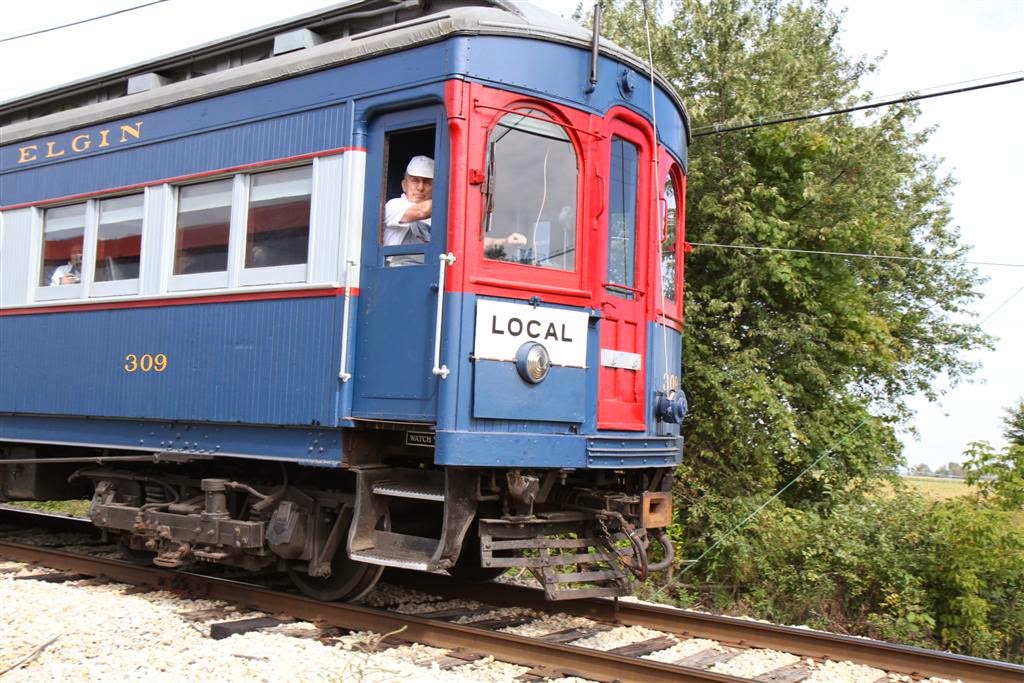
David Wilkins flew in from Utah to participate, and he was running the open car during the day.  Frank and I were running the three-car blue train (36, 308, and 309) with the able assistance of Larry Stone.  The weather provided several opportunities for us to demonstrate our ability to overcome obstacles.

 
Things went well for the first four trips.  Here are a couple of pictures of both ends of the train, but I was too busy to take any more.


The Museum had a good crowd of visitors, many of whom had never been here before.  This is the 36, of course, and since this is the "solarium" end, you can see that Frank is the guest motorman.

There were a few sprinkles on and off during the day, nothing to worry about, but after our 1:30 trip Larry looked at the weather radar on his phone and told us it looked bad -- soon!  Luckily, we were able to set a new record for getting the train put away into the barn.  The dispatcher gave us immediate permission to go to the tail track, and Joel Ahrendt set up the switches and turned on power in the barn, so we were able to get back inside quickly.  In the past it's often taken a half hour to get through all the obstacles.   Five or ten minutes after the cars were put away, a terrific rain storm blew through.  I can't tell you how relieved I was that the cars were safely inside!  Thanks to Larry, Chris, and Joel for making this possible!

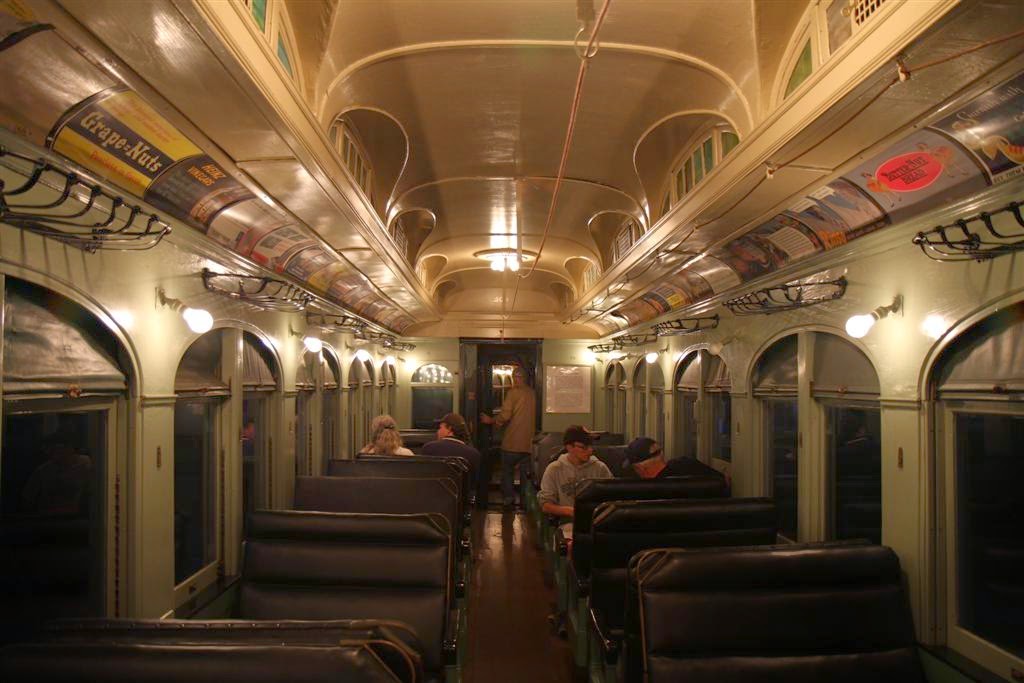
So then we had a few hours to spend as tourists.  Hey, the Electroliner is open, let's see what's inside!


Work is progressing on the interior, in addition to main goal of raising the money to rebuild the motors.   John Arroyo was on duty, explaining to visitors the scope of the project.


And then, I went for a ride on a trolley bus.  Rich Schauer was running the Dayton bus around the new loop to get the feel of the newly-installed wire.  This is a big improvement over the old wye.  And of course this is still the only regular museum trolley bus operation in the country.

John Myhre (above) and Randy and Betty Anderson were visiting, among other long-time members.  It's always great to see old friends.

How late is the zoo open?  Frank Sirinek and Bill Thiel were running the West Towns car 141 ("This Car Direct to Zoo"), which provides a great ride, but I never got to see the gorilla.  Maybe next year.


And besides the electric trains and the Zephyr, the 1630 was pulling an extra-long coach train: eleven cars, including the water car, the dynamometer, CB&Q RPO, combine, and seven coaches.  The dynamometer was even carrying passengers.  This train is just about the maximum length that Johnson siding can handle.  Soon we will all have to learn how to "saw by", just like the old days!


After the supper, nighttime operations started.  The blue train made one trip on the main line and once around the car line, and there were many other trains operating, including the Illinois Terminal 277, 518, and 234.  I didn't take any pictures, and I'm no good at night photography anyway, so I'm hoping we'll get some good submissions.  Anyway, it was a blast!


Sunday required some clean-up work.  And during nighttime operations, I had noticed that the brakes were not always releasing as they should.  This was traced to the feed valve on the 36, which had stuck open again.  That's not a big problem to fix, but we want to run the car next Sunday for the CERA visit, so it was replaced with a recently cleaned valve from stock, and adjusted.
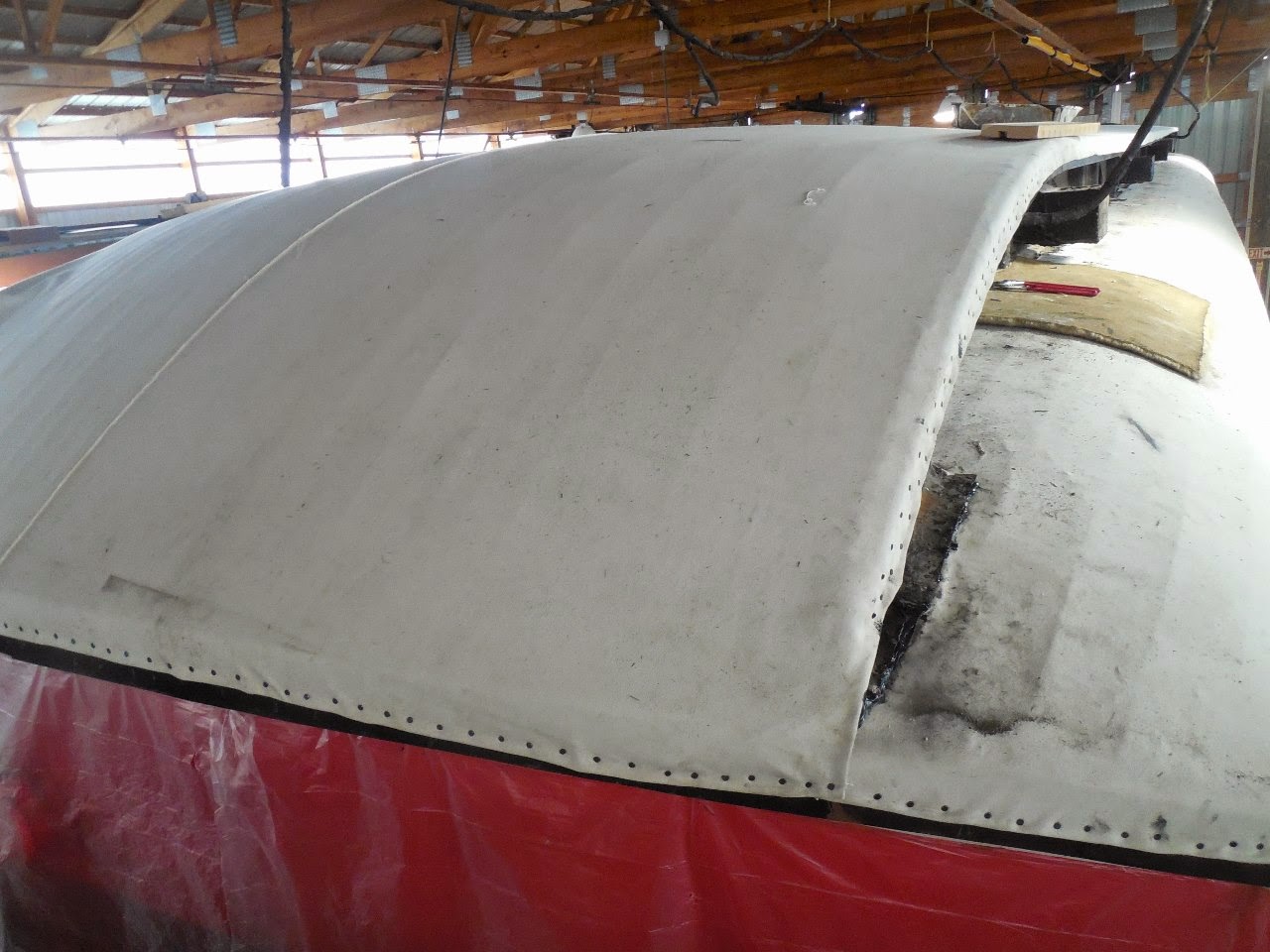


And then another corner of the 319's roof was completed, and I nearly got the last one done before running out of time.   Painting should start soon.


Showcase Weekend

Here are a couple of pictures of our Showcase Weekend, taken yesterday by Stephen Scalzo, just to whet your appetite.  We'll have more!


Here's our three car train, with the 36 leading.  WB alongside Barn 2.

And here's my conductor, who seems to be enjoying his job.  And so did everybody else!

And I should add that we appreciate any photo submissions, and also the people who mentioned that they read and enjoy the blog.  That makes it all worthwhile.

Friday, September 19, 2014

319 Report

On the radio they were promoting an exposition in Freeport of artworks created from salvaged material.  But you don't actually have to go all the way to Freeport; we've got your objets d'art made from salvaged material right here!


On Wednesday I was able to finish tacking down the canvas on one end of the 319, as seen here.


Meanwhile, the kit for the 972 truck is being assembled.  


And work continues on the 28.  Jeff is painting window guards.  These will be installed inside the car in the back platform, so that people don't accidentally break the big plate glass windows in the solarium rear end.


A couple of views of historic buildings at dusk.


On Thursday I continued working on the roof.  I might have gotten installation of the canvas more or less finished, but we had a couple of charter groups visiting, and a streetcar motorman was needed.  So I was volunteered into operating the 3142.  It's an interesting change from running trains on the main line.  And it's good to attract charter groups whenever we can.  One of them was a group of Lincoln/Mercury owners, so we had a smaller version of the old car show as well.

Well, tomorrow is Member's Day, and we can only hope the weather will allow us to operate.  See you there!

Tuesday, September 16, 2014

The Paper Wheel

It may sound like a joke, but this is actually thought to be a "paper wheel" under our old wooden Soo Line coach 67.  The "paper" is actually a type of stiff cardboard pressed between the hub and the rim, and it's the same basic idea of employing an elastic material to cushion the ride and deaden the sound as later used on PCCs.
(Photo by Bill Wulfert)

The paper wheel was invented about 1870 by Richard Allen, a former locomotive engineer.  He had been persuaded by his brother-in-law to invest in a factory making cardboard for textbook covers and so on, but the market was glutted and the factory was losing money.   So he began looking for new uses for the material, and came up with the idea of using the material to dampen the noise of the wheels on the rail from being transmitted into the cars.  At one time these paper wheels were widely used by Pullman and others on passenger cars.  The paper is held between two plates bolted together, and you can see the bolt heads inside the rim of the wheel.  At some point it might be interesting to examine the wheel more closely, but for now, it's another historic artifact in storage.  IRM has lots of hidden treasures.