Wednesday, July 26, 2017

Paint and More Paint

It was hot and humid again today, but there was a good crowd of visitors for a weekday.

Let's start with other Car Dept. projects.  Pete Galayda is repainting windows for the IT Class B locomotive.  Now that the Charles City Western engine is complete, Pete has started fixing up the IT engine.


This big beam is destined for the 1754.  By the end of the day, it had been cut down to its rough shape and test-fit onto the car.


The front end of the 1754 is making good progress.


And here Tim is working on other parts of the car.


The new door for the MD cars has been repainted.


I spent most of the day repainting the vestibule floors in the 36.   The #1 vestibule was still in white primer.  By the way, my camera seems to be having trouble in poor lighting conditions, when it's not quite dark enough for the flash.


The #2 vestibule got a second coat.  


And then the 319's stepwell was painted black, plus silver on the handrail.


I also got a chance to talk to a new volunteer, a young man who wanted to start working with the Car Dept.  We looked at a few of the active projects, found him a waver to sign, and he's planning to come back on Sunday.  New volunteers are just what we need, so I'm hoping things will work out well with him.  And that goes for you too!!!

Wednesday, July 19, 2017

Wednesday Report

First of all, the rebuilt truck for the 68 has been assembled.  With its small wheels and tiny motors, it provides an excellent view of how a motor truck is put together.  Of course, the gears will be covered with the gear pans in service, but meanwhile we see how the the motor is suspended between the axle and the truck frame, so that the gears remain meshed.


Henry Vincent, Rich Witt, and John Faulhaber spent much of the day cleaning and polishing seat handles for the 68.


I wanted to look at spare controllers in storage for a better throttle assembly for the 36.  Gerry Dettloff helped me move them around.  I removed a part from this controller, which came from car 28, but it turned out not to work in the 36's controller, so it had to be reassembled.  Perhaps after the operating season is over the old one can be brazed.


And then I relettered the 319's fuse box.


The scrap fuse box has been repainted and relettered, but I couldn't find the right screws to attach it.   Have to wait until next time.


And then the one remaining stepwell was wire-wheeled and painted with primer.


Speaking of "watch your step", I should point out that Gerry runs a very tight ship in the Car Dept.  Anyone who talks back to the boss is liable to have to spend hours sorting screws, as Henry has found out.  It's the IRM equivalent of KP.  No joking around here, so watch your step!

Tuesday, July 18, 2017

History of the Rock Island Southern

HISTORY OF THE 

ROCK ISLAND SOUTHERN

BY RANDALL HICKS

"Few interurbans died a slower and more painful death than the Rock Island Southern, although the road began life with great promise."   Hilton and Due

The Rock Island Southern had a complex and interesting history, and we will present the information largely gathered from the archives of the late Stephen Scalzo.  Paul Buhrke has also provided valuable help and guidance.  Any mistakes in this work are my responsibility.

The RIS consisted of two divisions, which had little in common physically, but were usually both under the control of the Walsh Brothers, a local family syndicate.  The Eastern Division (1906-1951) was built first, from Monmouth to Galesburg, with typical interurban standards.  Ordinary simple-suspended trolley wire was used, energized at 600V DC.  Except for work trains during construction, there was no steam operation.  Passenger service ended in 1924, but freight service continued with a series of second-hand electric equipment until the end in 1951. 

The Northern Division (1910-1952) consisted of a branch line built earlier by the Chicago Rock Island and Pacific south from Rock Island, which was then leased by the RIS, plus new construction southwards to Monmouth.  The line was electrified with the Westinghouse AC system at 11,000V, the last interurban to adopt AC.  Initially, most passenger service was provided by large Niles cars with AC power, and there were two AC box motors.  But throughout its history, most of the freight service on this division was provided by steam, often using leased CRI&P engines.  Electric operation ended in 1920, when the electrical equipment at the power plant was repossessed by Westinghouse.  After that, passenger service was limited to steam-hauled mixed trains.

The two divisions met at Monmouth, but there were no through trains.  Freight cars could be interchanged at that point.  The electrical systems were of course incompatible.

This history is divided into the following parts:
All pictures unless otherwise noted are courtesy of the Stephen Scalzo estate.

Additional RIS photos from the Schmidt Collection can be found here.

Monday, July 17, 2017

Trip to Indiana

Gregg Wolfersheim reports on a quick day trip to Indiana:

 When I worked for the TP&W a few years ago, I knew about these places, but never got to visit them. Yesterday I took a trip over there. 


The first stop was in DeMotte, Ind. This depot and cabin car are located in Spencer Park. The displays are in nice shape, but, they are only open on Saturday, or by appointment.

 Next I went to Monon. A little bit north of town on IN 421 is this place. I first had lunch at the Whistle Stop. This is a nice family type restaurant that was quite busy. Then I went on a tour with a very informed gentleman as a guide.


  The 150 ton wrecker is the first thing you see as you arrive. This collection was started by a couple that own a quarry up the road near Francesville. They bought an old hopper car that is displayed by the highway. In 1993 they then started collecting other objects, and soon after created this place. 


Inside are over 6000 objects. Many lanterns, keys, locks, dining car items, signs, whistles, bells and watches.


 There are 2 watches that have two hour hands for working in areas near a time zone. I often wish I'd had something like that when I worked in the area! There are handcars and speeders on display in the main hall. 


All around are tailsigns, pictures and station signs.


A display of fire call boxes includes several from New York City that were near the 9-11 site.


 A small display shows the famous Kingsland interurban wreck, with a voltmeter from one of the cars. 

An old saw blade was turned into a piece of artwork depicting the wreck. 


    Outside is an old PRR depot that is the gift shop, with a Monon caboose nearby. All around are signal displays and other railroad signs.


 A reefer set on CB&Q Bettendorf trucks. Hmmm?


 A nicely restored outside braced boxcar from the M&StL along with another Monon caboose and a steel one from the Nickel Plate Road. Also, there is a nice model railroad display depicting mainline railroading in the Colorado mountains.  One can easily spend hours looking at all the displays, while having a meal along the way!

Thomas weekend two

Frank writes...

I was helping out at the museum entrance both days this weekend for Thomas again. Attendance seemed decent; Sunday in particular was pretty busy despite a brief rain shower in the morning.

I've been working on marketing for the museum and between the two weekends of the Thomas event I had asked about getting a sign made advertising IRM's Facebook page. Dave Diamond and our friends at Buildings & Grounds obliged, as seen here; Richard Schauer is to the left while Carl Illwitzer helpfully points out the new sign and Gerry Dettloff peers suspiciously at the photographer. Are you on Facebook? If so, why? (Or at least, why aren't you following IRM?)
Up on Station Track 2, the heavyweight coach train was top-and-tailed by the 1630 and this fellow with the unusual water tank design. Anyway, I should mention that the hard work of the Coach Department over the past number of years was quite obvious. The Thomas train included five fully restored Rock Island coaches, the C&NW combine, and a Lackawanna coach - a very impressive train of commuter cars and all in admirable cosmetic shape. The Percy train, above, was all railroad-roof cars including more Lackawanna coaches, the DM&IR day coach, and two combines.
But anyway, back to traction land. Saturday night the car shop crew was hard at work reassembling the truck for Sand Springs 68, shown above. The motors have been successfully tested, though a small bit of adjustment or shimming may be needed. Brake rigging on one side still needs to be fitted, as do the axle dust guards.
And the 68 itself has been switched from Barn 7 over to the pit track. Hopefully this historic lightweight car will be running again sooner rather than later!
And Jeff Brady was hard at work on Michigan Electric 28, helped along by a new volunteer named John. The steel framing at the end of the car has had some welding done and is now in fresh black paint, which I suppose is a good sign that things are going back together. Progress is also being made on the 1754, the 4223, and the Electroliner.

Saturday, July 15, 2017

After the Fire

We've told this story before.  Back in 1970, CA&E car 309 was selected for restoration over the winter for operation in 1971.  The car was basically in good shape and just needed repainting both inside and out.  Since there were no barns, an oil stove was put into the car to heat the interior for repainting over the winter, and the exterior was to be done in the spring.  On March 13, 1971 the oil stove set fire to the car and the interior was heavily damaged.  The Union volunteer fire department responded and put the fire out, and Phil Hehn happened to arrive as they were leaving.  He took a number of pictures of the car at that time, and these are now being made public for the first time.

This was a few years before I joined the Museum, so they are of special interest to me.  By the time I joined the project, a lot of cleaning up had been done, but major restoration work remained.

Three views of the exterior of the car.  It was located on the old caboose track, about where the switch from the car line to the tail track is now:


The #1 end vestibule:


The #2 end:


(I might point out that the train door at this end had badly rotted and was replaced at North Chicago with one from the 310.)

What's left of the frame of the oval window in the main compartment, sitting on one of the badly burned seats.  All upholstery in the main compartment had to be replaced.


The ceiling above the stove was completely burned, along with the clerestory windows.


The bulkhead in the main compartment, with remains of the toilet compartment on the left:


Looking towards the bulkhead from farther back in the main compartment:


The clerestory over the toilet compartment door:


And a final view of the exterior.


Thanks to Phil for letting me scan in his slides.   And if anybody else has pictures from this era, especially just before the fire, I'd love to see them.


Update: Here we have a picture from the Strayhorn Library Collection scanned in for us by Ray Piesciuk.  This must be soon after the cars arrived at Union in 1964.   The paint is still in good condition, and the poles have not been planted.  Looking northwest.


You Can Never Have Too Much Thomas

Ask, for example, Harold Krewer, who is there every day, all day, directing the event, making the announcements, dealing with crises, listening to the "music"...  sorry, feel free to ignore any esthetic judgments I might let slip.  Without him and many others, it wouldn't be possible.  It's a great event for children of all ages, and today the weather was perfect, and people all seemed to be having a great time.


Percy will need some help, so the 1630 is warming up.

I was the conductor on the 4391 again today, so I didn't get a chance to take many pictures.


But it's very rewarding to get a chance to talk to people during the day.  For instance, I talked to a couple with three kids who drove up from Egypt and stayed overnight in order to spend a day with Thomas.  They certainly seemed to think it was worthwhile.  Another couple I talked to had been to a similar event last year elsewhere, and thought ours was much better organized.  To an ex-Army officer, it appears to be absolute chaos, but what do I know???  I talked to a man from Toronto who remembered riding the PCCs there, and we discussed the differences from one to another.  And as I say, everybody seemed to be having a good time.

During my break, I had an opportunity to visit my old friend Phil Hehn, whom I've known since the seventies, who was the engineer on the Thomas train today.   Here's the control stand on C&NW 411.


 And the crew: Phil on the left, fireman J.D. on the right.


And the engine has a nice memorial sign on it remembering the late Roger Smessaert.  Sorry, the spotting pole was in the way.


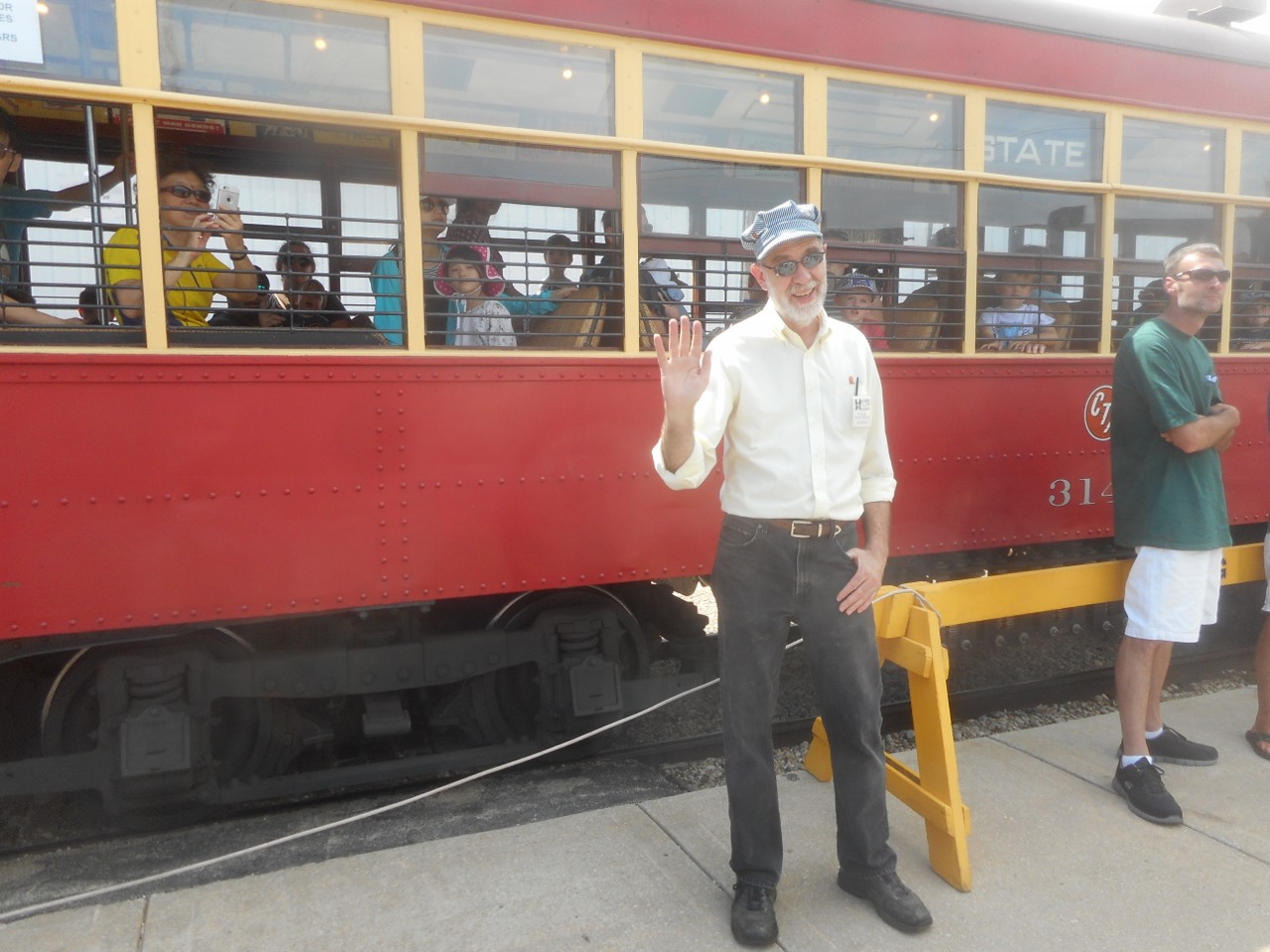
As just one example of Thomas dedication, our friend Buzz Morrisette spent all day holding a rope to keep people from crossing the track in front of the streetcars.  He could easily be doing something more interesting, but luckily there are many similar stories all across the property.


And even so, some projects continue working.  Here Ed Woytula is welding parts for the Cleveland PCC.  And at the end of the day, instead of putting the 4391 away, we ran it over to the shop for Joel and the crew to do necessary maintenance.  The Museum almost never sleeps.