Sunday, October 9, 2022

Cleanup in Yard 4

Frank writes...


Sunday afternoon was all about yard cleanup, at least for me. When I arrived, the Track Department was hard at work taking apart the track that was vacated just yesterday. In this photo, Marcus and Fred Z. are in the right foreground working on Track 43, while in the background over on Track 41 you can see Joel, new volunteer Jimmy, Good Nick, and Zach on the L4, all of whom were working on putting crater grease in the 1754's gear pans and pulling the truck back and forth to distribute it. I didn't get any photos, but Bill was also working on making waste bundles to serve as dust covers in the 1754's axle cap bearings. This truck is getting very close to being put under the 1754.
Here's what Yard 4 East looks like without a single car on tracks 42 (which is currently missing) or 43:
Weird! That's Marcus, Fred, and Bob over on the right, with Joel on the left. There was still some stuff scattered along the north side of track 43 that we needed to move, plus a giant stack of gear pans at the east end of track 43 that needs to get moved at some point soon, so I mostly helped with cleaning up this stuff.

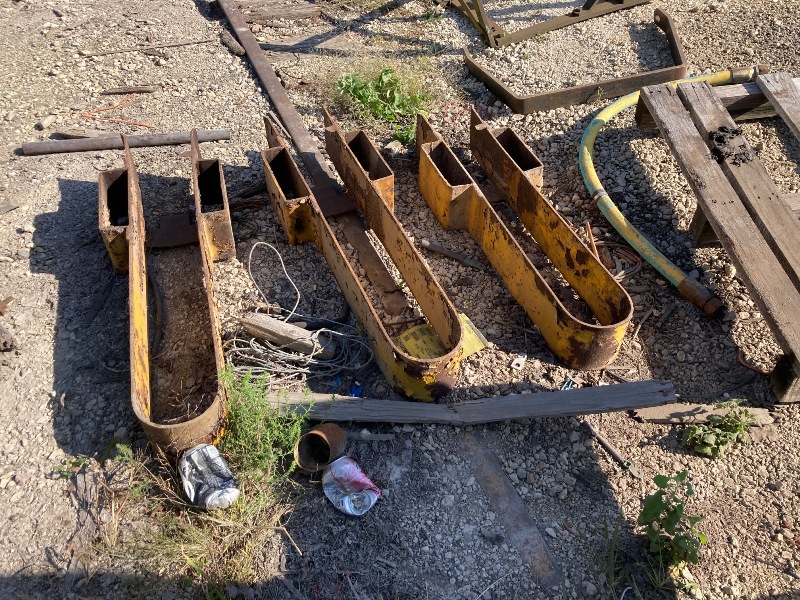
Here's a question: what are these three things? They're steel and painted yellow.
One side project was building a "corduroy road" out of ties so that we can put gear pans on it. This was set up in the parts storage area along the south side of Bruneau Drive, near the east end. Nathan ran the Bobcat to set this up (and was also using the Bobcat all afternoon to relocate a lot of the miscellaneous stuff left along track 43). Jeron and Jimmy also worked on this.
It's been a very, very long time since the below view of Barns 3 and 4 was possible. It's also been several years since we had all three doors at the east end of Barn 4 open.
Here's Bob using a torch to cut some bolts near the east end of track 43 that were frozen, thanks to having been buried in the dirt that formed a "crosswalk" for a couple of decades.
My father's description of track 43's condition as "almost comically wretched" is about perfect. Many of the ties had basically disintegrated underneath the rail. All of this will get re-graded in the near future, then the track will be replaced once our contractor finishes with the work they're doing to replace rail on the main line.
And a final photo for the day, showing roughly the same view as the second photo in this post, but with all of the remaining stuff removed from between tracks 42 and 43. The steel thing in the foreground is the bucket for the Bobcat. Next up: clearing out the strip between Bruneau Drive and track 43. That ought to be... interesting.

Saturday, October 8, 2022

See Swift, Stupefying, Successful Saturday Switching

As you probably know, one of our major projects right now is the extension of storage barn 4 eastward, and in order to do this, the storage cars that were on tracks 42 and 43 have to be moved.  Here are the cars on 43 that had been in this location for the last 40 years or so, a familiar sight to anyone who's worked in the Car Department during that time.  But like a clearance sale, "Everything Must Go!"


In the morning, we had a department meeting with curator Joel Ahrendt to discuss what needs to be done, both immediately and in the long term, with lots of important information including the secret handshake you'll need to get into the new barn.

And then we had to get to work.  The main challenge was not only to get these tired old freight cars moving, but around the sharp curve at the west end of the track.  To do this, two locomotives are needed.  Below is the 25 tonner, since there is no wire over the east end of the track.  Jeron was our expert engineer.


Each car had to be brought into the barn, and then jacked up one end at a time to lubricate the center bearings and side bearings to go around the extremely tight curve.  Dan and Jon Fenlaciki did a lot of the work on this, along with Joel.


Then the critter has to get out of the way, and the L4 with its greater power comes in to pull the reefer around the curve.  Nick and Zach were the crew on the electric engine.  We needed plenty of people to watch for problems as it went around the curve, but all was well.


Well, that wasn't so bad:


And this process continued, step by step.  The track the cars had been sitting on had deteriorated badly, and could not be maintained with cars sitting on it, so it's almost comically wretched.


The farther we got, the worse the track became.  But Bob Olson and some other track guys were on hand to help patch it up enough so that the cars could continue to leave.


And in other news:

During breaks in the action, I had a chance to tape up the plastic shields on the 460.


Our paint expert, Pete Galayda, mixed the black canvas paint I needed:


And in the afternoon it had warmed up enough that I could start painting the canvas roof.  As before, of course, more coats will be needed, but this is a good start.


And watch this space for more news on the big switch move!

UPDATE:  As promised, Bill Wulfert sends along more pictures of the action.

The first car:


The second car, which was much the heaviest:

The third car:

The fourth car -- This one is not a storage reefer, but an historic wooden boxcar which is scheduled for restoration and display:

And lastly, the fifth car, which will remain in the barn until the reconstruction is complete:


Well, that was an especially interesting and challenging day at the Museum.  A large number of members of various departments participated to make it a success.  Thanks!!!

Friday, October 7, 2022

Before the Blog

309 c. 1995

Before this blog was started, beginning in 1995 Frank and I kept computer logs of our activities, which are still occasionally useful for reference purposes.  (Before that, I kept handwritten logbooks, which are still in existence.)  However, computer files can easily get lost or corrupted, so we have decided to copy these files onto the blog for safekeeping and reference.  It's a good question as to whether these will ever be useful to anybody else, except as a cure for insomnia, but here they are for your viewing pleasure.

 Quick links to our IRM journals for the years 1995-2008:

1995     1996    1997    1998    1999    2000    2001    2002     2003    2004    2005   2006    2007   2008    


Thursday, October 6, 2022

DeKalb Sycamore & Interurban Traction


DeKalb Sycamore & Interurban Traction
by Stephen M. Scalzo

Headline image: Handsome DS&IT suburban car 101 is pictured at the southwest end of the line, at the gate of the Northern Illinois Normal School (today Northern Illinois University), with motorman Charley Burr and conductor Harry Altivaro. All photos are from the Stephen Scalzo Collection of the Illinois Railway Museum except where noted.

The Sycamore & DeKalb Electric Railway Company was chartered on August 30, 1899, to build a railway. In January of 1900, the company obtained a franchise from the city of DeKalb. In January of 1901 the company changed its name to the DeKalb County Light Heat & Power Company (DCLH&P). Construction began in May on the eight-mile line. In September of 1901, the franchise was extended, allowing the company until 1902 to complete the line.

The DeKalb-Sycamore Electric Traction Company (DSETC) was chartered and incorporated on March 31, 1902, with $200,000 of capital. The company obtained the unused right-of-way of the Geneva Lake Shore & Northern Railroad, which had been incorporated in 1898. The company then took over the DCLH&P and construction proceeded. Interurban passenger service using streetcars with 550-volt DC power for the overhead began operating on December 14, 1902, with 1,300 riders being carried on opening day.

Car 108 is on Lincoln Highway just west of 4th Street in downtown DeKalb, with the C&NW crossing the intersection at an angle in the foreground. The streetcar line turns at the building in the right foreground to head north on 4th.

Trailer 67, still wearing its Chicago City Railway initials and fleet number, is at Electric Park on August 4, 1904, with P. Swanson noted as conductor.

The trackage of the line ran from the west door of the Administration Building of Northern Illinois University in DeKalb, and was located half on the east side and half on the west side of Sycamore Road. The company controlled the DeKalb-Sycamore Power Company, and with that affiliate passed into the hands of the Commonwealth Power system, which also owned the Rockford & Interurban. The line connected in DeKalb with the Chicago Aurora & DeKalb interurban line (ed. note: there was no track connection, but passengers could transfer with a short walk). The Chicago & North Western Railroad opposed a grade crossing until April 17, 1903, and subsequently there was freight interchange with the Chicago Great Western Railroad.

In 1904, the company opened Electric Park, located two miles from Sycamore, as a tourist attraction; the park contained a baseball diamond, a pavilion for dances, a theater, and a picnic ground. The company operated 24 daily round trips over the line, with a 25-minute running time between terminals, leaving DeKalb at the top of the hour and Sycamore at the bottom of the hour. As a result of that frequent service, the CGW halted its six daily locals and the C&NW cut service from six to three trains by 1906. The line did a thriving business in the days before hard roads and automobiles, and was used by many workers in the area between the two towns.

The DeKalb Sycamore & Interurban Traction Company was organized on June 30, 1906, with $100,000 of capital (later became $1 million), and after purchasing the DSETC, spent $40,000 to upgrade the system. Plans were developed to extend the trackage 22 miles from DeKalb to Belvidere; however nothing was ever built. In 1907, the company had 7.6 miles of trackage, 0.23 miles of second trackage, and five closed and two open streetcars. By 1910, the company owned six streetcars and two trailers.

Car 108 is at the northeastern terminus of the line, at State and Main in Sycamore, with the DeKalb County Courthouse behind it. Passengers looking to connect with the Woodstock & Sycamore, which never electrified, had a four-block walk north from this point to the W&S terminus.

The DS&IT owned one piece of non-revenue equipment, a snow sweeper, but they managed to make some revenue with it anyway by removing the brooms and hauling open trailers with it during the summer. It's shown at the two-track carbarn in DeKalb, which survived into the 1950s.

During 1912, the Union Railway group took over the operations of the company. Ridership declined from 386,265 in 1912 to only 264,431 by 1915, with earnings of $36,351 in 1915. By 1916, the company was operating four streetcars and four trailers. In August of 1918, the Public Utilities Commission allowed the company a fare increase; all round trip tickets were abolished and the sales price of coupon books was increased from $3.75 to $4.25, with the $0.15 fare between DeKalb and Sycamore remaining unchanged. Private ownership of automobiles and the paving of Lincoln Highway in 1922 started to draw away passengers, and revenues started to drop.

In 1923, the company went into bankruptcy when it could not pay a $3,600 power bill. The receiver continued to operate the line, but the paving of Highway 23 in the area marked another downturn for the company when increased bus competition started drawing away passengers. The abandonment of the CA&D interurban in January of 1923 left the line stranded without a passenger connection, and abandonment was inevitable. The receiver offered to sell the city portions to the towns for continued operation, but nothing ever came of the offer.

The DS&IT's cars were essentially large streetcars, albeit with heavy trucks designed for suburban use, but at least some of its motormen dressed in interurban - rather than street railway - style. Date and location are unknown.

The origins of car 108 are unknown. It's shown with its crew at the carbarn in DeKalb.

On March 14, 1924, the company made an application to the Illinois Commerce Commission to quit business. The last streetcar operated on April 17, 1924. Authority was received on May 1, 1924, to abandon the entire line, and the remaining equipment, trackage, and overhead was soon torn up and scrapped.

This article was edited and laid out by Frank Hicks. Thanks to Ray and Julie Piesciuk and to Richard Schauer for making available the materials from the Stephen Scalzo Collection that were used to publish this history.


Roster of Equipment
This roster is incomplete

67 & ? (2 cars?) - DE ST TR 8-bench open trailers - CCRy shops, c1880s - ex-Chicago City Railway, possibly converted from horsecars, quantity of cars uncertain

101-102 (2 cars) - DE DT DR closed streetcars - St. Louis, 1902 (order #304)

101 (1 car) - DE DT DR closed streetcar - American, 1912 (order #963)

108 (1 car?) - DE DT DR closed streetcar - builder and year unknown

Number unknown (1 car) - DE ST streetcar - acquired 1905, builder unknown - used in city service within DeKalb city limits

Number unknown (1 car) - DE ST AR snow sweeper - McGuire-Cummings - used in summer months to tow open trailers

AR = Arch Roof; DE = Double End; DR = Deck Roof; DT = Double Truck; ST = Single Truck; TR = Turtleback Roof

Route Map


This 1905 Sanborn fire insurance map shows the DS&IT's brick carbarn near the top right. North is roughly to the right. The large building filling much of the image lasted into the 2010s.


Wednesday, October 5, 2022

Tuesday Report

On Tuesday, the first priority was to check out the possible problem with the 36.  After thorough inspection and testing, we decided that there was no mechanical problem, so that's good news.  The car is cleared for service again.   Gerry Dettloff helped with this process.


A lot of other things were going on back in Barn 4, but I didn't get much of a chance to capture them.   Jim the new guy was hard at work again on needle-chipping the 306 trucks.  That's a job I hate, but he keeps blasting along.
 

Meanwhile, John was doing more work on the interior parts, and he and Norm discussed the wiring of the car.  Because so many changes to the electrical system were made at Shaker Heights, it's quite a puzzle.


As you might expect, Tim continued rebuilding the floor of the 1808, and Mike was working on the seat frames.  And that's just in Barn 4.  There were several people working over in 10 and 11, and the contractors were hard at work on grading and moving rails, and I don't know what else.  Seldom a dull moment!

Tuesday, October 4, 2022

More Doerr Collection Photos

More photos have been added to the Ron Doerr Collection page - this time, images #140 through #169, including a mystery steam engine photo that I ought to be able to identify but can't. And yes, at some point I'll sort these into sub-pages to make the collection easier to navigate and less unwieldy, but right now I'm just trying to get everything scanned, cropped, and uploaded.

Monday, October 3, 2022

Motors and Trucks

Frank writes...


Sunday was all about motors and trucks. When I arrived at about 2pm, it was just after a motor issue with the 36 had been discovered. The service train for the day was the 36 and 319, but the 36 was spinning its wheels immediately upon starting. This could be a stuck contactor or something else, but we're hoping (fingers crossed) that it's an easy and - more importantly - cheap fix. In the meantime, with a lot on the agenda for the day, Greg and Good Nick cut out the motors on the 36 and moved the car back to Barn 8 using the 319 as the horse. Troubleshooting will be done as time permits.

After the train was back in the barn, the next of the day's planned activities commenced. Greg and Norm had agreed to walk through some of our outdoor parts storage areas to identify components (mostly trucks, motors, and control equipment) that are allocated for specific projects or uses. Norm has been around long enough that he recalls the histories of some of these pieces better than just about anyone, so this was a way of recording some of this information for future use. It was also a fascinating couple of hours for a "parts fan" like myself! Trivia question: can you ID one or both of these? (And yes, there is a correct answer for both!)
While this was going on, Joel, Nick, Zach, Brian, and Doodlebug Bob were getting to work on the big project for the day: pulling the truck out from under the L4, putting its rebuilt motor in, and replacing the truck. At the same time, the replacement carbody center bearing was to be installed. Below, by 4:30 the locomotive had been towed to the usual jacking location at the barn door and lifted.
And by 5:30 the truck was out and Brian had the forklift ready to lift the motor into the truck. The axle caps are in the right foreground.
Voila! By 6:30, the motor was in the truck, though some finagling of one axle cap still needed to be done. Here Joel is standing astride the truck fender.
While the truck and motor work was happening, the new center bearing was test-fit to the locomotive. A few minor adjustments were needed, which Doodlebug Bob took care of, and then Joel and I lifted it into place. The new bearing is at center top in the photo below.
It was at about this point that we took a break for dinner. Our friend Jim Ward was visiting from Rio Vista, so it was great to get a chance to talk to him. After dinner, the truck was moved under the locomotive using the 25-tonner and then the L4 was gently set back down. And there you go.
Some work is still needed, including hooking up brake rigging and motor leads, reattaching sand hoses, and oiling axle caps, but the L4 should be useable again for the first time since it was taken out of service in late 2017. While I was at it, I noticed the below emblem on the side of the locomotive. It still wears its 1960s-era Wisconsin Electric Power Company paint, but underneath the "Reddy Kilowatt" logo, you can still see part of the old TMER&T diamond emblem showing through.
And just for yucks, another overall view of Barn 4 in oddly empty condition.
The below photos were sent in by Bill Wulfert, who was around on Sunday afternoon to observe the proceedings. Thanks, Bill! First of all we have a shot of the L4 up on jack stands while Joel and Zach crouch underneath to test-fit the center bearing plate.
Here's Zach, myself, and Joel, with Brian out of sight running the forklift, lowering the traction motor into place. Zach and I are mainly watching the axle cap bearings and trying to keep the bearings from falling off the axle into the dirt.
More of the same, with Zach and I holding up the bearings with sticks while Joel practices his dance moves atop the truck.
And finally, a photo of one of the motors installed in the 1754 truck. This installation project, begun last weekend, was finished on Saturday by Dan and others. The axle caps are now fully bolted in and this truck (I think?) is ready to put under the 1754.

Saturday, October 1, 2022

Line Car Progress

 Gregg Wolfersheim sends us another update on his impressive line car restoration project:


The rebuilding of the #1 end of the line car is coming along.


Most of this end is done, including the headlight socket and retriever bracket. The motorman's windshield still needs to be created once we're allowed back in the wood shop.


Most of the south side of the car has been stripped of siding. Only a small amount of the framing will need replacement.

Hillsboro Railway Company


Hillsboro Railway Company
by Stephen M. Scalzo

Headline image: Arley and Ernest Johnson are pictured with Hillsboro Railway 4, a homely product of the McGuire-Cummings company built in 1912. All photos are from the Stephen Scalzo Collection of the Illinois Railway Museum except where noted.

Ed. Note: Hillsboro, Illinois, is a city near the center of the state, about 50 miles northeast of St. Louis. It was the terminus of a branch line of the Illinois Traction System interurban network and in 1910 it had a population of about 3,400 people.

The Hillsboro Street Railway, incorporated in 1903, and the Hillsboro Electric Railway, incorporated in February 1903 with $15,000 of capital, were allied with the local power company, but neither company ever built anything. On June 23, 1905, the Sangamon Valley Electric Railroad Company was incorporated to construct a streetcar line from the Hillsboro Hotel in the Public Square to Union Station; the company was controlled by the Mississippi Valley Interurban Railway, which had been incorporated in May 1905.

The line was built to furnish transportation to employees of the Schram Automatic Fruit Jar Company and the residents of the villages of Hillsboro and Schram City, and to carry passengers to and from the Big Four and Frisco combined railroad depot. Schram City was established as a village on May 11, 1907, and the depot was built in 1905. Construction began in early 1907, and on October 16, 1907, the inaugural streetcar run was operated on the line carrying Mr. J.E. Melich, president of the line, and 40 invited guests.

The Hillsboro Railway, a company chartered on May 22 to operate the line, began regular streetcar service on November 6 using one streetcar on the 1.5 miles of trackage, operating every 20 minutes with a five-cent fare (or 7 tickets for 25 cents, or 30 for $1.00). The carbarn was located at the north end of King Street. By 1910, Hillsboro had a population of 3,424.

Hillsboro Railway 1 is standing in front of the Hillsboro Hotel, which was - and still is - located at the northeast corner of the courthouse square. The courthouse itself is just out of frame to the left. Car 1's lineage is uncertain but it strongly resembles St. Louis 300-series streetcars and may have been one of the original two cars acquired in 1907.

Surveying began on a new line from Hillsboro to Taylor Springs in August 1911. However, Mr. Melick's empire, which also included the Hillsboro Electric Light & Power Company, collapsed during the early part of 1912, and the Southern Illinois Light & Power Company (which was formed by the consolidation of a number of utility companies in the area) purchased the company on April 1, 1912. The company announced that it would spend $110,000 to extend trackage to Taylor Springs, which had become a boom town. Taylor Springs had come into existence with the sinking of a coal mine in 1908, and became a thriving community after the American Smelter located there in 1911. A connection track was built in May 1912 with the Illinois Traction System at Hillsboro to service customers and to handle carloads of material for construction of the line.

Little is known of car 2. It appears to be a McGuire-Cummings product but its date of construction is unknown. It's also unknown whether any other cars of this type ran in Hillsboro.

Construction of the line to Taylor Springs began in July 1912 after the contract was awarded to Driscoll and McCalman of Decatur in March. New streetcars were ordered at a cost of $20,000 each to operate on the new line. Hourly streetcar service initially began between Hillsboro and the city limits of Taylor Springs on November 1 using one streetcar; a delay by the city of Taylor Springs in granting a franchise held up construction of the southern end of the line for a short period. In November, the company entered into an agreement with the Big Four Railroad to construct trackage on the railroad right-of-way into Taylor Springs. Streetcar service over the entire 1.87-mile into Taylor Springs from the Hillsboro courthouse finally began on December 6, operating on the hour and half hour with a six-cent fare. The entire system then consisted of 3.29 miles of track operated by four streetcars between 5:00am and midnight.

By the end of 1913, the company had a surplus of $50,490 out of an operating income of $80,490. The SIL&P purchased the Sangamon Valley Railway on December 31, 1913. During the latter part of 1916, construction began on a half-mile trackage extension in Taylor Springs to the American Zinc Company smelter. The streetcar system eventually consisted of 4.21 miles of track operated with five streetcars.

Car 4 is on the east side of the courthouse square in Hillsboro, signed for a trip to the Big Four/Frisco depot on the east side of town. In the left background can be seen St. Paul's Lutheran Church, which still stands on the north side of the square just west of what was once the Hillsboro Hotel.

As the years went by, both the Taylor Springs and Kortkamp mines were closed, employment dropped at the remaining industries, and the automobile became the popular means of transportation. The Illinois Power & Light Corporation acquired the system in May of 1923. The streetcar system soon became unprofitable, and nothing was done to repair or rebuild the facilities. By 1927 the utility contended that the streetcars were losing money at the rate of $500-700 a month, and that the system was no longer serving the purpose for which it was established. On September 27, 1927, authority was received to abandon the system and run replacement bus service, and on October 4, the last streetcar operated.

This article was edited and laid out by Frank Hicks. Thanks to Ray and Julie Piesciuk and to Richard Schauer for making available the materials from the Stephen Scalzo Collection that were used to publish this history.


Roster of Equipment

Information on the Hillsboro roster is extremely sketchy. This information comes from James Buckley.


Cars 1 and 2 (two cars) - acquired secondhand in 1907 from St. Louis Rail & Equipment on an installment plan, probably ex-United Railway of St. Louis - reclaimed by SLR&E in 1909 for nonpayment

Car 2 (one car, ST DR) - McGuire-Cummings? - only information from photos, not sure how many cars there were in this series

Car 3 (one car, DT DR) - St. Louis Car Company, 1908 (order #785) - built for Springfield Clear Lake & Rochester but used instead in Hillsboro from 1908 until 1911, then returned to the SCL&R

Cars 3 and 4 (two cars, ST AR) - McGuire-Cummings, 1912 - 32' long, 32 seats, McGuire Columbian truck, GE 80 motors

Hillsboro car 2 is shown in a builder's photo at McGuire-Cummings in Paris, Illinois.


Route Map


The carbarn in Hillsboro is visible at center-right in this 1912 Sanborn fire insurance map, though it's erroneously described as "stables." Dearborn is today known as Church Street (the church visible on the Sanborn map is still there) but dead-ends at Broad Street.