Wednesday, November 13, 2019

Back at Arden

Frank writes...

Business had me in Pittsburgh (again) this past weekend, and of course that meant that I was (again) down at the Pennsylvania Trolley Museum in Washington to darken the door of Bruce Wells and the other volunteers there. The usual progress was being made, with their dump motor in the shop for work and some ongoing maintenance chores being performed on West Penn 832.

Their Shaker Heights PCC car, shown above, has acquired a coat of yellow paint since I last saw it. This is a cosmetic restoration, at least for the moment. They are working on reattaching the floor-level rub rail on this side of the car and new glass has been obtained for the narrow opening sash in the right side motorman's window, among other tasks. One question that has cropped up is how to remove the window sash. This car has the same type of windows as does IRM's Cleveland PCC (another Pullman product) but it's not obvious how the windows come out of the posts. Anyone know?
And Artie Ellis, one of PTM's resident volunteer machinists, was working on machining armature bearings for motors from their Rio open car. These motors had been cleaned up but not totally rebuilt prior to being put into service, and this summer a strand or two of the waste got into one armature bearing and tore it up a bit. So new bearings were procured and are being machined to fit precisely onto the armature shafts. We rarely do motor work like this at IRM and it's definitely impressive to see in action.

Tuesday, November 12, 2019

Train sold separately

Frank writes...

Last week, before the snow arrived, our intrepid cub reporter Jeron Glander sent the above photo of a new piece of track that has been installed alongside Yard 5. This is about where the McKeen trailer sat for many years. Of course the big question is, what is it doing there and why are we building panel track when we have so much non-panel-track around? The answer will shock you - so don't touch that dial!

Update - another of our intrepid cub reporters, Nick Espevik, sends along the below teaser shot to deepen the mystery. Make of this what you will!

Monday, November 11, 2019

Saturday Report

The weather has been unseasonably cold for the past several days, but work continues as usual.

On the 451, I started by drilling out some of the holes, and installing the remaining support bracket for the trap door.


And I put primer on the bottom of the door.  It was later painted black and should be ready for installation soon.


And I want to start checking out the electrical systems.  The car operated at Cleveland on the RTA, and we don't expect any major problems.  But you never know.

The batteries are still in good condition, and read about 38V.  These are thought to have been put in by the RTA.  And I started installing the new bulbs we ordered.


The roof cables have to go through holes in the canvas, which have these good-sized cast bushings.


And the roof now looks like this, with all saddles installed.  Next time I will go to Woodstock and get the running boards.


Speaking of roof work, Nick Espevik was caulking joints on the roof of the Highliners, to keep them watertight.   Or at least tighter.  Matt went up there to supervise, so I decided to join them.  Warning: don't try this yourself without Car Dept. permission!


You have to carefully make your way over the pan without tripping the release mechanism.  That would be bad.


Here are the vents for the ventilation system.


Thursday, November 7, 2019

More Roof Work

Right now we're going through another spell of cold weather, but we don't let that stop us.  Wednesday was another busy day in the Car Shop, with most of the regular activities.  I was working on the roof of the 451 again.  Being up on the roof, I didn't have much opportunity for taking pictures of other projects.

At the #2 end, a hole was cut in the canvas for the vent:


Which looks like this when installed.  The canvas is actually black, it just looks like a light grey with flash lighting.


And I installed the horn piping at the #2 end also.


By the end of the day, all of the saddles were installed and caulked.


The next step will be to buy the running boards, trim, paint, and install them.


Here's one of the horn guards.  They need to be cleaned up and painted.


Gerry Dettloff and Chuck Meter did some work on the 460.  At one end, where the pilot had been removed, the two diagonal braces had never been reinstalled, because we had to torch off the bolts.  They wheeled the torch over to Barn 6 to heat up the bolts so they could be removed, and I came along to help carry tools and so forth.    


Once this job was done, it will be relatively easy to attach the braces.


Tim is almost done with the floor in the 1754.  It looks great.


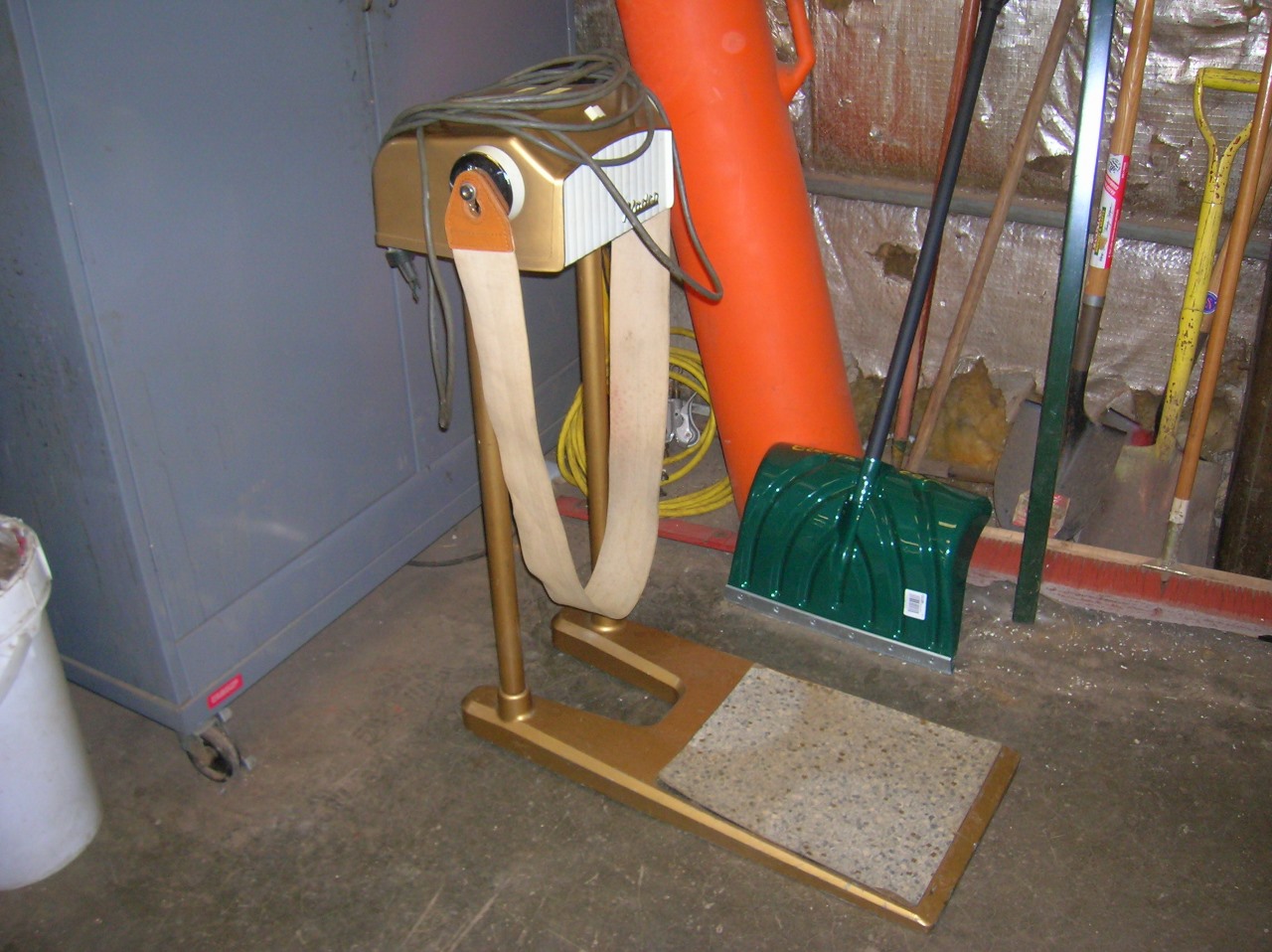
Finally, you never know what you might find in storage at IRM.  Some of the guys had gone into the King Cotton to look for parts, and discovered this.  


Somebody labeled it a "55 gallon drum paint shaker".  Nobody knows how, when, or why things like this show up at the Museum.

Tuesday, November 5, 2019

Pictureless Report

Sorry for the delay.  I was out on Saturday, but somehow the photos I took mysteriously vanished, probably while changing the battery in my camera.  And if something doesn't show up on the blog, maybe it never happened.  But I won't let this tragedy stop me.  We'll just have to see if it works OK tomorrow.

I continued installing saddles on the roof of the 451, and installed one of the roof ventilators.  The other one got stripped and painted and will be ready for next time.  Meanwhile there were several other things going on, as always.   The B&G guys were installing steel poles in front of the Multi-Purpose Building, in spite of the cold, wet weather.  And all of the usual Car Department projects were being worked on.

So that's it.  My apologies, and as a result you're getting the blog this week absolutely free!

Wednesday, October 30, 2019

Roof Work on 451

I was on vacation in Arizona since my last report, but there isn't much of railroad interest to see from the trip, although we had a great time visiting with family.  I just missed seeing the 4014 at Casa Grande.  And while doing some off-roading, we crossed what appears to be a railroad to nowhere:


But now that we're back in Illinois, there's plenty to report.

First of all, while I was gone, Gerry Dettloff and Chuck Meter installed the second pilot on the 451, at the #1 end, along with the diagonal braces.  That's a big help and is much appreciated.


Then I went over to the 453 to check out its roof.  It certainly appears that nothing has been done to it since leaving Wheaton, other than removing the bases and fuse box.  But it makes clear how everything should be arranged on the 451.  Bob Albertson helped by coming along to hold the ladder, and I wouldn't want to be climbing onto the car in an empty barn all by myself.  I took these pictures of the 453 mostly for my own reference.  


This is the #2 end.  I noticed immediately that the horn appeared to be slightly offset to one side.  I later figured out why.


  I spent the rest of the day working on the roof of the 451.  I installed six more saddles before running out of caulk, since I was trying a different brand.  It worked well.  Only six more to go.


Then, it was time to work on other parts.  There's no reason not to install the rest of the roof apparatus.  Here we're looking up into the attic at the #2 end of the 451.  You can see where the roof cable will go up through the canvas at one side, and also the piping for the horn.  There is a longitudinal bar supporting the roof right in the middle, which is why the pipe has to be slightly offset to one side.


And here's another part of the attic at the #1 end.


So I started installing the pipes for the horns.  This is the #1 end, and I had just enough caulk to install the casting.  Victor wandered by and helped by pushing the pipe up through the canvas until I could thread the casting onto it.


And also we need to install the roof vents.  There's one at each end, over the motorman's position.  The #1 vent has already been painted black and will be installed next time.  The #2 vent needs primer and finish black, so I left it on the table in the barn with our other parts.


You will wonder what else was going on.  The 1754 was temporarily over the pit.


And the 757 is now at the west end of 43.


Bill is busily painting the siding for the Pennsy bobber.


And roof work is progressing nicely on the 65.  By the end of the day, Jon had started tacking.


And the Cleveland PCC truck now has all four wheels.  Chuck has really been working hard on this project. 


Pete Galayda has been working on the interior of the 160.  A lot of the nice woodwork is ready for varnish, and in the second picture below we see what it will look like.  Almost like the 309!


Anyway, in spite of the weather, there's always more to be done, and we can certainly use more help.
See you soon!

Monday, October 28, 2019

End of the season

Frank writes...

I was able to make it out to IRM on Sunday for a rather unorthodox day. It was the last day of the regular operating season and the Pumpkin Train event was in full swing (and seemingly well patronized) but I didn't go up to the depot to get a photo of the service trains. It appeared that CA&E 409-431 and NSL 160-749 were the service trains. Anyway, I started off by checking in on the 453. I hadn't seen this car since it was in North Olmsted.

Not terribly exciting, I know, but I was glad to see the car safe and sound in Barn 6. Then I spent a while leading a few friends on a guided tour of the south barns. They're mostly freight car fans so they were happy to see the restored (and unrestored) freight cars in those buildings. One of the things we stumbled upon was the Santa Fe stock car, which has nice newly-printed exhibit boards. I believe the plan is for this car, and maybe one or two other freight cars, to be put on public display in Barn 3 starting next year. There is also track lighting in the ceiling which should make for a very attractive and professional-looking display.
And the products of some recent switch moves were also in evidence. It appears someone was checking the oil on TE 1 and left the hood up. Either that, or this is the railroad version of "hungry hungry hippos."
But after the tour it was on to something completely different: a field trip to the Fox River Trolley Museum in South Elgin. The car shop crew has made a practice the last few years of going on a fall field trip to another museum within driving distance, so this year it was just up the road to FRTM where we were met by Jeff, one of the higher-ups there. The tour started with a walk through their three-track barn. Below is CA&E 458, which is nearing the end of a re-roofing job. They've replaced the tack molding and roof boards already. The next step will be applying a rubber roof, which has been very effective on NSL 715 in keeping the rain out, even for cars stored outside. This is now the only 450-series CA&E car not at IRM.
The 458 was on the center track at the door, while on the west track at the door was their Fox River Electric car. Behind it was a personal favorite of mine, the Chicago mail car.
And across from it, behind the 458, was CTA 4451. Up until a few years ago this car was in the regular operating fleet but its roof failed and it was retired until repairs could be made. That's now in progress, with a new roof being put on and a lot of steel work being done as well.
This is the back corner of the barn, with the CA&E line car to the left (it's behind the mail car) and a Soo Line caboose to the right (behind the 4451). Most of the damage from the bad vandalism case FRTM suffered a year ago has been repaired or at least cleaned up, but as you can tell from the 11 there is still some evidence of it here and there.
The east track is CA&E cars, with the 20 at the door and the 316 behind it (the 317 is temporarily outside and tarped until the roof job on 458 is completed). I took a couple of photos on the platform of the 316. Although it's the same series as 319 and 321, there are some unusual differences. First, it's got a brake valve to actuate the sleet scrapers. Our steel cars have a similar setup but all of our wood cars have a simpler three-position valve. Note too that the 316 retained its C-21 controller until the end and that it has a cover over the trap button at this position as well as on the off-side position.
And while all of our cars have a solid - and very hefty - bracket on the train door for hanging the cab heater, the 316 has this collapsible bracket that folds down to lie somewhat flat against the door when not in use. Interesting. The 316 was painted by FRTM in "coffee and cream" 1930s colors, same as we did with the 321, but apparently they found evidence that the vestibule interior was painted the same tan color as the doors so that's what they repainted it. On our cars, evidence suggested that the vestibule interiors remained painted Pullman green up until they were painted blue in the 1940s. Wheaton never did anything the same way twice!
Then it was time to go for a ride. We went for a trip on North Shore 715, sister car (of course) to our own 714. The museum just finished a complete repainting of this car within the last few weeks, including some steel repair work on the ends, and it really looks very nice. It probably hasn't looked this good since it was at East Troy, and maybe not since it was on the North Shore! It was pointed out that this end is still missing the lower half of its anti-climber, which was broken when the car was being moved to North Freedom, WI back in the mid-1960s. It's also - like the 714 - missing its rooftop "lobster traps," which FRTM hopes to replace if and when the car can be stored indoors.
And here's a group shot at Coleman Siding courtesy of one of the FRTM guys: Dan Fenlaciki, Nick Espevik, yours truly, Gregg Wolfersheim, Jeron Glander, Zach Ehlers, Joel Ahrendt, Greg Kepka, and Richard Schauer.
The other service train was a pair of spam cans, but why ride 'L' cars when you can ride this instead? The Fox River guys were kind enough to fire up CTA L202, which was built as Chicago Surface Lines L202 (though completely rebuilt by the CTA - probably little more than the frame and maybe the controller is left over from CSL days). A trip with the steeplecab pulling their IC caboose ensued.
And hey, I even got to run a bit! The cab of the L202 is very small - the locomotive is elevated width but there's a narrow walkway down each side of the cab, so the cab is even narrower - and it has a single ancient K-14 controller in the middle of the cab facing sideways. Neat stuff! Thanks to Zach for snapping the photo.
Many thanks to Jeff and the other FRTM guys for showing us around! It's always a good thing to "network" with other museums to share knowledge and help each other when possible. You never know when IRM and FRTM maybe able to help each other out. Before leaving, another interesting CA&E-ism was pointed out to me near the Fox River entrance. Below is a "wiper" actuator for a crossing signal bell on their lower loading track. The thick wires pointing towards the rail are sprung, and when hit by the wheel of a car they activate (or deactivate) the crossing signal. Pretty neat!

EDIT: Many thanks to Tim Fennell who sent along the following photographs:

First, a photo of the stock car interior with the track lighting lit:
And a photo of the Pullman car John McLoughlin, which has been the subject of recent interior restoration work as well as an exterior paint job, during a recent switch move:
And our heavyweight solarium car Mt Harvard during switching. This car too has been the focus of recent work to rehab its interior and at some point will hopefully enter revenue service at the museum.