Sunday, July 10, 2022

Thomas, Day One

Thomas is in full swing again this year.  On Saturday I was on streetcar relief, so in the morning I had some time to tighten up the clamps on the 460's canvas.  Meanwhile, crowds are gathering around the real star of the show.


So I found a seat and watched the parade of CSL streetcars.  Here's the 144:


And 3142:


And 1374:


Next is Thomas himself....


followed by an impressive train of six Rock Island coaches, plus the North Western combine...


and finally, our nicely repainted Rock Island Geep as a helper...


At least, that is what they want you to believe.


And here's a cheery sight: the entire south parking area, west of Lake Diamond, full of autos.


After that, I had to get to work and run streetcars.  But I'm sure there will be plenty of pictures on the web in various places.  And as always, you really need to be there in person.

Thursday, July 7, 2022

Chillicothe Streetcars


The People's Street Railway of Chillicothe
by Stephen M. Scalzo

Headlime image: Riders pose on and in front of a lineup of horsecars at an unknown location, possibly Columbia Park. All photos are from the Stephen Scalzo Collection of the Illinois Railway Museum.

Ed. note: Chillicothe, Illinois, is a small city along the west bank of the Illinois River about 15 miles north of Peoria. In 1890, it had a population of around 1,600 people.

The Chillicothe Street Railway was organized on August 27, 1887, by W.M. Meade, J.S. Russel, L.S. Hoyt, and R.H. Truitt. The company was incorporated on September 19, 1887, when it issued $4,000 in shares of capital stock. The company planned to build a 1.5-mile line, but failed to obtain a franchise from the Chillicothe city council.

The People's Street Railway was then organized on April 27, 1888, by James Kinlock and W.F. Ryan, formerly of Peoria. That company issued $8,000 in shares of capital stock. By May, the owners constructed 3.5 miles of standard gauge trackage using 16- and 25-pound T-rail between the Atchison Topeka & Santa Fe depot and the newly founded Columbia Park, located south of the downtown area. Service started with four small four-wheel cars and 15 mules borrowed from Peoria, with six cars and 12 horses eventually being used. Normally two cars handled the business, each on one section of the line. However, on special occasions, the line used four cars between the Rock Island depot and Columbia Park, and one car between the Rock Island depot and the Santa Fe depot. In 1890, the company earned $2,150 and carried 40,000 passengers.

The Midland Hotel, shown here with a horsecar in front of it, was at the north end of the line, where Santa Fe Avenue dead-ended at the AT&SF tracks.

On May 1, 1892, the company was leased to James Kinlock for 10 years. The company had two prosperous years in 1892 and 1893. However, profits were nonexistent after that time, and the company was eventually sold in 1897, with service ending in the fall of 1898. On April 26, 1899, W.F. Ryan purchased the company, and sold the rail and cars for scrap. The property had originally cost $13,000, and at the end was sold for $800.

It's May 14, 1893, and we're looking out the front of one horsecar (as you can tell by the ears in the lower right corner) at a second car waiting at a passing siding. Location uncertain but this may be Second Street south of downtown Chillicothe.

Route map of the People's Street Railway of Chillicothe. Location of the carbarn and stable is unknown.

This article was edited and laid out by Frank Hicks. Thanks to Ray and Julie Piesciuk and to Richard Schauer for making available the materials from the Stephen Scalzo Collection that were used to publish this history.

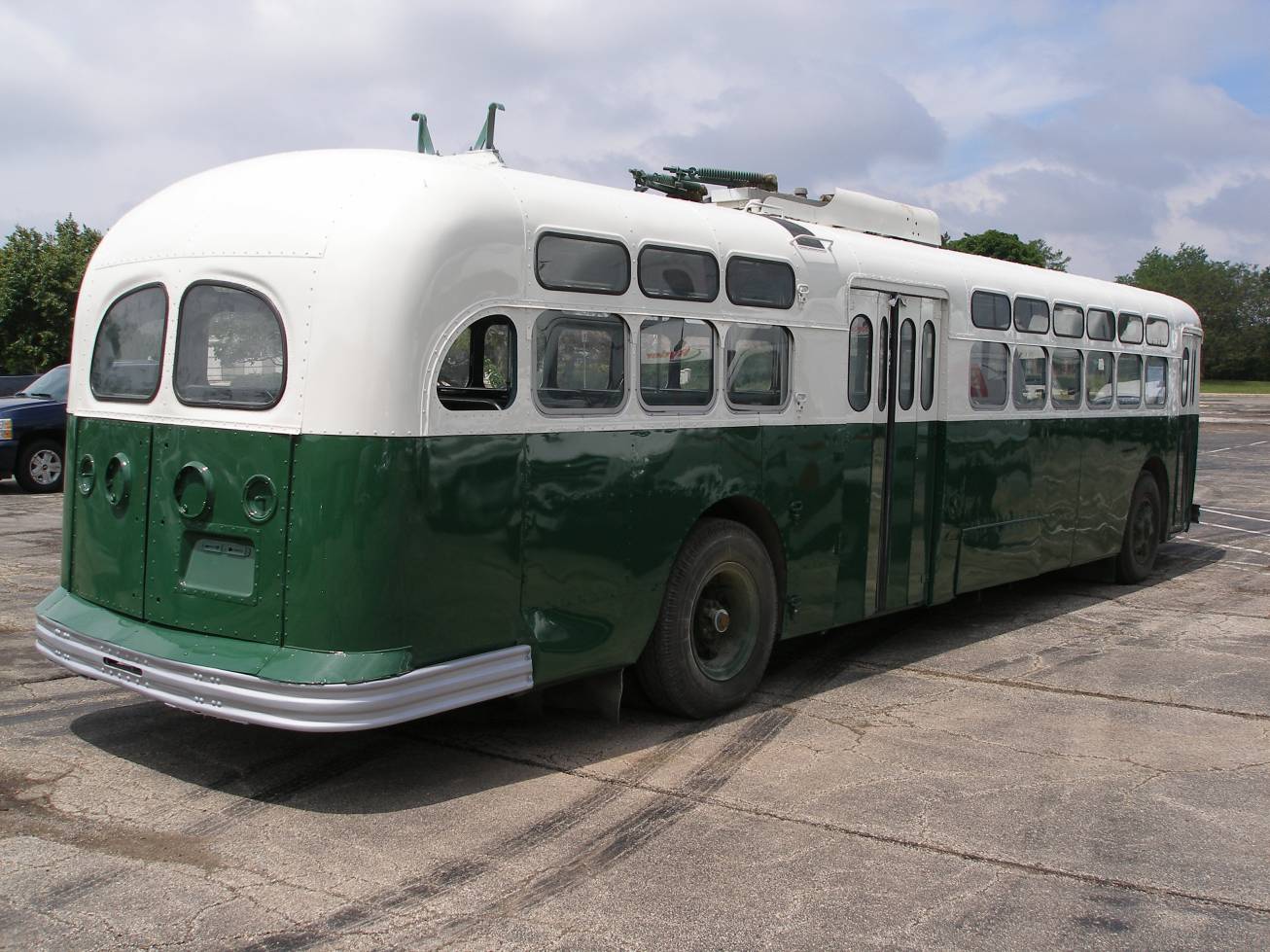
The trolley bus returns

Many thanks to Richard Schauer for sending along the latest update on CTA 9631 last night:


IRM received delivery of a like-new 1951 Marmon-Herrington trolley coach today!  Unfortunately, IRM also received delivery of five inches of rain last night.  The Museum was closed due to the flooding, and it changed how and where we brought the truck to deliver the bus.  But, at the end of it all, the bus arrived without incident, and now lots of work starts to complete 9631's restoration work by its return to service in September.

You will observe that all of the photos were taken in the parking lot of the body shop.  When we got to IRM, I was quite tied up in dealing with the delivery, and was unable to take more pictures.  (For reference, the water was about two inches deep in the street in front of the Andersen and Hoffman Garages, which is where we planned to unload the bus.)  9553 did the honors of pulling the 9631 with a towbar from in front of the diner to the Andersen Garage, where it's stored inside until the water recedes and we can put it in the Hoffman Garage to work on it with a lot more room.


Wednesday, July 6, 2022

Water, Water Everywhere

 The big news for today was the flooding due to heavy rains yesterday.  We've seen worse flooding in the past; it's something we can never completely escape.  When I arrived at 7:30 this morning it looked like this:


The day's operations were cancelled, of course.

The main worry, however, is that Thomas is starting on Saturday, and the loading area for the Thomas train was under water.  If we get much more rain before then, the Thomas event may not happen on schedule.  That would be a real problem.  Anyway, updates will appear on the Museum website as they become available.

But the water was slowly receding, and watching it doesn't help, so it was time to get to work.

As Frank reported, the car department resoaked the canvas over the weekend and placed it back on the roof of the 460.  Their assistance is greatly appreciated.  By this morning, it was pretty dry, so I rolled it out and started stretching lengthwise.


And the rest of the time was spent making repairs to the tack molding in various places.


Here we see what the canvas looks like after lengthwise stretching.  The seam is nice and straight and centered.  There are some obvious lumps, but these will all disappear once we start stretching lengthwise.  I verified this by pulling, but I can't take a picture at the same time.  To the right of the seam, you can see the row of bumps from the round-head screws for positioning the saddles.  That will work just as intended.

The other shop regulars had their projects, most of which I didn't photograph.  But here we see John painting the new trolley boards for the 306.


Meanwhile, Pete and Fritz continued painting the 160, Tim was working on the 1808, and Lorne was working on parts for the Cleveland car.

And here are some views of Bill Wulfert painting truck parts for the new motor truck for the 1754.


(Sorry that these are out of focus.  My new cell phone has many unwanted features that can be triggered inadvertently.  That's the price of progress.)

By 2:00 in the afternoon the waters had subsided to a degree.


And we can only hope we don't get too much more precipitation.  If you have some time, you can look up the Rail and Wire for July 1978 to see how bad it could get years ago.  Those were the days!

Monday, July 4, 2022

Sunday Coda

Frank writes...


My father described the morning operations and abandonment reenactment on Sunday, so I'll see if I can pick up where he left off. I ended up sticking around into the evening.
First off, I got this nice shot of the 1630 departing on an eastbound trip while the 309 and 36 were in the tail track. This was another day with a lot of trains moving at once - on one of our trips, we were pulling out of Station 1 pacing the 1630, which was right alongside us pulling up to the east end of Station 2, and meanwhile ComEd 4 was passing both of us westbound on the main with the caboose train. Neat stuff! Dispatcher Larry Stone kept everything moving smoothly all day. After the CA&E cars were put away around 1pm, a North Shore train and the three-car IT "Tangerine Limited" held down service in the afternoon.
After changing into work clothes, I was able to get some help dragging the canvas from the 460 off the car and onto the lawn between Barn 3 and Yard 4 east. Many thanks to Nick, Greg, and Mikey! We decided that we hadn't gotten enough of the sizing out of the canvas, so that meant power-washing it. This was certainly a warmer job than the last time we tried this. Shown here is Nick, who with help from Greg got out the power washer and set it all up.
In the meantime, CTA 30, which has been restored to its 1960s appearance complete with bow trolleys, was on the pit lead for inspection and some tweaks to the couplers. Here Nick (L) and Greg show off the bent-up hinged cover to the couple button box, which protects the electrical connector buttons from debris and weather damage when not in use and folds underneath the coupler when MUed to another car. The official CTA name for this item is the "diaper." So now you know. Later in the day, after trolley bus operation ended, Jerry came over and was working on this car along with Greg and Nick.
The power washing took about three hours, and then we left the canvas until after dinner so that it could air dry a bit. A large group of eight or nine people including Nick, Greg, Joel, Mikey, Zach, Brian L, Lee E, and Doodlebug Bob (and maybe one or two others - my apologies if I'm forgetting anyone!) carried the now-heavier canvas back up onto the scaffold and laid it out on the roof of the 460 to dry. This is Lee from the Diesel Shop, who probably doesn't get a lot of time atop wooden roofs over in Barn 2. A huge THANK YOU to everyone who helped with this!
And Joel, helping get the canvas spread out. Some work is also due to be performed on the car's tack molding, so for now the canvas was left somewhat bunched up to permit that work to go forward. And finally, after this I spent about an hour wire wheeling more of the smoker interior inside the 460. I got the rest of the smoker/main compartment bulkhead done (well, the visible part - there's a section of this wall hidden behind seats, so that may just get a quick overcoat instead of the full down-to-bare-metal treatment). Unfortunately I didn't take any photos of the progress; oops.

Sunday, July 3, 2022

Preserving the Abandonment

Sunday was another great day out at the Museum, with one of our yearly reenactments of the abandonment of the CA&E on July 3, 1957.  A good time was had by all.

We had two CA&E trains operating: the 36 and 309, seen here, and the 409 and 431.  I was too busy to get many pictures, but I'm sure Frank will be along later with more.


Here we are, the best-dressed crew on the railroad:


And some passengers from 1957 also:


Everything seemed to go well, and we had a very good crowd of visitors.  The 1630 was operating and as popular as ever.  There were two streetcars and a trolleybus in operation also, as well as the caboose train.  At one point I was following the 431 down the railroad about a mile behind -- just like downtown!  And we got to make some new friends, as usually happens.  


Of course, there were lots of other things going on, and I'll let Frank fill in some of the blanks.  But we've been doing this since 1987, and we have no intention of abandoning the abandonment.

Saturday, July 2, 2022

Friday Snapshots

Just some quick photos from Friday to show a few of the things that are going on.  It was rather hot, so be sure to drink plenty of water while viewing these.

Earlier this week John and Gerry drove up to Wisconsin to pick up some 16' 2x6 fir lumber for making running boards.  John knew a reliable lumber yard there that provides good quality material.  Here are the boards for the 460:


And these are for the 306, which will be used almost immediately.  John had already started marking them.


And next, some close-ups of the progress on the North Western facade, which indeed faces northwest.


I spent most of the day fixing and lubricating the walkover seats in the 309 and 36, which will be running on Sunday morning until noon, when service will be abandoned without warning.  But you have no way of knowing that.


The 36 didn't take long, but I spent a while on various seats in the 309.  The 309 has always given me more problems in this department than the rest of the cars put together.  I don't know why.  In any case, show up on Sunday and say hello!


Back outside, the paving is now complete on the new steam lead switch, and it looks great.

So the detour signs have been removed.

Finally, Tim continues his total rebuilding of the 1808; here's a new post being carefully fit into place.


Friday, July 1, 2022

Voila!

Many thanks to Richard Schauer for forwarding along this report of the exciting result to the CTA 9631 repainting saga!


Here's what you've all been waiting for!  9631 was rolled out of the paint booth today, mainly to paint the ad racks and rub rails.  It looks pretty sharp, and even the folks at the body shop were impressed after seeing it for the last nine months.

It will be trucked back to IRM next week.  Then follows lots of detail and reassembly work!